
Real Estate AI Lead Qualification Platform: Automatically Qualify, Prioritize & Follow Up with Every Lead


Get a summary of this article with your favorite AI




AI Summary
- •AI qualifies and prioritizes leads by analyzing intent, timing, budget, engagement, and conversation signals, helping agents focus on higher-intent prospects.
- •Speed to lead matters, with AI handling first responses, follow-up, nurturing, appointment booking, and re-engagement across connected lead sources.
- •A real estate AI lead qualification platform needs strong CRM integration, reliable routing, human handoffs, consent controls, and support for platforms such as Follow Up Boss, kvCORE, and Lofty.
- •Evaluate AI lead qualification tools for real estate based on qualification quality, conversation accuracy, implementation requirements, total cost, and measurable ROI rather than feature count.
- •Svermo's work across real estate AI workflows provides firsthand context on lead conversations, qualification, scheduling, and CRM handoffs, which helps inform practical platform evaluation.
What happens when a new Zillow, Facebook, or website lead comes in while you’re already on the phone, showing a property, or heading home for the day?
A real estate AI lead qualification platform can take over that first response, ask the right questions, figure out who is actually ready to move, and keep following up until an agent needs to step in. It can also score leads, route them to the right person, book appointments, and bring old leads back into the conversation.
For agents looking at AI lead qualification for real estate agents, the useful comparison is not simply which tool has the longest feature list. It is whether the platform can handle your lead volume, work with your CRM, qualify leads reliably, sound natural, and know when a conversation needs a human.
Svermo works specifically on AI products for real estate in USA, giving the team firsthand exposure to the practical details of AI-led lead conversations, qualification, follow-up, and handoff. That experience is useful when evaluating where automation actually fits into an agent’s workflow.
Still Losing Good Leads After the First Response?
See where AI fits into your lead qualification and follow-up workflow before another lead slips through.
How Does AI Qualify and Prioritize Real Estate Leads Automatically?
AI qualifies real estate leads by analyzing lead details, conversation responses, engagement, and buying or selling intent. A real estate AI lead qualification platform uses those signals to determine lead priority and trigger the appropriate follow-up or agent handoff. For a broader look at how to use AI for real estate, these same signals form the basis for automated lead qualification, prioritization, and follow-up.
AI Uses Lead Data and Conversation Signals
AI analyzes information such as lead source, property interest, location, timeline, budget, financing status, and conversation activity.
For example, “We need a three-bedroom home in the next 60 days and already have a preapproval” signals stronger buying intent than “Can you send me some listings?”
For high-volume teams, AI lead qualification for real estate agents creates a consistent process for evaluating these signals.
AI Scores Leads as Hot, Warm, or Cold
A lead scoring model assigns priority based on signals such as intent, timing, engagement, and readiness.
- Hot: Strong intent, near-term timing, and clear next steps
- Warm: Genuine interest with an uncertain timeline or missing details
- Cold: Low engagement or no clear near-term intent
The score then determines the next action, such as immediate agent follow-up, continued nurturing, or lower-priority outreach.
AI Asks Questions to Qualify Buyers and Sellers
AI asks questions based on the lead’s situation and previous answers. Buyer qualification typically covers property needs, preferred areas, timing, budget, and financing. Seller qualification focuses on the property, selling timeframe, motivation, and current representation. The resulting conversation gives the agent the key qualification details before the handoff.
AI Hands Off Leads When Intent Is Unclear
AI hands a conversation to an agent when the lead requests human help, gives unclear answers, asks a question outside the workflow, or needs judgment beyond the configured qualification process. The handoff includes the conversation history and relevant qualification details, so the agent has the context needed to continue the conversation.
Can AI Respond to New Real Estate Leads Within a Minute?
Yes, some real estate AI platforms are built for sub-minute responses. The actual response time depends on how the lead source, CRM, messaging channel, and automation are connected. Follow Up Boss, for example, supports instant automated texts for new leads, while its current integrations include third-party tools that handle AI voice, text, and email outreach.
Response Through SMS, Email, Voice, and Chat
The response channel depends on the platform and workflow:
| Channel | Typical First Response | Best Use |
|---|---|---|
SMS | Immediate text | Start qualification and get a reply |
Immediate or scheduled | Send details and continue follow-up | |
Voice | Automated call | Qualify or connect with higher-intent leads |
Website chat | Real-time conversation | Qualify visitors while they are active |
A useful setup keeps the conversation history available to the agent, regardless of the channel.
Starts the Conversation Immediately
When a new lead enters the workflow, the first message goes out automatically. Follow Up Boss documents automated texts that send as soon as a new lead enters the CRM.
The first message needs a clear purpose. A listing inquiry, for example, gets an acknowledgment followed by a relevant qualification question about the property, timing, or next step.
Handles Leads Outside Agent Availability
AI lead qualification system for real estate agents keeps the initial response running when agents are unavailable. That includes evenings, weekends, and periods when the team is busy with appointments or calls.
The agent then receives the conversation and qualification details for follow-up. This creates a simple workflow: lead arrives -> AI responds -> AI qualifies -> agent takes over when needed.
Response-Time Data Shows Where Leads Are Being Missed
Response-time reporting through automated follow up for real estate leads helps teams see whether leads receive prompt attention and where delays occur.
Track these four numbers:
- Time to first response
- Percentage of leads receiving an immediate response
- Qualified leads by response-time range
- Appointments by response-time range
The last two metrics connect speed to lead with actual pipeline results. A faster response is useful when it leads to more qualified conversations and appointments.
A common question among real estate teams is:
"I am running a real estate business and I get around 200 new leads a month from Zillow, Facebook ads and my website. Most of them go cold because I cannot call everyone back fast enough. Can you suggest companies that offer AI lead qualification and follow-up software that texts and calls new leads within a minute?"
Look for platforms that support automated SMS and voice outreach triggered by new lead activity. The right setup connects the lead source and CRM so qualification starts immediately. Compare response speed, qualification depth, CRM integration, compliance controls, and pricing.
Can AI Qualify Leads from Zillow, Realtor.com, Facebook Ads, and Your Website in One Place?
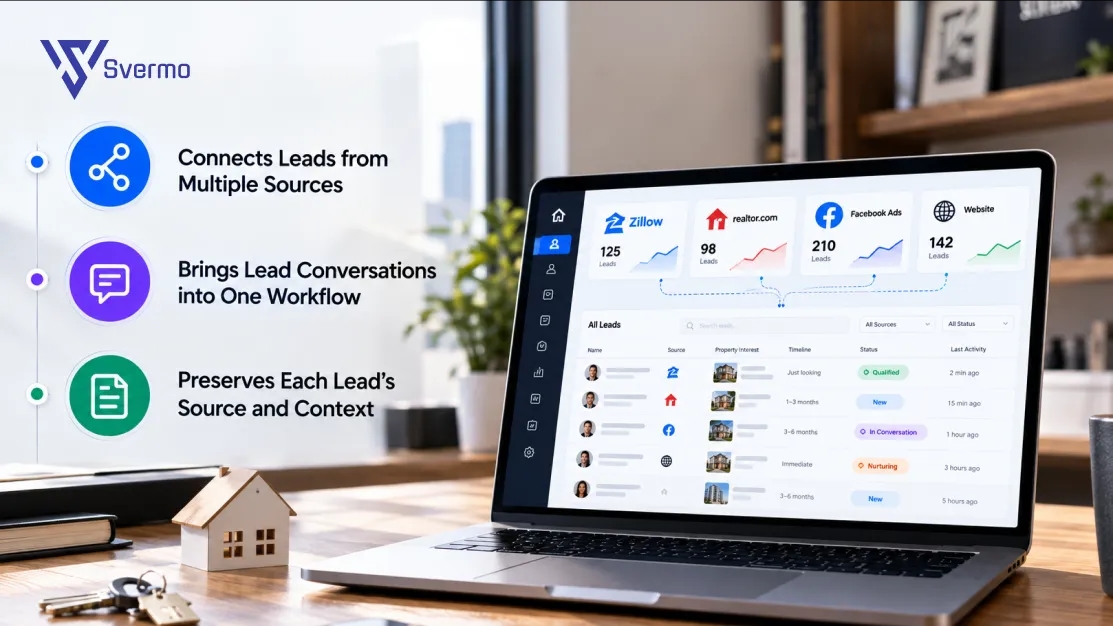
Yes. A real estate AI lead qualification platform brings leads from different sources into one qualification workflow. AI automation with real estate systems connects lead sources, CRM data, and communication workflows so each inquiry enters the right process.
Connects Leads from Multiple Sources
Instead of managing each source separately, the workflow looks like this:
Lead source -> Lead capture -> AI response -> Qualification -> Scoring -> Routing
| Lead Source | Information AI Works With |
|---|---|
Zillow | Lead details, property interest, inquiry |
Realtor.com | Contact details, listing inquiry, lead activity |
Facebook Ads | Contact information, campaign or ad source, inquiry |
Website | Form details, page or property interest, conversation |
The platform brings supported sources into the same qualification process. Teams then apply consistent qualification criteria across incoming leads.
Brings Lead Conversations into One Workflow
A single workflow keeps the main actions connected:
- Capture: A new inquiry enters the system.
- Respond: AI starts the conversation.
- Qualify: AI asks questions about intent, timing, budget, property needs, or selling plans.
- Prioritize: The lead receives a qualification status or score.
- Route: Qualified leads move to the appropriate agent or team.
- Follow up: Leads that need more time continue through the configured follow-up process.
This creates automated follow up for real estate leads across multiple acquisition channels without requiring agents to start each conversation manually.
Preserves Each Lead’s Source and Context
The source remains part of the lead record alongside the conversation and qualification details.
An agent reviewing a qualified lead gets the context behind the handoff:
- Source: Zillow, Realtor.com, Facebook, website, or another connected channel
- Campaign: The campaign or listing that generated the inquiry
- Conversation: Questions, answers, and relevant messages
- Qualification: Timing, budget, property needs, financing, or selling details
- Next step: Agent call, showing, appointment, or continued follow-up
That source-level context also gives teams a clearer way to compare lead quality across channels and connect marketing sources with qualified conversations and appointments.
What Can an AI Lead Qualification Platform Automate?
A real estate AI lead qualification platform handles the repetitive follow-up that happens after a new lead comes in. AI real estate automation extends that workflow across qualification, routing, follow-up, scheduling, and CRM updates.
It asks questions, figures out how serious the lead is, keeps talking to leads who need more time, and gets qualified prospects to the right agent.
Asking Questions and Identifying Lead Intent
AI asks questions based on what the lead actually says.
A buyer who says, “We need to move in six weeks” gets questions about budget, financing, area, and when they want to see homes. Someone who says, “I’m just looking right now” gets a different conversation.
That gives the agent a much clearer picture before they jump into the conversation.
Nurturing Leads That Are Not Ready
Some leads are interested but not ready to talk to an agent today. AI keeps those leads warm without making the agent remember to follow up every few weeks.
For example:
Lead: “We’re probably buying next year.”
AI: “Got it. Do you already have an area in mind, or are you still looking around?”
If the lead replies, the conversation continues. If their timeline changes, AI picks that up and adjusts the follow-up.
That is where lead nurturing automation becomes useful. The agent does not have to chase every long-term lead manually.
Prioritizing and Routing Qualified Leads
Once AI has enough information, it separates the leads that need attention now from the ones that need more follow-up.
A buyer who has financing ready, knows the area, has a budget, and wants to move soon gets higher priority than someone who has not decided when they want to buy.
The qualified lead then goes to the right agent based on the team's rules, such as location, property type, lead source, or team assignment.
AI Books Appointments With Qualified Prospects
When a lead is ready to talk, AI moves the conversation toward an appointment.
For example:
“You’re looking for a three-bedroom home in Scottsdale under $750K and want to move within two months. I can get you connected with Sarah. Does this afternoon work?”
If the calendar and CRM are connected, AI books the appointment and updates the lead record.
This gives the team a direct link between qualification and the lead-to-appointment conversion rate.
AI Re-Engages Older Leads
Old leads often have useful information sitting in the CRM. AI uses that history to start a new conversation.
For example:
“You were looking at homes around $600K in Gilbert a few months ago. Are you still planning to buy, or has your timeline changed?”
If the lead replies, AI picks up where the previous conversation ended. If the lead is ready again, they move back into the active follow-up workflow.
That gives agents another way to find opportunities in the database they already have.
Can AI Replace an ISA for Real Estate Lead Follow-Up?
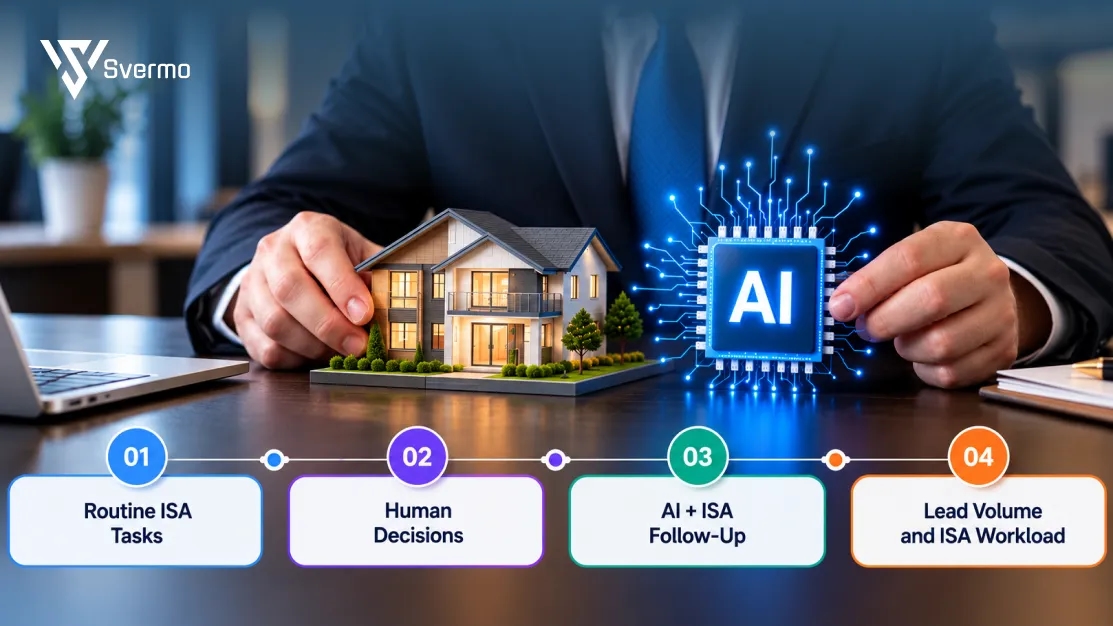
AI does not fully replace an ISA in every real estate business. It handles much of the repetitive work, such as responding to new leads, asking qualification questions, following up, and booking appointments, while ISAs and agents handle conversations that need judgment, expertise, or a personal touch.
Routine ISA Tasks
A lot of ISA work follows the same pattern every day:
- Respond to new leads
- Ask basic qualification questions
- Follow up when leads go quiet
- Check whether a lead is still looking
- Book appointments
- Update lead information
- Reconnect with older leads
AI handles these tasks across many conversations at once. For teams dealing with a high number of inquiries, AI lead qualification for real estate agents reduces the amount of manual follow-up sitting on the ISA's plate.
Human Decisions
Some conversations need an agent or ISA.
A buyer asking whether a property is worth the asking price, a seller discussing pricing, or a lead asking about a complicated transaction needs someone with real estate knowledge.
The same applies when a lead asks to speak with a person. AI hands over the conversation along with the messages and qualification details already collected.
AI + ISA Follow-Up
The practical setup gives AI and the human team different jobs.
AI handles:
- First response
- Basic qualification
- Routine follow-up
- Lead prioritization
- Appointment requests
- Re-engagement
Agents and ISAs handle:
- Complex questions
- High-intent leads
- Property advice
- Negotiation
- Personal conversations
- Situations that need judgment
When evaluating the best AI ISA for real estate, look at how much routine follow-up it actually handles and where the human ISA still needs to step in.
Solo agents frequently ask:
"I am running a real estate business as a solo agent, I close 5 to 6 deals a month, and I do not have the budget to hire an ISA. Can you suggest companies with top-rated AI tools that can qualify my leads, follow up for months and sync with Follow Up Boss without a complicated setup?"
Look for top-rated AI tools for realtors that support long-term nurturing, qualification, appointment booking, and Follow Up Boss integration. Check the setup requirements and which lead data flows between the systems. The goal is to reduce manual follow-up while keeping qualified leads visible in the CRM.
AI handles the repetitive volume, while the ISA focuses on leads that need a person.
Lead Volume and ISA Workload
Lead volume determines how much ISA work moves to AI.
An agent receiving 10 leads a week has a very different workload from a team receiving hundreds of leads each month. At higher volumes, replying, following up, updating records, and reconnecting with older prospects takes a significant amount of ISA time.
For those teams, an AI lead qualification platform takes more routine conversations off the ISA's workload and leaves the human team focused on qualified leads and conversations that need a person.
How Should AI Lead Qualification Integrate with a Real Estate CRM?

AI lead qualification integrates with a real estate CRM through lead capture, qualification, scoring, assignment, pipeline updates, appointment booking, and follow-up. Real estate AI platfrom integrations help connect these workflows with the systems teams already use. The CRM stays as the main lead record while AI handles the conversation and sends the resulting information and actions back into the CRM.
Lead and Qualification Data Flows Into the CRM
Imagine a Zillow lead comes in asking about a $700K listing.
AI starts the conversation and learns that the buyer:
- Has a $750K budget
- Is already pre-approved
- Wants to move within 60 days
- Is focused on three neighborhoods
- Wants to see the property this weekend
Those details flow into the CRM with the lead record. The agent opening the lead then sees more than a new contact. They see why the lead is qualified, what the buyer wants, and what needs to happen next.
AI Updates Assignments, Tags, and Pipeline Activity
The CRM also reflects what happens during the AI conversation. If AI identifies a buyer who is ready to move within 30 days, the workflow might:
Update lead status -> Apply a hot-lead tag -> Assign an agent -> Create a follow-up task -> Record the AI conversation
If the same lead says they are six months away from buying, the workflow sends the lead into nurture instead. Agents then spend less time reading conversations and manually updating lead records.
Follow Up Boss, kvCORE, and Lofty Need the Right Integration
A platform being "integrated with Follow Up Boss, kvCORE, or Lofty" does not tell you enough. The important question is what the integration actually does.
Check whether the AI workflow:
- Receives new leads automatically
- Reads existing lead information
- Writes qualification answers back to the CRM
- Updates lead stages or tags
- Assigns leads to specific agents
- Records conversations
- Creates appointments or follow-up tasks
- Works with existing CRM automations
A team looking for an AI lead qualification platform with Follow Up Boss integration needs to check these workflow details before choosing a platform.
Native Integrations Simplify Setup
A native integration keeps more of the workflow inside the existing CRM instead of relying on multiple separate connections.
For example:
New lead -> CRM -> AI qualification -> CRM update -> Agent assignment -> Appointment -> Follow-up
Teams comparing the best real estate CRM with AI need to look at how the CRM and AI share lead data, qualification details, assignments, and follow-up activity.
That is what matters when evaluating real estate CRM integration. The connection needs to carry the lead from the first response through qualification and agent handoff without creating extra manual work.
Does AI Lead Follow-Up Comply With TCPA, Opt-Out, and Do-Not-Call Rules?
AI lead follow-up is compliant when the workflow follows applicable TCPA, opt-out, and Do-Not-Call requirements. That means tracking consent, honoring opt-out requests, suppressing Do-Not-Call contacts, and applying the right controls to SMS, email, and voice outreach.
Consent Matters Before Automated Outreach
Before automated SMS or voice outreach starts, the system needs to know how the lead entered the database and what they agreed to receive.
Consent details need to stay with the lead record so the team has a clear record of why the outreach started.
AI Needs to Handle Opt-Outs and Do-Not-Call Requests
If a lead replies "STOP" or asks not to receive calls, the system needs to recognize the request and stop the applicable outreach.
The same applies to Do-Not-Call requests. The FTC requires covered businesses to maintain procedures for honoring these requests.
Automated SMS, Email, and Voice Need the Right Controls
Each channel has different requirements, so one general compliance setting is not enough.
The workflow needs controls for:
- SMS consent and opt-outs
- Voice calling permissions
- Do-Not-Call screening
- Email unsubscribe requests
- Lead-level suppression
For teams using AI voice workflows, AI IVR and real estate CRM integration connects calls with lead qualification, CRM updates, routing, and follow-up.
AI Should Stop and Escalate When Needed
AI needs to stop the outreach when a lead opts out, disputes consent, or raises a situation that requires human review.
The system then records the request and routes the conversation to the appropriate person when needed. This keeps compliance actions inside the follow-up workflow instead of leaving agents to manage them manually.
How Much Does AI Lead Qualification Cost, and What ROI Can You Realistically Expect?
AI lead qualification costs vary by platform, lead volume, channels, integrations, and implementation requirements. ROI comes from measurable improvements in response time, qualified leads, appointments, conversion rates, and the amount of manual ISA work the system replaces.
Platform and Implementation Costs
Look beyond the monthly platform fee. Total cost often includes:
- Platform or usage fees
- CRM integrations
- SMS and voice usage
- Implementation and configuration
- Custom workflows or setup
Compare the full cost against your monthly lead volume.
Response Time, Leads, and Appointments
Start with a simple baseline:
Leads received -> Response time -> Qualified leads -> Appointments -> Closed deals
Track these numbers before and after implementation. This shows whether faster speed to lead and consistent follow-up are producing more qualified opportunities.
Conversion Rates and Revenue
Connect each stage to revenue.
For example, if 1,000 leads produce 100 qualified leads, 30 appointments, and 6 closed deals, track how those numbers change after AI is introduced.
The key metric is not the number of AI conversations. It is the change in lead-to-appointment conversion rate, opportunities created, and revenue generated.
AI Cost vs. ISA Capacity
Compare the AI investment with the amount of ISA work it handles. If an ISA spends hours each week responding to new leads, chasing replies, qualifying contacts, and re-engaging older leads, calculate that workload against the AI platform's total cost.
The comparison becomes clearer when you measure cost per qualified lead, cost per appointment, and cost per closed deal.
How Quickly Can You Implement an AI Lead Qualification Platform?
A focused real estate AI lead qualification platform pilot often gets started faster than a full brokerage rollout. The timeline depends mainly on the lead sources, CRM integration, qualification workflow, communication channels, and compliance requirements involved.
Start With an Initial Pilot
Start with one specific workflow rather than configuring the entire operation at once. A buyer-lead workflow from one source gives the team a manageable starting point.
A pilot usually defines:
- Lead source: Website, Zillow, Facebook, or another channel
- Lead type: Buyer, seller, or both
- Qualification: Questions, scoring, and handoff rules
- Team: A small group of agents or one market
- Success metrics: Response time, qualified leads, and appointments
Test the Workflow Before Going Live
Run test leads through the complete conversation before real prospects enter the workflow. This catches problems in messaging, qualification logic, CRM updates, and agent handoffs.
Test scenarios such as:
- A lead gives complete qualification details
- A lead gives vague or conflicting answers
- A lead asks to speak with an agent
- A lead stops responding
- A lead asks to book an appointment
- A lead sends an opt-out request
CRM and Compliance Needs Affect Setup Time
The AI workflow needs to match the way the CRM stores leads and the rules governing automated outreach. More dependencies mean more setup and testing.
Review these areas before launch:
- CRM fields and lead stages
- Agent assignment and routing
- Existing CRM automations
- Consent and opt-out records
- SMS and voice settings
- Calendar and appointment workflows
Broader Rollouts Require More Configuration
Adding more lead sources, teams, markets, or qualification paths increases the number of workflows that need testing. A brokerage handling buyers, sellers, multiple territories, and several lead sources has more configuration than a single-team pilot.
A broader rollout often adds:
- Multiple qualification paths
- Territory-based routing
- Different agent assignments
- Source-specific messaging
- Additional CRM workflows
- More testing across lead scenarios
For teams using AI lead qualification for real estate agents, the practical approach is to prove one workflow first, then expand based on what the team learns from real conversations.
How Do You Choose the Best AI Lead Qualification Platform for Your Real Estate Business?
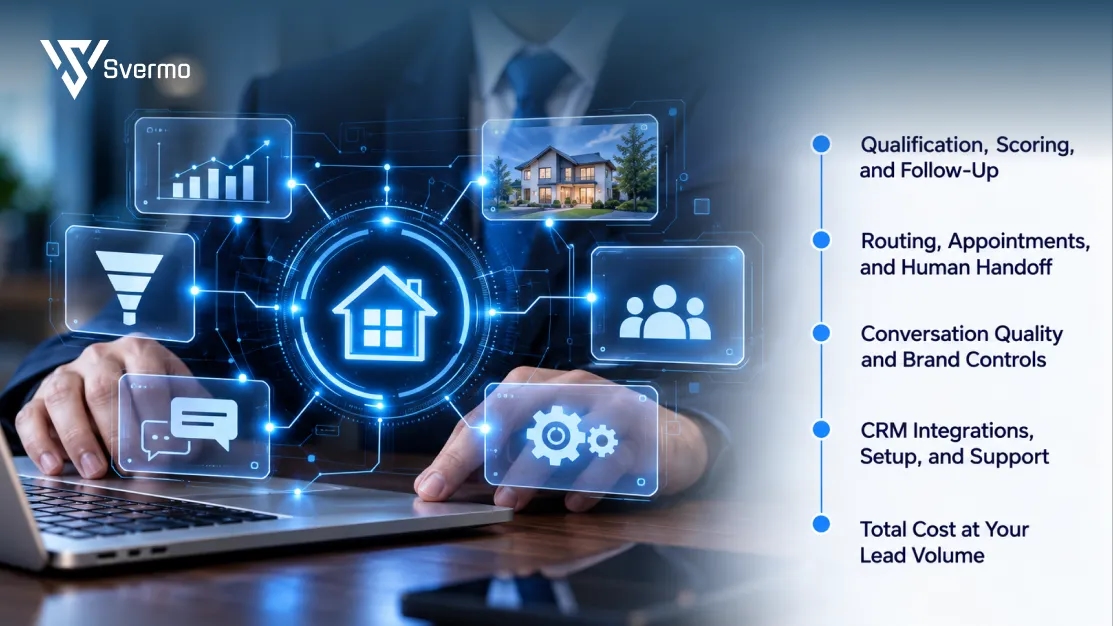
The best real estate AI lead qualification platform is the one that fits your lead volume, qualification process, CRM, follow-up workflow, and budget.
Compare the actual workflow from first response to agent handoff instead of comparing feature lists. A broader look at the best real estate AI automation tools also helps when comparing workflows, integrations, and operational fit.
Qualification, Scoring, and Follow-Up
Start with how the platform handles a new lead. The top AI lead qualification tools for real estate ask relevant questions, understand the answers, score lead intent, and adjust follow-up based on the conversation. Look for a workflow that separates a buyer ready to move next month from someone who is still browsing.
Routing, Appointments, and Human Handoff
Once a lead is qualified, the platform needs to move it to the right next step. Check how it assigns leads, books appointments, and hands conversations to agents. The agent needs the conversation history and qualification details when taking over.
Conversation Quality and Brand Controls
Test the platform with real lead scenarios before choosing it. Pay attention to how it handles vague answers, unexpected questions, pricing questions, and requests to speak with an agent. For best AI lead qualification tools for high-volume real estate agents, consistent conversation quality matters because the AI handles a large number of first interactions.
CRM Integrations, Setup, and Support
Check what the CRM integration actually does. A platform that lists Follow Up Boss, kvCORE, or Lofty as an integration still needs to support the specific workflow your team uses.
From our work around AI products for real estate, these integration and handoff details often matter more in day-to-day use than the headline AI features. Svermo, for example, works specifically on AI workflows across real estate lead qualification, customer conversations, scheduling, and CRM-connected operations.
Total Cost at Your Lead Volume
Compare the full cost at your actual lead volume, including platform fees, SMS and voice usage, implementation, integrations, and support.
Then compare that cost with the qualified leads, appointments, and closed opportunities the workflow produces.
Ready to Find Out Where Your Leads Are Falling Through?
Turn missed responses, weak follow-up, and buried CRM leads into a workflow your team can actually manage.
Final Thoughts!
The real question is not, “Does AI qualify leads?” It is, “What happens to a lead at 8:30 p.m. when nobody is watching the CRM?” A real estate AI lead qualification platform earns its place when it responds fast, asks useful questions, knows when to hand off, and keeps the CRM clean without creating more admin work.
That is also where Svermo's real estate AI experience matters. Working on AI workflows across lead conversations, qualification, scheduling, and CRM handoffs gives the team a practical view of where automation works and where humans still need to step in.
Before choosing a platform, ask: where are leads slipping today, and which part of that workflow actually needs fixing? Contact Svermo, and the answer to your existing process rather than adding another disconnected AI tool.
 https://www.linkedin.com/in/saanvi-verma-38711a36a
FAQs
The best AI assistant for real estate agents depends on the work you want it to handle. For lead operations, look for an assistant that works with your CRM, understands real estate conversations, remembers lead context, and supports tasks beyond simple automated replies.
AI identifies duplicate contacts by matching information such as phone numbers, email addresses, and existing CRM records. This keeps the same prospect from entering separate follow-up sequences and gives the team one conversation history to work from.
Yes, when the qualification workflow is built for those lead types. AI uses different questions and qualification criteria for investors, renters, buyers, sellers, landlords, or commercial prospects instead of forcing every contact through the same workflow.
AI uses qualification rules, conversation data, and lead outcomes. Teams get better results when they compare AI-qualified leads with actual appointments and closed opportunities, then refine the qualification criteria based on those results.
Look beyond response automation. Top-rated AI tools for realtors need to fit the team's actual workflow, including CRM data, lead sources, qualification rules, agent handoffs, reporting, and the conversations agents handle every day.
AI works with existing lead databases when the platform supports the required CRM or data connection. This extends AI qualification to older contacts, helping identify changes in buying or selling plans and leads worth re-engaging.
AI also works with leads collected through open houses, property events, landing pages, and other offline campaigns when those contacts enter a connected system. The workflow uses the available contact and event information to start a relevant qualification conversation.