

Real Estate AI Software Integrations: Benefits, Challenges and Future Trends


Get a summary of this article with your favorite AI





AI Summary
- •Real estate AI software integrations connect existing business systems, enabling a unified and intelligent property operations ecosystem.
- •AI software integrations for real estate businesses automate workflows, improve collaboration, and deliver measurable operational efficiency.
- •Successful integrations begin with the right strategy, clean data, phased implementation, and scalable technology foundations.
- •Real Estate Software Integration in 2026 will be shaped by autonomous AI, digital twins, and intelligent property operations.
- •Svermo's intelligent real estate software integration platform unifies your existing technology stack to power end-to-end real estate automation.
What if your existing CRM, MLS, accounting software, and property management systems could work together intelligently, without replacing your entire technology stack? That's exactly what real estate AI software integrations make possible.
Most real estate businesses rely on multiple applications to manage daily operations. Your CRM stores leads, your MLS manages listings, your property management software handles tenants, and your accounting platform tracks finances.
When these systems don't communicate, your teams spend more time switching between tools, entering duplicate data, and fixing inconsistencies than moving deals and properties forward.
This challenge comes at a time when AI adoption is accelerating across industries. According to Deloitte's state of AI in the enterprise 2026 report, 25% of business leaders say AI is already having a transformative impact on their organizations, more than double the 12% reported a year earlier.
The same report also found that 84% of organizations are increasing their AI investments, while 78% of leaders report greater confidence in AI as a business capability.
As you evaluate AI, you may be asking:
- Can AI integrate with our existing software?
- Which workflows should we automate first?
- How can we improve operations without disrupting our current systems?
- Which platform can connect everything together?
These are the questions real estate leaders should be asking. The goal isn't to replace the tools your business depends on. It's to make them work better together.
That's where Svermo comes in. By leveraging AI in real estate, Svermo serves as an intelligent real estate software integration platform designed for real estate agencies, property management companies, commercial real estate firms, and enterprise operations teams.
As AI becomes a bigger part of real estate operations, the real advantage lies in connecting the technology you already use into one intelligent, efficient ecosystem. But what exactly is real estate AI software integration, and why is it becoming a priority for modern real estate businesses?
Is Your Tech Stack AI-Ready?
Connect what you already have and let AI do the heavy lifting.
What Is Real Estate AI Software Integration, and Why Do Modern Businesses Need a Connected AI Ecosystem?
Real estate AI software integration means connecting AI with the software you already use, such as CRM, MLS, property management, accounting, and document systems. Instead of working separately, these tools share data and automate tasks through AI.
For example, when a new lead enters your AI-powered CRM Software, AI can assign it to an agent, update related systems, and trigger follow-ups automatically. Tasks that once took multiple steps happen instantly.
This reduces manual work, keeps data consistent, and helps your teams move faster without switching between tools.
Now comes the reasons why real estate businesses need AI software integrations
Disconnected systems don't just slow down individual teams. They affect the speed, accuracy, and efficiency of your entire organization. That's why AI software integrations for real estate businesses are becoming a strategic investment.
Here's why more organizations are adopting them:
- Eliminate data silos: Keep CRM, MLS, accounting, ERP, and property management platforms synchronized to maintain a single source of truth.
- Automate repetitive workflows: Reduce manual tasks such as lead assignment, document processing, lease administration, maintenance requests, and reporting.
- Improve operational visibility: Give sales, operations, finance, and property management teams access to consistent, real-time information.
- Increase team productivity: Spend less time switching between applications and more time serving clients, tenants, and investors.
- Scale without replacing existing software: Extend the capabilities of your current technology stack instead of investing in entirely new systems.
- Enhance customer and tenant experiences: Deliver faster responses, personalized communication, and seamless service throughout the property lifecycle.
- Make better business decisions: AI analyzes data across connected platforms to uncover trends, identify risks, and support smarter planning.
- Build a future-ready technology ecosystem: Create a flexible foundation that can adapt as your business grows and new AI capabilities emerge.
When your systems work together instead of operating independently, every workflow becomes faster, more accurate, and easier to manage. That's the real value of building a connected AI ecosystem for modern real estate operations.
Understanding what real estate AI software integrations are is only the first step. The real business value comes from how these integrations simplify everyday operations, reduce manual effort, and keep work moving without constant intervention.
So, how do AI integrations for real estate workflow automation transform day-to-day property operations?
How Do AI Integrations for Real Estate Workflow Automation Transform Daily Operations?
The real advantage of AI integrations for real estate workflow automation isn't just automation. It's the ability to connect everyday business processes so information moves where it's needed, when it's needed. Instead of relying on manual handoffs between teams and systems, AI keeps operations moving with minimal intervention.
1. Lead Qualification and Customer Engagement
Every new inquiry doesn't require the same level of attention. AI can evaluate lead behavior, prioritize prospects based on intent, route them to the right agent, and trigger personalized follow-ups automatically.
When integrated with an AI lead management system for real estate and an automated CRM software, sales teams spend more time closing opportunities instead of managing administrative tasks.
2. Listing Management and Property Discovery
Property information often needs to be updated across multiple platforms. AI helps synchronize listing details, recommend similar properties, improve listing descriptions, and surface the most relevant properties based on buyer preferences.
Solutions such as a real estate AI property search engine make property discovery faster while improving the experience for buyers and agents alike.
3. Document Processing and Transaction Management
Purchase agreements, lease documents, disclosures, inspection reports, and compliance paperwork generate significant administrative work throughout the property lifecycle.
AI can classify documents, extract key information, identify missing fields, and organize files automatically. An AI document management software solution further simplifies document handling while reducing manual reviews and processing delays.
4. Tenant and Leasing Operations
For property management companies, tenant communication is one of the most time-consuming responsibilities. AI can answer routine questions, schedule property tours, manage maintenance requests, and assist prospective tenants throughout the leasing process.
Capabilities like an AI leasing assistant and an AI chatbot virtual assistant help maintain responsive communication without increasing workload for on-site teams.
5. Property Operations and Maintenance
Maintenance requests often involve multiple departments, vendors, and approval workflows. AI can prioritize work orders, assign technicians, monitor progress, and notify stakeholders throughout the process.
When connected with operational systems, property managers gain better visibility into service performance while resolving issues more efficiently.
6. Financial and Portfolio Management
AI can streamline invoice processing, rent tracking, financial reporting, and portfolio analysis by working alongside existing accounting and ERP systems.
For organizations managing multiple assets, tools such as AI investment analytics software provide deeper insights into portfolio performance, helping leadership make faster, data-driven investment decisions.
As more workflows connect through AI, daily operations start running with less manual effort and fewer delays. Teams can focus more on outcomes instead of coordination.
That naturally leads to the next question: which real estate systems can AI actually connect to make this level of automation work?
What Real Estate Software Systems Can AI Integrate with to Create a Unified Property Operations Platform?
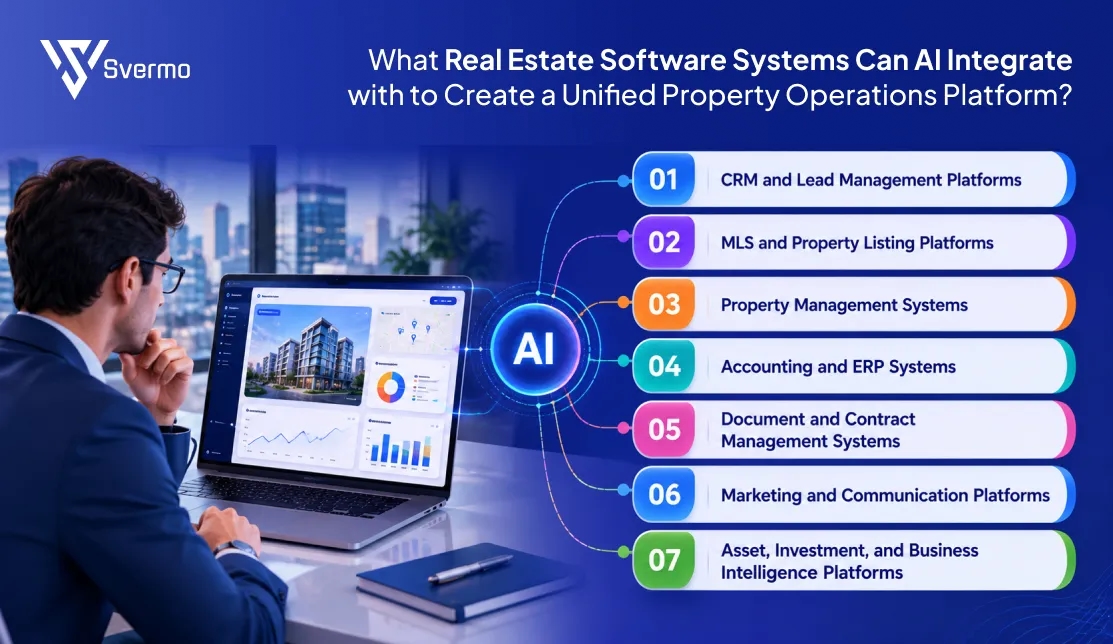
One of the biggest misconceptions about AI adoption is that it requires replacing your existing software. In reality, the best approaches to real estate AI software integrations are designed to work with the technology your teams already rely on.
Whether you're running a brokerage, property management company, or commercial real estate portfolio, AI can integrate with nearly every core business application to create a more connected and efficient operation.
1. CRM and Lead Management Platforms
Your CRM is often the starting point for customer interactions. AI strengthens it by qualifying leads, recommending next actions, identifying sales opportunities, and keeping customer records up to date across connected systems.
AI capabilities include:
- Automated lead scoring and prioritization based on behavior and intent
- Intelligent follow-up scheduling and reminders
- Predictive insights to identify high-conversion opportunities
- Real-time data synchronization across sales and marketing tools
This is why real estate CRM and AI software integrations are among the first investments many organizations make.
2. MLS and Property Listing Platforms
MLS platforms generate a constant flow of listing updates, pricing changes, and market activity. Through real estate AI platform integration with MLS and CRM, AI can synchronize listing information, enrich property data, recommend comparable listings, and improve listing distribution across sales and marketing channels.
AI capabilities include:
- Automated listing updates and data synchronization
- Smart property recommendations based on buyer preferences
- AI-generated listing descriptions and enhancements
- Market trend analysis and pricing insights
Also read: AI powered MLS software
3. Property Management Systems
Property management teams handle everything from tenant onboarding to maintenance coordination and lease administration. AI supports these operations by integrating with existing property management platforms rather than replacing them.
Solutions such as AI tenant screening software, AI LeaseFlow Automation, and automated rent collection software become even more effective when connected to your existing property management ecosystem.
AI capabilities include:
- Automated tenant screening and risk assessment
- Lease lifecycle automation and renewal tracking
- Intelligent rent collection and payment reminders
- Maintenance request prioritization and routing
4. Accounting and ERP Systems
Financial information shouldn't remain isolated from operational workflows. AI can connect accounting software and ERP platforms to automate invoice processing, reconcile financial records, monitor budgets, and improve financial reporting accuracy.
This AI integrated accounting software and AI invoice processing software creates better visibility across finance, operations, and executive leadership.
AI capabilities include:
- Automated invoice processing and expense categorization
- Real-time financial reconciliation and anomaly detection
- Budget forecasting and variance analysis
- Integrated financial reporting across departments
5. Document and Contract Management Systems
Every transaction generates contracts, disclosures, inspection reports, lease agreements, and compliance documents. AI helps organize, classify, retrieve, and validate these files while keeping them connected to the appropriate customer, property, or transaction.
Organizations managing large document volumes often benefit from AI document management capabilities that reduce manual administration and improve accessibility.
AI capabilities include:
- Automated document classification and tagging
- Data extraction from contracts and forms
- Compliance checks and missing field detection
- Smart search and retrieval across document repositories
6. Marketing and Communication Platforms
Marketing teams use multiple tools to manage campaigns, email communication, advertising, and customer engagement. AI connects these platforms to deliver personalized outreach, automate campaign execution, and improve lead nurturing throughout the customer journey.
An AI real estate marketing software can further enhance campaign performance by using insights from your CRM, MLS, and customer interactions.
AI capabilities include:
- Personalized campaign targeting and segmentation
- Automated email and messaging workflows
- Performance tracking and campaign optimization
- AI-driven content generation for listings and promotions
7. Asset, Investment, and Business Intelligence Platforms
Commercial real estate firms and investment companies depend on accurate portfolio insights. AI integrates with asset management systems and analytics platforms to consolidate operational, financial, and market data into actionable intelligence.
This enables leadership teams to evaluate portfolio performance, identify emerging opportunities, and make informed investment decisions with greater confidence.
AI capabilities include:
- Portfolio performance analysis and forecasting
- Risk assessment and opportunity identification
- Data consolidation across multiple assets and markets
- Predictive analytics for investment decision-making
The more connected your technology stack becomes, the greater the value AI can deliver across every department. But connecting systems is only one part of the equation. The real question for most decision-makers is whether these integrations produce measurable business results.
So, what are the biggest benefits of real estate AI software integrations for modern businesses?
What Business Results Can You Expect from Real Estate AI Software Integrations?

By this stage, you know what real estate AI software integrations are, how they automate workflows, and which systems they can connect. The next question is whether these integrations deliver measurable business value.
The answer depends on how well AI is aligned with your operational goals. When implemented strategically, the impact extends beyond automation and supports long-term business growth.
| Business Outcome | How AI Integrations Create Value | Impact on Your Business |
|---|---|---|
Increase operational capacity | AI enables your existing teams to manage more transactions, properties, and customer interactions without proportionally increasing administrative overhead. | Support business growth while controlling operational costs. |
Maximize existing technology investments | Extend the capabilities of your CRM, MLS, ERP, accounting, and property management platforms instead of replacing them. | Improve ROI from software you've already invested in. |
Improve executive decision-making | Bring together operational, financial, customer, and property data to provide a more complete business view. | Make faster decisions backed by accurate, connected data. |
Reduce business and compliance risks | Monitor critical processes, identify anomalies, improve documentation accuracy, and support regulatory compliance. | Minimize costly errors and strengthen operational governance. |
Scale operations with confidence | Standardize processes across offices, regions, portfolios, and business units while maintaining consistency. | Expand operations without creating fragmented workflows. |
Enhance portfolio performance | Analyze occupancy trends, leasing activity, operational metrics, and financial performance across assets. | Identify opportunities to improve asset utilization and profitability. |
Strengthen customer and tenant retention | Deliver consistent, timely experiences across every touchpoint using connected operational data. | Build stronger long-term relationships and improve customer satisfaction. |
Create a future-ready technology foundation | Support new AI capabilities and emerging technologies without rebuilding your existing software ecosystem. | Stay adaptable as business needs and technology continue to evolve. |
The most successful organizations measure AI integrations by the business outcomes they improve, whether that's higher profitability, better operational resilience, or faster growth.
Next is, how are organizations using real estate AI software integrations across the property lifecycle?
What Are the Most Valuable Use Cases of Real Estate AI Software Integrations Across the Property Lifecycle?
The value of AI real estate software integrations isn't limited to one department or one stage of the property lifecycle. From attracting prospects to managing assets, AI helps different teams work more efficiently while making better use of the systems they already have.
Here are some of the most impactful use cases for modern real estate businesses.
1. Accelerating Property Leasing from Inquiry to Move-in
Leasing involves multiple steps, including responding to inquiries, scheduling tours, screening applicants, preparing lease documents, and coordinating move-ins. AI connects these activities, reducing delays and ensuring prospects move through the leasing process without unnecessary manual follow-ups.
Example:
A 450-unit apartment community was losing weekend leads because no leasing staff were available. An AI voice assistant answered inquiries, booked tours, qualified prospects, and shared complete lead details with leasing agents before business hours resumed.
2. Improving Property Investment Decisions
Investment decisions depend on accurate financial, operational, and market intelligence. AI consolidates information from multiple sources, helping investment teams evaluate opportunities, compare assets, and identify potential risks much faster.
Example:
While evaluating a multi-property acquisition, a commercial real estate firm used real estate property valuation intelligence to combine market trends, comparable sales, and rental data, helping analysts compare opportunities without manually collecting information from multiple sources.
3. Strengthening Property Security and Risk Monitoring
Managing security across multiple properties requires continuous monitoring. AI identifies unusual activity, analyzes events in real time, and notifies the right teams immediately, helping organizations respond before issues escalate.
Example:
A mixed-use commercial building experienced repeated unauthorized after-hours access. An AI security and surveillance system detected unusual activity, alerted security teams instantly, and automatically logged every incident for investigation and compliance reporting.
4. Managing Large Real Estate Portfolios More Efficiently
As portfolios expand, monitoring operational performance across hundreds of properties becomes increasingly complex. AI brings together asset, financial, leasing, and operational data to provide portfolio managers with a unified view for faster decision-making.
Example:
A portfolio manager overseeing more than 300 properties used an AI asset management agent to consolidate operational and financial data, quickly identifying underperforming assets that required immediate attention.
5. Delivering More Interactive Property Experiences
Many buyers and tenants want to evaluate properties before scheduling an in-person visit. AI enhances digital experiences through intelligent property recommendations, immersive visualizations, and personalized interactions that keep prospects engaged.
Example:
A brokerage serving relocation buyers implemented AI property visualization software, allowing prospects to explore interactive property tours remotely before scheduling visits, resulting in better-qualified buyer inquiries.
6. Improving Property Inspection and Maintenance Planning
Routine inspections generate valuable information, but reviewing reports manually often delays maintenance decisions. AI analyzes inspection findings, identifies recurring issues, and helps maintenance teams prioritize repairs before problems become more expensive.
Example:
A property management company inspected hundreds of units each month. AI property inspections software identified recurring maintenance issues, prioritized repairs by urgency, and automatically generated work orders for maintenance teams.
These examples demonstrate that AI-driven real estate technology integrations for modern property operations create value across leasing, investments, security, portfolio management, customer engagement, and maintenance.
Of course, knowing what's possible is different from putting it into practice. Many organizations hesitate because they believe integration will be expensive, complex, or disruptive.
Is integrating AI into your existing real estate software really that difficult?
Ready to Put AI to Work?
See how these use cases can fit into your real estate operations.
How Can You Integrate AI into Real Estate Software Systems Without Replacing Your Existing Technology?
Adopting AI doesn't have to mean rebuilding your entire technology stack. The most successful AI software integrations for real estate businesses begin with a clear roadmap that aligns technology with business priorities. By taking a phased approach, you can reduce implementation risks, encourage user adoption, and achieve measurable results sooner.
1. Assess Your Existing Technology Stack
Before introducing AI, understand what you already have. Review the systems your teams rely on every day, identify how data flows between them, and uncover areas where manual work or disconnected processes are slowing operations.
Focus on identifying:
- Core business applications such as CRM, MLS, ERP, accounting, and property management software.
- Existing integrations and API availability.
- Repetitive tasks that consume significant time.
- Data quality and consistency across systems.
2. Prioritize High-Impact Workflows
Not every process needs AI from day one. Start with workflows that generate the greatest operational impact while requiring minimal disruption to existing processes.
Look for workflows that:
- Require repetitive manual effort.
- Involve multiple teams or departments.
- Experience frequent delays or bottlenecks.
- Directly influence customer or tenant experience.
3. Choose an Intelligent Integration Platform
The right platform should connect your existing systems instead of replacing them. As you evaluate best real estate AI software integration solutions, prioritize flexibility, scalability, and compatibility with your current technology ecosystem.
Evaluate platforms based on:
- Native integrations and API support.
- Security and compliance capabilities.
- Workflow automation features.
- Scalability for future business growth.
4. Prepare and Standardize Your Data
AI performs best when it works with reliable information. Before connecting systems, review your existing data to remove duplicates, standardize records, and resolve inconsistencies that could affect automation accuracy.
Your preparation should include:
- Cleaning duplicate customer and property records.
- Standardizing naming conventions.
- Validating critical business data.
- Defining data ownership across departments.
5. Launch a Pilot Before Scaling
Rather than deploying AI across every department at once, begin with a focused pilot. This allows your teams to validate workflows, identify improvements, and build confidence before expanding implementation.
A successful pilot should:
- Target one business function or department.
- Define measurable success metrics.
- Gather feedback from end users.
- Refine workflows before wider deployment.
6. Train Teams and Encourage Adoption
Technology delivers value only when people use it effectively. Provide practical training so employees understand how AI supports their daily responsibilities instead of changing the way they work completely.
Support adoption by:
- Offering role-specific training sessions.
- Creating simple workflow documentation.
- Addressing employee questions early.
- Sharing measurable improvements from early deployments.
7. Measure, Optimize, and Expand
AI implementation doesn't end after deployment. Regularly review performance, identify new automation opportunities, and refine workflows as business needs evolve. This approach helps organizations maximize the long-term value of real estate business automation with AI integrations.
Track metrics such as:
- Workflow completion times.
- Operational costs.
- User adoption rates.
- Customer and tenant satisfaction.
- Return on technology investment.
A successful AI integration isn't defined by how many systems you connect. It's measured by how effectively those systems support your business goals and adapt as your organization grows.
Even with a well-planned implementation, every organization encounters obstacles along the way. Understanding those challenges early can help you avoid costly delays and build a more resilient integration strategy.
What challenges do businesses face when implementing real estate AI software integrations, and how can they overcome them?
What challenges should real estate companies consider before implementing AI software integrations?
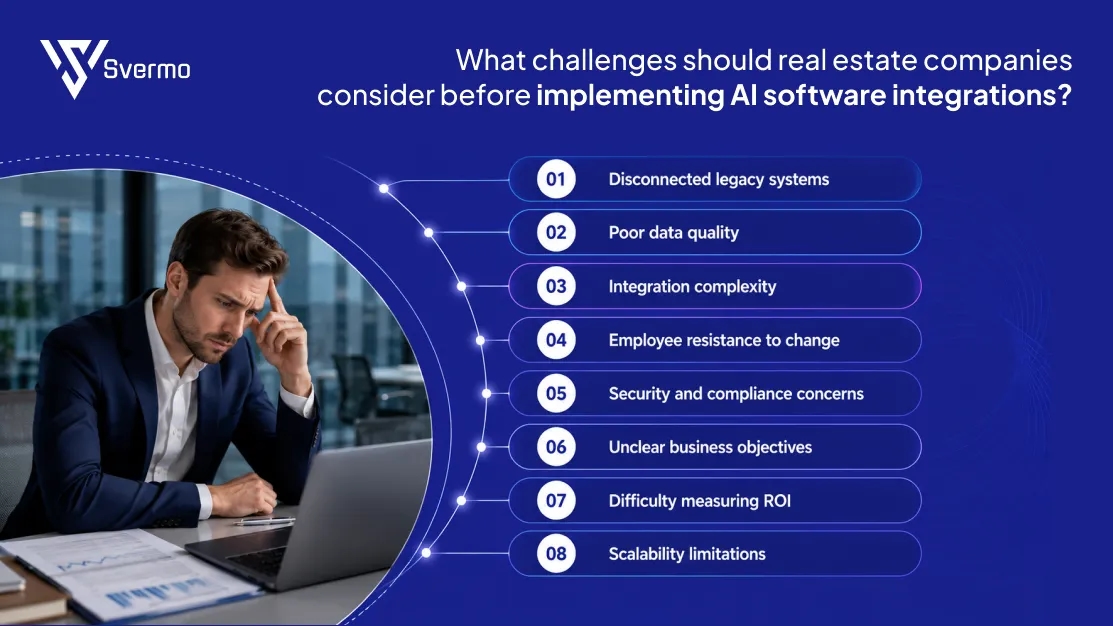
While AI adoption offers clear advantages, many real estate organizations encounter practical hurdles during implementation of real estate AI software integrations. These challenges are often linked to existing processes, system limitations, or unclear execution strategies rather than the technology itself. Recognizing these factors early allows businesses to plan more effectively and avoid unnecessary delays.
| Challenge | Why It Happens | Practical Solution |
|---|---|---|
Disconnected legacy systems | Older CRM, ERP, or property management platforms may not support modern integrations or standardized data exchange. | Use an intelligent real estate software integration platform that supports APIs, middleware, and legacy system connectivity instead of replacing existing software. |
Poor data quality | Duplicate records, missing information, and inconsistent property data reduce AI accuracy and workflow reliability. | Clean and standardize business data before implementation, and establish clear data governance practices. |
Integration complexity | Connecting multiple systems across different departments often introduces technical and operational challenges. | Start with a limited implementation, connect high-priority systems first, and expand gradually after validating results. |
Employee resistance to change | Teams may worry that AI will disrupt their roles or require them to learn entirely new processes. | Involve end users early, provide role-specific training, and demonstrate how AI reduces repetitive work instead of replacing employees. |
Security and compliance concerns | Real estate businesses handle sensitive customer, financial, and property information that must remain protected. | Select AI platforms with enterprise-grade security, role-based access controls, encryption, and compliance support. |
Unclear business objectives | Many organizations implement AI because it's trending rather than solving a defined operational problem. | Identify measurable business goals and prioritize workflows that deliver the highest operational impact. |
Difficulty measuring ROI | Without clear success metrics, it's hard to evaluate whether AI initiatives are delivering business value. | Define KPIs before implementation, such as processing time, operational costs, response times, conversion rates, or portfolio performance. |
Scalability limitations | Point solutions often solve one problem but struggle as the organization grows or adds new systems. | Choose enterprise AI software integrations for commercial real estate and growing businesses that can support expanding portfolios, additional users, and future technology requirements. |
While these challenges are common, they're also manageable with the right planning and technology strategy. Organizations that approach AI as a long-term operational investment are better positioned to scale successfully and adapt to future innovations.
As AI capabilities continue to advance, what should real estate businesses expect from real estate software integration in 2026 and the years ahead?
What Future Trends will Shape Real Estate Software Integration in 2026 and Beyond?
The next generation of AI-driven real estate technology integrations for modern property operations will move beyond connecting software systems. As these technologies mature, businesses will be able to create smarter, more adaptive operations that anticipate problems, coordinate workflows, and support faster decision-making across the entire property lifecycle.
1. Autonomous AI Agents will Become the Next Digital Workforce
Today's AI typically completes individual tasks after receiving instructions. Over the next few years, AI integrations for real estate workflow automation are expected to evolve into autonomous agents capable of managing complete business processes across multiple applications.
Instead of handling one task at a time, these AI agents could coordinate leasing, maintenance, finance, and customer interactions from start to finish. This will reduce manual coordination between teams, accelerate response times, and enable organizations to manage higher workloads without increasing operational complexity.
2. Multimodal Property Intelligence will Improve Decision-Making
Future AI will understand more than written information. It will combine floor plans, inspection images, drone footage, maintenance reports, voice conversations, and operational data to build a richer understanding of every property.
This evolution will strengthen an AI-powered property operations platform, allowing businesses to identify issues earlier, improve property evaluations, and make faster decisions using multiple sources of information instead of relying on isolated datasets.
3. Digital Twins will Enable Predictive Property Operations
Digital twins are expected to become more accessible beyond large enterprise buildings. These virtual representations will continuously reflect real-world building conditions using AI, IoT devices, and operational data.
As part of a unified property operations platform, digital twins will help organizations predict maintenance needs, optimize energy consumption, and monitor building performance in real time, reducing unexpected disruptions while improving long-term asset performance.
4. Specialized AI Agents will Collaborate Across Departments
Instead of relying on one AI assistant, organizations are expected to deploy specialized AI agents for leasing, finance, maintenance, customer service, compliance, and asset management.
Working together as a connected AI ecosystem for real estate operations, these agents will exchange information automatically, helping departments coordinate activities more efficiently and creating smoother workflows across the entire property lifecycle.
5. AI-Native Integration Platforms will Simplify Enterprise Automation
As organizations adopt more AI capabilities, managing integrations manually will become increasingly difficult. Future AI integration platforms for real estate property operations are expected to recommend workflows, identify automation opportunities, and simplify expansion as business needs evolve.
This will allow businesses to introduce new applications and automation faster while reducing the technical effort typically associated with enterprise software integrations.
6. Industry-Specific AI Models will Deliver Smarter Real Estate Insights
General-purpose AI models are becoming more capable, but future models trained specifically on leases, valuations, regulations, MLS data, and property operations are expected to deliver more relevant and accurate insights.
These advancements will further strengthen enterprise AI software integrations for commercial real estate, helping organizations improve investment analysis, operational planning, compliance, and portfolio management with AI that better understands the nuances of the real estate industry.
Organizations don't need to wait for these technologies to become mainstream before preparing for them. Building a flexible, integration-ready technology ecosystem today will make it much easier to adopt future innovations as they become part of everyday real estate operations.
Why Is Svermo the Right Intelligent Real Estate Software Integration Platform for Modern Property Operations?

Svermo serves as an intelligent real estate software integration platform that connects your CRM, MLS, ERP, accounting software, property management systems, document management solutions, communication platforms, and other operational technologies into one AI-powered ecosystem.
This allows your teams to automate workflows, share data seamlessly, and manage property operations from a connected technology environment.
With Svermo, you can:
- Connect your existing software without disrupting day-to-day operations.
- Automate workflows across sales, leasing, finance, property management, marketing, compliance, and customer service.
- Eliminate information silos by keeping business systems synchronized in real time.
- Build a connected AI ecosystem for real estate operations that supports every stage of the property lifecycle.
- Scale AI adoption across teams, offices, and portfolios without replacing your current technology investments.
- Stay prepared for future innovations as AI capabilities continue to evolve.
Beyond integrations, Svermo unifies AI tools for lead management, marketing, leasing, tenant engagement, operations, and more into one connected platform. Organizations evaluating future-ready solutions may also find it helpful to review how different platforms are evolving to support both agents and operations teams, as discussed in the overview of best AI platforms for real estate.
This approach accelerates real estate business automation with AI integrations, improves visibility, and maximizes existing systems. It supports brokerages, property managers, and enterprise portfolios alike.
As AI evolves, connected and scalable platforms like Svermo help businesses stay competitive and future-ready.
Ready to Connect It All?
Build one intelligent ecosystem instead of managing disconnected tools.
Bringing It All Together!
The future of real estate won't be defined by how many software applications your business owns. It will be defined by how well those applications work together.
As real estate AI software integrations continue to evolve, organizations that build connected, scalable, and AI-ready technology ecosystems will be better positioned to improve operational efficiency, respond faster to market changes, and deliver better experiences across the property lifecycle.
At Svermo, we believe AI should strengthen the technology you've already invested in, not replace it. That's why our platform is designed to unify your existing systems while bringing together purpose-built AI solutions for every stage of real estate operations. Whether you're modernizing brokerage workflows, managing commercial portfolios, or streamlining property management, Svermo provides the foundation for long-term, intelligent automation.
Connected AI ecosystems extend beyond back-office automation. Technologies such as AI avatars for real estate and the expanding use cases of conversational AI agents are helping organizations deliver more consistent customer experiences while reducing operational effort.
The next generation of real estate operations won't be built on disconnected software. It will be powered by connected intelligence, and the businesses that prepare today will be the ones setting the pace tomorrow.
Build smarter connections today. Let your software do the teamwork.
 https://www.linkedin.com/in/saanvi-verma-38711a36a
FAQs
Yes. Most modern real estate AI software integrations use APIs, middleware, or connectors to work with existing CRM, ERP, accounting, and property management systems. Legacy platforms without APIs may require additional integration layers, but they rarely need to be replaced.
Implementation timelines depend on the number of systems, data quality, and workflow complexity. A pilot integration can often be completed within weeks, while enterprise-wide deployments typically follow a phased rollout to minimize business disruption.
The best AI integration platforms for real estate property operations support native or API-based connections with MLS, CRM, property management, accounting, and communication systems, allowing businesses to automate workflows without replacing their existing software.
Security depends on the platform you choose. Look for enterprise-grade encryption, role-based access controls, audit logs, secure API authentication, and compliance features that protect customer, financial, and operational data.
Yes. Modern enterprise AI software integrations for commercial real estate are designed to scale across multiple offices, regions, and portfolios while maintaining standardized workflows, centralized reporting, and consistent operational visibility.
Prioritize platforms that offer native integrations, API flexibility, enterprise security, workflow automation, scalability, real-time data synchronization, analytics, and support for your existing technology ecosystem rather than requiring software replacement.
The return on investment depends on your implementation goals and adoption strategy. Most organizations measure success through reduced manual effort, faster process completion, improved data accuracy, lower operational costs, higher employee productivity, and better customer experiences.