

AI-Powered MLS Software for Real Estate Operations (2026): Core Capabilities, Use Cases and Future Trends


Get a summary of this article with your favorite AI





AI Summary
- •AI-powered MLS software for real estate is evolving from listing management to operational intelligence.
- •AI real estate MLS software helps unify property data, workflows, and business operations.
- •AI-powered MLS systems for real estate automate property matching, listing management, and leasing workflows.
- •The future of AI MLS software in real estate includes autonomous operations, AI agents, and connected property intelligence.
- •Svermo combines real estate AI platform for MLS workflow automation, MLS intelligence, and operational automation in one platform.
Real estate teams do not struggle with finding property data. They struggle with managing it across listings, lead pipelines, CRMs, marketing systems, and operational workflows. AI-powered MLS software for real estate addresses this problem by combining listing management, property search, workflow automation, and data intelligence into a single operational platform.
For brokers, agencies, and property management companies, AI real estate MLS software helps reduce manual updates, improve property matching, accelerate lead response times, and create a more connected operating environment.
The urgency is growing. The global AI in real estate market is approximately at $404.9 billion, expected to grow to $1303.09 billion in 2030 at a compound annual growth rate (CAGR) of 33.9% reflecting significant investment in automation, analytics, and intelligent property operations.
At the same time, AI adoption is expanding across critical real estate functions, including CRM management, property search, valuation, workflow automation, and property management operations.
For decision-makers evaluating technology investments, the challenge is selecting an AI real estate multiple listing service (MLS) software that can unify property data, automate repetitive processes, and support growth without increasing operational complexity.
A modern MLS platform should function as a central operating layer that connects people, property data, and business processes in one environment.
But, do you know what exactly an AI-powered MLS software for real estate is and why are more companies making the switch?
Still Managing MLS Operations the Hard Way?
See how AI-powered MLS software can automate listings, workflows, and property operations at scale.
What Is AI-Powered MLS Software for Real Estate and Why Are Companies Replacing Traditional MLS Systems?
Traditional MLS platforms are designed to store, distribute, and search property listings. While that function remains important, modern real estate operations require much more than listing visibility.
This is where AI-powered MLS software for real estate comes into the picture.
AI real estate MLS software combines MLS data with intelligence, automation, and workflow management capabilities. Instead of serving only as a property listing repository, it acts as an operational platform that helps real estate organizations manage data, processes, and business activities from a centralized environment.
1. Traditional MLS Systems Create Operational Friction
Property information often exists in separate systems. Teams manually transfer data between platforms. Updates may be delayed or duplicated and reporting becomes fragmented.
In many organizations, MLS data operates separately from marketing tools, transaction systems, and real estate CRM software, creating unnecessary friction across teams.
As transaction volumes increase, these inefficiencies become more difficult to manage. The issue is rarely access to data. The issue is coordinating that data across people, processes, and systems.
2. Traditional MLS System vs. AI-Powered MLS Platform
While both systems provide access to property listings, they serve very different operational purposes.
| Area | Traditional MLS System | AI-Powered MLS Platform |
|---|---|---|
Primary Purpose | Listing storage and distribution | End-to-end real estate operations management |
Property Data | Static listing records | Dynamic, enriched, and continuously updated data |
Workflow Management | Manual coordination across tools | Centralized workflow automation |
Lead Handling | Separate systems required | Integrated lead and property workflows |
Property Matching | Filter-based searches | Intelligent matching based on user preferences |
Data Visibility | Fragmented across platforms | Unified property and operational visibility |
Team Collaboration | Multiple disconnected systems | Shared operational environment |
Scalability | Requires additional tools as operations grow | Designed to support growth from a single platform |
Operational Efficiency | High manual workload | Reduced administrative effort |
Business Impact | Supports listing access | Supports revenue, productivity, and operational performance |
AI-powered MLS software for real estate extends beyond listing management. It helps organizations create a connected operating environment where property data, workflows, and business processes work together rather than in isolation.
3. Business Benefits of AI-Powered MLS Software
The primary value of AI-powered MLS systems for real estate comes from operational efficiency. By centralizing property data and reducing manual processes, organizations can spend less time managing systems and more time serving clients.
Benefits typically include:
- Faster listing administration
- Better data consistency
- Reduced operational workload
- Improved collaboration across teams
- Stronger visibility into property and client activities
- Greater scalability for growing operations
For decision-makers, these improvements directly impact productivity, service quality, and operational costs.
Understanding the value of an AI-powered MLS platform is one thing. Understanding how it connects property data, workflows, and business processes behind the scenes is what determines whether it can support your operational goals.
So, how does an AI-powered MLS platform for real estate business actually work in practice?
How Does AI-Powered MLS Software for Real Estate Work Behind the Scenes?
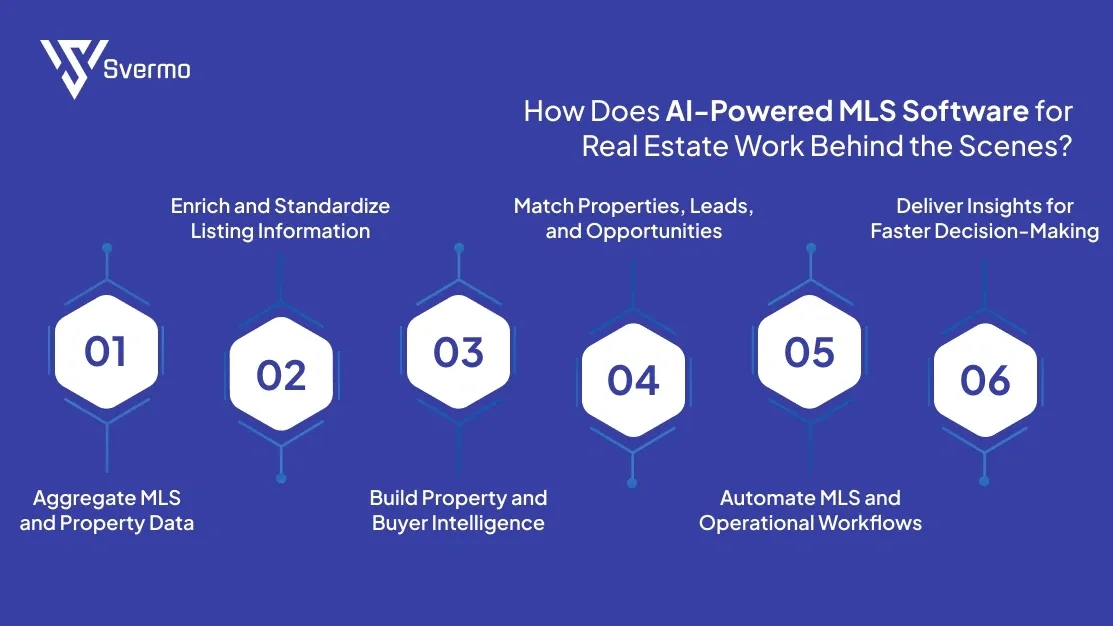
An AI-powered MLS platform for real estate business does more than collect property listings. It continuously processes MLS data, analyzes patterns, automates decisions, and supports operational workflows across the organization.
While every platform has its own architecture, most real estate AI platforms for MLS workflow automation follow a similar process to transform raw MLS data into actionable business intelligence.
1. Aggregate MLS and Property Data
The process begins by collecting information from multiple sources, including MLS feeds, CRM platforms, transaction systems, property databases, and operational tools. A modern AI real estate property search and MLS integration platform brings this information together to create a centralized operational environment.
Bringing data into a single platform eliminates information silos and provides teams with a consistent view of property and client activity.
This foundation allows organizations to:
- Consolidate property and client data across systems
- Reduce duplicate records and manual data transfers
- Improve visibility into listings, leads, and transactions
- Support a unified property data management system
2. Enrich and Standardize Listing Information
Raw MLS data often contains missing fields, inconsistent formats, duplicate records, or outdated information. Managing these issues manually can slow down operations and create data quality problems.
AI reviews listing information and improves its quality before it reaches operational teams. This layer enables a real estate MLS data automation and enrichment tool to make listing data more reliable and easier to manage.
As part of this process, the platform can:
- Detect duplicate property records
- Identify incomplete listing information
- Standardize property descriptions and attributes
- Improve overall listing quality and accuracy
3. Build Property and Buyer Intelligence
Once listing data is organized, AI begins analyzing relationships between properties, buyers, market activity, and operational performance. Instead of treating listings as static records, the platform develops a deeper understanding of property characteristics and buyer behavior.
This intelligence layer transforms a traditional MLS database into a real estate data intelligence platform that supports smarter decision-making.
Organizations can use this intelligence to:
- Understand property demand patterns
- Analyze buyer preferences and interests
- Monitor listing engagement trends
- Create stronger property profiles for internal teams
4. Match Properties, Leads, and Opportunities
One of the most valuable capabilities of AI real estate multiple listing service (MLS) software is its ability to connect the right opportunities with the right people. Rather than relying solely on manual searches and filters, AI evaluates multiple data points to identify relevant matches.
Many organizations use an intelligent MLS system for real estate lead and property management to improve matching accuracy and reduce manual search efforts.
This enables the platform to:
- Support an AI-driven real estate listing and matching system
- Recommend relevant properties to prospective buyers
- Improve lead qualification processes
- Surface high-potential opportunities faster
A real estate AI property search engine can further strengthen this process by helping users discover properties based on intent, preferences, and behavioral patterns rather than simple keyword searches.
5. Automate MLS and Operational Workflows
After identifying opportunities, the platform can automate routine tasks that typically require manual effort. This reduces administrative overhead while improving consistency across teams.
This is where a real estate AI platform for MLS workflow automation helps organizations streamline operations and improve execution across departments.
The platform can automatically:
- Trigger listing updates across systems
- Route leads to the appropriate teams
- Update customer records and activity logs
- Generate notifications and task assignments
6. Deliver Insights for Faster Decision-Making
The final stage focuses on helping teams take action. Rather than manually reviewing large amounts of property and operational data, users receive recommendations, alerts, and performance insights in real time.
By combining automation, intelligence, and centralized data management, an AI-powered MLS platform for real estate business in USA helps organizations make faster and more informed decisions.
The result is:
- Faster operational decision-making
- Better visibility into business performance
- More efficient resource allocation
- Greater scalability across real estate operations
By combining data aggregation, intelligence, automation, and decision support, AI-powered MLS systems for real estate transform MLS data from a static listing resource into an operational intelligence layer that supports the broader business.
How AI-powered MLS for real estate operations works behind the scenes provides important technical context. The next consideration is how are brokers, agencies, and property management companies using AI-powered MLS systems for real estate to improve daily operations and drive growth?
Where Are AI-Powered MLS Systems for Real Estate Creating the Biggest Business Impact?
The value of AI-powered MLS systems for real estate becomes clear when they are applied to everyday operational workflows. From lead management to leasing operations, these platforms help organizations execute processes faster while reducing manual effort.
1. Real Estate Brokers Automating Property Matching and Lead Assignment
Brokers often spend significant time reviewing buyer requirements, searching listings, and assigning leads to agents. An AI-driven real estate listing and matching system automates this workflow by matching prospects with suitable properties and routing opportunities to the right team members.
Example: A brokerage receiving hundreds of inquiries each week automatically matches prospects with relevant listings and assigns qualified leads to agents based on location, expertise, or workload.
2. Real Estate Agencies Automating Listing Management Across Channels
Managing property information across multiple systems can lead to inconsistencies and repetitive administrative work. A real estate MLS data automation and enrichment tool helps agencies keep listing information synchronized across connected platforms.
Example: A multi-office agency updates a property's status or pricing once, and the changes are automatically reflected across websites, internal systems, and marketing channels.
3. Property Management Companies Streamlining Leasing Workflows
Property management teams often coordinate leasing activities across several platforms. An AI-powered MLS platform for property management helps connect property data with leasing workflows to improve operational efficiency.
Example: A property management company uses MLS data alongside AI tenant screening software and an AI leasing assistant to accelerate applicant processing and reduce leasing delays.
4. Growing Real Estate Businesses Centralizing Multi-Location Operations
As organizations expand, operational visibility becomes increasingly important. A next-generation MLS system for real estate operations helps leadership teams monitor activity and maintain consistency across locations.
Example: A real estate company operating in multiple markets uses an intelligent MLS system for real estate lead and property management to track listings, leads, and operational performance from a centralized dashboard.
Use cases show how organizations apply AI-powered MLS platforms in real-world workflows. The next step is understanding the specific capabilities that enable these workflows and what functionality buyers should expect from a modern MLS solution.
What Would Your Team Do With 10 Extra Hours Every Week?
Reduce manual listing updates, lead routing, and operational bottlenecks with a smarter MLS platform.
What Are the Essential Features of AI-Powered MLS Software for Modern Real Estate Operations?
The effectiveness of an AI-powered MLS software for real estate platform depends on the capabilities it provides beyond traditional listing management. While feature sets vary between vendors, the following capabilities form the foundation of a modern AI-powered MLS platform for real estate business.
| Core Feature | What It Does | Business Value |
|---|---|---|
MLS Data Integration | Connects MLS feeds with internal systems, property databases, and operational platforms. | Creates a centralized source of truth for property information. |
Automated MLS Listing Management Software for Real Estate | Maintains listing information, updates records, and synchronizes property data across connected systems. | Reduces manual administrative work and improves data consistency. |
Real Estate MLS Data Automation and Enrichment Tool | Standardizes property records, fills data gaps, and improves listing quality. | Helps teams maintain accurate and reliable property information. |
Unified Property Data Management System | Consolidates property, client, and operational data within a single environment. | Improves visibility and eliminates information silos. |
Intelligent MLS System for Real Estate Lead and Property Management | Connects leads, listings, and operational activities within the same platform. | Improves coordination between sales and operations teams. |
AI-Driven Real Estate Listing and Matching System | Matches buyers, renters, and prospects with relevant properties using predefined criteria. | Accelerates property discovery and lead handling processes. |
Property Listing Automation System | Automates repetitive activities related to listing updates and property administration. | Increases operational efficiency and reduces manual effort. |
Real Estate AI Platform for MLS Workflow Automation | Automates operational workflows tied to property, lead, and listing activities. | Improves execution speed and process consistency. |
AI Real Estate Property Search and MLS Integration Platform | Enables users to search, access, and manage property information across connected systems. | Simplifies property discovery and information access. |
Operational Reporting and Visibility Dashboards | Provides real-time visibility into listings, leads, and business activity. | Supports better decision-making and performance monitoring. |
Together, these capabilities form the operational foundation of modern AI-powered MLS systems for real estate. They help organizations manage property information more effectively, streamline workflows, and create a more connected operating environment.
Core features establish the foundation of an AI-powered MLS platform. However, organizations looking for competitive advantages often evaluate capabilities that go beyond operational efficiency and traditional MLS functionality.
Which advanced AI MLS software capabilities are shaping the next generation of real estate operations?
Core features help organizations manage listings, property data, and operational workflows efficiently. Advanced capabilities focus on a different objective: helping teams make better decisions, identify opportunities faster, and extract greater value from their MLS data.
These capabilities are increasingly becoming key differentiators in advanced AI MLS software, enterprise-grade AI MLS software, and the next-generation MLS system for real estate operations.
| Advanced Feature | What It Does | Business Value |
|---|---|---|
AI-Based Property Recommendation Engine | Analyzes buyer preferences, search behavior, and property attributes to recommend highly relevant listings. | Improves property discovery and increases engagement with qualified prospects. |
Natural Language Property Search | Allows users to search properties using conversational requests instead of filters and structured queries. | Creates a faster and more intuitive property search experience. |
Predictive Lead Prioritization | Evaluates lead behavior and engagement signals to identify prospects with the highest likelihood of conversion. | Helps sales teams focus on high-value opportunities. |
Uses market activity, comparable properties, and listing trends to support valuation and pricing decisions. | Improves pricing accuracy and investment analysis. | |
Predictive Listing Performance Analytics | Estimates potential listing performance based on historical and market data. | Helps teams optimize marketing strategies and listing outcomes. |
Market Trend Forecasting | Identifies emerging demand patterns, pricing shifts, and market opportunities using MLS and external data sources. | Supports strategic planning and market expansion decisions. |
Property Portfolio Intelligence | Analyzes performance across multiple properties, locations, and asset categories. | Improves portfolio-level visibility and operational planning. |
Automated Compliance and Data Quality Monitoring | Continuously reviews listing records for inconsistencies, missing information, and compliance issues. | Reduces risk while improving data governance. |
Cross-System Operational Intelligence | Connects MLS data with CRM, transaction, leasing, and operational systems to uncover business-wide insights. | Provides a comprehensive view of organizational performance and opportunities. |
These capabilities extend the value of AI-powered MLS software for real estate industry beyond operational efficiency. Instead of simply managing listings, organizations can use AI to improve forecasting, optimize decision-making, and uncover opportunities that would be difficult to identify through traditional MLS platforms alone.
How Can Integration AI MLS Software for Real Estate Create a Connected Property Operations Ecosystem?
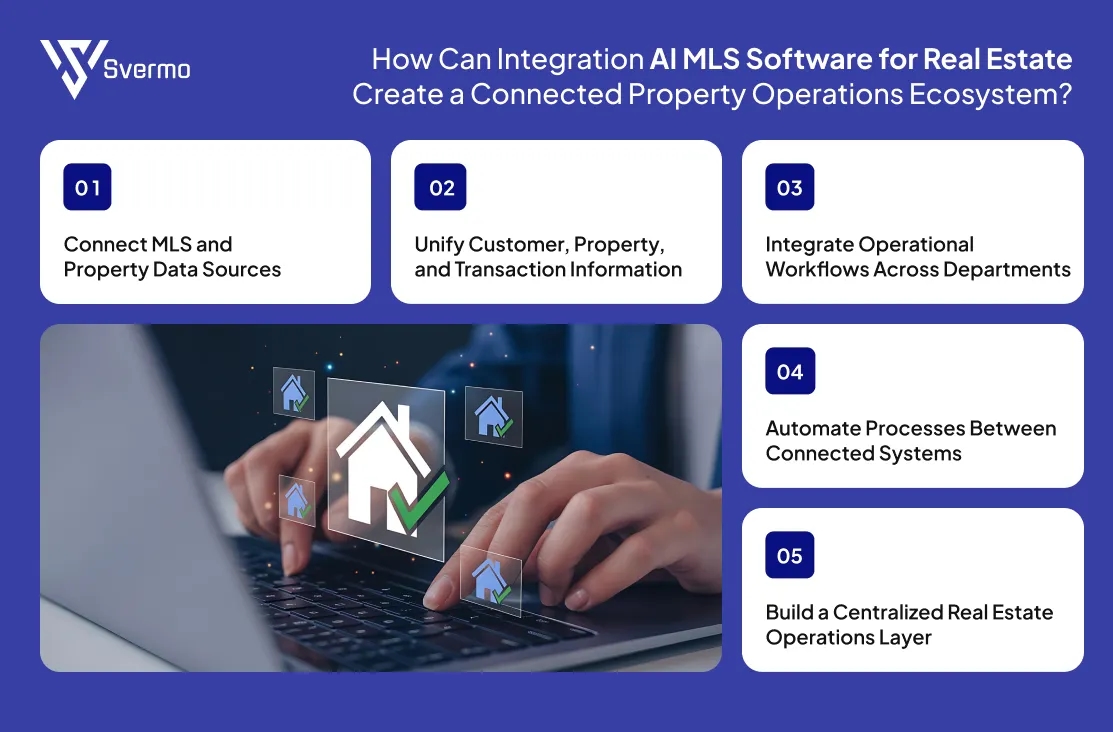
Integrating AI MLS software for real estate helps create a connected ecosystem where data flows seamlessly across the organization, enabling better visibility, automation, and operational efficiency.
1. Connect MLS and Property Data Sources
The integration process typically begins by connecting MLS feeds, listing databases, and other property data sources. This creates a centralized foundation that ensures all teams are working from accurate and up-to-date property information.
Without this step, inconsistencies can quickly spread across systems and workflows.
This foundation helps organizations:
- Consolidate property data from multiple sources
- Reduce duplicate listing records
- Improve data consistency across platforms
- Create a reliable source of property information
2. Unify Customer, Property, and Transaction Information
Once property data is connected, the next step is linking it with customer and transaction information. This creates a more complete operational view by connecting properties with leads, buyers, sellers, tenants, and ongoing transactions.
A connected data environment helps eliminate information gaps between departments.
Organizations can use this integration to:
- Connect customer activity with property records
- Improve visibility into transaction lifecycles
- Reduce manual data reconciliation
- Support more informed decision-making
3. Integrate Operational Workflows Across Departments
Property activity impacts multiple teams, including sales, leasing, operations, marketing, and management. Integrating these workflows ensures that information moves automatically between departments instead of relying on manual coordination.
This helps create a more consistent operational process across the business.
The benefits of this integration include:
- Better collaboration between teams
- Faster information sharing
- Reduced operational bottlenecks
- More consistent business processes
4. Automate Processes Between Connected Systems
Once systems are connected, organizations can begin automating routine activities that previously required manual effort. This allows information to trigger actions automatically across the technology stack.
Automation becomes significantly more effective when data is already synchronized between platforms.
This enables organizations to:
- Reduce repetitive administrative tasks
- Improve process execution speed
- Minimize manual data entry
- Increase workflow consistency
5. Build a Centralized Real Estate Operations Layer
The final stage is creating a unified operational environment where leadership teams can monitor performance, activity, and workflows across the business. Rather than relying on separate systems for visibility, organizations gain a consolidated view of operations.
This is where MLS-integrated real estate platforms deliver their greatest long-term value.
A centralized operations layer helps organizations:
- Monitor activity across teams and locations
- Improve operational reporting and visibility
- Identify inefficiencies more quickly
- Scale operations with greater control
By following this integration approach, real estate multiple listing service (MLS) software integrating AI becomes more than a property database. It evolves into a connected operational platform that supports property management, customer engagement, workflow automation, and business growth from a single ecosystem.
Even with the right integration strategy, organizations can encounter challenges related to data quality, implementation planning, user adoption, and operational change management.
What challenges do organizations face when integrating AI-powered MLS software, and how can they overcome them successfully?
What Challenges Do Organizations Face When Adopting AI-Powered MLS Software and How Can They Overcome Them?
While the benefits of AI-powered MLS software for real estate are significant, implementation is not always straightforward. Organizations often encounter challenges related to data quality, legacy systems, operational processes, and user adoption.
The good news is that most of these challenges can be addressed with the right implementation strategy and platform selection.
| Challenge | Impact on Operations | Recommended Solution |
|---|---|---|
Poor Data Quality | Inaccurate, incomplete, or duplicate property records reduce trust in the platform and affect decision-making. | Establish data governance processes and use AI-driven data validation before migration. |
Disconnected Legacy Systems | Information remains fragmented across multiple platforms, limiting visibility and automation opportunities. | Prioritize platforms that support flexible integrations and centralized data management. |
Complex MLS Data Structures | Different MLS feeds often use inconsistent formats, making standardization difficult. | Use a platform with built-in data normalization and enrichment capabilities. |
Low User Adoption | Teams continue relying on spreadsheets or legacy workflows, limiting platform value. | Invest in training, change management, and intuitive user experiences. Many organizations also leverage use cases of conversational AI agents to simplify user interactions and improve adoption. |
Workflow Misalignment | Existing business processes may not align with how the new platform operates. | Map operational workflows before implementation and configure processes accordingly. |
Scalability Concerns | Systems that work for small teams may struggle as listing volumes and operations expand. | Select enterprise-grade AI MLS software designed to support long-term growth and increasing operational complexity. |
Security and Compliance Requirements | Property data, customer records, and transaction information require proper protection and governance. | Evaluate security controls, access management, audit capabilities, and compliance standards during vendor selection. |
Measuring ROI | Organizations may struggle to quantify the business value of MLS modernization initiatives. | Define success metrics early, including operational efficiency, response times, data accuracy, and productivity gains from tools such as an AI chatbot & voice assistant and workflow automation platforms. |
Overcoming implementation challenges is only part of the equation. Organizations also need to understand how MLS technology is evolving and which capabilities are likely to influence real estate operations in the coming years.
Solving MLS Challenges or Just Working Around Them?
Modern real estate operations need more than temporary fixes. Build a scalable foundation with AI.
What Does the Future of AI MLS Software in Real Estate Look Like?
The next generation of AI-powered MLS software for real estate will move beyond workflow automation and property search. Future platforms are expected to become intelligent operational systems that can analyze, coordinate, and execute real estate processes with minimal human intervention.
1. Autonomous MLS Operations
Future MLS platforms will increasingly automate entire operational processes rather than individual tasks. Instead of manually coordinating activities, teams will oversee workflows that run largely on their own.
This evolution may include:
- Automated listing creation and validation
- Intelligent lead routing and assignment
- Dynamic workflow orchestration across departments
- Automated follow-up and task management
2. Unified Property Intelligence Graphs
MLS platforms are expected to move beyond traditional databases and build connected intelligence layers that understand relationships between properties, buyers, agents, transactions, and market activity.
This will help organizations:
- Discover hidden business opportunities
- Improve property and buyer matching
- Surface relationships across large datasets
- Support more informed decision-making
4. Connected Property Intelligence Models
Property data will increasingly be connected with operational, financial, and market information to create continuously updated intelligence models for assets and portfolios.
As these models mature, organizations may be able to:
- Monitor asset performance in real time
- Evaluate portfolio-level opportunities
- Improve forecasting accuracy
- Support long-term investment planning
Many organizations are already evaluating in this direction through technologies such as an AI asset management agent.
5. Multi-Agent Real Estate Operating Systems
Rather than relying on a single AI assistant, future platforms are expected to use multiple specialized agents working together across business functions.
This approach could include:
- Agents focused on listings and property operations
- Agents responsible for lead qualification
- Agents monitoring compliance and data quality
- Agents supporting customer interactions and communications
Current technologies like AI chatbot virtual assistant, provide early glimpse of this trend.
6. Autonomous Compliance and Data Governance
As MLS data volumes continue to grow, manual monitoring will become increasingly difficult. Future platforms will continuously evaluate records for quality, consistency, and regulatory compliance.
Organizations can expect:
- Automated compliance monitoring
- Continuous data quality validation
- Early detection of listing inconsistencies
- Reduced operational risk
7. MLS Platforms Becoming the Operational Layer for the Entire Property Lifecycle
The most significant long-term trend is the expansion of MLS from a listing platform into a complete operational intelligence layer.
Rather than supporting a single stage of the property journey, future AI-powered MLS platforms for real estate business will connect acquisition, listing, leasing, sales, property management, and portfolio operations within a unified ecosystem.
This shift is likely to drive:
- Greater operational visibility
- More connected customer experiences
- Stronger business intelligence capabilities
- End-to-end process automation
Emerging technologies such as AI avatars for real estate may eventually become part of these broader property engagement ecosystems.
Future trends provide a view of where the market is heading. The more immediate question for buyers is which platform can deliver measurable value today while providing a foundation for future growth.
Why are real estate organizations choosing Svermo's AI-powered MLS software to modernize operations?

Many MLS platforms focus on a single part of the real estate workflow: listing management. The challenge is that real estate operations rarely stop at listings. Teams also need to manage lead qualification, property search, leasing activities, customer communications, transaction records, and portfolio performance.
As a result, organizations often find themselves moving data between multiple systems just to complete everyday processes.
Svermo's AI-powered MLS for real estate operations is built for organizations that want MLS data to play a larger role in business operations. Instead of treating listings as isolated records, the platform helps organizations connect property information with customer activity, operational workflows, and business intelligence.
This approach is particularly valuable for brokers, agencies, and property management companies that are looking to modernize operations without continuously adding new tools for every business function.
Whether the objective is improving property discovery, supporting operational automation, strengthening decision-making, or preparing for future AI adoption, organizations increasingly need a platform that can evolve alongside their business rather than solving only one operational problem at a time.
That is why many real estate teams are moving beyond traditional MLS systems and evaluating platforms that can support both current operational requirements and long-term digital transformation initiatives.
Ready to Move Beyond Traditional MLS Systems?
Discover how Svermo helps real estate teams connect data, automate operations, and scale with confidence.
Final Insight!
The role of AI-powered MLS software for real estate is expanding far beyond listing management. Modern platforms are helping organizations automate workflows, improve property discovery, connect operational systems, and transform MLS data into actionable business intelligence.
As the future of AI MLS software in real estate continues to evolve, organizations that invest in connected, intelligence-driven platforms will be better positioned to improve efficiency, scale operations, and adapt to changing market demands.
For teams evaluating the best AI platform for real estate agents, MLS modernization should be viewed as part of a broader strategy to create a connected and intelligent real estate operations ecosystem.
Svermo helps real estate organizations move beyond traditional MLS limitations by combining property data, workflow automation, operational intelligence, and AI-driven capabilities within a unified platform built for modern real estate operations.
if you are ready to modernize your real estate operations with AI-powered MLS technology then contact us.
 https://www.linkedin.com/in/saanvi-verma-38711a36a
FAQs
Most modern AI-powered MLS platforms do not require organizations to build AI models from scratch. They can begin delivering value using existing MLS records, listing activity, customer interactions, and operational data. Platform performance typically improves as more data becomes available over time.
Yes. Many enterprise-grade AI MLS software platforms are designed to support multiple MLS feeds and property data sources. This is particularly valuable for brokerages, agencies, and property management companies operating across multiple markets or regions.
Before migration, organizations should evaluate data quality, integration requirements, workflow dependencies, reporting needs, and user adoption plans. A structured migration strategy can help reduce implementation risks and improve long-term outcomes.
In many cases, yes. Modern AI-powered MLS software for real estate can integrate with existing CRM, leasing, transaction management, and operational systems, allowing organizations to modernize gradually rather than replacing their entire technology stack.
Common success metrics include reduced administrative workload, faster lead response times, improved listing accuracy, increased operational efficiency, and stronger visibility across property and customer operations.
MVP-level AI MLS software typically focuses on basic listing management and workflow automation. Enterprise-grade AI MLS software provides broader integrations, advanced automation, governance controls, scalability, reporting, and operational intelligence capabilities.
Organizations should assess integration capabilities, scalability, workflow automation features, security controls, reporting functionality, data management capabilities, and long-term product vision rather than focusing solely on listing management functionality.
Have Questions Your Current MLS Can't Answer?
Let's explore how AI can help you automate operations, improve property intelligence, and scale more efficiently.