

AI-Powered Asset Management for Real Estate: Use Cases, Automation, and Future Trends for Modern Property Portfolios


Get a summary of this article with your favorite AI





AI Summary
- •AI-powered asset management for real estate centralizes portfolio data, workflows, and operational insights.
- •A real estate asset management platform with AI automation and analytics improves monitoring, reporting, and decision-making.
- •AI delivers value across portfolio management, maintenance, capital planning, and property operations.
- •Successful implementation depends on integration, data quality, and user adoption.
- •Svermo's AI-powered real estate asset management software for property portfolios connects asset management, operations, and portfolio intelligence in one platform.
How do you maintain complete visibility across hundreds of properties when operational data is scattered across multiple systems?
Managing a growing property portfolio becomes difficult when critical information is spread across multiple systems and teams. AI-powered asset management for real estate addresses this challenge by helping property owners, asset managers, and operations teams centralize portfolio data, automate workflows, monitor asset performance, and identify operational risks before they affect portfolio outcomes.
Instead of relying on spreadsheets, disconnected software, and manual reporting, organizations can manage property operations from a single intelligence layer that supports faster and more informed decisions.
The demand for AI-driven operational platforms continues to grow across the real estate sector. From digital receptionists to hyperlocal valuation models, AI is expected to generate nearly $34 billion in efficiency gains for the real estate industry by 2030. For portfolio managers and property operations teams, much of that value comes from reducing manual work, improving visibility across assets, and accelerating decision-making.
These are some of the key challenges AI-powered asset management platforms are designed to address.
Many organizations are turning existing data into actionable insights. That is why platforms supporting asset management, operations, leasing, reporting, and customer interactions are increasingly being connected through an AI-powered real estate CRM software platforms.
The challenge for most real estate organizations is no longer accessing data. It's turning scattered operational information into decisions that improve portfolio performance, reduce inefficiencies, and support growth at scale.
What separates an AI-powered asset management platform from the traditional systems many real estate teams still rely on?
Still Managing Property Portfolios Across Multiple Systems?
See how Svermo's AI-powered asset management for real estate helps centralize operations, reporting, and portfolio intelligence.
What Is AI-Powered Asset Management for Real Estate and Why Are Property Portfolios Adopting It?
Traditional asset management platforms primarily store information. An AI-powered real estate asset management software for property portfolios goes further by continuously analyzing operational and financial data to surface insights that might otherwise go unnoticed.
These platforms can:
- Monitor asset performance across multiple properties
- Detect operational anomalies
- Automate reporting workflows
- Track maintenance trends
- Prioritize high-impact issues
- Support portfolio optimization decisions
Many organizations also connect supporting technologies such as an AI asset management agent to automate routine monitoring, asset reviews, and portfolio reporting activities.
The result is a more proactive approach to managing property portfolios.
1. From Reactive Management to Intelligent Operations
Many real estate teams still operate in a reactive environment.
An intelligent asset management platform for real estate operations helps shift teams from reacting to events toward continuously monitoring and managing portfolio performance.
Instead of reviewing disconnected reports from different departments, stakeholders can access a centralized operational view that combines asset, financial, leasing, and maintenance information.
2. Why Real Estate Firms Are Investing in AI
The primary reason organizations adopt AI-powered asset management software is to gain better control over growing property portfolios without increasing operational complexity.
As portfolios expand, asset data, maintenance records, financial performance metrics, lease information, and operational workflows become harder to manage across disconnected systems. Manual tracking often leads to reporting delays, limited visibility, and inconsistent decision-making.
Key drivers behind adoption include:
- Managing larger and more complex property portfolios
- Improving visibility into asset performance
- Automating reporting and operational workflows
- Tracking maintenance activities more efficiently
- Reducing manual data management efforts
- Supporting faster portfolio-level decisions
Organizations that invest in these systems gain more than operational efficiency. They establish a centralized framework for managing assets, improving performance oversight, and making informed decisions across every property in their portfolio.
Once portfolio data is centralized, how are insights, recommendations, and automated actions actually generated behind the scenes?
How Does an Automated Real Estate Asset Management Platform Actually Work?
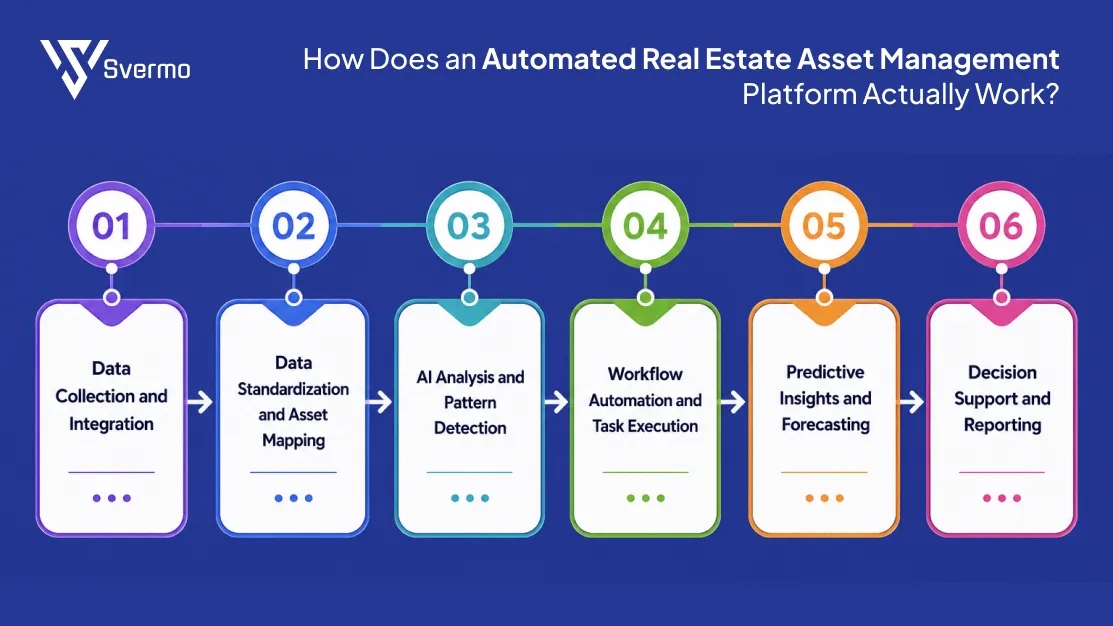
An automated real estate asset management platform with predictive insights follows a structured process that turns fragmented property data into actionable recommendations. It continuously collects information from multiple systems, analyzes portfolio activity, automates routine workflows, and delivers insights that help teams manage assets more effectively.
1. Data Collection and Integration
The process starts by connecting the systems already used across the property portfolio. Rather than replacing existing software, the platform pulls information from multiple sources into a centralized environment.
Common data sources include:
- Property management systems
- Accounting and financial platforms
- Maintenance and work order software
- Lease administration and tenant management tools
Many organizations also connect AI document management software to automatically extract information from leases, contracts, inspection reports, and compliance documents.
This creates a continuous flow of operational and financial data into a single platform.
2. Data Standardization and Asset Mapping
Once data enters the platform, it is organized into a consistent structure.
Information from different systems is matched to specific properties, assets, vendors, leases, and operational activities. This eliminates duplicate records and reduces inconsistencies that often exist across disconnected systems.
The platform creates:
- Unified asset profiles
- Standardized property records
- Centralized operational data
- Portfolio-wide data relationships
This foundation is essential for accurate analysis and reporting.
3. AI Analysis and Pattern Detection
After the data is structured, AI models begin analyzing portfolio activity. The system evaluates historical performance, operational trends, financial metrics, and maintenance records to identify patterns that may require attention.
AI can automatically detect:
- Changes in asset performance
- Unusual maintenance trends
- Occupancy and leasing shifts
- Operational inefficiencies across properties
Instead of manually reviewing multiple reports, teams receive prioritized insights based on actual portfolio conditions.
4. Workflow Automation and Task Execution
Once specific conditions are identified, the platform can trigger predefined actions automatically. This is a core capability of an AI-driven property portfolio operations management platform, helping teams reduce manual effort while maintaining operational consistency.
Examples include:
- Creating maintenance tasks
- Escalating unresolved operational issues
- Scheduling inspections and reviews
- Sending alerts to relevant teams
Organizations often strengthen these workflows by integrating an AI chatbot & voice assistant, helping automate communication between tenants, vendors, and property teams.
This reduces administrative effort and helps ensure important tasks are not overlooked.
5. Predictive Insights and Forecasting
Beyond monitoring current operations, the platform analyzes trends to identify what may happen next.
Using historical and real-time data, AI can help forecast:
- Asset performance recommendations
- Portfolio risk indicators
- Budget and cost management insights
- Property-level and portfolio-level forecasts
These insights help teams address issues before they impact portfolio performance.
6. Decision Support and Reporting
The final stage is delivering insights in a format that supports faster decision-making.
Instead of waiting for monthly reports, stakeholders gain access to continuously updated information such as:
- Asset performance summaries
- Operational health indicators
- Portfolio risk assessments
- Financial performance metrics
This allows portfolio managers, operations leaders, and executives to focus on high-impact decisions rather than data collection and manual analysis.
The value of AI-powered asset management comes from connecting data, automation, and intelligence into a single operational framework that supports more efficient portfolio management at scale.
What are the most impactful use cases for AI-powered asset management in real estate operations?
Where Does AI-Powered Commercial Real Estate Asset Management and Workflow Automation Deliver the Most Value?
The value of AI-powered commercial real estate asset management and workflow automation becomes clear when applied to day-to-day portfolio operations. From performance tracking and maintenance management to investment planning and executive reporting, AI helps real estate teams reduce manual effort while improving operational visibility and decision-making.
1. Commercial Real Estate Portfolio Management
Managing multiple commercial properties requires constant oversight of occupancy, operating costs, lease performance, maintenance activities, and asset health. As portfolios expand, manually tracking these variables becomes increasingly difficult.
An AI real estate portfolio management software for commercial properties helps centralize portfolio intelligence and continuously monitor performance across assets.
Example Scenario
A commercial real estate firm managing 75 office and retail properties noticed declining performance in several locations. Instead of reviewing monthly reports property by property, the AI asset management platform identified assets with rising vacancy rates and increasing maintenance costs.
2. Property Management Company Operations
Property management companies often coordinate large volumes of operational activities across tenants, vendors, maintenance teams, and property owners.
AI helps streamline these activities by reducing administrative work and automating routine processes. Organizations frequently combine these workflows with an AI chatbot virtual assistant to handle service requests, FAQs, and routine tenant interactions.
Example Scenario
A property management company overseeing 12,000 residential units struggled with delayed maintenance response times. The AI asset management software automatically categorized incoming requests, assigned vendors based on priority, and tracked completion status. As a result, property managers spent less time coordinating requests and more time resolving operational issues.
3. Real Estate Investment Portfolio Optimization
Investment teams need continuous insight into portfolio performance, asset value trends, revenue generation, and operational efficiency.
An AI-driven property portfolio management software for real estate firms helps connect operational and financial data to support investment decisions. Organizations often complement these insights with real estate property valuation intelligence to better understand asset value movements and investment opportunities.
Example Scenario
An investment firm managing a mixed-use portfolio identified two properties with declining net operating income despite stable occupancy. AI analysis revealed escalating maintenance expenses and underperforming lease structures, helping the team prioritize improvement strategies before acquisition plans for the following year.
4. Asset Lifecycle Management and Capital Planning
Every property asset moves through a lifecycle that includes acquisition, operation, maintenance, renovation, and replacement.
Managing these decisions proactively helps reduce unexpected costs and improve long-term portfolio performance.
Example Scenario
A real estate company in U.S. managing several aging commercial buildings used AI analysis to identify HVAC systems approaching failure based on maintenance history and performance trends. Instead of reacting to breakdowns, the company scheduled replacements during planned capital improvement projects.
5. Maintenance Automation and Asset Monitoring
Maintenance remains one of the largest operational expenses for many property portfolios. AI improves maintenance operations by continuously monitoring asset conditions and identifying potential issues earlier.
Organizations managing large rental portfolios often combine maintenance automation with AI tenant screening software to streamline broader property operations.
Example Scenario
A multifamily housing operator noticed recurring maintenance requests across several communities. The platform identified patterns linked to aging equipment and recurring vendor issues, allowing operations teams to address root causes rather than repeatedly responding to individual service requests.
6. Executive Reporting and Portfolio Visibility
Senior leaders need accurate information without waiting weeks for consolidated reports. AI helps automate data collection and reporting across departments, creating a clearer picture of portfolio performance.
Example Scenario
A regional property operator previously spent several days preparing monthly executive reports. After implementing AI-driven reporting, leadership teams gained access to live dashboards that automatically updated operational and financial metrics across all managed properties.
7. Portfolio Risk Identification and Performance Forecasting
Portfolio risks often emerge gradually and remain hidden until they affect revenue, occupancy, or operating costs. AI helps identify these risks earlier by continuously evaluating portfolio activity.
Example Scenario
A commercial property portfolio experienced rising vacancy levels in a specific market. The platform detected occupancy trends and declining tenant engagement months before traditional reporting highlighted the issue, allowing leadership to adjust leasing strategies and marketing efforts proactively.
The most successful real estate organizations use AI across multiple operational areas rather than treating it as a standalone reporting tool. The broader the integration across portfolio workflows, the greater the opportunity to improve efficiency, visibility, and asset performance.
What features should organizations prioritize when evaluating an AI-powered real estate asset management platform?
Ready to Turn Portfolio Insights Into Action?
Discover how Svermo's AI-driven property portfolio management software for real estate firms helps automate workflows and improve portfolio performance at scale.
What Core Features Every AI-Powered Real Estate Asset Management Platform Must have?
Not every platform marketed as AI-powered delivers the capabilities required to manage modern property portfolios effectively. Before evaluating advanced automation, predictive intelligence, or AI agents, organizations should ensure the platform provides a strong operational foundation.
The following features are considered essential for any AI-powered real estate asset management software for property portfolios and should be present regardless of portfolio size or asset type.
| Core Feature | Why It Matters | Business Impact |
|---|---|---|
Centralized Portfolio Dashboard | Consolidates property, financial, leasing, maintenance, and operational data into a single environment. | Eliminates data silos and provides a unified view of portfolio performance. |
Asset Performance Monitoring | Tracks occupancy, revenue, expenses, maintenance activity, and operational KPIs across assets. | Helps teams identify underperforming properties and prioritize corrective action. |
Workflow Automation | Automates routine operational processes such as task assignments, maintenance coordination, inspections, and approvals. | Reduces administrative effort and improves operational consistency. |
Portfolio Reporting and Analytics | Generates standardized reports and dashboards for asset managers, operations teams, and executives. | Accelerates reporting cycles and improves decision-making. |
Document and Data Management | Organizes leases, contracts, compliance records, inspection reports, and other critical documents with the help of AI document management software to improve document accessibility and data extraction. | Reduces time spent searching for information and improves operational transparency. |
Maintenance and Work Order Management | Tracks maintenance requests, asset conditions, vendor performance, and service completion status. | Supports proactive maintenance planning and lowers operational disruptions. |
Portfolio-Wide Search and Data Access | Allows teams to quickly locate property information, asset records, operational data, and portfolio documents from a single interface. | Improves productivity and reduces dependency on multiple systems. |
Integration Framework | Connects property management software, accounting systems, maintenance platforms, leasing tools, and other operational technologies. | Creates a centralized real estate operations platform without requiring teams to replace existing systems. |
Role-Based Access Controls | Provides secure access to information based on user responsibilities and organizational structure. | Protects sensitive data while improving collaboration across departments. |
Real-Time Dashboards and Alerts | Delivers operational updates, performance notifications, and portfolio insights as conditions change. | Enables faster responses to operational issues and portfolio risks. |
These core features form the operational backbone of a modern asset management platform. Without them, even the most advanced AI capabilities struggle to deliver meaningful value because the underlying data, workflows, and portfolio processes remain fragmented.
What capabilities move an asset management platform beyond operational efficiency and into predictive, intelligence-driven portfolio management?
Which Advanced AI Capabilities Separate Modern Asset Management Platforms from Traditional Software?
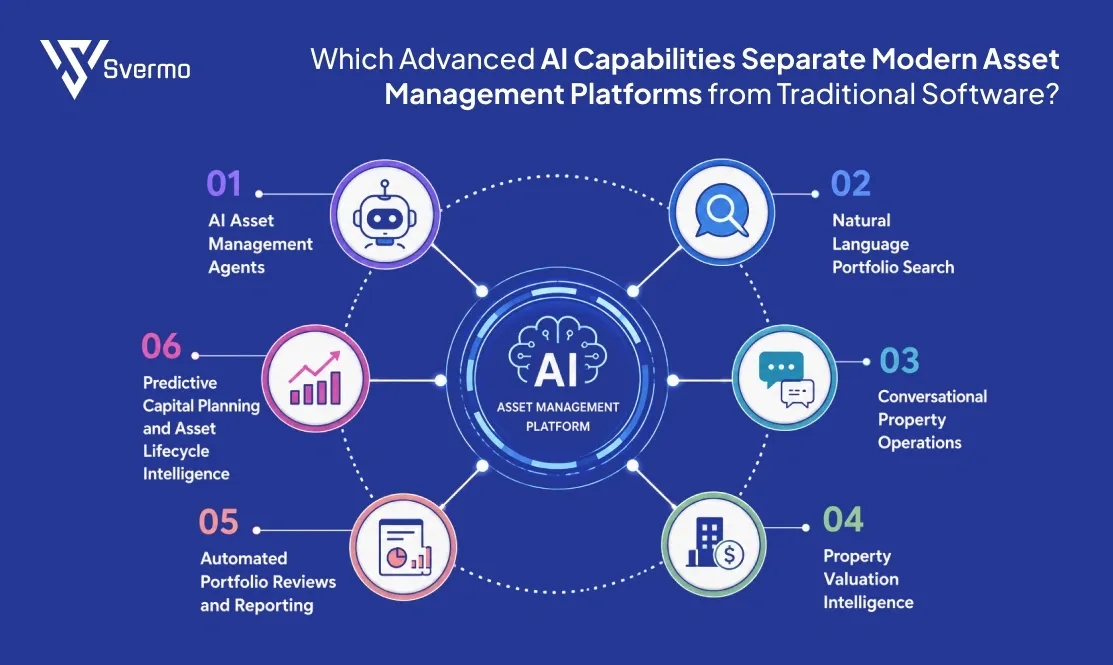
Core features help real estate teams manage assets, workflows, and portfolio operations efficiently. Advanced AI capabilities go a step further by helping organizations automate analysis, uncover hidden opportunities, and make faster decisions across large property portfolios.
These capabilities are increasingly becoming key differentiators for organizations evaluating a next-generation AI asset management system for property portfolios.
| Advanced AI Capability | What It Does | Business Value |
|---|---|---|
AI Asset Management Agents | Continuously monitor portfolio activity, identify anomalies, generate recommendations, and assist with routine asset management tasks. | Reduces manual monitoring and improves operational responsiveness. |
Natural Language Portfolio Search | Allows users to retrieve asset, lease, maintenance, financial, and operational information using conversational queries. Software such as a real estate AI property search engine simplify access to portfolio intelligence. | Helps teams locate information faster and improves productivity. |
Conversational Property Operations | Enables users to interact with portfolio systems through AI-powered conversations rather than traditional interfaces. This capability is becoming increasingly valuable across many use cases of conversational AI agents. | Improves user experience and accelerates operational workflows. |
Property Valuation Intelligence | Analyzes market conditions, portfolio performance, and property-level factors to support valuation decisions by integrating real estate property valuation intelligence into investment and asset management processes. | Supports acquisitions, dispositions, refinancing, and investment planning. |
Automated Portfolio Reviews and Reporting | Generates portfolio summaries, performance assessments, risk reports, and executive updates without requiring manual report preparation. | Reduces reporting effort while improving decision-making speed. |
Predictive Capital Planning and Asset Lifecycle Intelligence | Forecasts asset replacement cycles, capital expenditure requirements, maintenance risks, and long-term asset performance trends. | Supports proactive capital planning and improves asset lifecycle management. |
These capabilities enable real estate teams to spend less time gathering information and more time acting on opportunities, risks, and performance improvements.
How can these capabilities connect with the property management, accounting, leasing, and operational systems already running across your portfolio?
How Does AI-Powered Asset Management for Real Estate Integrate with Existing Property Systems?
Modern cloud-based AI software for real estate portfolio and asset management is built to fit into existing technology ecosystems with minimal disruption. Instead of forcing organizations to migrate away from familiar tools, it connects disparate data sources and workflows to create a single source of truth for asset managers, operations teams, and portfolio stakeholders.
1. Data Discovery and System Assessment
The first step is identifying where critical portfolio information currently resides. Most real estate organizations operate across several applications, making it difficult to establish a complete view of assets and operations.
The assessment typically focuses on:
- Existing property and portfolio systems
- Data quality and consistency
- Integration requirements across departments
This stage helps determine how much preparation is needed before data can be consolidated.
2. Data Consolidation and Mapping
Once systems are identified, information from different sources must be standardized and connected. This allows the platform to create a consistent structure across assets, properties, and operational records.
Common activities include:
- Asset and property record mapping
- Data cleansing and normalization
- Duplicate record identification
This step creates the foundation for a smart real estate asset tracking and management system capable of supporting accurate analysis and automation.
3. Workflow Integration
After data is organized, operational workflows are connected to the platform. This ensures that information flows automatically between teams, systems, and processes rather than relying on manual coordination.
Organizations typically integrate:
- Maintenance and service workflows
- Leasing and tenant operations
- Approval and compliance processes
This enables a more connected AI-driven property operations management environment across the portfolio.
4. AI Model Configuration and Context Building
AI models require business context to generate useful recommendations. During this phase, the platform learns portfolio structures, operational patterns, asset relationships, and performance indicators.
Typical inputs include:
- Historical asset performance data
- Maintenance and operational records
- Portfolio-specific business rules
The stronger the context, the more relevant the recommendations generated by the AI platform for real estate asset lifecycle management and operational intelligence.
5. Reporting and Intelligence Activation
Once systems and workflows are connected, organizations can activate portfolio intelligence capabilities. This is where the platform begins generating operational insights, forecasts, and automated analysis.
Capabilities commonly enabled include:
- Portfolio performance dashboards
- Automated reporting workflows
- Predictive analytics for property portfolio management
This stage transforms raw operational data into actionable business intelligence.
6. Enterprise Adoption and Governance
The final phase focuses on ensuring teams can consistently use the platform across the organization. Even the most advanced technology will struggle to deliver value without strong adoption and governance practices.
Key priorities include:
- User onboarding and training
- Data governance policies
- Role-based access management
This helps organizations maximize the value of their cloud-based AI software for real estate portfolio and asset management while maintaining security, consistency, and operational control.
Successful integration is ultimately about creating a connected operational ecosystem. When data, workflows, and portfolio intelligence work together, organizations can unlock the full value of automated property portfolio analytics and asset performance management software without replacing the systems they already rely on.
But do you know what obstacles can slow down implementation, and how can real estate firms avoid them before they impact adoption?
Want AI to Work With Your Existing Property Systems?
Learn how Svermo's cloud-based AI software for real estate portfolio and asset management integrates with your current technology stack without disrupting operations.
What Problems Can Arise When Implementing a Next-Generation AI Asset Management System for Property Portfolios?

The benefits of AI-powered asset management are significant, but implementation is rarely a plug-and-play process. Most challenges stem from data quality, operational processes, and organizational readiness rather than the technology itself.
Understanding these obstacles early helps organizations reduce deployment risks and accelerate value realization.
| Challenge | Impact on Operations | Recommended Solution |
|---|---|---|
Disconnected and Inconsistent Data | Portfolio information spread across spreadsheets, legacy applications, and departmental systems can create reporting inaccuracies and incomplete asset visibility. | Conduct a data audit, standardize asset records, and establish data governance policies before implementation. |
Legacy System Compatibility Issues | Older systems may lack modern integration capabilities, making data synchronization difficult and slowing adoption. | Prioritize high-impact integrations, use middleware where necessary, and implement a phased integration strategy. |
Resistance to Operational Change | Teams accustomed to manual processes may hesitate to adopt new workflows, reducing platform utilization and ROI. | Involve end users early, provide role-specific training, and focus on operational outcomes rather than technology features. |
Poor Data Quality | Incomplete, outdated, or inaccurate records can limit the effectiveness of AI models and operational insights. | Clean historical data, assign data ownership, and establish ongoing data quality monitoring processes. |
Unclear Business Objectives | Without defined goals, organizations often struggle to measure success and maximize platform value. | Establish measurable KPIs, define success metrics, and align implementation goals with business priorities. |
Security and Compliance Concerns | Consolidating financial, tenant, investor, and operational data increases governance and compliance requirements. | Implement role-based access controls, define security policies early, and conduct regular compliance reviews. |
Scaling Across Large Property Portfolios | Processes that work for smaller portfolios may become difficult to manage as the number of assets and users grows. | Start with a pilot deployment, standardize workflows, and build a scalable governance framework. |
Most implementation challenges are predictable and manageable when addressed proactively. Organizations that prioritize data readiness, stakeholder alignment, and structured deployment strategies are more likely to unlock the full value of their AI-powered property asset optimization software for portfolio managers while minimizing operational disruption.
As AI adoption expands across real estate, which innovations are expected to influence the future of portfolio and asset management?
How will AI-Powered Asset Management for Real Estate Evolve in future?
Most real estate firms already use AI for automation, reporting, and operational insights. In the upcoming time, the focus will shift toward connected operations, continuous optimization, and portfolio-wide intelligence that supports faster and more strategic decision-making.
1. Unified Real Estate Operating Systems
Many organizations still manage leasing, maintenance, accounting, and asset management through separate platforms. Future real estate asset management platforms with AI automation and analytics are expected to consolidate these functions into a single operational environment, reducing data silos and improving portfolio visibility.
2. Outcome-Based Portfolio Management
Future platforms will focus less on reporting metrics and more on helping organizations achieve business objectives. AI will increasingly support occupancy growth, cost optimization, tenant retention, and overall real estate portfolio optimization platform initiatives.
3. Continuous Portfolio Optimization
Asset managers are moving away from periodic portfolio reviews toward continuous monitoring and optimization. Advanced predictive analytics for property portfolio management will help teams identify risks and opportunities as conditions change.
4. Hyper-Personalized Stakeholder Experiences
Different stakeholders require different information. Future platforms will automatically tailor dashboards, reports, and recommendations for investors, operators, property managers, and executives, improving decision-making across the organization.
5. AI-Native Real Estate Operations
As adoption matures, organizations will begin designing workflows around AI rather than adding AI to existing processes. This shift will strengthen AI-driven property operations management and create more scalable operating models.
6. Portfolio-Level Decision Intelligence
Future AI-powered property investment intelligence will combine operational, financial, and market data to support portfolio-wide decision-making. This will help organizations improve capital allocation, investment planning, and long-term asset performance.
The future of AI-powered asset management for real estate will be defined by connected operations, continuous optimization, and smarter portfolio decisions rather than standalone automation tools.
What should organizations look for when evaluating an AI-powered asset management platform for long-term portfolio success?
Why Is Svermo a Strong Choice for AI-Powered Asset Management for Real Estate?

Most real estate asset management platforms focus on a single function such as reporting, maintenance tracking, or portfolio analytics. As a result, property teams often continue switching between multiple applications to manage daily operations.
Svermo takes a broader approach by connecting asset management with the operational workflows that directly influence portfolio performance. Rather than treating leasing, tenant operations, payments, and asset oversight as separate processes, the platform brings them into a connected ecosystem.
For example, an AI leasing assistant can help reduce leasing bottlenecks and accelerate prospect engagement, while automated rent collection software helps streamline payment operations across large property portfolios.
This approach allows real estate firms to manage asset performance and operational execution within the same environment rather than relying on disconnected point solutions.
For organizations evaluating an AI-driven property portfolio management software for real estate firms, the long-term advantage comes from connecting portfolio strategy with the day-to-day activities that drive property performance. That alignment is where Svermo delivers the greatest value.
Looking for More Than Just Another Asset Management Platform?
See how Svermo combines asset management, leasing, operations, and portfolio intelligence within a single AI-powered environment.
Final Words!
AI asset management is rapidly transforming the U.S. real estate industry. By combining AI real estate asset management, predictive analytics, and intelligent automation, property owners and investors can optimize operations, improve occupancy rates, reduce maintenance costs, and enhance portfolio performance. From commercial real estate asset management to multifamily property portfolios, AI is enabling faster, data-driven decision-making across every stage of the asset lifecycle.
As the demand for AI property management solutions and real estate portfolio management software continues to grow, organizations that embrace these technologies will gain a significant competitive advantage. The future of real estate lies in leveraging AI to maximize asset value, streamline operations, and deliver stronger investment returns.
At Svermo, we specialize in developing AI-powered solutions for real estate, helping organizations implement scalable automation, advanced analytics, and intelligent asset management strategies that drive measurable business results.
Ready to modernize your real estate asset management with AI? Contact us.
 https://www.linkedin.com/in/saanvi-verma-38711a36a
FAQs
Yes. A modern AI-powered commercial real estate asset management and workflow automation platform can automate repetitive operational tasks such as reporting, maintenance coordination, asset monitoring, and performance tracking. By centralizing data across multiple properties, AI helps teams reduce manual work while improving operational visibility and response times.
AI improves portfolio optimization by continuously analyzing operational, financial, and asset performance data. An AI real estate portfolio management software for commercial properties can identify underperforming assets, detect emerging risks, forecast trends, and provide recommendations that support better investment and operational decisions.
Property management companies should prioritize platforms that provide centralized portfolio visibility, workflow automation, predictive analytics, reporting capabilities, and integration with existing systems. A strong intelligent asset management platform for real estate operations should also support scalability as portfolios grow.
Yes. Most cloud-based AI software for real estate portfolio and asset management softwares support a wide range of asset types, including multifamily housing, commercial buildings, mixed-use developments, office portfolios, retail properties, and industrial assets.
Implementation timelines vary based on portfolio size, data quality, and integration requirements. Smaller deployments may take a week, while large enterprise portfolios often require more time. Organizations that have well-structured data and clearly defined processes typically experience faster implementation.
Yes. Most modern platforms are integrated to property management systems, accounting software, maintenance tools, leasing platforms, CRM systems, and other operational technologies. Integration is essential for creating a connected real estate asset management platform with AI automation and analytics.
ROI depends on portfolio size, operational complexity, and existing processes. Common benefits include reduced administrative workload, faster reporting, improved asset utilization, lower maintenance costs, and better portfolio decision-making. Many firms see value through increased operational efficiency and stronger portfolio performance rather than a single financial metric.
Have Questions About AI-Powered Real Estate Asset Management?
Let's discuss your portfolio challenges and explore how AI can improve operational efficiency and asset performance.