

AI Chatbot Voice Assistant for Real Estate: Benefits, Use Cases, and Business Impact

Get a summary of this article with your favorite AI





AI Summary
- •AI chatbot voice assistants automate customer communication, qualify leads, schedule appointments, and connect CRM, MLS, and property management systems.
- •Successful AI implementation starts with clear goals, seamless integrations, quality data, and continuous optimization for better business results.
- •Choose an AI chatbot platform with real estate expertise, workflow automation, omnichannel support, enterprise security, and scalability.
- •Future AI innovations like agentic AI and predictive automation will transform real estate operations and customer experiences.
- •Svermo's AI chatbot voice assistant unifies communication, CRM, MLS, and property operations to help real estate businesses scale efficiently.
What if your existing CRM, MLS, accounting software, and property management systems could work together intelligently, without replacing your entire technology stack? That's exactly what real estate AI software integrations make possible.
Most real estate businesses rely on multiple applications to manage daily operations. Your CRM stores leads, your MLS manages listings, your property management software handles tenants, and your accounting platform tracks finances.
Organizations are moving well beyond AI experimentation. Deloitte found that 64% of businesses already credit AI with enabling innovation, while 23% have scaled agentic AI within at least one business function and another 39% are actively testing AI agents. These numbers highlight a growing focus on AI that works across business systems rather than in isolated applications.
The right AI software integrations for real estate businesses connect these systems into a unified workflow. Instead of operating in silos, your technology stack shares information automatically, streamlines routine tasks, and gives every team access to accurate, real-time data.
As you evaluate AI, you may be asking:
- Can AI integrate with our existing software?
- Which workflows should we automate first?
- How can we improve operations without disrupting our current systems?
This is where platforms like Svermo make a difference. Svermo's AI chatbot voice assistant is built specifically for real estate businesses, helping brokerages, agencies, and property management companies automate customer communication while seamlessly connecting with CRM, MLS, calendars, and operational workflows. Svermo’s AI real estate software enables faster responses, consistent customer engagement, and more efficient property operations from a single AI-powered ecosystem.
Understanding what an AI chatbot voice assistant can actually do is the first step toward improving customer communication, reducing manual work, and building more efficient real estate operations.
So, what exactly is an AI chatbot voice assistant for real estate, and how is it different from the traditional chatbots many businesses have already tried?
Still Letting Great Leads Slip Through the Cracks?
Your next customer could be waiting for a response right now. Let AI handle the first conversation before someone else does.
What Exactly Is an AI Chatbot Voice Assistant for Real Estate and Why Are So Many Businesses Adopting It?
An AI chatbot voice assistant for real estate is a conversational AI solution that communicates with buyers, sellers, tenants, property owners, and prospects through both voice and text. Unlike traditional chatbots that follow predefined scripts, it understands natural conversations, identifies user intent, and responds with relevant information based on your business data.
More than just answering questions, it connects with your CRM, MLS, calendars, and property management systems to automate communication and support everyday real estate operations.
Core Capabilities
A modern AI chatbot voice assistant can:
- Respond instantly to property inquiries across websites, phone calls, SMS, and messaging apps.
- Qualify buyers, sellers, tenants, and investors before routing them to the right team.
- Schedule property showings, meetings, and follow-ups automatically.
- Answer listing, pricing, leasing, and property-related questions 24/7.
- Keep CRM and operational systems updated through seamless integrations.
Key Benefits for Real Estate Businesses
By automating repetitive conversations and routine tasks, an AI chatbot voice assistant helps you:
- Reduce manual work for agents, brokers, and property managers.
- Improve response times and customer satisfaction.
- Capture more qualified leads without missing after-hours inquiries.
- Deliver consistent communication across every customer touchpoint.
- Scale customer engagement without proportionally increasing operational costs.
Instead of replacing your team, the assistant handles repetitive interactions so your professionals can focus on advising clients, closing transactions, and building stronger relationships.
Most real estate leaders don't invest in AI just to answer inquiries. They invest to improve efficiency across the business. So, which workflows should you automate first to maximize operational and customer impact?
How Does an AI Chatbot Voice Assistant for Real Estate Work?
An AI-powered chatbot voice assistant for real estate businesses acts as the communication layer between your customers and your business systems. It combines conversational AI for real estate with workflow automation to manage customer interactions and operational processes from a single platform.
Rather than relying on scripted responses, it uses natural language processing (NLP) and large language models (LLMs) to understand what a customer is asking, identify their intent, retrieve relevant information, and take the appropriate action.
If a request requires human expertise, it seamlessly transfers the conversation to the right team along with the complete context. This is the same approach that powers Svermo's AI chatbot & voice assistant, enabling real estate businesses to automate conversations while keeping operational systems connected.
| Stage | What Happens | Business Impact |
|---|---|---|
Understand | The assistant listens to or reads the customer's request, identifies their intent, and extracts key details such as property preferences, budget, location, or service needs. | Every inquiry is understood accurately, even when customers ask questions differently. |
Retrieve | It securely retrieves relevant information from connected systems such as CRM, MLS, calendars, knowledge bases, and property management platforms. | Customers receive accurate, real-time answers without employees manually searching for information. |
Respond | Using the retrieved information, the assistant generates a personalized response or completes the requested action. | Customers receive immediate assistance while maintaining a consistent experience across every interaction. |
Execute | If required, the assistant schedules appointments, updates business records, creates tasks, or triggers predefined workflows. | Routine business processes move forward automatically without manual intervention. |
Escalate | When a conversation requires negotiation, legal guidance, or complex decision-making, the assistant transfers it to the appropriate team member along with the full conversation history. | Your team joins the conversation with complete context instead of starting from scratch. |
This connected approach transforms every conversation into an operational workflow rather than a standalone interaction. Instead of simply answering questions, the assistant helps your business respond faster, maintain accurate information, and ensure the right actions happen at the right time.
Understanding how the technology works is only one part of the picture. The bigger question is which everyday workflows are best suited for AI-powered automation?
Which Real Estate Workflows Can an AI Chatbot Voice Assistant Automate?
The answer goes far beyond answering customer questions. An AI chatbot voice assistant for property management streamlines communication-driven processes across sales, leasing, customer support, and day-to-day operations while working alongside the software your teams already use.
The most common workflow categories include:
1. Customer Communication
- Managing communication across buyers, sellers, tenants, and property owners.
- Answering property, leasing, and general inquiries.
- Responding to frequently asked questions consistently across every channel.
2. Sales and Leasing
- Supporting AI chatbot voice assistant for property inquiries and lead qualification by capturing and routing incoming prospects.
- Scheduling property tours, meetings, and follow-ups.
- Keeping prospects engaged throughout the buying or leasing journey.
3. Property Operations
- Updating CRM and business records automatically.
- Synchronizing information across MLS and property management systems to support voice-enabled real estate operations.
- Routing internal tasks and collecting required documents.
4. Cross-Channel Communication
- Maintaining conversations across websites, phone calls, SMS, email, and messaging apps.
- Escalating complex requests to the right team member with full conversation context.
- Delivering an omnichannel experience across every customer touchpoint.
Every automated workflow removes repetitive work while keeping customers moving through their journey without unnecessary delays. But beyond improving operational efficiency, how does an AI chatbot voice assistant turn everyday conversations into qualified leads and long-term customer relationships?
Where Are Real Estate Businesses Using AI Chatbot Voice Assistants Today?
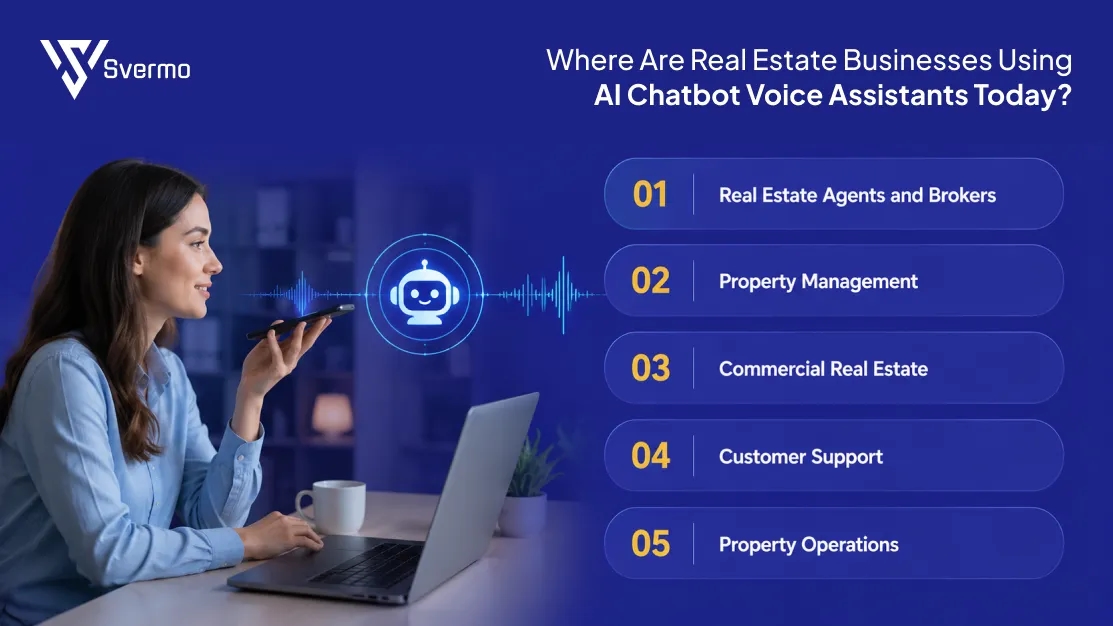
An AI chatbot voice assistant for real estate creates the most value when it solves everyday operational challenges. Whether you're managing buyer inquiries, tenant communication, or commercial properties, it helps automate repetitive conversations while keeping your teams focused on work that requires human expertise.
1. Real Estate Agents and Brokers
Agents often spend hours answering repetitive questions, qualifying prospects, and coordinating property visits. An AI chatbot voice assistant for real estate agents and brokers handles these interactions automatically, allowing agents to focus on negotiations and client relationships.
Example
A buyer visits your website after business hours looking for a three-bedroom home. The assistant answers listing questions, collects the buyer's preferences, schedules a property tour, and shares the conversation with the assigned agent before the next business day.
2. Property Management
Property managers deal with a constant stream of tenant requests and leasing inquiries. An AI chatbot voice assistant for property management responds instantly, reducing support workloads while keeping tenants informed.
Example
A tenant reports an air conditioning issue through SMS. The assistant records the request, creates a maintenance ticket, notifies the service team, and keeps the tenant updated until the issue is resolved.
3. Commercial Real Estate
Commercial real estate teams often manage multiple properties and longer leasing cycles. An enterprise AI chatbot voice assistant keeps communication organized across locations and stakeholders.
Example
A company searches for office space in two cities. The assistant gathers requirements, recommends suitable properties, schedules meetings with regional leasing managers, and records every interaction in the CRM.
4. Customer Support
Many customer inquiries involve routine questions that don't require human intervention. An AI chatbot voice assistant for customer support in real estate provides accurate answers while escalating only complex requests.
Example
A homeowner asks about document status, while another customer requests payment information. The assistant answers both instantly and forwards only the request requiring manual review to the appropriate team.
5. Property Operations
Operational teams rely on multiple systems to manage leasing, maintenance, inspections, and internal coordination. An AI chatbot voice assistant for property operations helps keep these processes connected.
Example
Once a lease renewal is approved, the assistant updates internal records, notifies the finance team, sends confirmation to the tenant, and creates follow-up tasks automatically.
These examples demonstrate that an AI chatbot voice assistant supports much more than customer conversations. It helps real estate businesses streamline daily operations while delivering a faster and more consistent customer experience.
As these use cases show, choosing the right platform becomes just as important as deciding where to apply it. What features should you look for in an AI chatbot voice assistant to ensure it meets your current needs and supports future growth?
What Could Your Team Accomplish Without Repetitive Conversations?
Replace routine inquiries with intelligent automation so your team can focus on closing deals, not chasing follow-ups.
What Core Features Should You Look for in an AI Chatbot Voice Assistant for Real Estate?
Not every platform offers the same level of intelligence, automation, or scalability. While evaluating an AI chatbot voice assistant software for modern real estate businesses, focus on the core features that improve customer communication, automate repetitive tasks, and integrate seamlessly with your existing business systems.
| Core Feature | Description | Why It Matters |
|---|---|---|
Natural Language Understanding (NLU) | Understands customer intent, context, and conversational language instead of relying on keywords or scripted responses. | Creates natural conversations that improve real estate customer communication and reduce misunderstandings. |
Voice AI | Enables two-way voice conversations using speech recognition and text-to-speech technology. | Supports customers who prefer calling instead of typing, creating a seamless voice experience. |
Generative AI (LLMs) | Generates contextual, personalized responses based on customer intent and business knowledge. | Delivers more relevant conversations while reducing repetitive responses. |
Knowledge Base Integration | Retrieves answers from company documents, FAQs, policies, and property information. | Keeps every response accurate, consistent, and aligned with your latest business information. |
CRM & Business System Integration | Connects with CRM, MLS, calendars, and property management software to exchange information in real time. | Gives your AI chatbot voice assistant the context needed to personalize every interaction. |
Omnichannel Communication | Maintains conversations across websites, phone calls, SMS, email, and messaging apps. | Creates a consistent customer experience regardless of where conversations begin. |
Workflow Automation Engine | Executes predefined business actions such as creating tasks, updating records, or triggering approvals. | Reduces manual work while supporting day-to-day property operations. |
Context Memory | Retains customer information and previous conversations across multiple interactions. | Prevents customers from repeating information and improves long-term engagement. |
Human Handoff | Transfers conversations to the appropriate employee along with the complete interaction history. | Ensures a smooth transition whenever human expertise is required. |
Conversation Analytics | Tracks conversation quality, response times, customer engagement, and operational performance. | Helps continuously optimize customer experiences and business outcomes. |
Enterprise Security & Access Controls | Protects customer information through encryption, role-based permissions, and enterprise-grade security controls. | Supports secure deployment across brokerages, agencies, property managers, and commercial real estate organizations. |
The right platform should combine these core features into a single solution that enhances customer experiences while simplifying day-to-day operations. When these capabilities work together, your AI chatbot voice assistant becomes more than a communication tool. It becomes a connected part of your real estate technology ecosystem.
Understanding the core features is an important step, but what should you do before deploying an AI chatbot voice assistant to ensure it delivers measurable business results from day one?
What Are the Best Practices for Successfully Implementing an AI Chatbot Voice Assistant?
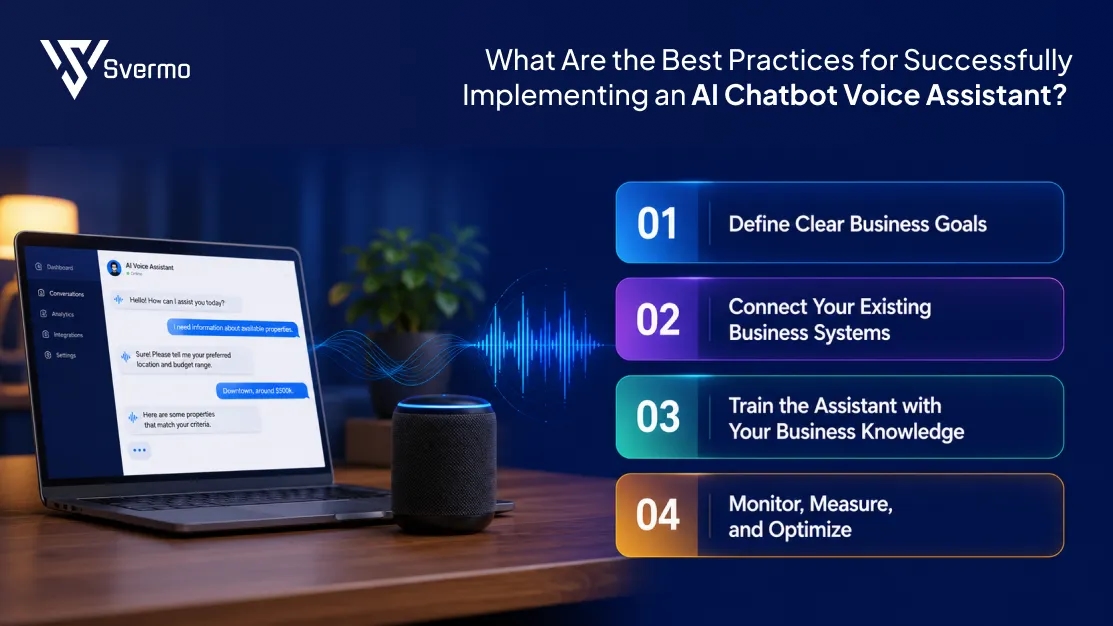
Implementing an AI chatbot voice assistant for real estate is about improving how your business communicates, responds, and operates. A thoughtful implementation approach helps your team see faster adoption, better customer experiences, and measurable business outcomes.
1. Define Clear Business Goals
Start by identifying the challenges you want the assistant to solve. Your implementation plan should focus on measurable outcomes rather than trying to automate everything at once.
Best practices:
- Prioritize high-volume, repetitive customer interactions.
- Set measurable KPIs such as response time, lead response rate, or customer satisfaction.
- Identify which departments will benefit first, such as sales, leasing, or property management.
- Roll out automation in phases instead of launching every workflow simultaneously.
2. Connect Your Existing Business Systems
The assistant becomes more valuable when it has access to accurate customer and property information. Integrating it with your existing systems helps deliver personalized conversations and keeps data synchronized across your business.
Best practices:
- Connect your CRM to provide customer context during conversations.
- Integrate calendars, MLS, and property management platforms to automate everyday processes.
- Organize business documents using an AI document management software solution so the assistant can retrieve accurate information.
- Ensure data remains clean and consistent before enabling automation.
3. Train the Assistant with Your Business Knowledge
An AI assistant performs best when it understands your properties, services, policies, and customer processes. The more relevant knowledge it has, the more accurate and helpful its responses become.
Best practices:
- Add FAQs, leasing policies, pricing guidelines, and property information.
- Review conversations regularly to identify knowledge gaps.
- Update the knowledge base whenever services or business processes change.
- Define clear escalation rules for conversations requiring human expertise.
4. Monitor, Measure, and Optimize
Implementation doesn't end after launch. Reviewing performance regularly helps you improve customer experiences and expand automation into new areas over time.
Best practices:
- Monitor conversation quality, resolution rates, and customer feedback.
- Use insights from your AI-powered CRM software to refine customer journeys and sales processes.
- Identify recurring customer questions and improve AI responses.
- Expand automation gradually as your teams become comfortable with the platform.
Successful implementation isn't measured by how many workflows you automate. It's measured by how effectively the assistant improves customer experiences while helping your teams work more efficiently.
Once your implementation strategy is in place, you need to know what could go wrong during the implementation and how to avoid it.
What Challenges Can You Face When Implementing an AI Chatbot Voice Assistant, and How Can You Overcome Them?
Implementing an AI chatbot voice assistant for real estate is not just a technology project. It requires clean data, connected systems, employee adoption, and well-defined business processes. Addressing the challenges below before deployment helps ensure a smoother implementation and faster return on investment.
| Implementation Challenge | Why It Happens | How to Overcome It |
|---|---|---|
Disconnected business systems | Customer information, property listings, calendars, and operational data are often spread across multiple applications. | Choose a platform that integrates seamlessly with your AI property management software and other business systems to keep information synchronized. |
Outdated or inconsistent property data | AI relies on accurate listing information, documents, and customer records. Inconsistent data leads to inaccurate responses. | Review and standardize your property information before deployment, and establish a process to keep business data updated. |
Complex MLS integrations | Many organizations use multiple MLS sources and legacy software that are difficult to connect. | Select a solution that supports modern AI powered MLS software integrations to reduce implementation complexity. |
Low employee adoption | Teams may hesitate to trust AI or believe it will replace their roles. | Involve employees early, provide practical training, and position AI as a productivity tool that supports, rather than replaces, their work. |
Poor conversation quality | Without business-specific knowledge, the assistant may generate incomplete or irrelevant responses. | Train the assistant using your listings, policies, FAQs, and historical customer conversations, then refine its knowledge continuously. |
Security and compliance concerns | Customer conversations often include sensitive personal and financial information that must be protected. | Implement enterprise security policies and complement your deployment with AI fraud & risk management software for real estate to strengthen data protection and reduce operational risk. |
Unrealistic implementation expectations | Organizations often try to automate every process immediately, making projects harder to manage. | Start with high-impact workflows, measure results, and expand automation gradually as your teams gain confidence. |
Most implementation challenges are the result of disconnected systems, poor data quality, or unrealistic rollout plans. Address these areas early, and your AI chatbot voice assistant will deliver value much faster while supporting long-term business growth.
By this stage, you've probably realized that success depends less on adopting AI and more on choosing the right solution. How do you distinguish a platform that's built for real estate from one that's simply another generic chatbot?
How Do You Choose the Best AI Chatbot Voice Assistant Platform for Real Estate That Truly Works for You?
The best AI chatbot voice assistant for real estate companies should do more than automate conversations. It should align with your business objectives, integrate seamlessly with your existing technology, and continue delivering value as your operations grow. Since every platform offers a different level of intelligence, flexibility, and industry expertise, evaluating the right criteria before making an investment is essential.
The following considerations will help you identify an AI chatbot voice assistant software for modern real estate businesses that supports both your immediate operational needs and long-term growth strategy.
1. Proven Real Estate Expertise
Many conversational AI platforms are built for general customer service and require extensive customization before they can support real estate workflows. An AI-powered chatbot voice assistant should already understand industry terminology, customer journeys, and operational requirements.
Before selecting a vendor, verify that it:
- Has experience supporting brokerages, agencies, property management companies, and commercial real estate firms.
- Offers pre-built workflows designed specifically for real estate operations.
- Demonstrates measurable success through industry-specific customer implementations.
- Continuously improves its platform based on evolving real estate business needs.
2. Integration Readiness
A platform should strengthen your technology ecosystem rather than create another disconnected application. Real-time integration enables customer conversations, property information, and operational data to move seamlessly across your business.
Look for a solution that:
- Provides native integrations instead of relying heavily on third-party connectors.
- Synchronizes customer and property data in real time.
- Offers flexible APIs for future technology expansion.
- Connects seamlessly with CRM, MLS, calendars, and property management systems.
A well-connected AI chatbot voice assistant platform for real estate workflow automation reduces manual effort while creating a unified operational environment.
3. Customization and Workflow Flexibility
Every real estate organization operates with its own unique processes. Your AI platform should adapt to your sales, leasing, customer support, and property management workflows instead of forcing standardized approaches.
Evaluate whether you can:
- Configure conversation flows without extensive coding.
- Customize automation rules for different business functions.
- Define escalation paths for complex customer requests.
- Expand workflows as operational requirements evolve.
This flexibility becomes especially valuable for an intelligent chatbot voice assistant for property management companies, where communication processes often differ from those of brokerages and commercial real estate firms.
4. Scalability and Enterprise Readiness
Technology investments should continue delivering value as your portfolio, customer base, and operational complexity increase. Whether you're expanding into new markets or managing multiple offices, your platform should support voice-enabled real estate operations without compromising reliability or security.
Choose a solution that provides:
- Enterprise-grade security and compliance.
- Reliable performance during periods of high inquiry volume.
- Support for multiple teams, offices, and property portfolios.
- Flexible deployment that scales with your organization.
An enterprise AI chatbot voice assistant for commercial real estate should also be capable of supporting larger portfolios, multi-location operations, and higher conversation volumes.
5. Vendor Partnership and Product Innovation
Technology evolves quickly, and so should the platform you choose. A reliable vendor continuously improves its products, introduces new AI capabilities, and helps customers adapt to changing business requirements. Long-term success depends as much on the vendor's commitment to innovation as it does on the software itself.
Before making a decision, ask whether the provider:
- Regularly releases meaningful product enhancements.
- Offers structured onboarding and ongoing customer success support.
- Maintains a clear product roadmap aligned with the future of conversational AI for real estate.
- Invests in expanding its AI ecosystem to support future operational needs.
A broader AI ecosystem is often a strong indicator of long-term product maturity. For example, a provider that also offers an AI asset management agent demonstrates the ability to extend automation beyond customer communication into portfolio and operational management as your business grows.
The right AI platform is the one that understands your industry, integrates with your business systems, adapts to your workflows, and continues delivering value as your organization evolves.
The platform you choose today will likely become part of your business for years to come. But AI is evolving faster than almost any other enterprise technology. Which innovations are set to redefine how real estate businesses communicate, automate, and compete over the next few years?
What Future Technologies will Shape AI Chatbot Voice Assistants for Real Estate?
Today's AI chatbot voice assistants already automate conversations and routine workflows, but the next wave of innovation is expected to move beyond responding to requests.
Over the next several years, advances in AI are likely to make these platforms more predictive, autonomous, and deeply connected with real estate operations. While many of the capabilities below are being researched or tested, they are not yet widely available in commercial real estate AI platforms.
| Emerging Technology | What It Could Enable | Potential Impact on Real Estate |
|---|---|---|
Autonomous Multi-Agent AI | Multiple specialized AI agents collaborate to complete complex tasks without human coordination. | A single customer inquiry could automatically trigger lead qualification, property matching, document preparation, compliance checks, and appointment scheduling across different AI agents. |
Predictive Customer Intent Modeling | AI anticipates customer needs before they are explicitly expressed by combining behavioral patterns, market signals, and historical interactions. | Real estate businesses could engage buyers or tenants proactively before they submit an inquiry or abandon their search. |
Emotion-Aware Voice Intelligence | Future voice models may recognize emotional cues such as hesitation, urgency, or frustration while respecting privacy and applicable regulations. | Customer conversations could adapt dynamically, allowing AI to escalate sensitive situations or adjust communication style more effectively. |
Digital Twin Property Assistants | AI interacts with live digital replicas of buildings, properties, and operational systems. | Property managers may monitor building conditions, answer tenant questions, and coordinate maintenance through a single conversational interface. |
Agentic Business Process Automation | AI plans, executes, monitors, and optimizes multi-step business processes with minimal human supervision. | Instead of completing individual tasks, AI could coordinate entire leasing, onboarding, or property management workflows from start to finish. |
Spatial AI for Property Exploration | Conversational AI combines with spatial computing to understand three-dimensional property environments. | Prospective buyers could ask questions while exploring immersive property experiences and receive contextual responses based on the space they are viewing. |
Personal AI Memory Networks | AI securely maintains long-term customer preferences and interaction history across multiple properties and transactions, subject to user consent and privacy controls. | Returning customers could receive highly personalized recommendations without repeating their requirements during future interactions. |
The future of AI chatbot voice assistants for real estate is likely to extend far beyond customer communication. As these technologies mature, AI is expected to become an active participant in decision-making, operational coordination, and customer engagement rather than simply responding to requests.
As these innovations move from research to real-world adoption, one question becomes increasingly important: how can you choose a platform today that is ready to evolve with tomorrow's AI capabilities instead of becoming obsolete after a few product updates?
Why is Svermo's AI Chatbot Voice Assistant the Best Platform for Real Estate?
You've seen that the success of an AI chatbot voice assistant depends on far more than answering customer questions. Long-term value comes from how well the platform fits into your existing operations, scales with your business, and supports every stage of the customer journey.
Svermo’s AI chatbot and voice assistant was built with that approach in mind. This allows information collected during a customer interaction to flow naturally into sales, leasing, customer support, and property operations without creating additional manual work.
As your operational needs grow, you can extend your AI capabilities through solutions such as:
- AI leasing assistant for leasing automation and tenant engagement.
AI tenant screening software to streamline applicant evaluation.
- Real estate property valuation intelligence for data-driven pricing decisions.
- Real estate AI property search engine to help customers discover properties more efficiently.
This connected approach reduces the need to manage multiple vendors while creating a unified experience for employees and customers.
Organizations that choose Svermo can:
- Deliver consistent voice and chat experiences across every customer touchpoint.
- Reduce manual effort by connecting conversations with CRM, MLS, and operational workflows.
- Support sales, leasing, and property management teams from a single AI-powered platform.
- Expand automation as business requirements evolve without replacing existing processes.
- Deploy an AI chatbot voice assistant platform for real estate workflow automation designed specifically for the real estate industry.
A solution that understands real estate, integrates with existing systems, and grows alongside your business will continue delivering value long after the initial implementation is complete.
Ready to Turn Every Conversation Into Business Value?
Bring customer communication, property operations, and AI automation together on one platform built for real estate.
Wrapping Up!
An AI chatbot voice assistant for real estate has evolved from a customer support tool into a strategic business asset. It helps real estate businesses automate communication, streamline operations, improve customer experiences, and scale efficiently without increasing manual effort.
The organizations that gain the greatest value from AI will be those that view it as a long-term operational investment rather than a standalone automation tool. That makes platform selection just as important as the technology itself. The right solution should integrate with your existing systems, adapt to your business processes, and continue evolving as your operational needs grow.
That's where Svermo stands apart. Instead of offering a standalone chatbot, Svermo delivers a connected AI ecosystem purpose-built for the real estate industry, enabling businesses to automate every stage of the customer and property lifecycle.
As your AI strategy matures, Svermo allows you to expand automation into complementary solutions such as AI real estate marketing software to improve customer acquisition and AI Property Inspections Software to streamline inspection workflows, all within a unified platform designed for real estate operations.
The future of real estate belongs to businesses that communicate faster, operate smarter, and make better decisions through connected AI. Svermo is built to help you stay ahead of that future with confidence.
Turn every conversation into your next competitive advantage with Svermo.
 https://www.linkedin.com/in/saanvi-verma-38711a36a
FAQs
Yes. Most enterprise AI chatbot voice assistants for real estate integrate with CRM platforms, MLS, calendars, and property management systems. These integrations synchronize customer information, automate updates, and help your team manage leads without switching between multiple applications.
Yes, provided it's connected to your property database, MLS, or knowledge base. An AI chatbot voice assistant for property inquiries and lead qualification can answer questions about pricing, availability, amenities, floor plans, and other listing details using real-time business data.
No. An AI voice assistant chatbot for real estate automates repetitive conversations and administrative tasks, while agents continue handling negotiations, property tours, relationship building, and complex client decisions that require human expertise.
Many enterprise platforms offer multilingual capabilities, allowing customers to communicate in their preferred language. This helps real estate businesses improve accessibility, serve diverse markets, and deliver a more personalized customer experience.
Implementation timelines depend on system integrations, business workflows, and data readiness. A well-prepared AI chatbot voice assistant platform for real estate workflow automation can often be deployed within a few weeks, while enterprise implementations may require additional planning.
Track metrics such as response time, qualified leads, appointment bookings, customer satisfaction, operational costs, and conversion rates. These KPIs help determine how effectively your AI-powered chatbot voice assistant for real estate businesses improves efficiency and business performance.
Enterprise platforms protect customer information through encryption, role-based access controls, secure integrations, and compliance with applicable data protection standards. Always verify a vendor's security practices before deploying an AI chatbot voice assistant for real estate across your organization.