
How to Integrate AI Automation with Real Estate CRMs, Listing Platforms and Lead Systems: A Practical Breakdown


Get a summary of this article with your favorite AI





AI Summary
- •AI automation integration for real estate helps connect CRM platforms, listing systems, lead channels, and communication workflows into one synchronized operational ecosystem.
- •Firms implementing real estate workflow automation and system integration reduce manual lead handling, delayed follow-ups, duplicate records, and disconnected reporting processes.
- •Successful AI automation integration with real estate listing platforms depends heavily on workflow planning, API architecture, scalable infrastructure, and clean CRM data.
- •Most real estate businesses spend between $15,000 to $150,000+ depending on workflow complexity, number of integrations, AI capabilities, and operational scale.
- •Long term success comes from choosing the right integration partner like Svermo that understands while maintaining operational stability and scalability.
Why are real estate firms still losing leads even after spending thousands on CRMs, listing platforms, and automation tools? Because most of those systems are not connected to each other.
A lead enters through Zillow, but your CRM updates are late, and agent follows up hours later. Another platform creates duplicate records. Meanwhile, your team manually moves information between systems that were supposed to simplify operations in the first place.
This is exactly why more firms are trying to integrate AI automation with real estate operations instead of adding more disconnected software to an already fragmented workflow.
The shift is happening across the industry. According to the latest AI research firms adopting AI tools are seeing up to 300% increases in lead volume and 40% higher conversion rate. The same report found that nearly 97% of real estate professionals now show active interest in artificial intelligence.
But here is the real question.
What happens when your CRM, listing platforms, lead systems, and AI workflows finally start operating as one connected system instead of separate tools?
That is where AI automation integration for real estate starts creating operational impact. Instead of relying on manual coordination, firms can automate lead routing, CRM updates, follow-ups, reporting workflows, and client communication across their entire ecosystem in real time.
Modern real estate AI software solutions are helping firms connect CRMs, listing platforms, lead systems, communication channels, and operational workflows without forcing teams to replace their existing tech stack.
Before implementing any automation, though, it is important to understand what AI automation integration actually means in a real estate environment and why it has become operationally necessary for modern brokerages.
Still Managing Leads Across Five Different Platforms?
Disconnected systems slow down follow-ups, reporting, and conversions faster than most brokerages realize. A connected automation workflow changes how your entire operation runs.
What AI Automation Integration with Real Estate CRM, Listing Platforms, and Lead Systems Actually Means and Why It Has Become Necessary?
AI automation integration in real estate is the process of connecting your CRM, listing platforms, lead sources, communication tools, and operational systems into one synchronized workflow. Automation handles data exchange, workflow execution, lead updates, and task coordination in real time.
As lead volumes increase and brokerages adopt more tools, disconnected workflows become harder to manage manually. Here is why integrating AI automation into real estate CRM and lead management systems helps to improve visibility, response times, and operational efficiency across teams.
1. Disconnected Systems Create Operational Blind Spots
Most real estate firms use multiple platforms for listings, communication, marketing, and CRM management. But when these systems cannot sync properly, teams lose visibility into lead activity, client interactions, and pipeline status.
A lead may exist in one platform while missing from another. Follow-up history becomes incomplete. Reporting accuracy drops because every system holds different information.
This is one of the biggest reasons firms are investing in AI powered CRM integration for real estate businesses to centralize operational workflows.
2. Manual Workflow Management Slows Down Lead Conversion
When agents or operations teams manually transfer lead information between systems, response times suffer. Delayed routing and outdated records often reduce conversion opportunities before a conversation even begins.
Connected automation workflows eliminate repetitive administrative tasks and keep information updated automatically across systems.
Many brokerages adopting AI automation tools for real estate brokers are doing so specifically to reduce operational delays caused by disconnected platforms.
3. Real Time Data Synchronization Has Become Operationally Critical
Modern real estate operations move too fast for delayed updates and batch processing. Listing changes, lead activity, agent communication, and CRM records need to stay synchronized continuously.
This is where AI driven real estate platform connectivity and sync becomes valuable. Automation ensures that updates happening in one system reflect instantly across connected platforms without requiring manual intervention.
4. AI Automation Reduces Workflow Fragmentation Across Teams
Sales teams, leasing managers, marketing departments, and operations teams often work in separate systems. Without integration, collaboration becomes inconsistent and difficult to scale. Connected workflows allow every department to access updated information through synchronized systems.
This creates a more unified operational structure while reducing duplicate work across teams. Real estate workflow automation and system integration is the foundational investment for growing brokerages and property firms in the USA.
5. Scalable Real Estate Operations Depend on Connected Systems
As brokerages grow, disconnected systems create larger operational bottlenecks. More leads, more listings, and more communication channels increase the complexity of manual coordination. Firms focusing on scalable workflows that connect CRMs, listing platforms, lead systems, and communication tools into one operational ecosystem, preferably build a custom AI real estate automation system.
Without understanding how these connected systems actually work together behind the scenes, it becomes difficult to choose the right automation strategy, integration workflow, or technology stack for your business.
The next step is understanding how AI automation moves data, triggers workflows, and synchronizes operations across your CRM, listing platforms, and lead systems in real time.
How the AI Automation Integration with Real Estate CRM, Listing Platforms, and Lead Systems Actually Works?
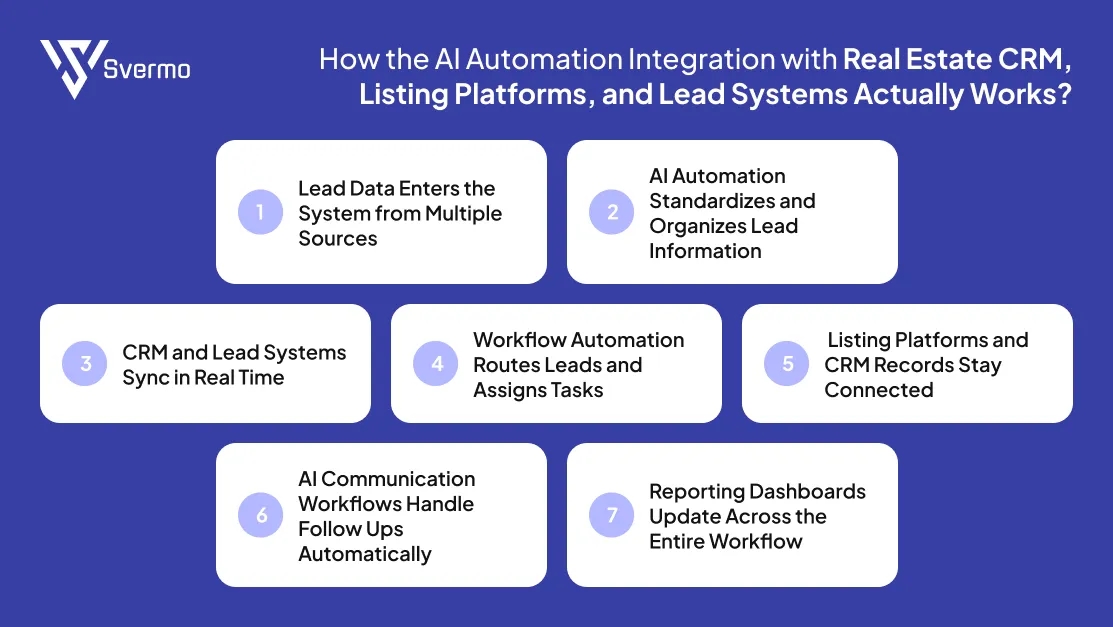
In a connected setup, every action across your real estate systems triggers the next operational step instantly. Lead information updates in real time, listing activity syncs automatically, and agents receive updated client data without switching between platforms.
For firms managing high lead volumes, multiple listing channels, and growing teams, AI automation integration for real estate helps reduce workflow delays, duplicate records, and operational inefficiencies across the business.
Here is a step by step breakdown of how the integration process actually works in practice.
1. Lead Data Enters the System from Multiple Sources
Real estate leads usually come from multiple channels including Zillow, MLS platforms, landing pages, paid campaigns, brokerage websites, and referral systems. Without integration, teams often move this information manually between platforms.
With AI automation integration for real estate, lead information enters a centralized workflow automatically as soon as an inquiry is submitted.
2. AI Automation Standardizes and Organizes Lead Information
Once the lead enters the workflow, automation validates and organizes the data before syncing it with connected systems. Contact details, inquiry source, property preferences, and communication activity get structured automatically.
This step reduces duplicate records, incomplete entries, and inconsistent lead formatting across platforms.
3. CRM and Lead Systems Sync in Real Time
After the data is processed, the CRM updates automatically with the latest lead activity and client information. Every interaction across listing platforms, communication channels, and lead systems reflects inside the CRM continuously.
This is a critical part of how to integrate AI automation with real estate CRM platforms because it keeps agents and operations teams working with updated information at all times. Firms integrating AI IVR system with real estate CRM platforms are also connecting call workflows directly into CRM activity tracking to centralize communication data.
4. Workflow Automation Routes Leads and Assigns Tasks
Once the CRM updates, automation workflows trigger the next operational actions automatically. Leads can be assigned based on:
- Territory
- Property category
- Deal value
- Agent availability
- Inquiry source
The system can also schedule follow-ups, create reminders, assign internal tasks, and trigger notifications across teams.
5. Listing Platforms and CRM Records Stay Connected
Listing updates across MLS systems, brokerage websites, and third-party property platforms synchronize automatically with CRM records and operational dashboards.
Changes to listing status, availability, pricing, or inquiry activity reflect across connected systems without requiring manual updates.
This synchronization layer is essential for firms investing in AI automation integration with real estate listing platforms to maintain operational consistency across channels.
6. AI Communication Workflows Handle Follow Ups Automatically
After lead routing and CRM synchronization, automation workflows can trigger:
- Email sequences
- SMS follow-ups
- Chatbot conversations
- Appointment scheduling
- Agent notifications
Businesses using real estate AI chatbot development strategies often connect conversational workflows directly with CRM and lead systems to improve response speed and engagement tracking.
7. Reporting Dashboards Update Across the Entire Workflow
As systems exchange data continuously, operational dashboards update automatically across lead pipelines, listing activity, communication tracking, and conversion reporting.
For growing brokerages, real estate workflow automation and system integration creates centralized operational visibility without replacing existing software platforms.
Connected automation changes how data moves across your real estate operations. Instead of relying on disconnected tools and manual coordination, every platform works as part of one synchronized workflow.
But how does this integration work inside actual real estate workflows on a day to day basis?
What Are the Most Valuable Use Cases of AI Automation Integration for Real Estate Firms?
The biggest advantage of AI automation integration for real estate comes from connecting operational workflows that directly impact lead conversion, client engagement, sales coordination, and transaction management.
Instead of operating as isolated tools, integrated systems allow AI workflows to interact continuously with CRMs, listing platforms, communication channels, and lead management systems.
1. Automated Lead Qualification and Prioritization
Not every lead entering your system has the same intent level. Some are actively searching for properties, while others are still in the research phase. AI automation helps firms analyze inquiry behavior, property preferences, engagement patterns, and communication activity to identify high intent prospects faster.
When firms integrate AI automation with real estate CRM platforms, qualified leads can automatically move to priority pipelines while low intent inquiries enter nurturing workflows without requiring manual review from agents.
Example:
A brokerage receives hundreds of inquiries weekly from paid advertising campaigns. The system automatically identifies prospects who repeatedly visit listings, request tours, or interact with financing pages and pushes them directly to senior agents for immediate outreach.
2. AI Powered Chatbots for 24/7 Lead Engagement
Real estate inquiries often happen outside business hours, especially for rental and residential listings. AI chatbots help firms maintain continuous engagement without relying entirely on live agents. Connected chatbot workflows can answer property questions, collect buyer requirements, schedule viewings, and sync conversations directly into CRM records.
Example:
A buyer browsing listings at midnight can receive instant responses about pricing, availability, and property features while the conversation history automatically updates inside the brokerage CRM.
Many brokerages searching for top 10 AI chatbot development companies for real estate are focusing on conversational workflows that reduce response delays across high inquiry channels.
3. Intelligent Lead Routing to the Right Agent
Lead assignment becomes difficult when firms manage multiple regions, offices, or property categories. Manual distribution often creates delays and uneven lead allocation across teams. Integrated workflows can automatically assign inquiries based on geography, property type, deal size, language preference, or agent specialization.
This is one of the most common implementations of how AI automation integrates with real estate lead generation systems across scaling brokerages.
Example:
A luxury waterfront inquiry from Miami automatically routes to an agent specializing in high value coastal properties instead of entering a general sales queue.
4. Automated Follow Up Campaigns
Consistent follow-up remains one of the biggest operational challenges for real estate teams managing large lead volumes. AI automation helps firms maintain communication throughout the buyer or renter journey without relying entirely on manual outreach. Integrated systems can trigger follow-up emails, SMS reminders, appointment confirmations, financing updates, and property recommendations based on client activity.
Example:
A prospect who viewed commercial listings but did not schedule a consultation automatically receives follow-up content related to similar investment properties over the next few days.
Businesses using approaches like AI assistant development for real estate are increasingly automating multi step communication workflows to improve lead engagement over longer sales cycles.
5. Personalized Property Recommendations
AI automation systems can analyze search history, saved listings, browsing patterns, pricing preferences, and engagement activity to recommend relevant properties automatically. Instead of sending generic listing updates, firms can deliver highly targeted recommendations connected directly with CRM activity and listing databases.
Example:
A buyer repeatedly viewing two-bedroom condos within a specific price range automatically receives newly listed properties matching those exact preferences as soon as they enter the MLS feed.
6. Predictive Analytics for Buyer and Seller Behavior
Predictive analytics helps firms identify patterns across buyer activity, lead engagement, property demand, and transaction trends. This allows brokerages to make faster operational and sales decisions using real-time behavioral insights.
Example:
A brokerage identifies that certain neighborhoods generate higher closing rates for first time buyers during specific seasonal periods and adjusts marketing allocation automatically.
Many companies investing in best agentic AI development companies for real estate in USA are building predictive workflows that adapt dynamically to customer behavior and market activity.
7. AI Driven Marketing Campaign Automation
Marketing teams often struggle to coordinate campaign activity with CRM updates and sales pipelines. AI automation connects marketing workflows directly with lead engagement data, helping firms optimize campaigns continuously. Integrated systems can adjust audience targeting, trigger retargeting campaigns, and personalize outreach based on lead activity across websites, ads, and CRM interactions.
Example:
A prospect who abandons a property inquiry form can automatically enter a retargeting campaign featuring similar listings and financing options across email and paid advertising channels.
8. AI Based Document and Contract Automation
Transaction management involves repetitive document handling, contract updates, compliance checks, and approval coordination. Connected workflows can automatically generate documents, extract property data, update transaction records, and route contracts for approvals while syncing activity across operational systems.
Example:
A purchase agreement generated after a property offer automatically pulls buyer information from the CRM, updates transaction records, and sends documents for digital signatures without requiring manual data entry.
The value of automation depends heavily on how well the underlying systems are connected.
Now see, what does the actual integration process look like when firms start connecting CRMs, listing platforms, and lead systems together?
How Many Leads Are Slipping Through Your Workflow Gaps?
If your agents are still manually updating CRMs, routing inquiries, or tracking follow-ups across platforms, your automation stack is already costing you time and revenue.
How Can Real Estate Firms Implement AI Automation Integration Step by Step?
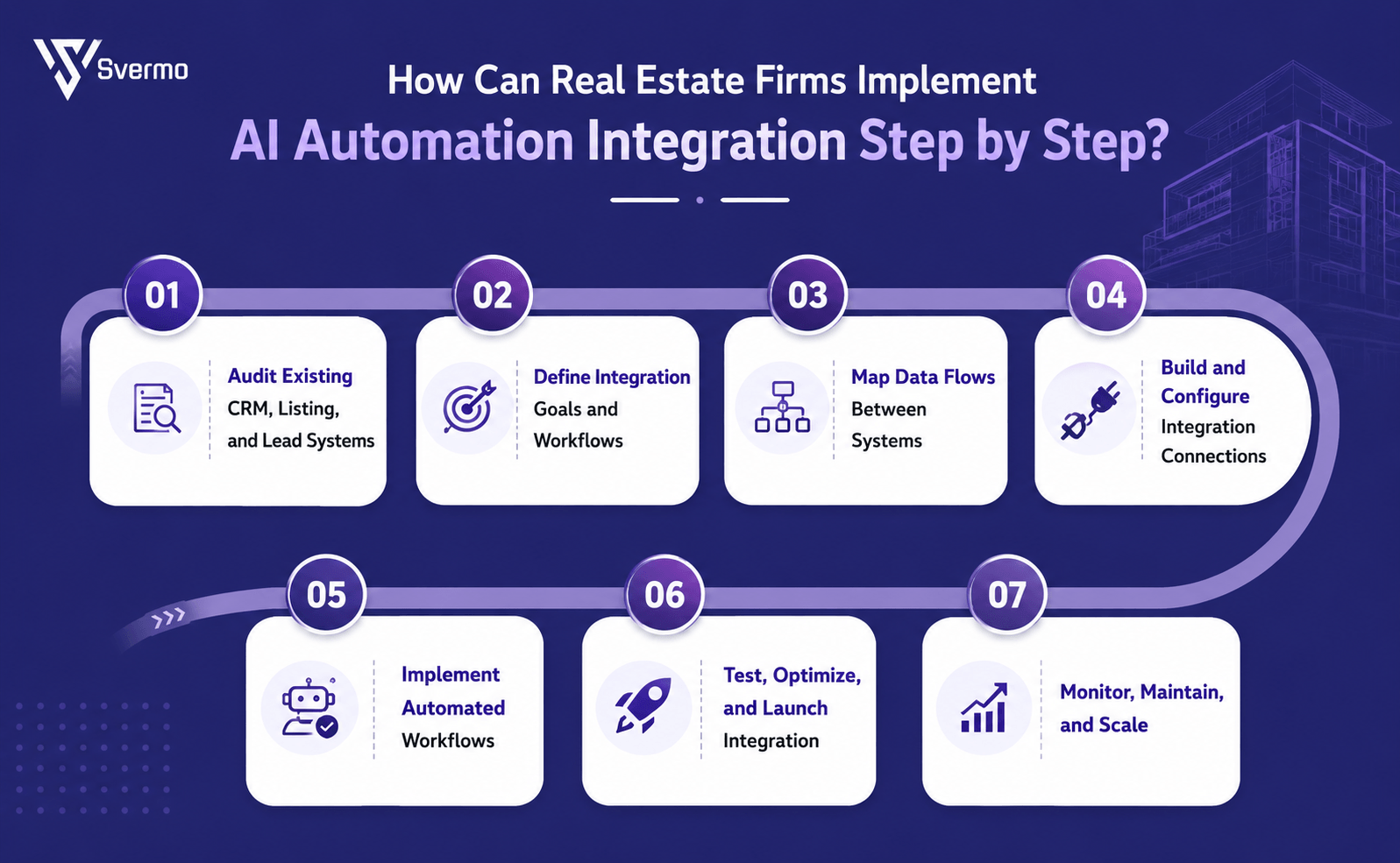
Integrating AI automation with real estate CRM, listing platforms, and lead systems requires careful planning, structured workflows, and a clear understanding of how data flows across systems.
Each step builds on the previous one, ensuring leads, listings, and operational tasks synchronize automatically while maintaining data accuracy. Below is a practical step-by-step approach used by US brokerages to implement connected automation workflows.
Step 1: Audit Existing CRM, Listing, and Lead Systems
Before connecting anything, it is essential to understand what systems are in place and how they are currently used. The audit identifies gaps, overlaps, and areas where automation can add value. This step ensures that AI automation integration for real estate is tailored to actual operational needs rather than theoretical workflows.
- Map every CRM, MLS feed, and lead source currently in use
- Document how leads move between systems and who updates data manually
- Identify duplicate records, missing fields, and inconsistent formats
- Record pain points reported by agents, managers, and operations staff
- Determine which processes are high priority for automation
Step 2: Define Integration Goals and Workflows
After understanding the current state, set clear objectives for what connected automation should achieve. This step aligns operational goals with technological capabilities. Goals might include faster lead response, accurate listing synchronization, or automated follow-up sequences.
- Specify which lead sources will automatically sync with the CRM
- Outline how listings update from MLS and third-party platforms should flow
- Decide rules for automated lead assignment and prioritization
- Identify which communication workflows should trigger automatically
- Establish performance metrics to track post-integration efficiency
Step 3: Map Data Flows Between Systems
Data mapping ensures that every field, record, and interaction moves correctly between CRM, listing platforms, and lead systems. Misaligned data mapping can break workflows, create duplicates, or delay automation. Proper mapping is key to integrate AI automation with real estate CRM platforms effectively.
- Identify data fields that need to sync across all systems (e.g., contact info, property ID, lead status)
- Determine how updates in one system trigger updates in others
- Define formatting rules and validation checks for incoming data
- Plan exceptions and error handling for incomplete or inconsistent records
- Include historical data migration if needed for continuity
Step 4: Build and Configure Integration Connections
Once data flows are mapped, technical connections are implemented. This may involve APIs, webhooks, middleware, or custom integration tools. The goal is seamless interaction between platforms without disrupting existing workflows.
- Set up API connections between CRM, MLS, lead systems, and communication tools
- Configure webhooks for real-time updates when leads or listings change
- Implement middleware to translate data formats between platforms if required
- Test connectivity to ensure no data is lost or misrouted
- Apply security protocols to protect sensitive client and property data
Step 5: Implement Automated Workflows
With connections established, define operational automation rules for lead handling, follow-ups, notifications, and reporting. This step turns connected systems into a cohesive workflow that executes tasks automatically.
- Automate lead assignment based on location, property type, or agent expertise
- Trigger follow-up sequences, emails, and messages without manual input
- Synchronize listings and property updates across platforms in real time
- Log all activity in CRM and lead systems for centralized visibility
- Activate monitoring alerts for failed workflow triggers or data conflicts
Step 6: Test, Optimize, and Launch Integration
Before full deployment, test workflows to ensure leads, listings, and operational tasks execute correctly. Continuous testing prevents bottlenecks, misassignments, and data errors once the system goes live.
- Run test leads and listings through each workflow to check routing and syncing
- Validate automated follow-ups and communication triggers
- Monitor real-time data updates for accuracy and consistency
- Collect feedback from agents and managers to refine workflows
- Launch integration incrementally to minimize disruption and address issues promptly
Step 7: Monitor, Maintain, and Scale
Post-deployment monitoring ensures that workflows continue to operate efficiently as the firm grows. Scaling the integration over time allows brokerages to expand automation across new offices, teams, or listing channels.
- Track lead response times, conversion rates, and workflow completion metrics
- Schedule regular audits to ensure CRM, listing, and lead systems remain synchronized
- Adjust automation rules for seasonal fluctuations, campaign spikes, or staffing changes
- Integrate additional tools or platforms as the technology stack evolves
- Use analytics to identify further opportunities for operational optimization
This step-by-step approach allows firms to implement steps to integrate AI automation with real estate listing and lead platforms in a structured, measurable, and scalable way.
What technologies and platforms are typically used to enable these connected workflows across real estate operations?
What Technology Stack Is Required for AI Automation Integration in Real Estate?
A successful AI automation integration with real estate software systems depends on how well different technologies work together across lead generation, CRM management, communication workflows, listing synchronization, analytics, and operational automation.
Most real estate firms already use several platforms independently. The goal of the integration stack is to connect those systems into one operational workflow without disrupting existing processes.
The table below breaks down the core components commonly used in real estate technology stack integration with AI tools and explains how each layer supports automation across brokerages, leasing firms, and property operations.
Technology Category | Component | Role in AI Automation Integration for Real Estate |
|---|---|---|
Frontend Technologies | React, Next.js, Angular, Vue.js, Flutter | Frontend frameworks power brokerage dashboards, client portals, agent interfaces, listing experiences, tenant applications, and communication panels. These interfaces allow agents and operations teams to interact with synchronized CRM, listing, and lead workflows in real time. |
Backend Technologies | Node.js, Python, .NET, Java, Django, FastAPI | Backend systems manage business logic, workflow execution, API handling, authentication, automation processing, and database coordination across integrated real estate platforms. During real estate AI software development firms build scalable backend architectures to support connected automation workflows. |
Lead Management Platforms | Zillow, Realtor.com, BoldLeads, Market Leader, BoomTown | These platforms generate inbound buyer, seller, and rental inquiries. Integrated workflows automatically capture lead activity, sync inquiries with CRM systems, and trigger engagement workflows without manual data entry. |
CRM Platforms | Salesforce, HubSpot, Follow Up Boss, kvCORE, Zoho CRM | CRM systems act as the central operational database for lead tracking, communication history, transaction management, and pipeline visibility. Connected CRM workflows are essential for how to integrate AI automation with real estate CRM platforms effectively. |
MLS and Listing Platforms | MLS, IDX, RESO APIs, Realtor.com syndication tools | Listing platforms distribute property data across brokerage websites and listing marketplaces. AI automation keeps pricing, property availability, listing updates, and inquiry activity synchronized continuously across connected systems. |
AI Chatbot Systems | Drift, Intercom, Custom GPT chatbots, Conversational AI platforms | AI chatbots handle buyer and tenant engagement, property recommendations, appointment scheduling, and lead qualification directly through websites and communication channels. |
AI Voice and IVR Systems | Twilio, Dialogflow, Air AI, Custom IVR platforms | AI voice systems automate inbound call handling, tenant communication, appointment coordination, and inquiry routing while syncing conversations directly with CRM platforms. The top AI IVR system development companies for real estate in USA often integrate voice workflows into leasing and brokerage operations. |
Workflow Automation Platforms | Zapier, Make, n8n, Workato, Pipedream | Workflow automation tools connect systems that do not communicate natively. They automate lead routing, trigger notifications, synchronize updates, and coordinate operational workflows across disconnected platforms. |
Middleware and API Management | REST APIs, GraphQL APIs, MuleSoft, Postman, API gateways | Middleware handles secure communication between systems, translates data formats, validates requests, and manages synchronization between CRMs, listing platforms, and automation layers. This layer is critical for scalable AI driven real estate platform connectivity and sync. |
AI Recommendation and Prediction Engines | OpenAI APIs, Vertex AI, Azure AI, Custom ML models | AI models analyze customer behavior, search activity, lead quality, and property engagement patterns to deliver predictive recommendations, lead scoring, and behavioral insights. |
Marketing Automation Platforms | HubSpot Marketing Hub, ActiveCampaign, Mailchimp, Marketo | Marketing automation systems manage email workflows, retargeting campaigns, segmentation, and lead nurturing sequences using synchronized CRM and engagement data. |
Analytics and Reporting Systems | Power BI, Tableau, Looker Studio, CRM dashboards | Reporting systems centralize operational insights across lead pipelines, property activity, agent performance, and conversion metrics. Real-time reporting improves decision-making across growing brokerages. |
Document and Transaction Management | DocuSign, PandaDoc, Dotloop, SkySlope | Transaction platforms automate contract generation, e-signatures, compliance tracking, and approval of workflows while syncing activity directly with CRM and operational systems. |
Communication Platforms | Slack, Microsoft Teams, RingCentral, Zoom | Communication tools connect agents, operations teams, leasing managers, and support staff through centralized notifications, workflow alerts, and collaboration updates. |
Cloud Infrastructure and Hosting | AWS, Microsoft Azure, Google Cloud Platform | Cloud infrastructure supports scalability, workflow processing, data storage, AI model deployment, and secure integration architecture for high volume real estate operations. |
Security and Compliance Layer | OAuth, MFA, SOC 2, role-based access systems | Security systems manage user permissions, secure API access, compliance monitoring, and protection of sensitive customer and transaction data across integrated platforms. |
The technology stack should always align with your operational workflows, lead volume, team structure, and long-term scalability plans. Choosing the wrong architecture often creates synchronization issues, reporting gaps, and expensive workflow limitations later.
But before implementation starts, most brokerages evaluate one critical factor first.
What does AI automation integration actually cost for real estate firms in the USA?
How Much Does AI Automation Integration Cost for Real Estate Firms?
The cost of AI automation integration for real estate typically ranges between $15,000 to $150,000+ depending on the number of systems involved, workflow complexity, customization requirements, automation depth, and infrastructure scale. This is closely tied to the overall real estate AI software development cost, which varies based on how deeply AI is embedded into your operations.
Below is a practical breakdown of common integration cost ranges across real estate operations.
Integration Component | Estimated Cost Range | What Impacts the Cost |
|---|---|---|
CRM Integration Setup | $5,000 to $20,000 | CRM complexity, API availability, custom fields, workflow depth, number of users |
MLS and Listing Platform Integration | $8,000 to $30,000 | IDX setup, MLS data access, listing synchronization logic, regional MLS restrictions |
Lead Management and Routing Automation | $5,000 to $25,000 | Number of lead sources, routing rules, automation conditions, response workflows |
AI Chatbot Integration | $10,000 to $40,000 | Conversational complexity, multilingual support, CRM synchronization, training requirements |
AI Voice and IVR Automation | $15,000 to $50,000 | Call workflows, voice models, CRM integration, leasing support complexity |
Marketing Automation Integration | $5,000 to $20,000 | Campaign workflows, audience segmentation, retargeting setup, lead scoring |
Predictive Analytics and AI Recommendation Systems | $20,000 to $75,000 | Data modeling, AI training, reporting logic, behavioral analysis complexity |
Document and Transaction Automation | $8,000 to $35,000 | Contract workflows, compliance rules, e-signature integrations, approval routing |
Custom Middleware and API Development | $10,000 to $60,000 | Number of connected systems, custom APIs, synchronization requirements |
Analytics and Reporting Dashboards | $5,000 to $25,000 | Dashboard complexity, reporting depth, data sources, real time processing |
Cloud Infrastructure and Hosting Setup | $3,000 to $20,000 | Hosting scale, data processing requirements, storage, security architecture |
Ongoing Maintenance and Optimization | $1,500 to $10,000/month | Workflow monitoring, API maintenance, system upgrades, automation refinement |
A small brokerage integrating a CRM with lead routing and follow-up workflows will cost significantly less than a multi office real estate firm connecting MLS systems, marketing automation, AI chatbots, analytics dashboards, transaction platforms, and predictive workflows together.
Factors that Impact the AI Automation Integration Costs
The cost of AI automation integration for real estate depends on workflow complexity, platform compatibility, automation depth, and operational scale. A brokerage connecting a few standardized systems will require far less implementation effort than a firm managing custom workflows, multiple offices, and disconnected legacy platforms.
Number of Connected Platforms
Integrating multiple CRMs, listing platforms, communication systems, and lead sources increases synchronization logic, workflow mapping, and testing requirements across the automation ecosystem.
API Availability and Flexibility
Platforms with modern and well documented APIs are easier to integrate compared to legacy systems with limited connectivity support.
Custom Workflow Requirements
Complex automation involving lead qualification, approval chains, territory-based routing, and multi-team coordination requires additional backend development and workflow engineering.
AI Model Sophistication
Predictive analytics, recommendation systems, conversational AI, and adaptive workflows require more advanced AI infrastructure, training pipelines, and processing capabilities.
Real Time Synchronization Requirements
Continuous live updates between CRM platforms, MLS feeds, dashboards, and communication systems demand stronger architecture for AI driven real estate platform connectivity and sync.
Reporting and Analytics Depth
Custom dashboards, centralized reporting systems, and multi-source analytics increase data processing complexity and operational visibility requirements.
Historical Data Migration
Migrating old CRM records, listing data, transaction history, and communication logs often requires restructuring, cleansing, and validation before automation workflows can operate reliably.
Security and Compliance Requirements
Advanced permission management, encrypted workflows, audit tracking, and compliance monitoring introduce additional implementation and infrastructure layers.
Mobile and Multi Office Support
Supporting distributed brokerage teams across multiple locations increases synchronization requirements for real estate workflow automation and system integration across departments.
Third Party Licensing and Infrastructure Fees
CRM subscriptions, AI services, MLS access, automation platforms, cloud hosting, and communication APIs contribute to recurring operational expenses over time.
Hidden Costs Do Real Estate Firms Often Miss
Many businesses planning AI automation integration for real estate calculate only the initial development and deployment cost. However, long term operational expenses often increase as integrations expand across CRM systems, listing platforms, communication channels, and brokerage workflows.
Data Cleanup Before Integration
Old lead records, listing information, and customer databases frequently require restructuring and validation before automation workflows can operate reliably.
AI Workflow Training and Optimization
Conversational AI systems and automated engagement workflows require continuous refinement to improve response quality and operational accuracy over time.
Temporary Productivity Slowdowns
Agents and operations teams may initially process fewer leads while adapting to synchronized workflows and new automation systems.
Emergency Integration Support Costs
Unexpected API failures, workflow disruptions, and third party platform issues may require ongoing technical troubleshooting and support resources to maintain stable AI driven real estate platform connectivity and sync.
Ways to Optimize the AI Automation Integration Costs
Many brokerages increase implementation costs by trying to automate every workflow at once. A phased rollout helps firms prioritize high impact operations first while keeping infrastructure, development, and maintenance costs under control during AI automation integration for real estate projects.
The most effective approach is building automation around existing systems instead of replacing the entire operational stack immediately.
Prioritize High Impact Workflows First
Start with lead routing, CRM synchronization, and follow-up automation before expanding into advanced AI workflows and predictive systems.
Use Existing Platforms Wherever Possible
Leverage current CRM, MLS, and communication systems that reduce migration costs and shorten implementation timelines significantly while integrating AI automation into real estate CRM and lead management workflows.
Choose Platforms with Strong API Support
Modern systems with reliable APIs reduce custom development requirements and simplify long-term workflow scalability.
Standardize CRM and Lead Data Early
Cleaning and organizing lead records before implementation helps avoid synchronization conflicts and duplicate workflow issues later.
Implement Modular Integration Architecture
Building integrations in modules allows firms to expand automation gradually without rebuilding the entire system infrastructure.
Automate Repetitive Operational Tasks First
Automating repetitive processes such as lead assignment, follow-ups, scheduling, and reporting usually delivers faster operational ROI for growing brokerages.
Reduce Unnecessary Custom Development
Using scalable automation frameworks and proven workflow architectures helps control development costs while improving deployment speed across integrated systems.
Monitor Workflow Performance Continuously
Tracking synchronization failures, response delays, and workflow bottlenecks helps firms optimize automation performance before operational issues start affecting lead handling and reporting visibility across real estate workflow automation and system integration environments.
Paying for Multiple Tools but Still Doing Manual Work?
Many real estate firms overspend on software because their platforms never actually work together. The right integration strategy reduces operational overhead before adding more tools.
What Technical and Operational Challenges Appear During AI Automation Integration in Real Estate?
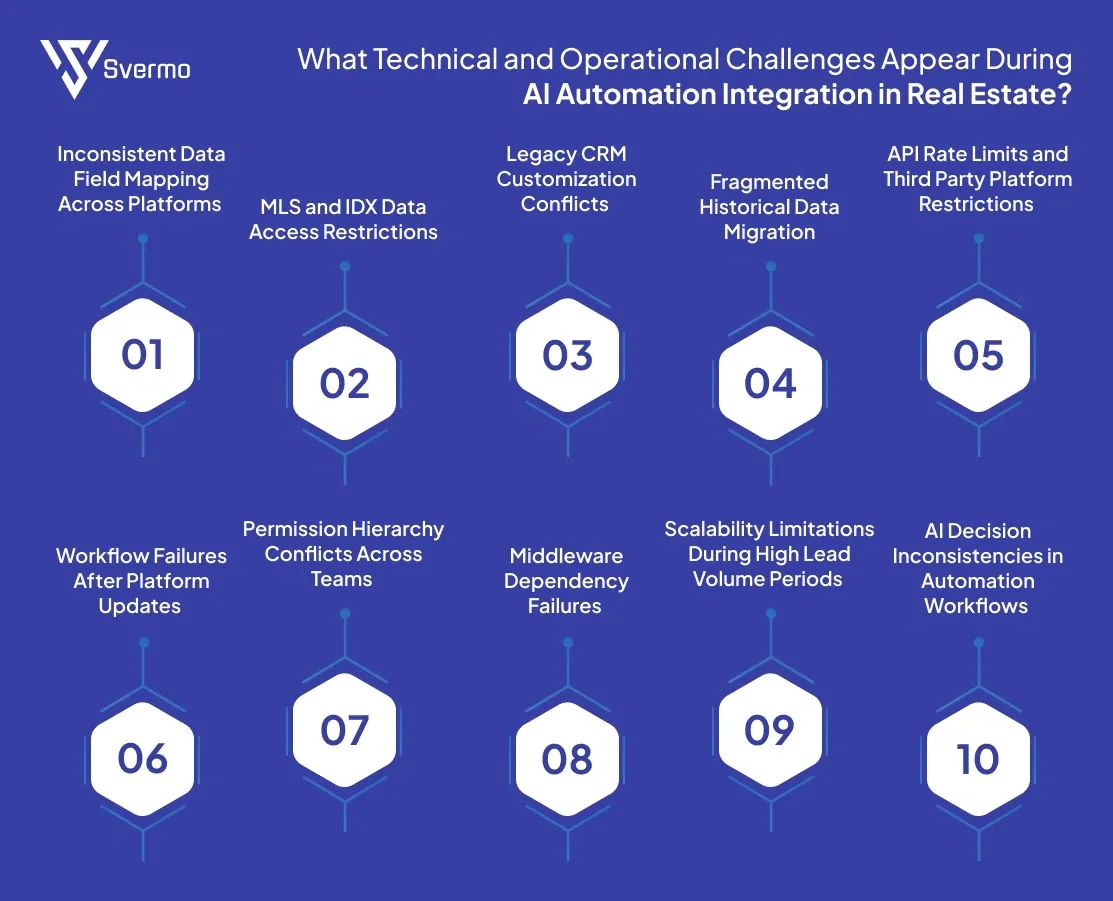
Most integration failures happen during implementation, scaling, or long term system maintenance. Real estate firms often deal with multiple CRMs, MLS restrictions, custom workflows, third party platforms, and fragmented historical data, which creates technical and operational complexity during deployment.
For firms planning AI automation integration for real estate, solving these issues early helps maintain workflow stability, reporting accuracy, and long term scalability.
Challenge | Operational Impact | Solution |
|---|---|---|
Inconsistent Data Field Mapping Across Platforms | Lead records, listing details, and client information sync incorrectly between systems, creating inaccurate CRM records and broken automation workflows. | Standardize CRM field structures, apply validation rules, and normalize incoming lead data before starting integrating AI automation into real estate CRM and lead management workflows. |
MLS and IDX Data Access Restrictions | Listing updates may sync slowly or incompletely, causing outdated property information, delayed status changes, and inaccurate listing visibility across platforms. | Use RESO compliant APIs, region specific MLS integration strategies, and monitored synchronization intervals for stable AI automation integration with real estate listing platforms. |
Legacy CRM Customization Conflicts | Existing custom CRM workflows can break after integration, affecting lead assignment logic, reporting structures, and communication tracking. | Audit all existing CRM customizations and rebuild unstable workflows using modular architecture designed for how to integrate AI automation with real estate CRM platforms reliably. |
Fragmented Historical Data Migration | Old transaction records, lead databases, and communication logs may import incorrectly, resulting in missing client history and inconsistent reporting. | Clean, restructure, and validate historical CRM and lead records before migration to maintain accurate reporting and workflow continuity. |
API Rate Limits and Third Party Platform Restrictions | High lead volumes and frequent data requests can interrupt synchronization between CRM systems, listing platforms, and automation workflows. | Implement queue management, request optimization, and scalable middleware layers to maintain stable AI driven real estate platform connectivity and sync during peak traffic periods. |
Workflow Failures After Platform Updates | CRM or platform software updates can silently disrupt automation workflows, causing lead routing failures and synchronization breakdowns. | Continuously monitor integrations, test workflow compatibility after updates, and maintain backup automation logic for critical operational processes. |
Permission Hierarchy Conflicts Across Teams | Agents, managers, and leasing teams may lose access to critical workflows or accidentally gain visibility into restricted operational data. | Configure centralized role based permissions and controlled workflow access across departments to maintain secure operational visibility. |
Middleware Dependency Failures | A middleware outage can stop communication between multiple connected systems simultaneously, interrupting operational workflows across departments. | Build redundant integration layers and automated recovery workflows to reduce operational downtime during middleware failures. |
Scalability Limitations During High Lead Volume Periods | Automation workflows may slow down during campaign spikes, causing delayed lead processing, reporting lag, and workflow bottlenecks. | Use cloud based scalable infrastructure and optimized workflow architecture to support growing real estate workflow automation and system integration requirements efficiently. |
AI Decision Inconsistencies in Automation Workflows | Inaccurate lead scoring, incorrect routing decisions, or irrelevant recommendations can reduce operational reliability and customer experience quality. | Continuously retrain AI models using updated customer behavior, engagement patterns, and operational data to improve workflow accuracy over time. |
Most integration challenges are manageable when workflows, data structures, APIs, and operational processes are planned correctly from the beginning.
But even with the right technology and workflows in place, the success of the integration still depends heavily on the expertise of the implementation partner managing the entire process.
Why Do Real Estate Firms Choose Integration Partners Like Svermo?
Successful AI automation integration for real estate requires much more than connecting software platforms together. Real estate firms need workflows that align with how their teams actually operate across lead management, listing coordination, leasing processes, communication systems, and CRM operations.
Svermo helps brokerages and property firms connect fragmented systems into one centralized automation environment without disrupting existing operations. The focus stays on creating scalable workflows that improve operational coordination, automate repetitive processes, and maintain reliable synchronization across CRM platforms, listing systems, and lead channels.
Instead of forcing businesses into rigid all in one platform, Svermo builds automation workflows around the systems firms already use daily. This approach helps reduce implementation friction while improving long term scalability for firms planning to integrate AI automation into real estate CRM and lead management environments.
Whether the goal is CRM synchronization, automated lead workflows, AI communication systems, or centralized operational visibility, the right integration strategy helps real estate firms scale more efficiently without increasing operational complexity.
Is Your Automation Setup Ready to Scale With Your Brokerage?
Growth becomes difficult when CRM systems, listing platforms, and lead workflows start operating in silos. Scalable automation requires operational architecture built for long term expansion.
Wrapping Up!
Disconnected CRM platforms, listing systems, and lead workflows create operational delays that directly affect lead conversion, reporting accuracy, and team productivity. As real estate operations become more data driven, firms need connected systems that can synchronize workflows, automate repetitive tasks, and maintain real-time operational visibility across departments.
That is why more brokerages are investing in AI automation integration for real estate instead of adding more disconnected tools to their existing stack. The focus is shifting toward scalable automation ecosystems that improve coordination between CRM platforms, listing channels, communication systems, and lead management workflows.
At Svermo, we help real estate firms design and implement automation systems that align with actual brokerage workflows, operational structures, and long-term growth goals. From CRM synchronization and listing platform integration to AI communication workflows and centralized reporting systems, our focus stays on building automation infrastructure that remains scalable, reliable, and operationally stable over time.
If your brokerage is planning to modernize disconnected workflows through AI automation integration with real estate listing platforms and CRM systems, contact us.
 https://www.linkedin.com/in/saanvi-verma-38711a36a
FAQs
Yes. Most older CRM platforms can support AI automation integration for real estate through APIs, middleware, or custom connectors. However, legacy systems with outdated architecture or heavy customization may require workflow restructuring before integration becomes stable.
Most firms continuously monitor APIs, audit workflows, optimize automation logic, and retrain AI systems regularly to maintain stable AI driven real estate platform connectivity and sync across operations.
Yes. Modern integration architecture supports AI automation integration with real estate listing platforms such as Zillow, MLS systems, Realtor.com, brokerage websites, and CRM platforms simultaneously through synchronized workflows and APIs.
No. Most businesses that integrate AI automation with real estate CRM platforms continue using their existing CRM while connecting automation workflows around it instead of replacing the entire system.
Most enterprise integrations use encrypted APIs, role based access controls, authentication layers, and compliance monitoring systems to secure customer, listing, and transaction data across connected workflows.
Yes. Many firms use automation for tenant communication, leasing workflows, appointment scheduling, maintenance coordination, and inquiry handling through connected property management systems.
Yes. Faster lead routing, automated engagement, and real time synchronization usually improve response speed and operational efficiency across real estate workflow automation and system integration environments.
Ready to Stop Managing Real Estate Operations Through Spreadsheets and Workarounds?
Your CRM, listing platforms, lead systems, and automation workflows should operate as one connected ecosystem, not as disconnected tools your team struggles to manage every day.