

How to Build a Custom AI Real Estate Automation System in 2026?


Get a summary of this article with your favorite AI





AI Summary
- •Start with workflows, not tools, when you build a custom AI real estate automation system to reflect real operations
- •Use custom solutions instead of generic tools for effective custom AI real estate automation system development
- •Strong integrations between CRM, portals, and communication channels ensure smooth operations
- •Control cost by starting small and expanding gradually as you develop real estate automation using AI
- •Choose the right partner like Svermo to build a scalable system that actually runs your operations
How many real estate leads slipped through your system this week… even though you had the tools to handle them?
If you are trying to build a custom AI real estate automation system, it means you are already facing this problem. Leads are coming in, but follow-ups are inconsistent, systems are disconnected, and opportunities are getting lost before your team can act.
This is not just an operational issue. It is a growing competitive gap. According to SmartDev real estate firms adopting AI are already seeing measurable gains. They report a 7.3% increase in productivity, a 6.9% improvement in customer engagement, and a 5.6% boost in operational efficiency.
Most real estate businesses are still relying on CRMs, scattered tools, and basic automation that do not reflect how their teams actually work. That is why leads get missed, follow-ups break, and scaling becomes harder instead of easier.
This is where AI real estate automation system changes the game. Instead of adding more tools, you create a connected system that captures leads, responds instantly, and manages workflows end to end.
Many teams at this stage start evaluating what it takes to build such a system and often investigate how a real estate AI software solutions approaches system design, integrations, and workflow automation in real-world scenarios.
Here, we will show you exactly how to build a custom AI real estate automation system that aligns with your workflows, connects your tools, and helps you scale without operational chaos.
Let’s start by understanding what a custom real estate AI automation system really is and why it is becoming essential in 2026?
Still Managing Tools Instead of Running a System?
If your workflow feels scattered, it probably is. Let’s turn it into a system that actually works.
What is a Custom AI Real Estate Automation System and Why are Real Estate Businesses Replacing Traditional Tools?
A custom AI real estate automation system is a connected system that manages your entire real estate workflow, from capturing leads to closing deals. Instead of relying on separate tools, it brings everything into one system that captures, qualifies, follows up, and moves leads forward automatically.
When you build a custom AI real estate automation system, you shift from managing tools to running a system that actually handles your operations.
It can:
- Capture leads from multiple sources in real time
- Automatically qualify and route them
- Handle follow-ups across channels
- Manage workflows from inquiry to closure
The real estate industry is shifting towards custom AI real estate automation system development because traditional tools cannot keep up as workflows become more complex.
Here’s how traditional systems compare with a custom approach:
Aspect | Traditional Tools | Custom AI Real Estate Automation System |
|---|---|---|
System Structure | Multiple disconnected tools working in silos | One unified system managing end-to-end workflows. This is the foundation when you build a custom AI real estate automation system that connects CRM, portals, and communication channels. |
Lead Handling | Manual assignment and delayed follow-ups | Automated capture, qualification, and routing in real time. This enables developing real estate automation system for managing leads and listings without missing opportunities. |
Workflow Execution | Rule-based automation with limited flexibility | Dynamic workflows that adapt to lead behavior and stages. This is how you build AI automation for real estate workflows that handle real-world complexity. |
Data Usage | Data is stored but rarely used for action | Data actively drives decisions, triggers, and prioritization. This supports AI-powered business process automation real estate where every interaction improves outcomes. |
Scalability | Breaks as lead volume and complexity increase | Designed to handle high volume and multi-team operations. This is essential to create scalable real estate automation systems for brokers operating across regions. |
Team Dependency | Heavy reliance on manual coordination | Reduced manual effort with automated processes. This allows teams to focus on conversions instead of repetitive tasks. |
Operational Visibility | Limited visibility across tools | Centralized view of leads, workflows, and performance. This improves decision-making across your entire AI real estate automation system development lifecycle. |
Many businesses reach this point after trying multiple tools and realizing the limitations. Exploring how full systems are structured, such as through real estate AI Chatbot development can give a clearer picture of how communication, automation, and workflows come together in practice.
The shift is simple. Instead of adjusting your workflow to fit tools, you build a system that fits your workflow.
Next, we’ll look at how this custom real estate AI automation system actually works behind the scenes.
How Does a Custom AI Real Estate Automation System Actually Work Behind the Scenes?
So how does a custom AI real estate automation system actually run your operations without constant manual effort? The answer is simple. It turns your entire operation into a connected flow where data triggers decisions, and decisions trigger actions automatically.
Here’s how the system operates behind the scenes:
1. Input Layer: Where All Your Data Comes In
This is where the system gathers everything happening across your business. Every inquiry, interaction, and signal is pulled into one place so your team is not switching between platforms or missing information. This layer lays the foundation for end-to-end real estate process automation, because without unified data, automation breaks.
You will typically see inputs coming from:
- Lead sources like websites, landing pages, and paid campaigns
- External platforms such as property listing portals
- Direct communication channels including calls and messaging apps
- Existing systems like your CRM or databases
2. Processing Layer: Where Decisions Are Made
Once the data is captured, the system evaluates it to decide the next step. This is where AI real estate automation system development becomes important, as the system starts interpreting information instead of just storing it. It looks at patterns, intent, and context to guide actions.
At this stage, the system focuses on:
- Identifying serious vs casual inquiries
- Understanding requirements based on user behavior
- Mapping leads to relevant inventory or agents
- Ranking opportunities based on likelihood to convert
3. Workflow Layer: Where Your Business Logic Runs
This layer defines how your operations actually function. It connects triggers with actions and ensures every step happens automatically without manual coordination. Using real estate workflow orchestration, you can create custom real estate automation workflows system that reflect how your business actually runs instead of forcing rigid processes.
This includes setting up:
- Rules for assigning and distributing leads
- Timelines for follow-ups and reminders
- Conditions that move leads across different stages
- Logic to handle different types of inquiries
4. Execution Layer: Where Actions Are Completed
After decisions are made, the system executes actions across your connected tools. This is where workflows turn into real outcomes. When you develop real estate automation using AI, this layer ensures that responses, updates, and scheduling happen instantly without manual effort.
This is where the system actively:
- Sends personalized responses across channels
- Books meetings or site visits automatically
- Updates records and tracks every interaction
- Coordinates communication across platforms
Many businesses also extend this setup to manage inbound calls. Integrating solutions like AI IVR system development for property management ensures that even phone-based inquiries are captured, routed, and handled efficiently.
Instead of focusing on theory understand where does a custom AI real estate automation system actually create impact in your day-to-day operations?
What Are the Most Valuable Use Cases of a Custom AI Real Estate Automation System Across Real Estate Businesses?

Instead of looking at this as a technical system, let’s make it practical. Where does a custom AI real estate automation system actually create impact in your business? This applies to brokerages, property managers, developers, and proptech platforms across the US.
When you build a custom AI real estate automation system, you are not solving one problem. You are fixing multiple operational gaps across your workflow.
Here are the most important use cases:
1. Lead Capture and Qualification
Most businesses lose leads at the first step due to delays or poor qualification. A custom AI real estate automation system captures every lead instantly. It evaluates inputs like budget, location, and urgency. It then routes leads to the right agent or team.
Real-world example:
A mid-sized brokerage in Texas receives 300 plus leads daily from Zillow, Google Ads, and referrals. The system qualifies buyers based on price range and intent, then assigns high-value leads to senior agents within seconds.
2. Automated Follow-Ups Across Channels
Follow-ups often break when teams handle multiple conversations. When you create AI automation system for real estate business, follow-ups become consistent and timely. The system triggers messages based on user actions.
Real-world example:
A property management company in Florida automates tenant inquiries. Prospective tenants receive instant responses, follow-ups after property views, and reminders without any agent involvement.
3. Property Matching and Recommendations
Manual matching slows down the buying process. With AI-powered business process automation real estate, recommendations become faster and more accurate. The system adjusts suggestions based on user behavior.
Real-world example:
A California-based real estate platform tracks user searches and clicks. It automatically sends curated property options that match evolving preferences, increasing inquiry-to-visit conversions.
4. Visit Scheduling and Coordination
Scheduling visits manually creates delays and missed opportunities. When you build AI automation for real estate workflows, scheduling becomes seamless. The system handles availability and confirmations.
Real-world example:
A New York brokerage allows buyers to book showings directly from listings. The system syncs agent calendars and confirms appointments instantly, reducing back-and-forth communication.
5. Lead and Listing Management at Scale
Managing large volumes of leads and listings is complex. This is where developing real estate automation system for managing leads and listings becomes essential. The system keeps everything aligned in real time.
Real-world example:
A multi-state brokerage managing thousands of listings uses a centralized system to update inventory across MLS platforms. Incoming leads are instantly matched with active listings in their preferred location.
6. Handling High Volume Inquiries
High inquiry volume can overwhelm teams. A custom AI real estate automation system ensures every inquiry is handled instantly. It maintains response quality even at scale.
Real-world example:
A proptech startup handling over 5,000 monthly inquiries uses AI assistant development for real estate to answer queries, qualify users, and guide them to the next step without human intervention.
7. Post-Sale and Tenant Lifecycle Automation
Post-sale processes often remain manual and inconsistent. When you develop real estate automation using AI, you can automate communication and lifecycle management.
Real-world example:
A property management firm in Chicago automates tenant onboarding, lease reminders, and maintenance requests. Tenants receive timely updates without needing to contact support.
8. Property Management Operations Automation
Daily property management tasks require constant coordination. A custom AI real estate automation system streamlines these operations and reduces manual workload.
Real-world example:
A large apartment management company automates maintenance requests. Tenants submit issues through a portal, and the system assigns tasks to vendors and tracks completion status automatically.
9. Investment Analysis and Deal Evaluation
Real estate investors need fast and accurate insights. With AI real estate automation system development, deal analysis becomes more efficient. The system processes financial and market data quickly.
Real-world example:
An investment firm in California analyzes hundreds of property deals weekly. The system evaluates ROI, rental yield, and market trends to shortlist high-potential investments.
10. Marketing Campaign Automation
Managing campaigns across channels is complex. When you create AI automation system for real estate business, campaigns become data-driven and adaptive.
Real-world example:
A real estate developer launching a new project uses automated campaigns. Leads receive personalized messages based on their interaction with ads and landing pages.
11. Agent Performance and Workflow Tracking
Tracking team performance manually is inefficient. A custom AI real estate automation system provides real-time insights into operations.
Real-world example:
A brokerage in California tracks agent response times and conversion rates. Managers identify top performers and optimize workflows based on real data.
12. Document and Transaction Workflow Automation
Real estate transactions involve multiple documents and steps. When you develop real estate business process automation system, document handling becomes structured and trackable.
Real-world example:
A US brokerage automates contract generation and document collection. Buyers and sellers receive reminders for pending documents, reducing delays in closing deals.
These use cases show one clear pattern.
You are not just automating tasks. You are building a system that supports your entire business lifecycle.
Now look at the key features your system needs to support these workflows.
Seeing the Possibilities but Not Sure Where to Start?
Use cases look great on paper. Execution is where most teams get stuck. Let’s map your exact workflow and build it right.
What Are the Core Features of a Custom AI Real Estate Automation System?

Now that you’ve seen where a custom AI real estate automation system creates impact, the next step is understanding what actually powers it. When you build a custom AI real estate automation system, these core features form the foundation. Without them, your system will struggle to handle real-world complexity.
Features | What It Does | Why It Matters |
|---|---|---|
Lead Capture and Centralization | Captures leads from websites, property portals, ads, calls, and social platforms in real time. It standardizes incoming data, removes duplicates, and ensures every lead is stored in a single system. This is critical when you develop AI real estate automation system capabilities that depend on unified and structured data. | Prevents missed opportunities and supports a centralized real estate lead management system, ensuring all lead data is actionable and not fragmented across tools. |
Lead Qualification and Routing | Evaluates each lead using factors like budget, location, property preference, and interaction behavior. It assigns a score and routes the lead to the right agent, team, or workflow automatically. This supports AI real estate automation system development by improving prioritization. | Improves conversion efficiency through automated lead distribution real estate systems, ensuring high-intent leads are handled quickly and accurately. |
Multi-Channel Communication | Integrates communication across email, SMS, WhatsApp, and calls into one system. It sends automated responses, follow-ups, and reminders based on lead actions while maintaining conversation continuity. This is essential to create AI automation system for real estate business workflows. | Ensures consistent engagement using a multi-channel real estate communication automation system, reducing drop-offs and improving response consistency. |
Workflow Automation Engine | Defines how leads move through stages such as inquiry, qualification, site visit, negotiation, and closure. It triggers actions like follow-ups, notifications, and task assignments automatically. This helps you create custom real estate automation workflows system aligned with real operations. | Enables end-to-end workflow automation for real estate businesses, reducing manual dependency and ensuring every process runs as defined. |
CRM and Data Synchronization | Syncs lead data, interaction history, and status updates across CRM and connected tools in real time. This ensures consistency across teams and supports real estate automation system development integrating multiple platforms. | Maintains accuracy through a real estate data synchronization system, ensuring teams work with consistent and updated information across tools. |
Scheduling and Calendar Automation | Enables leads to book meetings, calls, or site visits based on real-time availability. It updates calendars automatically and sends confirmations and reminders. This improves efficiency when you build AI automation for real estate workflows. | Improves operational speed using an automated real estate scheduling system, reducing delays and simplifying coordination across teams and clients. |
Property and Listing Integration | Connects with MLS and listing platforms to pull live property data. It ensures property details, pricing, and availability stay updated. This is key for developing real estate automation system for managing leads and listings effectively. | Supports accurate matching through a real estate listing integration system, ensuring leads always see updated inventory aligned with their preferences. |
Activity Tracking and Interaction History | Tracks every interaction including calls, messages, email responses, and property views. This creates a complete timeline of each lead and supports develop real estate business process automation system with visibility. | Enables better decisions using a real estate interaction tracking system, giving full visibility into lead behavior and engagement patterns. |
Role-Based Access Control | Defines access levels for different roles such as admin, manager, and agent. It controls who can view or modify data, ensuring structured access as your system scales. | Ensures security through a role-based access system for real estate platforms, maintaining control while supporting team scalability. |
Reporting and Performance Insights | Tracks key metrics like lead sources, response times, conversion rates, and agent performance. This supports continuous optimization and strengthens AI-powered business process automation real estate. | Drives optimization using a real estate performance analytics system, helping teams improve workflows and make data-driven decisions. |
So if these are the core features that keep your system running, what additional capabilities do you need to truly scale, optimize performance, and stay ahead of the competition?
What Advanced Features Make a Custom AI Real Estate Automation System Truly Scalable?

So once your foundation is in place, what actually helps you scale, improve conversions, and reduce dependency on manual effort?
When you build a custom AI real estate automation system, advanced features focus on intelligence, adaptability, and continuous improvement. They move your system from executing tasks to optimizing outcomes.
Here are the features that truly make the difference:
Features | What It Does | Why It Matters |
|---|---|---|
AI-Based Lead Scoring and Prioritization | Continuously analyzes lead behavior such as clicks, response time, property views, and interaction depth. It assigns dynamic scores and updates them in real time as new data comes in, ensuring the most relevant leads are always prioritized. | Helps teams focus on high-value opportunities and reduces time spent on low-intent leads. This strengthens an AI-driven workflow engine for real estate by aligning effort with conversion probability. |
Predictive Property Recommendations | Uses historical behavior, browsing patterns, saved listings, and similar user profiles to recommend properties. It updates recommendations dynamically as user preferences evolve during the journey. | Improves engagement and matching accuracy by showing relevant inventory. This enhances real estate workflow orchestration by aligning user intent with available properties in real time. |
Behavioral Trigger Automation | Monitors user actions such as repeated visits, inactivity, document downloads, or message responses. Based on these signals, it triggers automated actions like follow-ups, alerts, or task creation instantly. | Enables real-time engagement without manual monitoring. This helps build AI automation for real estate workflows that respond exactly when user intent is highest. |
Intelligent Follow-Up Optimization | Tracks how users respond to messages, including timing, frequency, and content performance. It adjusts follow-up schedules and messaging dynamically to improve engagement. | Improves response rates and reduces missed opportunities. This supports efforts to develop real estate automation using AI with more effective communication strategies. |
Conversion Funnel Analytics | Tracks how leads move through each stage such as inquiry, qualification, site visit, and closure. It identifies drop-off points and measures performance across each step. | Identifies where deals are lost and what needs improvement. This strengthens end-to-end real estate process automation by making workflows measurable and optimizable. |
Predictive Deal Forecasting | Uses historical deal data, current pipeline status, and lead behavior to estimate the likelihood of conversion and expected timelines for closures. | Improves planning and revenue visibility. This helps teams develop real estate business process automation system strategies with better forecasting accuracy. |
Agent Assist and Recommendation Engine | Provides real-time suggestions to agents such as recommended replies, next best actions, and property matches based on lead context and past interactions. | Increases agent productivity and consistency. This supports intelligent workflow automation system development for real estate brokers by enhancing decision-making without removing human involvement. |
Dynamic Property Matching Engine | Continuously refines property recommendations using patterns from successful deals, user preferences, and behavioral data. It adapts as more data is collected. | Enhances precision in recommendations and improves conversion rates. This aligns with modular automation system design real estate for flexible and evolving matching logic. |
AI-Driven Insights and Decision Support | Aggregates data from leads, campaigns, workflows, and agent performance to generate insights. It highlights trends, anomalies, and opportunities for improvement. | Reduces manual analysis and supports better strategic decisions. This helps teams create scalable real estate automation systems for brokers with data-driven planning. |
Automated Experimentation and Optimization | Runs continuous tests on messaging, workflows, response timing, and engagement strategies. It identifies high-performing variations and applies improvements automatically. | Ensures continuous system improvement without manual effort. This strengthens real estate automation system development integrating optimization into daily operations. |
These features are what take AI real estate automation system development beyond basic automation.
At this stage, many businesses also explore advanced architectures. Approaches like agentic AI development for real estate enable different parts of the system to operate independently while staying connected.
Now the real question is:
How do you actually build a system like this without overcomplicating it? Here is the step by step break down.
How Do You Build a Custom AI Real Estate Automation System Step-by-Step Without Overcomplicating It?
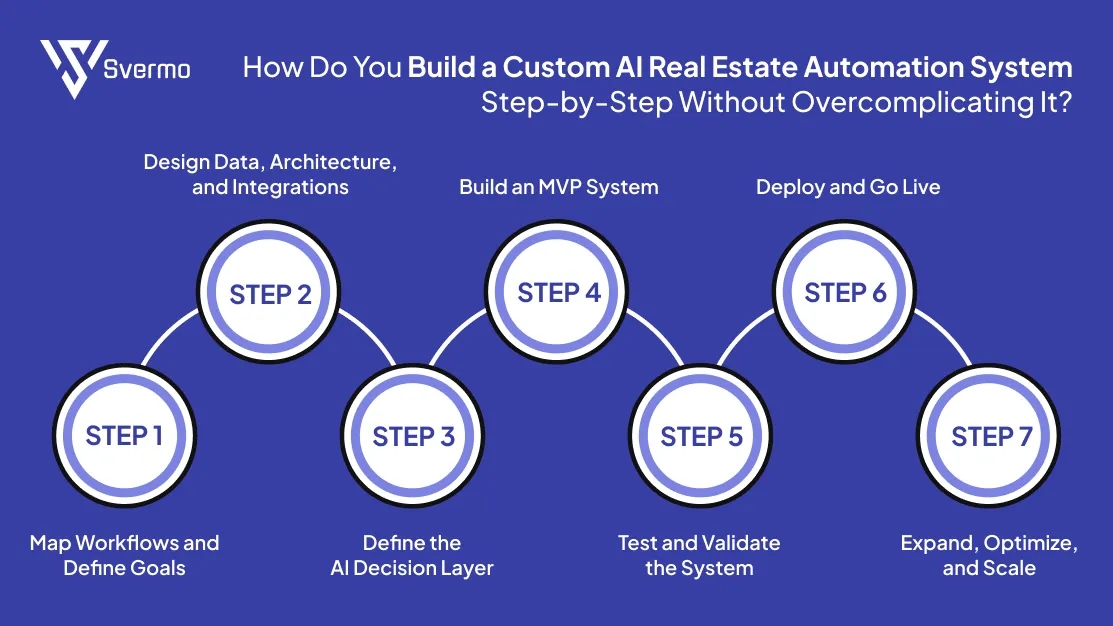
So how do you go from scattered tools to a system that actually runs your operations? The key is not adding more tools. It is structuring the process correctly. When each step is done in the right order, your system becomes easier to build, test, and scale.
Here’s the refined process to build a custom AI real estate automation system.
Step 1: Map Workflows and Define Goals
Start by understanding how your business currently operates. Look at how leads enter, how they move across stages, and where delays occur. This gives you clarity on what needs to be fixed first. Without this step, automation will only replicate existing inefficiencies. This is how you develop AI real estate automation system based on real gaps.
- Identify all lead sources and entry points
- Track how leads are handled and followed up
- Define clear goals like faster response or better conversion
Step 2: Design Data, Architecture, and Integrations
Once workflows are clear, define how your system will function behind the scenes. This includes how data is structured, how systems connect, and how workflows are triggered. This step ensures everything works as one connected system instead of isolated tools. It is critical for real estate automation system development integrating all platforms.
- Structure lead and workflow data
- Map connections between CRM, portals, and communication tools
- Define how data flows and triggers actions
Step 3: Define the AI Decision Layer
Now decide where AI should be applied. Focus only on areas where decisions are required, not simple rule-based tasks. AI should help with prioritization and decision-making. This is how you create AI automation system for real estate business that delivers real value.
- Define use cases like lead scoring and prioritization
- Separate AI-driven actions from rule-based workflows
- Identify data required for AI decisions
Step 4: Build an MVP System
Instead of building everything at once, start with a small working version. Focus on one complete workflow, usually lead capture to first response. This approach reduces risk and helps you validate quickly. It is the fastest way to build AI automation for real estate workflows.
- Automate lead capture and initial response
- Connect core tools and workflows
- Prepare the system for real-world testing
Step 5: Test and Validate the System
Before going live, test your system using real scenarios. This is where most gaps and issues appear. Testing ensures your workflows work under actual conditions. It helps you fix problems before they impact operations.
- Run workflows with real or simulated leads
- Check response timing and workflow accuracy
- Identify and fix issues before deployment
Step 6: Deploy and Go Live
Once testing is complete, deploy your system in a controlled way. Start with a small team or region before full rollout. This reduces risk and gives you time to adjust based on real usage. It also ensures smoother adoption.
- Launch with limited users or locations
- Monitor performance closely after launch
- Train teams on how to use the system
Step 7: Expand, Optimize, and Scale
After deployment, focus on improving and expanding the system. Add more workflows and optimize based on real performance data. This is how you create scalable real estate automation systems for brokers that grow with your business.
- Add new workflows and automation layers
- Optimize based on user behavior and results
- Scale across teams, regions, and operations
As you move through these steps, many teams also look into how specialized partners approach building such systems end to end. Working with a property management AI software solutions provider can give you a clearer view of how architecture, workflows, and integrations come together in real-world implementations.
So now that you understand how to build a custom AI real estate automation system step by step, the next question becomes practical.
What technology stack do you actually need to power this system and make it work reliably at scale?
What Tech Stack Do You Need to Build a Custom AI Real Estate Automation System That Actually Scales?
So you understand the process. Now comes the execution layer. What technologies actually power a custom AI real estate automation system, and how do you choose the right stack without overengineering it?
The goal is not to pick trendy tools. The goal is to select technologies that support flexibility, integrations, and long-term scalability.
Here’s how to think about the tech stack.
Layer | What You Should Use | Why It Matters |
|---|---|---|
Frontend (User Interface) | React or Vue for web apps, optional mobile apps for field teams | Provides a clean and responsive interface for agents and managers. A well-built frontend improves usability and speeds up daily operations. |
Backend (Application Logic) | Node.js, Python, or Java-based frameworks | Handles workflows, automation logic, and system coordination. A strong backend ensures your AI real estate automation system development remains scalable and reliable. |
Database (Data Layer) | PostgreSQL for structured data, MongoDB for flexible schemas | Stores leads, listings, and interactions in a structured way. Clean and scalable data storage is critical for accurate automation and decision-making. |
AI/ML Layer | Machine learning models for scoring, recommendations, and predictions | Powers intelligent decisions like lead prioritization and property matching. Many teams refer to approaches like real estate AI software development to understand how this layer is implemented in real systems. |
Integration Layer (APIs) | REST APIs, webhooks, and middleware platforms | Connects CRM, listing portals, communication tools, and marketing platforms. This is essential for real estate automation system development integrating multiple systems into one flow. |
Communication Layer | WhatsApp APIs, email services, SMS gateways, call integrations | Enables real-time communication across channels. This ensures consistent engagement and supports create AI automation system for real estate business workflows. |
Workflow Automation Engine | Custom workflow engine or automation tools | Manages triggers, actions, and process flows. This is what allows you to build AI automation for real estate workflows that run without manual effort. |
Cloud & Infrastructure | AWS, Google Cloud, or Azure | Provides hosting, scalability, and performance. Cloud infrastructure ensures your system can handle growth without performance issues. |
Security & Access Control | Authentication systems, encryption, role-based access | Protects sensitive data and ensures controlled access. This is essential for maintaining trust and secure operations. |
Now that the process and technology are clear, the next question becomes practical.
How Much Does It Cost to Build a Custom AI Real Estate Automation System and What Actually Drives It?
If you’re planning to build a custom AI real estate automation system, the first question is always cost. In most cases, the investment ranges between $20,000 to $300,000+. This varies based on workflow complexity, integrations, AI capabilities, and scale.
A basic setup costs less, while a fully integrated system designed for large teams and multiple regions costs significantly more. Understanding this cost is critical when you start AI real estate automation system development, because each component directly impacts how your system performs in real operations.
Feature Wise Cost Breakdown of Custom AI Real Estate Automation System Development
Feature / Component | Estimated Cost Range | What You’re Paying For |
|---|---|---|
Workflow Design and Mapping | $5,000 – $15,000 | You are paying for analyzing operations and designing structured workflows. This defines how you create custom real estate automation workflows system that controls lead movement and process flow. |
Lead Capture and Distribution System | $5,000 – $20,000 | This includes capturing leads from multiple sources and routing them automatically. It supports developing real estate automation system for managing leads and listings across channels. |
CRM Integration and Data Layer | $10,000 – $30,000 | You are paying for structuring and syncing data across systems. This ensures consistency required to develop real estate business process automation system. |
Communication Automation (Email, WhatsApp, SMS) | $5,000 – $25,000 | This covers automated follow-ups and engagement workflows. It helps create AI automation system for real estate business that responds instantly. |
AI Lead Qualification and Scoring | $10,000 – $40,000 | You are paying for intelligence that evaluates and prioritizes leads. This supports AI-powered business process automation real estate. |
Scheduling and Calendar Automation | $5,000 – $15,000 | This automates bookings, site visits, and coordination. It reduces manual effort and improves workflow efficiency. |
Workflow Automation Engine | $10,000 – $35,000 | This is the core engine that runs workflows and triggers actions. It enables build AI automation for real estate workflows. |
Dashboard and Reporting | $5,000 – $20,000 | You are paying for visibility into leads, performance, and operations. This helps track and optimize outcomes. |
Multi-Platform Integrations | $10,000 – $40,000 | This connects CRM, portals, and communication tools. It is essential for real estate automation system development integrating all systems. |
Factors that Affect the Cost of AI Real Estate Automation System
The cost of AI real estate automation system development depends on how complex and customized your system needs to be.
1. Workflow Complexity
More workflows mean more logic and automation layers. If you aim to create custom real estate automation workflows system, cost increases with variations.
2. Number of Integrations
Each integration adds development effort. Connecting multiple platforms increases complexity in real estate automation system development integrating systems.
3. Level of AI Implementation
Basic automation costs less. Advanced features increase cost when you develop AI real estate automation system with deeper intelligence.
4. Customization Level
Fully custom builds require more effort than templates, but they provide flexibility and scalability.
5. Scale of Operations
Systems built for larger teams require stronger architecture. This impacts cost when you create scalable real estate automation systems for brokers.
Hidden Costs in Custom AI Real Estate Automation System Development
- Data Cleanup and Structuring: Unstructured or inconsistent data must be cleaned before automation works. This is essential for accurate end-to-end real estate process automation.
- Integration Maintenance: Third-party APIs change frequently. Maintaining integrations requires ongoing updates and monitoring.
- Workflow Updates: As your business evolves, workflows need adjustments. This adds continuous development effort.
- Training and Adoption: Teams need time and support to use the system effectively. Poor adoption reduces ROI.
- Third-Party Service Costs: Costs for APIs like messaging, email, or CRM tools can increase as usage grows over time.
- Performance Optimization: As data and usage grow, system performance tuning may be required to maintain speed and reliability.
- Security and Compliance Updates: Ongoing updates are needed to keep data secure and aligned with compliance requirements.
How to Optimize Cost While You Build a Custom AI Real Estate Automation System
- Start With One Workflow: Focus on one high-impact process first. Then expand gradually to develop real estate automation using AI efficiently.
- Avoid Overengineering AI: Apply AI only where needed. Keep other workflows simple to control cost.
- Plan Integrations Early: Early planning reduces rework and avoids unnecessary cost in AI real estate automation system development.
- Build for Long-Term Use: Avoid patching tools together. A well-designed system reduces long-term operational cost.
- Use Modular Development Approach: Build in phases so you can expand features without rebuilding the entire system.
- Prioritize High-Impact Features: Invest first in features that directly improve lead conversion and response time.
- Choose Scalable Infrastructure Early: Selecting the right infrastructure reduces future migration and scaling costs.
Many businesses also evaluate how real automation systems are implemented before investing. Looking at integrating AI IVR system with real estate CRM platforms can help you understand how communication, CRM, and automation layers connect in a real-world setup.
In the next section, understand the key challenges you may face while developing a custom AI real estate automation system.
Not Sure What This Will Cost for Your Business?
Every system is different. The right estimate comes from your workflow, not a guess. Let’s break it down for your exact requirements.
What Challenges Should You Expect When Building a Custom AI Real Estate Automation System and How Do You Solve Them?

So before you move ahead and start building, there’s one more important thing to consider.
What actually breaks when you try to build a custom AI real estate automation system, and why do so many implementations fail? It’s not because automation does not work. It’s because most systems are built without aligning workflows, data, and real business behavior.
If you are planning AI real estate automation system development, these are the issues you will face.
1. Too Many Tools, No Real Control
Most real estate businesses already use multiple tools. CRM, listing portals, WhatsApp, email, and ad platforms all operate separately. Nothing is truly connected.
This creates confusion, delays, and missed opportunities. Teams keep switching tools, and no one has full visibility across operations.
Solution:
Instead of adding more tools, focus on building a unified system. Bring all channels and data into one place. This is where real estate automation system development integrating all platforms becomes critical to regain control and visibility.
2. Automation Doesn’t Fit How We Work
This is one of the most common frustrations. Many businesses try automation tools, but they do not match real workflows. Real estate processes are not linear. They change based on lead behavior, property type, and team structure. This is where most generic tools fail.
Solution:
Design workflows around your actual operations. You need to create custom real estate automation workflows system that adapts to your business instead of forcing your team to adjust.
3. Disconnected Data Across Channels
Leads come from multiple platforms, but the data is not consistent. The same lead often exists in different systems with incomplete or conflicting information. This breaks follow-ups and reduces conversion efficiency.
Solution:
Create a unified data layer with standardized inputs. This is essential for AI-driven workflow engine for real estate to function accurately and maintain consistency across workflows.
4. Overengineering the AI Layer
Many teams assume more AI will solve more problems. They try to apply AI across every workflow without clear use cases. This increases cost, slows down implementation, and creates unnecessary complexity.
Solution:
Apply AI only where it improves decision-making. Focus on key areas like prioritization and intent analysis when you develop AI real estate automation system, and keep the rest simple.
5. Automation Without Context
Basic automation executes actions but lacks understanding of user behavior. This leads to irrelevant follow-ups and poor user experience. Leads receive messages that do not match their intent or stage.
Solution:
Use context from past interactions and behavior. This is where real estate workflow orchestration becomes important to ensure actions are relevant and timely. Many teams also explore approaches like AI chatbot development for real estate to handle contextual conversations at scale.
6. Low Team Adoption
Even a well-built system can fail if your team does not use it consistently. This usually happens when the system feels complex or disconnected from daily workflows. Teams revert to manual processes, and automation loses its value.
Solution:
Keep the system simple and aligned with real usage patterns. Introduce automation gradually and ensure proper onboarding for your team.
7. Systems That Break When You Scale
Many systems work at a small level but fail when lead volume increases or operations expand. Performance drops, workflows break, and manual work starts increasing again.
Solution:
Build with scalability in mind from the start. This is critical when you want to create scalable real estate automation systems for brokers handling large volumes and multiple teams.
8. Expecting Automation to Fix Broken Processes
Automation cannot fix unclear workflows. If your process is inefficient, automation will only make those inefficiencies faster. This leads to poor results and frustration.
Solution:
Fix your workflows before automating them. This is key to successful end-to-end real estate process automation that delivers real business outcomes.
Now that you’ve seen what can go wrong and how to fix it, one thing becomes clear. This space is evolving fast. So what should you expect next, and how will custom AI real estate automation systems change in the coming years?
Where Is Custom AI Real Estate Automation Headed Next and What Should You Prepare For?
You’ve seen how to build a custom AI real estate automation system, what it costs, and what can go wrong. At this point, the focus shifts from execution to direction. What you build today should not just solve current problems, it should stay relevant as your business grows and the market evolves.
The real difference over the next few years will not come from adding more features. It will come from how well your system is designed to handle complexity, adapt to change, and support long-term growth.
1. From Tool-Centric Setups to System-Centric Operations
Most real estate businesses still operate using multiple disconnected tools. Teams rely on CRM, portals, communication apps, and spreadsheets, all working separately. This creates constant manual effort just to keep operations running. The shift is toward systems that act as the central operating layer.
Instead of switching between tools, everything runs through one structured environment that manages workflows, communication, and data together. To align with this shift, you need to design your system as the core of your operations. When you develop AI real estate automation system, it should replace fragmented processes rather than sit on top of them.
2. Custom-Built Systems Becoming the Standard
Generic platforms are useful at the beginning, but they quickly become limiting as operations grow. Real estate workflows are not fixed. They vary based on team structure, lead sources, and business models. As complexity increases, businesses are moving toward custom AI real estate automation system development services that match their specific needs.
This allows them to build workflows that reflect how they actually operate. To stay ahead, you need to move away from one-size-fits-all solutions. Building a system tailored to your workflows ensures flexibility, better adoption, and long-term scalability.
3. Continuous Operations Instead of Trigger-Based Execution
Most automation today works on triggers. A lead comes in, and then the system reacts. While this works, it still creates gaps between actions. Future systems will operate in a continuous flow. They will monitor activity, maintain engagement, and keep workflows moving without waiting for specific triggers.
This is a more advanced form of real estate workflow orchestration. To prepare for this, design workflows that stay active and responsive. Instead of relying only on triggers, your system should be able to maintain momentum across the entire process.
4. Data Maturity Defining Market Leaders
Many businesses collect large volumes of data, but very few use it effectively. Data often remains unstructured or disconnected across systems. In the coming years, the gap between companies will depend on how well they structure and use their data.
Strong data foundations directly impact the success of AI real estate automation system development. To take advantage of this, focus on building a clean and consistent data layer. The better your data structure, the more effective your automation and decision-making will become.
5. Growth Without Operational Expansion
Scaling a real estate business has traditionally required hiring more agents, coordinators, and support staff. This increases operational complexity and cost. That model is changing. Systems now allow businesses to handle higher volumes without proportional team growth.
This is where you start to create scalable real estate automation systems for brokers that support expansion without increasing workload. To align with this trend, your system should be designed to absorb growth. The goal is to increase output while keeping operations efficient and manageable.
6. Depth of Integration Becoming a Competitive Edge
Using multiple tools is not the problem. The real issue is how weak the connections between them are. Poor integration leads to data gaps, delays, and inconsistent workflows. Future systems will rely on deeper integrations where data flows seamlessly across platforms.
This is shaping how real estate automation system development integrating evolves. To prepare for this, focus on building strong integration layers. Well-connected systems reduce friction and allow your workflows to operate smoothly across all platforms.
7. Systems Designed for Constant Evolution
Real estate operations are not static. Markets change, customer behavior shifts, and business models evolve. Systems that cannot adapt quickly become outdated. Future-ready systems are built to evolve continuously. They allow updates, improvements, and expansion without requiring a complete rebuild.
This aligns with long-term develop real estate business process automation system strategies. To stay competitive, build with flexibility in mind. Your system should adapt as your business changes, without disrupting ongoing operations.
What This Means for Your Business
The direction is clear. Automation is no longer just about efficiency. It is about building systems that support growth, adaptability, and long-term performance. If you are planning to build a custom AI real estate automation system, your focus should not be limited to solving current problems. You need to think about how your system will perform as your business scales and evolves.
Now you have the full picture. From understanding automation to building it, optimizing it, and preparing for what comes next. The final step is to turn this understanding into action
Why Choose Svermo for Custom AI Real Estate Automation System Development?
Svermo builds systems around how your business actually operates. Instead of forcing tools into your workflow, the focus is on helping you build a custom AI real estate automation system that aligns with your lead flow, sales process, and team structure. This ensures the system works in real conditions, not just as a setup.
The approach is fully custom, not template-based. This allows you to develop AI real estate automation system that adapts as your business grows and supports different workflows without limitations.
Integration is treated as a core layer. CRM, property portals, and communication channels are connected into one system, ensuring smooth real estate automation system development integrating all platforms without data gaps or delays.
AI is applied where it creates real impact. The focus stays on lead prioritization, routing, and response workflows, keeping your AI real estate automation system development practical and scalable.
When comparing providers, it helps to look at how leading teams approach this space. Lists like best agentic AI development companies for real estate in USA
often highlight companies that focus on workflow-first design and deep integrations, which is exactly how Svermo builds systems.
From design to deployment, everything is handled as one connected process, ensuring your system remains stable, scalable, and aligned with your operations.
Ready to Replace Tools with a System That Actually Runs Your Business?
If you’re serious about scaling without chaos, this is the next step. Let’s build something that works in real conditions.
Wrapping Up!
You’ve seen how to build a custom AI real estate automation system, including workflows, tech stack, cost, and risks.
The goal is not more tools. It is a system that handles leads, follow-ups, and communication without gaps. When everything is connected, response time improves and operations become consistent. Most teams struggle because their tools are disconnected. Fixing this creates immediate impact. Leads are not missed, follow-ups are timely, and teams focus on conversions.
Start with one workflow. Validate it. Then expand. This is how you develop real estate automation using AI without unnecessary complexity. Many businesses compare providers before building. Looking at top 10 AI chatbot development companies for real estate helps you understand different approaches to system design and delivery.
Svermo builds systems around real workflows, not templates. The focus is on integration, scalability, and practical AI implementation. The result is a system that runs operations, not just supports them.
If you want to replace fragmented tools with a system that works, contact now.
 https://www.linkedin.com/in/saanvi-verma-38711a36a
FAQs
Start by mapping your current workflows and identifying gaps. Then design your data layer, integrations, and automation logic. The right approach is to build a custom AI real estate automation system step by step, starting with one workflow and expanding gradually.
Begin with lead entry points, then define how leads move across stages like qualification, follow-up, and conversion. Each stage should have clear triggers and actions. This is how you create custom real estate automation workflows system that reflects real operations.
You need to connect your website, portals, and ads to a central system. Then automate responses, lead routing, and scheduling based on rules or AI. This is a key part of developing real estate automation system for managing leads and listings efficiently.
This requires API-based integration where data flows between systems in real time. A unified architecture ensures all platforms stay connected. This is critical for real estate automation system development integrating multiple tools into one workflow.
Yes, AI can respond to inquiries, qualify leads, and schedule visits based on availability. It works best when combined with structured workflows. This is where AI-powered business process automation real estate delivers real efficiency.
Most tools fail because they do not match your workflows. Real estate processes are dynamic, and generic tools cannot handle that complexity. That is why businesses choose to develop AI real estate automation system tailored to their operations.
The cost typically ranges from $20,000 to $300,000+, depending on features, integrations, and scale. A basic system costs less, while a fully integrated solution costs more. Investing in custom AI real estate automation system development services ensures long-term scalability and better ROI.
Want to See This for Your Business?
Start with your workflows. Build from there.