
Agentic AI Development for Real Estate: Architecture, Steps, Cost & Challenges


Get a summary of this article with your favorite AI





AI Summary
- •Agentic AI development for real estate runs end-to-end workflows autonomously across leasing, maintenance, and tenant operations.
- •Key use cases of agentic AI include tenant communication, predictive maintenance, leasing pipeline, and approval workflows.
- •Requires orchestration layers, decision engines, and API integration across CRM, PMS, and ERP systems to enable agentic AI for property operations automation.
- •Development costs of Agentic AI range from $30K–$250K+, with hidden expenses like data cleanup, team training, and infrastructure inflating budgets.
- •Start with high-impact workflows, expand using reusable components the smartest way to scale agentic AI development for real estate.
- •Svermo builds custom agentic AI workflow-specific automation system dedicated to real estate operations.
Why do real estate operations become harder to manage as your portfolio and systems grow?
As your real estate business scales, operations don’t get simpler, they get more fragmented. Leasing workflows slow down, internal coordination becomes complex, and critical processes start depending on manual follow-ups across teams and systems. Even with CRM, PMS, and other tools in place, workflows rarely move seamlessly end to end. This is exactly where agentic AI development for real estate is starting to gain attention across the industry.
Most systems today support tasks but don’t run workflows. That’s why your team still spends time on follow-ups, handoffs, and tracking.
Now here’s what makes this urgent.
According to Morgan Stanley’s real estate AI insights, AI can automate up to 37% of real estate tasks, unlocking billions in operational efficiency.
So the opportunity is already here.
This is why more companies are turning to AI-driven automation for real estate firms and investing in real estate AI software solutions to streamline enterprise operations.
Instead of adding more tools, they’re building systems that can manage workflows across leasing, maintenance, and tenant operations.
This is what agentic AI for property operations automation enables. Let's break it down. But do you know what exactly agentic AI is in real estate, and why are more property teams adopting it now?
Are Your Property Operations Still Running on Manual Workflows?
If your team is still chasing tasks across systems, it’s time to rethink how your operations run.
What Is Agentic AI in Real Estate and Why Are Property Operations Turning to Agentic AI for Automation?
Let’s keep this simple.
Agentic AI is not just automation. It is a system that can handle tasks, make decisions, and move workflows forward without waiting for manual input.
In real estate, this means your operations don’t stop after a trigger. They continue until the task is completed. With agentic AI development for real estate, you’re building systems that actively manage workflows instead of just supporting them.
Most existing tools work differently. They follow fixed rules, stop after one action, and require your team to step in to move things forward.
Agentic systems handle multi-step workflows, make decisions based on context, coordinate across systems, and complete tasks end to end. This is where agentic AI for property operations automation starts to outperform traditional tools.
Here’s what’s driving the shift:
- Fewer manual handoffs across leasing, maintenance, and tenant workflows
- Faster response times without increasing team size
- Better coordination between CRM, PMS, and communication tools
- Reduced delays caused by follow-ups and approvals
- Consistent execution across properties and locations
- Higher operational efficiency without adding complexity
That is the reason more teams are investing in property management AI software solutions and adopting enterprise AI solutions for real estate operations.
What this means for your operations is simple.
- You move from tools that support tasks to systems that actually run workflows.
- You reduce manual coordination and improve process reliability.
- And you build operations that can scale without breaking.
At this point, you might be thinking this sounds similar to chatbots or basic automation tools. But the difference is bigger than it looks, and it directly impacts how your operations perform.
Let’s break that down next.
Agentic AI vs AI Agent in Real Estate: Are You Automating or Just Conversing?
Most real estate teams use AI agents that respond and assist at a task level. They follow predefined logic and still rely on human input to complete workflows. Agentic AI goes further. It operates at a process level, makes decisions, coordinates across systems, and completes workflows end to end.
This is the core difference behind agentic AI vs chatbots in real estate. Teams that rely solely on real estate AI chatbot development often find it handles conversations well but falls short on end-to-end workflow execution.
Capability | AI Agent | Agentic AI |
|---|---|---|
Interaction | Responds to user queries or prompts, typically in a conversational format without initiating actions on its own. | Takes actions based on context, such as triggering workflows, updating systems, or initiating next steps automatically. |
Workflow Handling | Executes predefined steps but stops once the task is completed or requires further input. | Runs complete workflows from start to finish, handling multiple steps without interruption. |
Decision-Making | Follows fixed rules or limited logic, often requiring human validation for next steps. | Makes context-aware decisions based on data, conditions, and workflow requirements. |
System Coordination | Operates within a single system or limited integrations, often requiring manual handoffs between tools. | Coordinates across CRM, PMS, ERP, and communication tools to keep workflows moving seamlessly. |
Workflow Continuity | Stops after completing a specific task or interaction, waiting for further instructions. | Continues executing until the entire workflow is completed, including follow-ups and updates. |
Scope of Execution | Focused on individual tasks such as answering queries or capturing data. | Operates at a process level, managing end-to-end operations like leasing or maintenance workflows. |
Adaptability | Limited ability to improve, mostly dependent on predefined logic or scripts. | Learns from data and interactions over time, improving execution and decision-making. |
Operational Role | Acts as an assistant that supports users in completing tasks. | Acts as an operator that executes workflows independently across systems. |
Human Dependency | Requires frequent human input for decisions, approvals, and workflow continuation. | Reduces human involvement by handling decisions, coordination, and execution autonomously. |
This is why moving from task-level automation to process-level execution changes everything.
So how does agentic AI actually coordinate tasks, make decisions, and keep workflows moving across your systems?
How Does Agentic AI Actually Work in Property Operations Behind the Scenes?
At a high level, agentic AI development for real estate connects your workflows, systems, and decisions into one execution layer.
Instead of isolated automation, it enables AI-driven workflows that move from input to completion without constant manual intervention.
Here is the full explanation of how AI agents for real estate workflow automation operate across day-to-day property operations.
1. From Input to Execution
Every workflow starts with an input, like a tenant request, a leasing inquiry, or a maintenance issue. Instead of just capturing it, the system understands intent and immediately moves the workflow forward.
It doesn’t wait for manual action and decides what needs to happen next and initiates the process across systems.
- Captures requests across channels (email, chat, portals)
- Interprets intent using context and past data
- Triggers the next step automatically
- Initiates workflows across connected systems
2. How Multi-Step Workflows Are Managed
Real estate workflows are rarely single-step. They involve multiple stages, dependencies, and stakeholders. Agentic AI treats them as one connected process rather than separate tasks.
It ensures that workflows don’t break between steps or require manual coordination to move forward.
- Breaks workflows into structured steps (leasing, maintenance, tenant lifecycle)
- Manages dependencies between tasks and approvals
- Executes actions in sequence across systems
- Ensures workflows continue until completion
3. Decision-Making in Real Time
A key part of how this system works is decision-making. Instead of following fixed rules, it evaluates real-time data and context to take the next best action.
This reduces delays and removes the need for constant back-and-forth coordination.
- Prioritizes tasks based on urgency and impact
- Selects vendors based on availability and performance
- Adjusts schedules dynamically
- Uses historical data to improve outcomes
4. Coordination Across Systems
Agentic AI connects your existing tools instead of replacing them. It ensures workflows move across systems without manual intervention.
This is where enterprise AI solutions for real estate operations create real value at scale. For inbound communication workflows specifically, AI IVR system development for property management plays a key role in routing and capturing tenant interactions before they enter the broader workflow.
- Integrates through APIs across CRM, PMS, ERP, and communication tools
- Syncs data between platforms in real time
- Eliminates manual system switching
- Enables seamless AI agents integration with property management software
5. Continuous Workflow Orchestration
The most important part is continuity. The system tracks workflows, manages progress, and ensures tasks are completed end to end.
It turns automation into agentic AI for property operations automation that actually runs operations.
- Monitors task progress across systems
- Sends automated updates to tenants and teams
- Handles exceptions and delays
- Ensures end-to-end workflow completion
Now that you understand how it works, the next question is where does it actually deliver value?
Let’s explore the key use cases next.
Where Can Agentic AI Create the Biggest Impact? Key Use Cases in Real Estate Operations
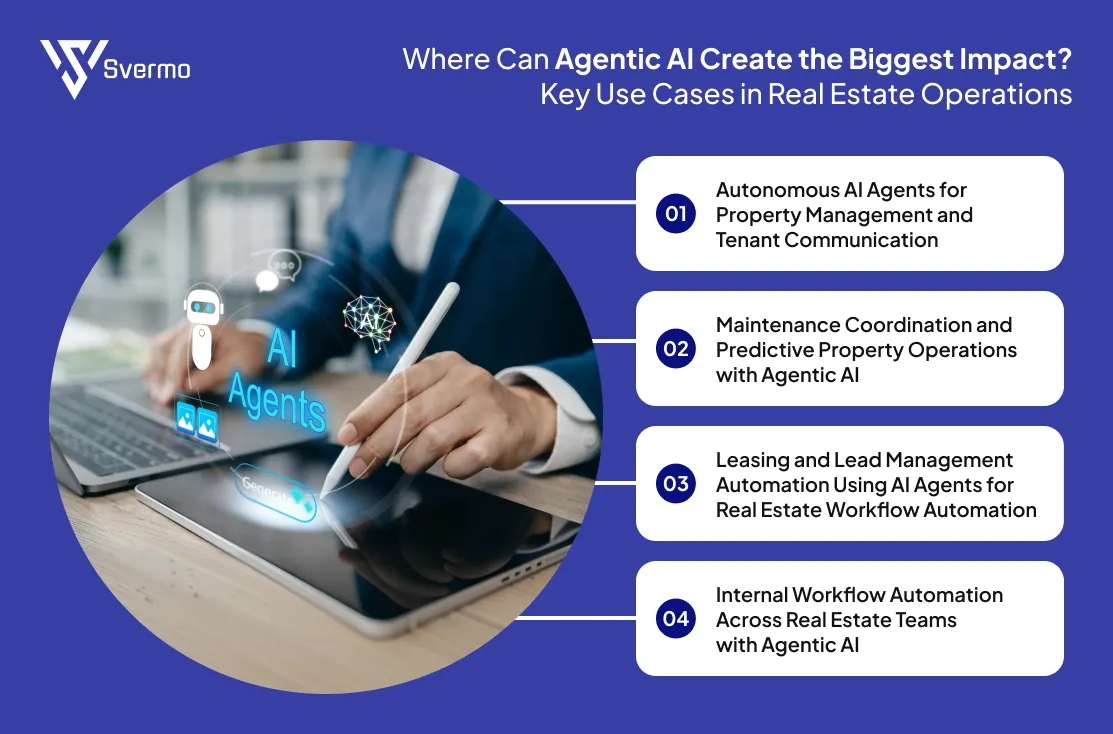
Real estate operations involve multiple workflows running in parallel, from tenant communication to maintenance and leasing. Most of these processes depend on coordination between people and systems, which often creates delays and inefficiencies.
This is where agentic AI for property operations automation starts delivering measurable impact by handling these workflows end to end without constant manual intervention.
Let’s look at the key use cases of agentic AI in real estate.
1. Autonomous AI Agents for Property Management and Tenant Communication
Tenant communication often breaks due to delays, missed follow-ups, and scattered channels. Teams spend significant time responding, tracking, and managing interactions.
With autonomous AI agents for property management, communication becomes structured and continuous. The system maintains context, handles follow-ups automatically, and ensures every interaction moves forward without gaps.
Example:
A tenant requests lease renewal details. The system checks lease data in the PMS, identifies available renewal options, shares the right plan, and schedules a follow-up based on the tenant’s response.
2. Maintenance Coordination and Predictive Property Operations with Agentic AI
Maintenance workflows involve multiple stakeholders and steps, which often leads to delays and poor visibility. Manual coordination slows down resolution and impacts tenant satisfaction.
At this point, an AI assistant development for real estate improves execution. Workflows move from request intake to vendor assignment and completion without delays, while historical data helps prevent recurring issues.
Example:
A tenant reports a plumbing issue. The system evaluates urgency, selects a vendor based on availability and past performance, schedules the visit, and keeps both the tenant and property manager updated throughout the process.
3. Leasing and Lead Management Automation Using AI Agents for Real Estate Workflow Automation
Leasing requires timely responses and consistent follow-ups, but delays often result in lost opportunities. Managing multiple leads manually makes it difficult to maintain momentum.
Using AI agents for real estate workflow automation, keeps the leasing pipeline active. Leads are captured, qualified, and progressed without interruption, ensuring faster conversions.
Example:
A lead comes from a listing site. The system qualifies the lead, checks property availability in the CRM, schedules a tour, and continues sending reminders until the visit is completed.
4. Internal Workflow Automation Across Real Estate Teams with Agentic AI
Internal operations often involve approvals, reporting, and coordination across teams. These processes are typically manual and slow, creating bottlenecks in execution.
This is where you start to see how agentic AI improves property operations efficiency. Workflows are connected, approvals move faster, and execution becomes more consistent across teams.
Example:
A maintenance expense exceeds a set threshold. The system routes it to the appropriate manager for approval, tracks the decision, and proceeds with vendor payment once approved.
These use cases highlight the impact, but they are only possible when the right system capabilities are in place behind the scenes.
So what core features are required to build a reliable agentic AI system for real estate operations?
Seeing the Potential but Not Sure Where to Start?
The right use case can unlock immediate value. The wrong one can cost you time and resources.
What are the Core Features that Makes a Powerful Agentic AI System for Real Estate Operations?

To make agentic AI development for real estate work at scale, you need a strong system foundation, not just automation. These core features define how a reliable agentic AI system architecture for real estate handles workflows, data, and system coordination across property operations.
Here’s a breakdown of the core features and how each one contributes to building a scalable agentic AI system:
Core Feature | What It Does | Why It Matters |
|---|---|---|
Autonomous AI Agents Layer | Executes tasks across leasing, maintenance, and tenant operations without manual intervention. | Enables AI agents for real estate workflow automation, ensuring consistent and scalable execution. |
Workflow Orchestration Engine | Controls task sequencing, dependencies, and workflow progression from start to finish. | Prevents workflow breakdowns and ensures end-to-end execution. |
Data & Context Layer | Stores and maintains tenant, lease, and property data across systems. | Keeps workflows accurate and context-aware for better decision-making. |
Decision Engine | Evaluates data and selects the next best action in real time. | Improves speed and supports agentic AI for property operations automation. |
Integration Layer | Connects CRM, PMS, ERP, and communication platforms via APIs. | Enables seamless AI agents integration with property management software and removes data silos. |
Execution Layer | Performs actions like assigning vendors, scheduling tasks, and updating systems. | Ensures workflows are fully executed, not just triggered. |
Event-Driven Processing | Initiates workflows instantly from tenant actions, lead activity, or system updates. | Ensures real-time responsiveness and eliminates delays in operations. |
Policy-Driven Automation | Applies business rules for approvals, prioritization, and task routing. | Ensures consistency, flexibility, and compliance across workflows. |
Conditional Approval Routing (Human-in-the-Loop) | Routes tasks for approval based on thresholds like cost, urgency, or risk. | Balances automation with control for critical decisions. |
Monitoring & Observability Layer | Monitors workflows, detects issues, and provides system-level insights. | Helps maintain reliability, troubleshoot problems, and optimize performance. |
Security & Access Control Layer | Controls user roles, access levels, and data security across the system. | Ensures compliance and protects tenant and financial data. |
These core features form the foundation of a reliable system, ensuring your operations run smoothly, consistently, and without constant manual intervention.
So once this foundation is in place, what additional capabilities make agentic AI systems more powerful and enterprise-ready?
What Are the Advance Features that Make the Agentic AI Highly Demandable?
Once the core foundation is in place, advanced capabilities define how well the system performs under real-world complexity. These features in the following table focus on optimization, intelligence, and control, helping enterprises move beyond basic automation toward high-impact AI-driven automation for real estate firms.
Advanced Feature | What It Does | Why It Matters |
|---|---|---|
Predictive Maintenance Modeling | Uses historical and real-time data to predict potential maintenance issues. | Reduces downtime and supports proactive property operations. |
Intelligent Lead Scoring | Evaluates lead behavior, intent, and engagement signals to rank prospects. | Helps prioritize high-value leads and improves conversion rates. |
Adaptive Workflow Optimization | Continuously adjusts workflows based on outcomes and performance data. | Improves efficiency over time and reduces operational bottlenecks. |
Multi-Agent Coordination | Enables multiple AI agents to collaborate across different tasks and workflows. | Supports complex AI agents for real estate workflow automation without conflicts or delays. |
Constraint-Based Scheduling | Optimizes scheduling based on availability, priorities, and operational constraints. | Ensures efficient resource utilization and faster task completion. |
Semantic Property Search | Uses context-aware search to match properties with user preferences. | Improves relevance in property recommendations and user experience. |
Autonomous Exception Handling | Detects workflow failures and automatically applies corrective actions. | Prevents workflow disruptions and reduces manual intervention. |
Dynamic SLA Management | Tracks and adjusts service levels based on urgency and predefined rules. | Ensures timely execution and maintains service quality across operations. |
Scenario-Based Decision Simulation | Simulates different outcomes before executing decisions. | Reduces risk and improves decision accuracy in complex scenarios. |
Explainable AI (XAI) | Provides transparency into how and why decisions are made. | Builds trust and supports compliance in enterprise environments. |
Model Versioning & Experimentation | Manages different AI model versions with testing and rollback capabilities. | Ensures stability while enabling continuous improvement. |
Operational Anomaly Detection | Identifies unusual patterns in workflows, performance, or data. | Helps detect inefficiencies, risks, or potential issues early. |
These advanced capabilities enhance how agentic AI for property operations automation performs at scale, making systems more intelligent, adaptive, and reliable.
So once you understand what these systems can do, the next question is how to actually build and implement them effectively in your real estate operations.
How Do You Successfully Develop Agentic AI in Real Estate?
Building agentic AI is not just about models or tools. It requires structured workflows, strong system design, and seamless integration with existing tools. This is where most teams face challenges while implementing agentic AI in real estate.
To simplify the process, here’s a step-by-step approach you can follow.
1. Identify High-Impact Automation Opportunities
Start by analyzing your current operations to find where delays, manual effort, or inefficiencies exist. Focus on workflows that are repetitive, time-sensitive, and involve multiple handoffs.
This ensures your AI workflow automation for real estate stays aligned with real operational impact rather than isolated use cases.
- Map tenant, maintenance, and leasing workflows
- Identify bottlenecks and delays
- Prioritize high-volume, repetitive tasks
2. Define and Structure Workflows
Once opportunities are identified, break each workflow into clear steps. This includes defining dependencies, decision points, and expected outcomes.
Well-structured workflows are essential for building automation that can run reliably across real estate operations without constant intervention.
- Break workflows into steps and stages
- Define dependencies and conditions
- Identify decision points
3. Design the System Architecture
At this stage, you define how your system will be structured to support workflows and data flow. This includes identifying layers like agents, orchestration, and integrations.
A well-designed agentic AI system architecture for real estate ensures the system can scale and operate reliably across multiple properties. Teams looking to build a custom AI real estate automation system should pay particular attention to this stage, as architectural decisions made here directly impact how well the system scales later.
- Define system layers and components
- Plan data flow and integrations
- Ensure scalability and flexibility
4. Build MVP for Autonomous AI Systems
This is where development begins. You create an MVP of an agentic AI system that can handle specific workflows and execute tasks across systems.
The goal is not to build autonomous AI agent for real estate operations but a platform that can coordinate actions, make decisions, and move workflows forward with minimal human input.
- Define workflow-driven AI execution
- Enable decision-making within workflows
- Connect system components across tools and processes
- Test MVP workflow execution and outcomes
5. Integrate with Existing Real Estate Systems
Your system should work with your current tools rather than replacing them. Integration ensures workflows can move across systems without manual intervention.
This enables smooth AI agents integration with property management software and ensures data consistency across operations. A key part of this is integrating AI IVR systems with real estate CRM platforms, which ensures inbound communication is properly captured and routed into your broader workflow.
- Integrate CRM, PMS, ERP, and communication tools
- Enable real-time data exchange
- Ensure seamless workflow execution
6. Test, Monitor, and Optimize
After deployment, continuous monitoring and optimization are critical. This ensures workflows perform as expected and improve over time.
This is a key part of enterprise agentic AI implementation, where systems evolve based on performance and operational feedback.
- Monitor workflows and system performance
- Identify and resolve issues
- Continuously optimize processes
So once the system is in place, the next question is what does the actual tech stack behind agentic AI systems look like?
What Agentic Tech Stack Is Used to Build an AI System for Real Estate and What Does It Actually Look Like?
To make agentic AI development for real estate work in production, the tech stack must support real-time workflows, intelligent decision-making, and seamless system coordination.
A well-designed agentic AI system architecture for real estate combines multiple layers and technologies to enable scalable AI-driven workflows across property operations.
Layer / System | Tools / Technologies | Role in the System |
|---|---|---|
Frontend Layer | React, Next.js, Angular, Vue.js | Provides user interfaces for dashboards, workflow visibility, and system interaction |
Backend Layer | Node.js, FastAPI, Django, Spring Boot, .NET | Handles business logic, API management, and system coordination |
Data Layer | PostgreSQL, MongoDB, Snowflake, AWS S3, Pinecone, Weaviate | Stores structured data and enables semantic search for better context and decision-making |
Agent Layer | OpenAI, Anthropic, Azure OpenAI, LangChain, AutoGen, CrewAI | Powers intelligent systems that execute workflows and enable AI agents for real estate workflow automation |
Orchestration Layer | Temporal, Prefect, Apache Airflow (batch workflows) | Manages workflow execution, sequencing, and dependencies across systems |
Integration Layer | REST APIs, GraphQL, MuleSoft | Connects systems and enables AI agents integration with property management software |
CRM Systems | Salesforce, HubSpot | Manages leads, customer interactions, and leasing workflows |
Property Management Systems (PMS) | AppFolio, Buildium, Yardi | Handles operational data, leases, and maintenance workflows |
This structure gives you a clear view of how different layers and systems work together to support real-world real estate operations.
So once the architecture is clearly defined, the next step is understanding what it actually costs to build and scale this system effectively.
What Does It Cost to Build Agentic AI for Real Estate and What Drives the Investment?
If you're planning agentic AI development for real estate, cost is one of the first things you need clarity on. For most enterprise use cases, the investment typically ranges between $30,000 to $250,000+, depending on system complexity, number of workflows, integrations, and level of customization.
In larger implementations involving multi-property portfolios, this can go even higher. In terms of timeline, most real estate agentic AI development projects take 2 - 4 weeks for an MVP and 6-8 weeks to build an enterprise level system.
Feature-Based Cost Breakdown for Agentic AI Systems
The cost of Agentic AI System development for real estate is primarily driven by the system components you choose to build and how deeply they are integrated into your operations.
Feature / Component | Estimated Cost Range | Why It Impacts Cost |
|---|---|---|
Workflow Orchestration Engine | $10,000 – $40,000 | Complexity increases with multi-step workflows, dependencies, and real-time coordination requirements. |
Autonomous AI Agents Development | $15,000 – $60,000 | Cost depends on number of agents, task complexity, and level of autonomy required. |
Decision Engine & Logic Systems | $10,000 – $30,000 | More advanced decision-making (context-aware vs rule-based) increases development effort. |
Data Layer Setup & Pipeline Development | $8,000 – $25,000 | Data cleaning, structuring, and pipeline setup vary based on data quality and volume. |
Integration with CRM, PMS, ERP Systems | $10,000 – $50,000 | Each additional system and deeper integration adds complexity and testing overhead. |
Event-Driven Processing Setup | $5,000 – $20,000 | Real-time event handling requires additional infrastructure and system design. |
Policy Engine & Approval Workflows | $5,000 – $15,000 | Custom business rules and approval logic increase implementation effort. |
Monitoring & Observability Setup | $5,000 – $15,000 | Advanced tracking, logging, and debugging capabilities require additional setup. |
Security & Access Control Implementation | $5,000 – $20,000 | Role-based access, compliance requirements, and data protection increase cost. |
Advanced Features (Predictive Models, Optimization) | $15,000 – $70,000 | Model training, tuning, and data requirements significantly impact cost. |
UI/Dashboard & Reporting Systems | $5,000 – $20,000 | Custom dashboards and analytics increase frontend and backend development effort. |
Key Factors That Influence Agentic AI Development Cost for Real Estate
Beyond features, several factors directly impact the final cost of agentic AI development for real estate.
1. Workflow complexity
More dependencies, decision points, and cross-system interactions increase development effort.
2. Level of customization
Building custom agentic AI solutions for property management requires more time than using standard modules.
3. Integration depth
Deep agentic AI integration with the existing property management software increases both development and testing effort.
4. Data readiness
Unstructured or inconsistent data adds significant overhead in preparation and validation.
5. Scale of deployment
Multi-property and multi-location implementations require more robust architecture and infrastructure.
Hidden Costs in Enterprise Agentic AI Implementation
Many teams underestimate the hidden costs involved in enterprise agentic AI implementation, especially when moving from pilot to production.
1. Data Cleanup and Preparation
Most real estate data is fragmented across systems. Cleaning, structuring, and validating this data often takes more time and effort than expected.
2. Internal Training and Adoption
Your team needs time to adapt to new workflows and systems. Training, onboarding, and change management add both time and cost.
3. Ongoing Maintenance and Updates
Agentic AI systems require continuous improvements, bug fixes, and updates to stay effective as operations evolve.
4. Infrastructure and API Costs
Cloud usage, API calls, and compute resources create ongoing expenses that scale with system usage.
5. Monitoring and Performance Optimization
Tracking system performance, debugging workflows, and optimizing execution requires additional tools and resources.
How to Optimize Cost in Agentic AI Development for Real Estate
Cost optimization is not about reducing scope. It’s about building smart and scaling gradually while maintaining performance.
1. Start with High-Impact Workflows
Focus on 1–2 workflows that deliver immediate value instead of building everything at once.
2. Use a Modular Architecture
Design systems in modules so you can expand capabilities without rebuilding the entire system.
3. Prioritize High-ROI Integrations
Integrate only the systems that directly impact operations and revenue in the initial phase.
4. Reuse Components Across Workflows
Build reusable components for agents, workflows, and integrations to reduce development effort.
5. Optimize Infrastructure and Model Usage
Control compute usage, API calls, and model execution to avoid unnecessary costs at scale.
The investment can vary based on how you design and scale your system, but most cost overruns don’t come from development alone, they come from implementation gaps.
So before you move forward, it’s important to understand the challenges that can impact your enterprise agentic AI implementation and how to address them early.
Also read: Real estate AI software development cost
Not Sure What Your Investment Should Look Like?
Every system is different. Let’s break down what it would actually cost for your operations.
What Are the Biggest Challenges in Enterprise Agentic AI Implementation for Real Estate and How to Solve them?

Even with the right architecture and budget, implementing agentic AI in real estate comes with practical challenges. These are not just technical issues, they directly impact adoption, performance, and long-term success of AI-driven automation for real estate firms.
Here are the most common challenges teams face and what they look like in real-world scenarios.
Challenge | What It Means in Real Scenarios | How to Solve It Effectively |
|---|---|---|
Data Fragmentation Across Systems | Tenant, lease, and property data is spread across CRM, PMS, and other tools, breaking AI agents for real estate workflow automation and causing inconsistencies. | Build a unified data layer, standardize formats, and implement strong pipelines to support enterprise AI solutions for real estate operations. |
Integration Complexity with Existing Systems | Connecting CRM, PMS, ERP, and communication tools often leads to delays and incomplete workflows. | Use API-first architecture and phased rollout to ensure smooth AI agents integration with property management software. |
Change Management and Team Adoption | Teams resist new workflows due to lack of clarity and training. | Introduce gradual rollout, provide training, and align workflows with existing processes for better adoption. |
AI Reliability and Decision Accuracy | Incorrect decisions or failed workflows reduce trust in agentic AI for property operations automation. | Start with controlled use cases, monitor outputs, and continuously improve models and workflows. |
Scaling Across Multiple Properties | Systems that work for one property fail when expanded across multiple locations. | Design scalable AI systems for property management companies with modular architecture from the beginning. |
Lack of Workflow Clarity | Poorly defined workflows lead to inefficiencies and failed automation. | Clearly map processes before development to enable effective intelligent workflow automation for real estate enterprises. |
These challenges are common, but they are also predictable if you approach them with the right strategy.
So how do you move forward with the right partner and ensure your implementation delivers real operational impact?
Let’s look at what to consider when choosing an agentic AI development partner.
Why Svermo is the Top most Partner as an Agentic AI Development Company for Real Estate?
Choosing the right partner for agentic AI development for real estate is not just about technical capability. It’s about finding a team that understands your operations, your systems, and how to translate them into scalable automation.
At Svermo, we focus on building systems that go beyond basic automation. We design and deliver custom agentic AI solutions for property management that align with how your business actually operates, not generic templates that require you to adjust your workflows.
Many off-the-shelf tools can handle simple tasks, but they fall short when it comes to multi-step workflows, system integrations, and enterprise-level requirements. That’s where a tailored approach becomes critical. Teams evaluating agentic AI development companies will find that deep operational expertise and integration capability are what separate effective partners from generic vendors.
When evaluating an agentic AI development company for real estate, what matters most is execution. You need a partner who can take your operational complexity and turn it into reliable, scalable automation without disrupting your existing systems.
We combine domain expertise with technical execution to help you move from fragmented processes to fully connected, intelligent operations.
If you're planning to move toward intelligent automation, the next step is not just understanding the technology, but taking action with the right strategy and partner.
Ready to Turn Your Workflows into Autonomous Systems?
You’ve seen what’s possible. Now let’s build a system tailored to your business.
Wrapping Up!
Real estate operations are becoming more complex with every new system, property, and workflow. Manual coordination and disconnected tools are no longer sustainable at scale.
This is where agentic AI development for real estate changes how operations run. Instead of managing tasks, your systems start executing them, connecting workflows, making decisions, and keeping everything moving without constant intervention.
From tenant communication to maintenance and leasing, AI-driven automation for real estate firms enables faster execution, fewer errors, and better operational control. Whether you're just starting with real estate AI software development or scaling an existing system, the path forward starts with a clear strategy and the right partner. And if you want to evaluate the leading vendors in this space, reviewing the top 10 AI chatbot development companies for real estate can help you benchmark what good looks like before committing.
The shift is already happening. The question is whether your systems are ready to keep up. At Svermo, we help real estate businesses move from fragmented processes to fully connected, intelligent operations. If you're ready to explore what agentic AI can do for your workflows, contact us and let's build it together.
 https://www.linkedin.com/in/saanvi-verma-38711a36a
FAQs
Agentic AI development for real estate focuses on building systems that can execute complete workflows, not just assist with tasks. Unlike traditional automation, these systems can analyze data, make decisions, and take actions across leasing, maintenance, and operations without constant human input.
This shift from assistance to execution is what enables real transformation in real estate operations.
Not necessarily. Agentic AI development for real estate delivers the most value for mid-to-large firms with complex workflows, multiple systems, and high operational volume. Smaller teams with simple processes may not need full-scale agentic systems.
Traditional workflow tools automate predefined steps, but they don’t make decisions. Agentic AI systems can evaluate context, choose actions, and execute workflows end to end without constant human input.
ROI is typically measured through:
* reduction in manual workload * faster workflow execution * improved lead conversion rates * lower operational costs
The impact is most visible in time savings and operational efficiency.
The cost of agentic AI development for real estate typically ranges between $30,000 to $250,000+, depending on:
1. Workflow complexity 2. Number of integrations 3. Level of customization 4. Data readiness
Enterprise-level systems with multiple workflows and integrations tend to fall on the higher end of the range.
Agentic AI improves efficiency by automating multi-step workflows instead of isolated tasks. It reduces delays, removes manual handoffs, and ensures consistent execution across systems.
This is how agentic AI for property operations automation helps teams handle more properties and workflows without increasing operational overhead.
Yes, but it depends on integration capability. Most enterprise AI solutions for real estate operations use APIs or middleware to connect with legacy CRM, PMS, and ERP systems. In some cases, additional integration layers are required.
Why Are Your Property Operations Still Waiting on a Human to Hit Send?
Your workflows won't fix themselves. Let's build a system that actually runs them.