

Real Estate AI Software Development Cost Explained: How to Budget Smart Solutions for Real Estate Industry?


Get a summary of this article with your favorite AI




AI Summary
- •The real estate AI software development cost ranges from $30,000 to $150,000+, based on features, AI complexity, and integrations.
- •Costs span the full lifecycle, from planning and development to maintenance and scaling.
- •Hidden costs like infrastructure, APIs, and retraining increase the total cost to build AI software for real estate in USA.
- •Start with an MVP and prioritize key features to build affordable AI solutions for real estate businesses in USA.
- •Choosing the right development approach and preparing data early helps control cost and improve efficiency.
Are you looking for the cost to develop real estate AI software and don’t know how to plan your budget? Then you are in the right place.
The real estate AI software development cost typically ranges between $30,000 to $300,000+, depending on AI complexity, data, integrations, and scalability.
That range creates a real challenge. You may come across low estimates that exclude critical components or higher quotes without clear breakdowns. Without understanding what drives the cost to build AI software for real estate, budgeting becomes guesswork.
At the same time, the upside is significant.
- AI-driven innovations could generate $34 billion in efficiency gains across the real estate industry by 2030, says Morgan Stanley.
- According to Blott, AI-powered valuation models have also improved accuracy, with median error rates now around 2.8%, down from 10–15% a few years ago.
But these outcomes depend on how well your solution is planned. Without a clear real estate AI software development budget, teams either overspend or miss critical components like data pipelines and infrastructure.
Here, we’ll break down:
- The AI real estate software development cost in 2026
- The key cost factors in real estate AI software development
- A practical real estate AI software development cost calculator approach
- Budget planning and cost optimization strategies
- Development timelines, hidden costs, and ROI expectations
We’ll also connect these insights to real implementations. Projects like real estate AI software development require early cost visibility to avoid rework and budget overruns. By the end, you’ll have a clear framework to plan and control your AI investment.
Still guessing your AI budget?
Get a clear estimate tailored to your real estate business, not generic ranges.
How to Calculate the Real Estate AI Software Development Cost?
To estimate your real estate AI software development cost, you need a structured way to calculate it based on actual effort and supporting expenses. This framework helps you move from rough estimates to a more practical budget.
Simple Cost Estimation Formula
Total development cost = (development hours × hourly rate) + additional expenses
This formula splits your cost into two clear parts:
- Development cost - Time and effort required to build the solution
- Additional expenses - Infrastructure, APIs, data preparation, and tools
This makes it easier to understand how your cost to build AI software for real estate is calculated instead of relying on assumptions.
How to Apply this Formula
To use this real estate AI software development cost calculator, break your project into measurable inputs. Start by estimating total development hours across planning, AI model development, integrations, and testing.
Then define your hourly rate based on your team structure and add additional expenses like infrastructure, APIs, and data. It gives you a realistic estimate of your total real estate AI software cost. See the explanation below:
1. MVP-Level AI Software
You’re building a focused solution with limited features such as a chatbot or basic automation.
- Development hours: 500 – 800
- Hourly rate: $50 – $100
- Additional expenses: $5,000 – $15,000
Estimated cost: $30,000 – $70,000
This approach helps you validate your idea quickly while keeping your budget under control.
2. Mid-Size AI Software Solution
You’re building a more advanced system with integrations, analytics, and recommendation features.
- Development hours: 1,000 – 2,000
- Hourly rate: $75 – $150
- Additional expenses: $10,000 – $30,000
Estimated cost: $70,000 – $150,000
This level balances functionality and cost, making it suitable for growing real estate businesses investing in AI solutions.
3. Enterprise-Level AI Platform
You’re building a large-scale AI platform with predictive analytics, automation workflows, and multiple integrations.
- Development hours: 2,500 – 5,000+
- Hourly rate: $100 – $200
- Additional expenses: $30,000 – $80,000+
Estimated cost: $150,000 – $300,000+
At this stage, cost is driven by complexity and scalability, with a strong focus on long-term ROI.
This real estate AI software development cost calculator gives you a clear way to estimate your budget based on your project scale.
Instead of guessing, you can adjust hours, rates, and additional costs to align with your requirements and make informed investment decision.
What Does a Real Estate AI Software Development Cost Overview Look Like in 2026?
The real estate AI software development cost depends on scope, AI complexity, and integration. A simple MVP costs far less than a fully scalable, feature-rich platform. The more features, data processing, and integrations you add, the higher the cost to build AI software for real estate.
For example, something like real estate AI chatbot development will cost significantly less than building a full predictive analytics platform. Use the breakdown below to estimate your real estate AI software development budget quickly.
Realistic Cost Ranges by Project Type
Different projects come with different levels of complexity, which directly impacts the real estate AI software cost. A simple MVP will require fewer resources, while a full-scale solution involves more features, integrations, and infrastructure.
The table below gives you a quick view of what you can expect at each level, so you can align your real estate AI software development budget with your goals.
Project Type | Cost Range | Features Included |
|---|---|---|
MVP (Minimum Viable Product) | $30,000 – $70,000 | AI chatbot for lead qualification, basic property recommendation engine, simple automation workflows, limited integrations, basic dashboard |
Mid-Level Solution | $70,000 – $150,000 | AI chatbot + recommendation engine, CRM & MLS integration, analytics dashboard, workflow automation, improved UI/UX, user management features |
Enterprise-Grade Solution | $150,000 – $300,000+ | Predictive analytics, AI pricing models, advanced automation, large-scale data pipelines, custom dashboards, multi-system integrations, high-performance infrastructure |
Want a cost breakdown for your exact use case?
See where your money goes before you commit to development.
What are the Key Factors that Affect the Cost to Develop Real Estate AI Software?
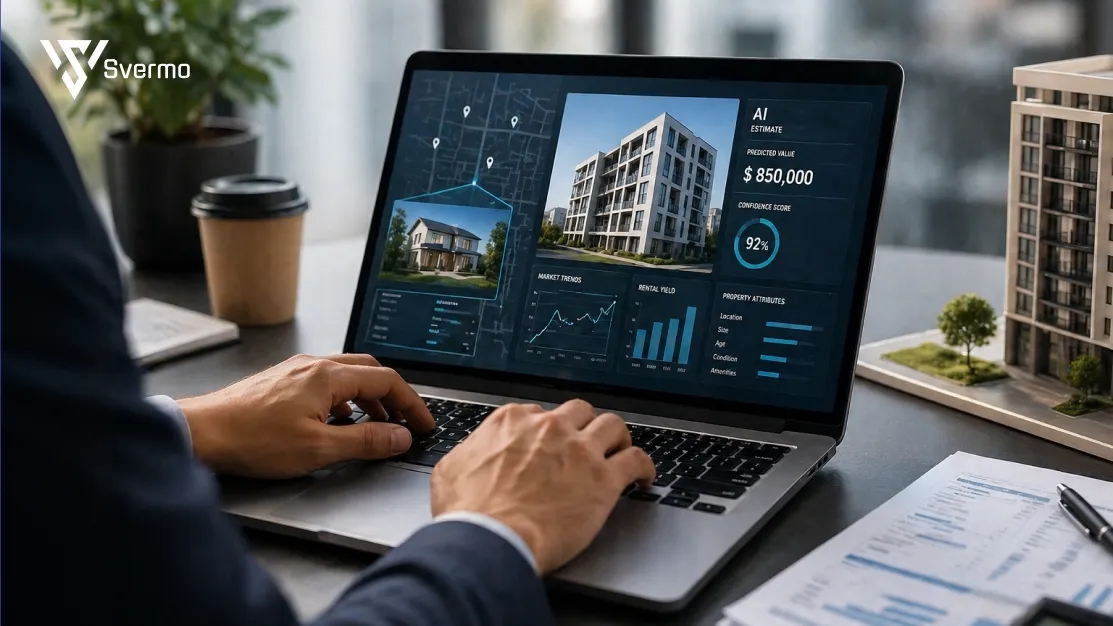
The real estate AI software development cost is shaped by a few core factors. These include AI complexity, data readiness, integrations, infrastructure, features, and team structure. Together, they determine your overall AI solution pricing for real estate in USA.
Understanding these early helps you plan a realistic real estate AI software development budget and avoid unexpected increases later.
1. Feature scope
The number and type of features you include directly define the base scope of your product. More features mean more development time, integrations, and testing effort.
Feature Level | Estimated Cost | Features Included |
|---|---|---|
Basic | $10,000 – $30,000 | Chatbots, lead capture, simple automation |
Moderate | $30,000 – $70,000 | CRM workflows, dashboards, notifications |
Advanced | $70,000 – $120,000+ | Analytics, recommendations, automation workflows |
Expanding feature scope increases development effort and directly impacts your real estate AI software development cost.
2. AI Complexity
AI complexity defines how intelligent your system is. As you move from simple logic-based systems to advanced AI models, the cost increases significantly.
AI Level | Estimated Cost | Capability |
|---|---|---|
Rule-based | $5,000 – $20,000 | Basic automation, predefined logic |
Machine learning | $20,000 – $60,000 | Predictions, recommendations |
Advanced AI | $80,000 – $200,000+ | Generative AI, multi-agent systems |
Higher AI complexity requires more data, training, tuning, and infrastructure, which increases your overall AI solution pricing for real estate in USA. Solutions like AI assistant development for real estate often involve multiple AI layers, which increases both effort and investment.
3. Data Preparation
The quality and structure of your data directly impact development speed and model performance. Well-prepared data reduces effort, while unstructured or fragmented data increases preprocessing time and cost.
Data Condition | Estimated Cost | Work Required |
|---|---|---|
Structured | $5,000 – $15,000 | Minimal cleaning and formatting |
Semi-structured | $15,000 – $30,000 | Cleaning, normalization, and mapping |
Unstructured | $30,000 – $50,000+ | Data labeling, transformation, validation |
This stage is often underestimated, even though it plays a major role in the cost of building AI software for real estate in USA.
4. Integration with CRM, MLS, and Third-Party Systems
Real estate AI systems need to connect with platforms like CRM, MLS, and other third-party tools to function effectively. Each integration adds backend complexity, data synchronization requirements, and testing effort. For instance, Integrating AI IVR system with real estate CRM platforms involves backend customization and validation, which increases development effort.
Integration Type | Estimated Cost | Scope |
|---|---|---|
Basic | $3,000 – $10,000 | Single CRM or API integration |
Moderate | $10,000 – $20,000 | CRM + MLS + third-party APIs |
Advanced | $20,000 – $30,000+ | Multi-system integrations with customization |
5. Infrastructure and Cloud Costs for AI Solutions
AI systems rely on infrastructure for data storage, processing, and model execution. As usage increases, costs scale based on how much data is processed, how many users interact with the system, and how frequently AI models run. As data volume and user activity grow, infrastructure becomes a larger share of your real estate AI technology investment.
Component | Estimated Cost | Usage |
|---|---|---|
Setup | $5,000 – $20,000 | One-time cost for cloud setup, server configuration, database setup, and deployment pipelines |
Monthly (low) | $1,000 – $3,000 | Limited users, low data volume, and basic AI processing with occasional model usage |
Monthly (high) | $5,000 – $10,000+ | High user traffic, real-time processing, frequent AI model execution, and large data storage |
6. Development Approach
The development approach you choose determines how your project is executed, how quickly it is delivered, and how costs are distributed over time. Each model has different implications for control, flexibility, and long-term investment.
Approach | Estimated Cost | Structure |
|---|---|---|
In-house | $80,000 – $200,000+/year | Dedicated internal team with full control and higher fixed costs |
Outsourced | $30,000 – $150,000 | External team with faster execution and lower upfront commitment |
Hybrid | Flexible | Combination of internal and external teams for balanced control and scalability |
For projects involving agentic AI development for real estate, outsourcing or hybrid models are often more efficient, as they provide access to specialized expertise without the overhead of building a full in-house team.
7. AI Model Type
The type of AI model you choose defines how your system processes data and makes decisions. As you move from simple logic-based systems to advanced AI, the requirements for data, training, and infrastructure increase significantly.
Model Type | Estimated Cost | Complexity |
|---|---|---|
Rule-based systems | $5,000 – $20,000 | Predefined logic, basic automation with no learning capability |
Machine learning models | $20,000 – $60,000 | Data-driven predictions, lead scoring, and recommendations |
Deep learning models | $60,000 – $120,000 | Image recognition, advanced pattern detection, and large datasets |
NLP models | $40,000 – $100,000 | Chatbots, virtual assistants, and conversational AI |
Generative AI models | $80,000 – $200,000+ | Content generation, advanced reasoning, and multi-agent workflows |
More advanced models require continuous training, larger datasets, and higher compute power, which increases your overall AI solution pricing for real estate in USA.
8. Automation Complexity
Automation defines how many processes your AI system can handle without manual intervention. As automation increases, the system requires more logic, integrations, and coordination between workflows.
Level | Estimated Cost | Scope |
|---|---|---|
Basic automation | $10,000 – $30,000 | Automates single tasks such as lead capture, basic responses, or simple follow-ups with minimal decision logic |
Moderate automation | $30,000 – $80,000 | Handles multi-step workflows like lead qualification, CRM updates, and scheduling with conditional logic |
Advanced automation | $80,000 – $150,000+ | Manages end-to-end workflows including decision-making, task orchestration, cross-system actions, and minimal human intervention |
As the scope expands from single tasks to fully automated workflows, development effort, integrations, and system complexity increase, raising the smart real estate software development cost.
9. Customization Level
Customization determines how tailored your AI solution is to your business processes. The more specific your requirements, the more development effort is needed to build and adapt the system.
Type | Estimated Cost | Flexibility |
|---|---|---|
Pre-built solutions | $10,000 – $40,000 | Limited flexibility with fixed features, minimal changes, and faster deployment |
Semi-custom solutions | $40,000 – $80,000 | Moderate flexibility with some custom features while using existing frameworks |
Fully custom solutions | $80,000 – $200,000+ | High flexibility with complete control over features, workflows, and system behavior |
Higher customization increases development time, testing, and integration effort, which directly impacts the custom AI software development cost of real estate in USA.
10. Third-Party Dependencies
Most AI systems rely on external APIs and services for data access, communication, and AI processing. These dependencies introduce recurring costs that scale with usage and system activity.
Usage Level | Estimated Cost | Scope |
|---|---|---|
Low usage | $200 – $1,000/month | Limited API calls for basic features like simple data retrieval or occasional AI requests |
Moderate usage | $1,000 – $3,000/month | Regular API interactions for CRM sync, property data access, and standard AI operations |
High usage | $3,000 – $5,000+/month | Frequent API calls for real-time data processing, multiple integrations, and continuous AI model usage |
Scope refers to how extensively your system depends on external services. As the number of integrations, API calls, and real-time operations increases, both usage and cost grow, impacting your overall real estate AI software cost.
11. Scalability Requirements
Scalability determines how well your AI system can handle growth in users, data, and activity over time. Systems built for higher scale require stronger architecture, better performance optimization, and more resources.
Scale | Estimated Cost | Requirement |
|---|---|---|
Small scale | $10,000 – $20,000 | Designed for limited users and low data volume with minimal load handling |
Medium scale | $20,000 – $40,000 | Supports growing users, moderate data processing, and stable performance under load |
Large scale | $40,000 – $50,000+ | Handles high traffic, real-time processing, and large datasets with optimized infrastructure |
Scalability requirements increase development complexity and infrastructure needs. Planning for scale early helps avoid costly system upgrades later and impacts your long-term real estate AI technology investment.
12. Testing and Validation
Testing ensures your AI system performs accurately and reliably in real-world scenarios. As system complexity increases, more extensive validation is required to handle edge cases and maintain performance.
Level | Estimated Cost | Scope |
|---|---|---|
Basic testing | $5,000 – $10,000 | Testing core features and basic workflows to ensure the system functions as expected |
Moderate testing | $10,000 – $15,000 | Validating performance, checking data accuracy, and testing multi-step workflows |
Advanced testing | $15,000 – $20,000+ | Comprehensive testing including edge cases, high-load scenarios, AI accuracy tuning, and system stability |
Scope refers to how extensively the system is tested across different conditions. As the scope increases, more scenarios, data variations, and performance conditions are covered, which increases effort and impacts the real estate AI software development cost.
13. Team structure
Team structure defines how your project is organized in terms of roles, responsibilities, and collaboration. A well-balanced team improves coordination, speeds up development, and reduces bottlenecks.
Structure | Estimated Cost Impact | Team Size |
|---|---|---|
Small team | Lower cost, slower delivery | 2–3 developers handling multiple roles |
Standard team | Balanced cost and efficiency | Developers, AI engineers, QA, and basic project management |
Large team | Higher cost, faster execution | Dedicated roles including PM, DevOps, AI specialists, and full QA support |
A larger team can handle complex requirements faster, while a smaller team may take longer, indirectly affecting the AI real estate software development cost.
14. Maintenance and Updates
AI systems require continuous updates to remain accurate, secure, and aligned with changing data and business needs. Unlike traditional software, AI models also need periodic retraining to maintain performance.
Type | Estimated Cost | Scope |
|---|---|---|
Basic maintenance | $8,000 – $15,000/year | Minor updates, bug fixes, and small improvements to keep the system running |
Moderate maintenance | $15,000 – $25,000/year | Regular updates, performance monitoring, and partial model improvements |
Advanced maintenance | $25,000 – $40,000+/year | Continuous model retraining, system optimization, and scaling support |
Higher maintenance scope ensures better performance and scalability but increases the long-term cost to build AI software for real estate in USA
Not sure what’s driving your AI cost?
Map your features, data, and integrations to a realistic budget.
What is the Step-by-Step Cost Breakdown of Real Estate AI Software Development?

The real estate AI software development cost is distributed across multiple stages. Each phase builds on the previous one, and following the correct sequence helps avoid delays, rework, and unnecessary expenses.
Every stage introduces its own cost component, from planning and data preparation to development and long-term maintenance. Missing any step can increase your overall cost to build AI software for real estate in USA.
1. Discovery and Requirement Analysis
This stage defines the foundation of your project by aligning business goals with technical requirements. It ensures clarity on what needs to be built before any development begins. A well-defined discovery phase helps reduce uncertainty and improves cost estimation accuracy in AI software development for real estate in USA.
- Includes stakeholder discussions and requirement gathering
- Helps prevent scope creep during development
- Sets the foundation for accurate cost planning
Estimated cost: $5,000 – $15,000
2. Data Collection and Preparation
Data plays a critical role in determining the success of your AI system. This stage involves collecting, cleaning, and structuring data required for model training. The quality of data directly impacts performance and significantly influences the real estate AI software development cost.
- Involves sourcing data from multiple systems
- Requires preprocessing and normalization
- Impacts model accuracy and efficiency
Estimated cost: $5,000 – $50,000+
3. Solution Architecture and Planning
This stage focuses on designing how the system will function technically. It includes selecting the tech stack, defining architecture, and planning integrations. A strong architecture ensures scalability and helps control long-term real estate AI technology investment.
- Covers backend, AI, and integration planning
- Defines system workflows and data flow
- Ensures alignment across components
Estimated cost: $5,000 – $15,000
4. Design and Prototyping
Design and prototyping define the user experience and interface of your application. It allows stakeholders to visualize workflows before development starts. This stage reduces errors and improves efficiency in the overall AI real estate software development cost.
- Includes wireframes and UI/UX design
- Refines user journeys and interactions
- Enables early feedback and iteration
Estimated cost: $5,000 – $20,000
5. AI Model Development and Training
This stage involves building and training AI models using prepared data. It includes model selection, training, validation, and optimization. The complexity of this phase has a major impact on AI solution pricing for real estate in USA.
- Includes data training and fine-tuning
- Requires multiple iterations for accuracy
- Depends on model type and data quality
Estimated cost: $10,000 – $100,000+
6. Development and Integration
This phase focuses on building the application and integrating AI with real estate systems such as CRM and MLS platforms. It is one of the most resource-intensive stages and contributes significantly to the cost of building AI software for real estate.
- Covers frontend and backend development
- Includes system integrations and APIs
- Ensures smooth communication across systems
Estimated cost: $20,000 – $100,000+
7. Testing and Quality Assurance
Testing ensures the system performs reliably under real-world conditions. It includes validation, bug fixing, and performance checks. Proper testing helps reduce long-term issues and protects your real estate AI software development budget.
- Includes functional and performance testing
- Identifies and resolves system issues
- Ensures stability and security
Estimated cost: $5,000 – $15,000
8. Deployment and Launch
Deployment involves releasing the system into a live environment and ensuring everything functions correctly. A smooth launch minimizes disruptions and supports better adoption of your AI real estate software solution.
- Includes production setup and configuration
- Ensures system readiness
- Supports initial monitoring
Estimated cost: $3,000 – $10,000
9. Maintenance and Continuous Improvement
After launch, ongoing updates and improvements are required to maintain system performance. AI models also need retraining to stay relevant. This stage is essential for managing long-term real estate AI software cost and ensuring scalability.
- Covers updates, bug fixes, and enhancements
- Includes monitoring and optimization
- Supports scaling based on usage
Estimated cost: 15% – 25% annually
Each stage builds on the previous one, and decisions made early affect your total cost. The more clearly you define scope and priorities, the better control you have over your real estate AI software development budget.
Working with an experienced property management AI software solutions provider like Svermo can help streamline execution and reduce unnecessary costs.
What Hidden Costs Do Real Estate Businesses Miss in AI Software Development?
When you estimate the real estate AI software development cost, most of the focus stays on development. But once the system is live, the spending shifts.
Instead of one-time costs, you start dealing with operational costs that are spread across data, infrastructure, APIs, and ongoing improvements. These don’t hit all at once, but they build over time and shape your total investment.
1. Ongoing Data Maintenance
AI systems constantly rely on fresh data. Most of the cost here goes into keeping that data usable.
Estimated cost: $3,000 – $20,000 per year
A large portion of this is spent on cleaning and structuring incoming data. Another part goes into maintaining data pipelines so information flows correctly between systems. Storage and updates take a smaller share but grow as your data volume increases.
2. AI Model Retraining and Performance Drift
AI models don’t stay accurate automatically. They need periodic updates as the market changes.
Estimated cost: $5,000 – $30,000
Most of this cost comes from retraining the model using new data and running compute-heavy processes. The rest goes into fine-tuning and testing to ensure the model performs well in real-world scenarios. More complex systems increase the custom AI software development cost of real estate in USA over time.
3. API and Third-Party Dependencies
External services are used for data, communication, and AI processing.
Estimated cost: $200 – $5,000
In the early stages, costs stay low. As usage grows, most of the spend shifts toward API calls for data and AI services. Communication tools like SMS or IVR take a smaller share but still add to the total cost of building AI software for real estate in USA.
4. Infrastructure Scaling
Your system needs infrastructure to run efficiently, and this grows with usage.
Estimated cost: $500 – $8,000
A major part of this cost goes into computing power, especially for AI processing. Storage and databases take another portion, while networking costs increase as more data moves through the system. Over time, this becomes a key part of your AI real estate software development cost.
5. System Integration
Integrations with CRM, MLS, and third-party platforms require ongoing maintenance to ensure stability and data consistency.
Estimated cost: $2,000 – $15,000 per year
Most of the cost comes from maintaining API connections, handling data synchronization issues, and updating integrations when external systems change. Complex integrations increase maintenance effort and impact your overall real estate AI technology investment.
6. Feature Expansion and Change Requests
Once your system is in use, new requirements always come up.
Estimated cost: $3,000 – $40,000+
Most of this cost goes into development efforts for new features or workflow changes. Some part is spent on updating AI capabilities, while testing and deployment ensure everything works as expected. This is where the smart real estate software development cost gradually increases.
7. Team Training and Adoption
Even a well-built system needs proper adoption.
Estimated cost: $1,000 – $8,000
Most of this cost is spent on training sessions and onboarding. Some goes into documentation and internal support. If adoption is slow, it directly affects your real estate AI software ROI. For teams implementing automation-heavy workflows such as AI IVR system development for property management, structured training becomes even more important to ensure consistent usage and performance.
Hidden costs are not just extra expenses. They are part of how your system operates after launch.
The key is understanding that your budget shifts from building the product to running and improving it. Planning for this early helps you manage your AI Software development for real estate in USA more effectively and avoid surprises later.
Worried about unexpected AI expenses?
Identify hidden costs early and avoid budget surprises later.
How to Optimize Real Estate AI Software Development Costs?
By now, you’ve seen how the real estate AI software development cost builds across development and operations. The goal is not to reduce cost blindly, but to make smarter decisions that improve efficiency and ROI.
1. Start with a Focused MVP
Trying to build a full-scale solution from day one often leads to higher costs, longer timelines, and unnecessary complexity. A focused MVP allows you to validate one use case before scaling.
- Identify one high-impact use case
- Avoid building multiple features in the first version
- Validate results before scaling
A focused MVP can reduce initial development costs by 30%–50%, helping you build affordable AI solutions for real estate businesses in USA without overcommitting resources.
2. Prioritize High-Impact Features
Not every feature contributes equally to business value. Adding too many features early increases complexity without guaranteed returns.
- Focus on features that directly impact revenue or efficiency
- Delay low-priority or experimental features
- Align features with measurable business outcomes
Prioritizing key features can lower your AI real estate software development cost by 20%–40% while maintaining strong business impact.
3. Use Existing Data Effectively
Data preparation is one of the biggest cost drivers. Poor data quality increases both time and effort during development.
- Clean and structure your current data early
- Avoid duplicate or irrelevant datasets
- Standardize data formats before development
Efficient data usage can reduce the cost of building AI software for real estate by 15%–35%, especially in early stages.
4. Choose the Right Development Approach
Your development model directly affects cost, speed, and scalability. The wrong choice can increase both expenses and delays.
- Use outsourcing for faster execution and lower upfront cost
- Consider a hybrid model for long-term scalability
- Avoid heavy in-house investment in early stages
Choosing the right approach can optimize costs by 25%–45%, especially when balancing outsourcing and in-house capabilities.
5. Plan for Scalability Early
Ignoring scalability often leads to expensive system redesigns later. Planning ahead helps avoid rework and performance issues.
- Design architecture for future expansion
- Choose scalable infrastructure from the start
- Avoid short-term solutions that limit growth
Early scalability planning can prevent 20%–30% additional costs that typically arise from rebuilding or upgrading systems later.
6. Monitor and Optimize Continuously
Cost optimization doesn’t stop after deployment. Ongoing monitoring helps identify inefficiencies and reduce unnecessary spending.
- Track infrastructure and API usage regularly
- Optimize model performance and resource usage
- Remove unused features or redundant processes
Continuous optimization can reduce ongoing real estate AI software cost by 10%–25% over time.
Cost optimization is about making smarter decisions at every stage. By applying these strategies, you can significantly reduce your real estate AI software development cost while improving efficiency and long-term ROI.
Are You Making These Budgeting Mistakes in Real Estate AI Development?
Planning your real estate AI software development cost is not just about estimating numbers. Many projects exceed their planned budget due to avoidable mistakes in planning, execution, and scaling.
Avoiding these pitfalls helps you make better decisions around your real estate AI technology investment and maintain long-term cost efficiency.
1. Building Everything at Once
Trying to build a complete AI platform in the first phase increases complexity and delays validation. Teams often include multiple features without confirming whether they solve a real business problem, which leads to inefficient resource usage.
Solution: Start with a focused MVP that solves one high-impact problem. This approach helps you build affordable AI solutions for real estate businesses in USA while validating outcomes before scaling further.
2. Ignoring Data Readiness
AI systems depend heavily on structured and high-quality data. Starting development without preparing your data creates inefficiencies and reduces model performance.
Solution: Clean, organize, and standardize your data before development begins. Proper data preparation improves accuracy and reduces delays in AI software development for real estate projects.
3. Underestimating Ongoing Costs
Many teams focus only on initial development and overlook operational costs such as infrastructure, APIs, and system updates. This leads to gaps in long-term budgeting.
Solution: Plan for ongoing expenses early, including infrastructure scaling, API usage, and maintenance. This ensures better predictability in your AI solution pricing for real estate in USA.
4. Choosing the Wrong Development Approach
Selecting the wrong development model can slow down execution and increase inefficiencies. Businesses often struggle with the decision between in-house and outsourced development.
Solution: Choose a model based on your current stage and goals. For faster execution and flexibility, outsourcing works well, especially for custom AI software development cost of real estate in USA where expertise is critical.
5. Overengineering in Early Stages
Building a highly complex system before validating the core use case increases effort without delivering immediate value. This slows down progress and complicates decision-making.
Solution: Keep the system simple in the early stages and focus on solving a single problem effectively. Gradually expand capabilities to manage smart real estate software development cost more efficiently.
6. Not Defining Clear ROI Metrics
Without defined success metrics, it becomes difficult to measure performance or prioritize development efforts. Many projects move forward without clear business outcomes.
Solution: Define measurable KPIs aligned with business goals. This helps you track performance and improve your real estate AI software ROI over time.
Avoiding these mistakes allows you to optimize your real estate AI technology investment, improve efficiency, and maintain better control over long-term costs.
What Makes Svermo the Right Choice for Real Estate AI Software Development?
Svermo focuses on building practical, scalable AI solutions tailored for real estate businesses, not generic implementations. The approach is centered on solving real use cases while keeping the real estate AI software development cost optimized, often reducing unnecessary spending by 20%–40% through better planning and execution.
Instead of overengineering, the focus stays on building the right features at the right stage. This helps businesses start with controlled budgets, typically in the range of $30,000 to $80,000 for MVP-level solutions, and scale efficiently without overspending.
From data preparation to deployment and ongoing optimization, every step is structured to control costs across development and operations. This ensures a predictable real estate AI technology investment, while avoiding hidden expenses that often increase long-term costs.
With experience across automation, analytics, and agentic workflows, Svermo is also recognized among best agentic AI development companies for real estate in USA, enabling efficient execution without delays or cost overruns.
If you're looking to build or scale AI solutions with clarity, efficiency, and cost control, Svermo provides the expertise needed to do it right.
Wapping Up: Plan Smart, Invest Right in Real Estate AI Software
The real estate AI software development cost is not a fixed number. It depends on how you define your scope, prioritize features, and plan for long-term execution. For most businesses, this investment typically ranges from $30,000 to $150,000+, depending on complexity and scale. Companies that treat AI as a structured investment, not just a technical build, achieve better outcomes with controlled costs.
Throughout this blog, one thing is clear: cost is influenced by decisions made early. From choosing the right development approach to avoiding hidden costs and focusing on ROI-driven features, every step impacts your total investment.
To get the most value:
- Focus on high-impact use cases first
- Plan your budget across development and operations
- Scale only after validating results
Working with an experienced partner like Svermo helps you avoid common pitfalls and align your investment with real business outcomes. Reviewing providers listed in top 10 AI chatbot development companies for real estate can help you compare capabilities, pricing, and execution quality before making a decision.
In the end, success comes down to making informed decisions. When planned right, your real estate AI software development cost becomes a strategic investment that drives efficiency, growth, and long-term ROI. If you're ready to move forward with a clear plan, contact us.
 https://www.linkedin.com/in/saanvi-verma-38711a36a
FAQs
The real estate AI software development cost typically ranges from $30,000 to $150,000+, depending on features, AI complexity, and integrations. Basic solutions cost less, while advanced systems with automation and analytics require higher investment. Ongoing expenses also impact the total real estate AI software cost.
The cost of building AI software for real estate increases with feature complexity, poor data quality, multiple integrations, and advanced AI models. Infrastructure, testing, and scalability also contribute. These factors directly impact your overall AI solution pricing for real estate in USA.
To reduce real estate AI software development cost, start with an MVP and focus on high-impact features. Use existing data effectively and avoid unnecessary complexity. Choosing the right development approach helps build affordable AI solutions for real estate businesses in USA.
The real estate AI software ROI comes from improved efficiency, automation, and better decision-making. AI reduces manual work and increases lead conversion rates. Over time, this improves revenue and strengthens your overall real estate AI technology investment.
AI software development for real estate timelines depend on scope and complexity. MVP solutions can typically be built within 2 to 4 weeks, allowing faster validation of key use cases. For more advanced or enterprise-level systems with integrations and automation, timelines usually range from 6 to 8 weeks.
Outsourcing is often more efficient for managing AI real estate software development cost in early stages. It offers faster delivery and lower upfront investment. In-house or hybrid models are better suited for long-term scalability.
Hidden costs in real estate AI software development include data maintenance, model retraining, infrastructure scaling, and API usage. Feature updates and optimization also add to long-term expenses. These factors increase your total cost to build AI software for real estate in USA over time.
Still Budgeting AI Without Knowing the Real Cost?
Get a clear idea of what you’ll actually spend before you start building.