

How to Use AI for Real Estate in 2026: Practical Use Cases and Property Operations Strategies


Get a summary of this article with your favorite AI





AI Summary
- •How to use AI for real estate in USA begins with automating key workflows like lead management, property operations, and communication.
- •Effective AI use cases in real estate focus on improving efficiency, solving operational challenges, and enhancing customer experience.
- •Implement AI in phases by setting clear goals, choosing the right tools, and scaling after proven results.
- •Select AI-powered real estate software for business automation based on fit, integrations, security, and scalability.
- •Svermo, a U.S.-based product-led AI company, offers AI products that streamline real estate workflows and operations.
Growing a real estate business in USA isn't just about generating more leads. It's about keeping every lead, listing, tenant request, document, and customer conversation moving without creating operational bottlenecks.
As your portfolio grows, so does the manual work behind it. Teams spend hours qualifying leads, updating listings, answering repetitive inquiries, coordinating maintenance requests, and switching between disconnected systems. Eventually, growth starts creating more complexity than opportunity.
That's why more business leaders are asking a different question: How to use AI for real estate in a way that improves operations instead of simply adding another software tool?
The answer lies in using AI to automate repetitive workflows, connect business systems, and help teams make faster decisions. In fact, more than 90% of leading real estate firms in United States now consider AI a strategic priority, with over 60% already running AI initiatives across their operations. Businesses that adopt AI early aren't just saving time. They're building more scalable processes while improving customer experiences.
So, where does AI create the biggest impact? Should you focus on lead generation, property operations, tenant communication, or workflow automation first? And how do you choose a platform that delivers long-term business value instead of solving only one problem?
Here comes Svermo with its expertise of AI in real estate with practical strategies, real-world use cases and implementation insights for brokers, agencies, property managers, commercial real estate firms, and investment teams.
Whether you're managing a growing brokerage, a portfolio of residential properties, or commercial real estate operations, the goal isn't simply to adopt AI. It's to build faster, more efficient workflows that help your teams do more with the resources they already have.
So, what does AI in real estate actually mean, and how is it helping businesses improve operations without replacing the people behind them?
Still Wondering Where AI Fits Into Your Real Estate Business?
See how purpose-built AI products can simplify your daily operations without changing the way your team works.
What Is AI in Real Estate and How Is It Improving Business Operations?
If you're evaluating how to use AI for real estate, it's important to separate what AI actually does from what many vendors claim it does.
AI in real estate refers to technologies that can analyze data, understand context, automate decisions, and assist with business processes that traditionally required human effort.
Unlike rule-based automation, which follows predefined instructions, AI can learn from patterns, prioritize tasks, generate content, and recommend the next best action based on available information.
For real estate businesses, that translates into measurable business outcomes such as:
- Faster lead qualification and response times
- Better visibility across property operations
- More consistent customer communication
- Reduced administrative workload
- Smarter property recommendations and portfolio decisions
- Higher team productivity without increasing headcount
This is also why many organizations are moving beyond standalone AI tools and investing in an integrated real estate CRM software platform that combines customer data, workflow automation, and AI-driven insights in one place.
The real value of AI isn't in replacing your existing systems or your team. It's in helping both work smarter together by turning disconnected tasks into connected, intelligent workflows.
But what does that actually look like in practice? How does AI move from simply analyzing data to qualifying leads, coordinating property operations, and supporting day-to-day business decisions across your real estate organization?
Behind the Scenes: How AI Powers Real Estate Business Operations?
Many real estate leaders understand what AI can do, but they're often unsure how it actually works behind the scenes. Fortunately, that you don't need to understand the technical details to benefit from it. Modern AI works by continuously collecting information, analyzing it, making recommendations, and automating actions across your existing business systems.
If you're wondering, "How are real estate companies using AI to automate property operations and improve efficiency?", the answer lies in a structured workflow rather than a single AI feature.
1. Collects Data from Multiple Business Systems
Every day, your business generates data through CRMs, property listings, websites, emails, maintenance requests, leasing software, customer conversations, and market reports. Instead of keeping this information isolated, AI brings it together to create a complete view of your operations.
AI can collect information from:
- Lead forms and CRM records
- Property listing platforms
- Tenant and customer communications
- Lease agreements and business documents
- Property management systems
- Market and pricing data
2. AI Understands and Analyzes the Information
Once the data is collected, AI identifies patterns that would normally take hours for a team to uncover. It understands customer intent, recognizes trends, compares historical activity, and prioritizes information based on business goals.
For example, AI can:
- Identify high-intent buyers
- Detect urgent maintenance requests
- Recommend suitable properties
- Flag incomplete customer records
- Analyze occupancy and pricing trends
- Summarize lengthy documents
3. AI Recommends the Best Next Action
Instead of simply presenting data, real estate workflow automation helps the team decide what to do next. It recommends actions based on historical outcomes, customer behavior, and operational priorities, allowing teams to respond faster and make more informed decisions.
Depending on the workflow, AI can:
- Assign leads to the right agent
- Recommend follow-up timing
- Suggest relevant properties
- Prioritize service requests
- Alert managers to operational issues
- Highlight investment opportunities
4. AI Automates Repetitive Business Workflows
After determining the next step, AI can automate routine activities that previously required manual effort. Your team remains in control while AI handles repetitive tasks in the background, reducing delays and improving consistency.
Common automated workflows include:
- Updating CRM records
- Scheduling appointments
- Sending customer follow-ups
- Routing maintenance requests
- Organizing business documents
- Generating reports and notifications
5. AI Learns and Continuously Improves Performance
Unlike traditional automation, AI improves as it processes more business data and user interactions. It continuously refines recommendations, identifies new patterns, and adapts workflows to changing business needs, helping your operations become more efficient over time.
As AI learns, it can:
- Improve lead qualification accuracy
- Personalize customer communication
- Predict operational bottlenecks
- Refine property recommendations
- Enhance forecasting and reporting
- Support better business decisions
Now that you understand how AI works behind the scenes, the next step is identifying where these capabilities create the greatest value across lead management, property operations, customer communication, and other day-to-day real estate workflows.
How Can You Use AI for Real Estate Business Operations Across Every Workflow?

If you're asking, "What are the most practical ways to use AI in real estate for agents, brokers, and property managers?", start by identifying the workflows that consume the most time.
AI for real estate creates the greatest value when it removes repetitive work, improves decision-making, and connects your existing systems instead of adding another tool to your technology stack.
1. Use AI for Real Estate Lead Generation
One of the most practical applications of AI in real estate businesses is lead generation. Instead of relying on manual follow-ups or scattered inquiries, you can use AI for real estate lead generation to capture prospects from multiple channels, qualify them automatically, and route them to the right agent in real time.
Example: A homebuyer submits an inquiry on a property listing at 10:30 PM. The AI platform instantly responds, asks a few qualifying questions, updates the CRM, scores the lead, and schedules a viewing. By the next morning, the agent receives a qualified lead with conversation history and next steps.
Business impact: Faster response times, fewer missed opportunities, and a healthier sales pipeline.
2. Use AI for Real Estate Lead Qualification
Not every inquiry is sales-ready. AI for real estate lead qualification evaluates buying intent using customer behavior, budget, preferred locations, engagement history, and timelines, allowing your sales team to prioritize prospects that are most likely to convert.
Example: A buyer downloads a brochure, revisits the same property several times, and requests pricing details. The AI platform recognizes these buying signals, increases the lead score, updates the CRM, assigns the lead to the right agent, and recommends an immediate follow-up.
Business impact: Higher sales productivity and more time spent engaging qualified buyers.
3. Deliver Smarter Property Recommendations
Finding the right property is about more than matching filters. One of the most valuable AI use cases in real estate is analyzing customer behavior to recommend listings that align with their actual preferences, even when those preferences aren't explicitly stated.
Example: A customer repeatedly views family homes near schools and parks, despite searching only by budget and location. The AI identifies the pattern, recommends similar properties, sends personalized listing alerts, and updates recommendations as the customer's browsing behavior changes.
Business impact: A better buying experience and less manual effort creating property shortlists.
4. Use Generative AI to Create Property Listings
Creating marketing content for every property can slow your team down, especially when managing a large inventory. Generative AI in real estate helps produce listing descriptions, social media posts, and email campaigns in minutes while maintaining a consistent brand voice.
Example: An agent uploads property details, amenities, and photos into the AI platform. It generates an SEO-friendly listing description, multiple property portal summaries, social media captions, and a buyer email, allowing the agent to review and publish the content quickly.
Business impact: Faster listing launches and more consistent marketing across every channel.
5. Improve Customer Communication with AI
Customers expect quick answers regardless of the time of day. AI chatbot & voice assistant helps automate routine conversations across chat, email, and voice, ensuring every inquiry receives an immediate response while escalating complex requests to the appropriate team member.
To make these interactions more engaging, many businesses are also adopting AI avatars for real estate that can present properties, answer common buyer questions, and support customer communication around the clock.
Example: A prospective tenant asks about rent, availability, parking, and pet policies after business hours. The AI platform answers each question, recommends suitable units, books a property tour, updates the CRM, and shares the conversation history with the leasing team before the appointment.
Business impact: Better customer experiences without increasing operational workload.
6. Automate Property Management Workflows
Managing multiple properties means coordinating tenant requests, maintenance issues, and vendor communication every day. AI-powered property operations automate these repetitive workflows, helping property managers focus on higher-value responsibilities.
Example: A tenant reports a plumbing issue through the resident portal. The AI platform categorizes the request, assigns an approved contractor based on availability, notifies the tenant of the scheduled visit, tracks the repair, and closes the ticket automatically once the work is completed.
Business impact: Faster issue resolution, improved tenant satisfaction, and greater visibility across property operations.
7. Simplify Document Management and Lease Processing
Real estate transactions involve contracts, leases, disclosures, and compliance documents that often require manual processing. AI document management software organizes documents, extracts important information, and automates approval workflows while reducing administrative effort.
Example: A signed lease agreement is uploaded to the AI platform. It extracts tenant information, lease dates, rent details, and renewal terms, updates connected systems, stores the document in the correct repository, and schedules a renewal reminder months in advance.
Business impact: Reduced administrative workload, improved accuracy, and faster document processing.
8. Automate Maintenance, Vendor Coordination, and Rent Collection
Routine operational tasks like maintenance coordination and rent collection can quickly consume a property manager's day. AI-driven real estate automated rent collection software keeps these workflows moving automatically through timely communication, task routing, and payment monitoring.
Example: Five days before rent is due, tenants receive automated payment reminders. During the same week, a maintenance request is submitted through the resident portal. The AI platform schedules the repair with a preferred vendor, tracks the job, updates the payment dashboard, and notifies the property manager only when an exception requires attention.
Business impact: Lower administrative overhead, improved cash flow, and more efficient property operations.
9. Use AI for Property Valuation and Investment Analysis
Evaluating investment opportunities requires analyzing market conditions, comparable sales, occupancy trends, and projected returns. AI for property investment analysis and forecasting along with AI investment analytics tool processes this information in minutes, helping investors and brokerage leaders make more informed decisions.
Example: An investment team evaluates multiple multifamily properties across different markets. The AI platform compares rental demand, historical pricing, operating costs, occupancy rates, and projected cash flow before ranking each opportunity based on expected returns and investment risk.
Business impact: Faster investment analysis and more confident acquisition decisions.
10. Automate Business Workflows and Executive Reporting
As your business grows, disconnected systems create delays and reduce visibility. Real estate workflow automation connects sales, leasing, finance, and property operations while AI generates real-time insights that support better business decisions.
Example: After a property moves under contract, the AI platform creates tasks for legal and finance teams, requests outstanding documents, updates transaction milestones, and automatically prepares executive dashboards showing pipeline health, occupancy, maintenance performance, and revenue trends.
Business impact: Better operational visibility, faster decision-making, and a more connected real estate business in US.
The biggest advantage of AI is connecting your sales, marketing, leasing, property management, and investment workflows into one intelligent operating system. When these functions work together, your teams spend less time on repetitive processes.
But do brokers, agencies, property managers, and commercial real estate firms all use AI in the same way? Or does each type of real estate business prioritize different AI capabilities based on its operational goals and day-to-day challenges?
Ready to Turn These AI Use Cases into Everyday Workflows?
Find AI products designed to automate the real estate tasks your team handles every day.
How Should Different Real Estate Businesses Prioritize AI Adoption in 2026?
After figuring out the most practical AI use cases in real estate, the next step is deciding where your business should start. The best way to use AI for real estate business operations depends on your business model, operational priorities, and the workflows that consume the most time.
Rather than implementing AI everywhere at once, successful organizations focus on the areas that deliver measurable business value first.
1. Real Estate Brokers and Brokerage Owners
For brokerages, growth depends on how quickly leads move through the sales pipeline. One of the best ways to use AI for real estate agents and brokers is to reduce lead response times, improve lead qualification, and automate repetitive administrative work so agents can focus on building client relationships.
Primary AI adoption priorities:
- AI for real estate lead generation and qualification
- Customer communication and follow-ups
- CRM and sales workflow automation
- Listing creation and marketing content
Success metrics to track:
- Lead response time
- Lead-to-client conversion rate
- Agent productivity
- Cost per acquisition
As these workflows mature, many brokerages move toward the best AI platform for real estate agents to manage customer engagement, operations, and AI automation from one place.
2. Real Estate Agencies
Real estate agencies often coordinate multiple agents, marketing campaigns, and property listings simultaneously. Their AI strategy should focus on creating standardized workflows that improve collaboration, reduce manual coordination, and support real estate workflow automation across every department.
Primary AI adoption priorities:
- Workflow automation
- Property search and recommendations
- Generative AI for marketing
- Business reporting
Success metrics to track:
- Listing turnaround time
- Marketing efficiency
- Customer engagement
- Team productivity
As customer interactions grow, agencies often expand their AI capabilities with use cases of conversational AI agents to automate routine conversations while maintaining a personalized customer experience.
3. Property Management Companies
Property managers handle hundreds of operational requests every week, making them one of the biggest adopters of AI-powered property operations. Instead of focusing on sales, they typically achieve faster ROI by automating tenant communication, leasing, maintenance coordination, and routine administrative tasks.
Primary AI adoption priorities:
- Tenant communication
- Maintenance workflows
- Lease administration
- Rent collection
Success metrics to track:
- Maintenance resolution time
- Tenant satisfaction
- Administrative workload
- Occupancy and lease renewal rates
Many property management companies gradually introduce specialized solutions such as AI tenant screening software and an AI leasing assistant to improve leasing efficiency while reducing manual effort.
4. Commercial Real Estate Firms
Commercial real estate firms manage larger portfolios, longer deal cycles, and higher-value transactions. Their AI adoption in real estate typically begins with improving operational visibility, investment analysis, and portfolio performance instead of customer-facing automation.
Primary AI adoption priorities:
- Property investment analysis
- Market intelligence
- Portfolio performance monitoring
- Executive reporting
Success metrics to track:
- Investment evaluation time
- Occupancy trends
- Portfolio performance
- Return on assets
To strengthen investment decisions, firms adopt real estate property valuation intelligence that combines market signals with historical property data.
5. Portfolio and Asset Managers
Portfolio managers need continuous visibility into asset performance rather than static monthly reports. One of the most valuable practical applications of AI in real estate businesses is monitoring financial performance, identifying operational risks, and recommending actions that improve long-term portfolio value.
Primary AI adoption priorities:
- Asset performance monitoring
- Financial forecasting
- Portfolio optimization
- Risk identification
Success metrics to track:
- Net operating income (NOI)
- Portfolio occupancy
- Asset utilization
- Forecast accuracy
As portfolios expand, organizations complement these capabilities with an AI asset management agent to continuously monitor asset performance and surface opportunities that require immediate attention.
The most successful organizations don't try to automate every workflow on day one. They begin with one or two high-impact operational challenges, measure the results, and gradually expand AI across the business as teams gain confidence and adoption grows.
So, once you've identified the right priorities for your business, how can you implement AI successfully across your real estate workflows while ensuring your people, processes, and existing technology continue to work together seamlessly?
How Can You Implement AI Successfully in Real Estate Business Workflows?
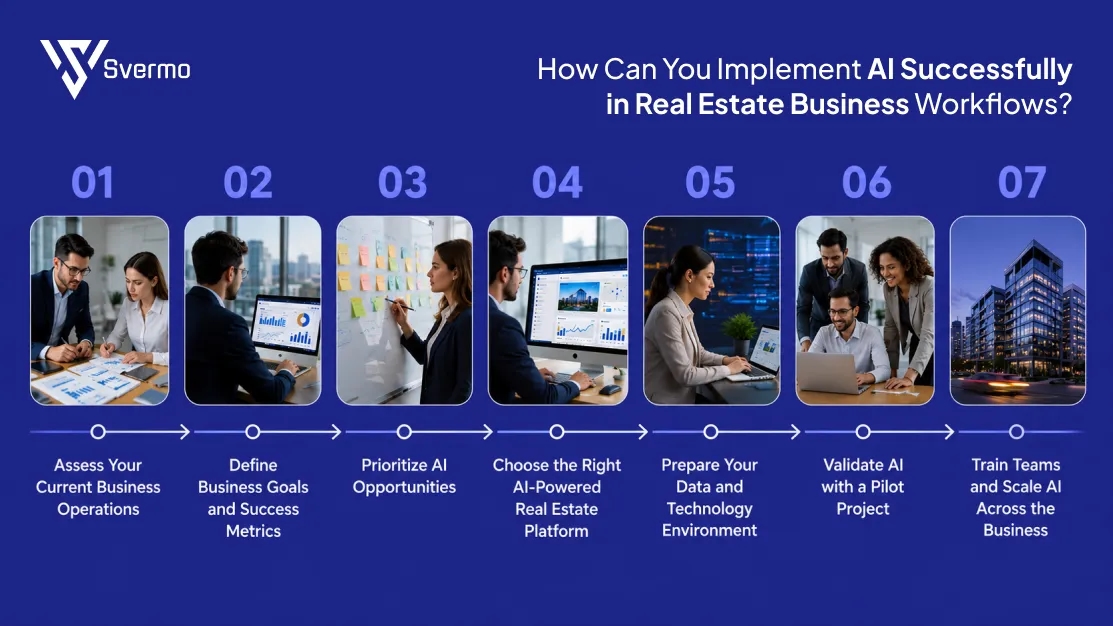
Knowing how to implement AI in real estate business workflows is different from knowing where AI can be used. Successful adoption is about following a structured roadmap that aligns AI with your business goals, existing processes, and technology ecosystem.
Whether you're exploring how to use AI in real estate business operations for the first time or expanding existing automation, a phased implementation approach delivers better long-term results.
1. Assess Your Current Business Operations
Before introducing AI, understand how your business operates today. Review every major workflow, identify where teams spend the most time, and document repetitive tasks that slow down operations.
This assessment helps you identify the practical applications of AI in real estate businesses that will deliver the greatest operational value instead of automating processes that already work well.
2. Define Business Goals and Success Metrics
Every AI initiative should solve a business problem, not simply introduce new technology. Define the outcomes you want to achieve before evaluating platforms.
Whether your objective is improving customer engagement, reducing manual work, or accelerating real estate workflow automation, clear success metrics keep every department aligned throughout the implementation process.
3. Prioritize AI Opportunities
Not every workflow needs AI immediately. Rank opportunities based on business value, implementation effort, and expected ROI.
Starting with one or two high-impact workflows helps demonstrate the benefits of AI in real estate business operations while reducing implementation risks and building confidence across the organization.
4. Choose the Right AI-Powered Real Estate Platform
Once you've identified your priorities, select an AI-powered real estate software for business automation that supports your long-term strategy.
Rather than purchasing separate AI tools for every department, choose a platform that connects sales, marketing, leasing, property management, and reporting workflows to create a smart real estate operations platform that scales with your business.
5. Prepare Your Data and Technology Environment
Even the best AI platform depends on reliable data. Before deployment, clean CRM records, organize property information, standardize documents, and ensure your existing systems can exchange information efficiently.
High-quality data improves the accuracy of AI-powered property operations and helps AI deliver more reliable recommendations and automation.
6. Validate AI with a Pilot Project
Instead of deploying AI across the entire organization, begin with a focused pilot project. Testing one workflow allows you to measure results, gather employee feedback, and refine the implementation before expanding AI across other departments.
This phased approach is one of the most effective ways to implement AI in real estate business workflows while minimizing operational disruption.
7. Train Teams and Scale AI Across the Business
Once the pilot proves successful, expand AI gradually across additional workflows and departments. Provide practical training, monitor adoption, and continue optimizing processes as your business grows.
As your teams become more confident, you can scale AI-driven real estate automation across the organization while maintaining consistent governance and operational standards.
Implementing AI is an ongoing business transformation rather than a one-time technology project. Organizations that follow a structured roadmap, validate results at every stage, and scale strategically are far more likely to maximize the benefits of AI in real estate business operations while building a connected, future-ready organization.
Now that you know how to implement AI successfully, the next question becomes equally important: how do you choose the right AI-powered real estate platform that aligns with your business goals, integrates with your existing technology stack, and continues to support your growth in the future?
How Do You Choose the Right AI-Powered Real Estate Platform for Smooth Business Operations and Growth?
Once you've identified your AI priorities and created an implementation roadmap, the next decision is selecting a platform that supports your long-term business objectives. With so many AI tools for real estate agents, brokers, and property managers available, comparing solutions based on features alone can make the evaluation process difficult.
If you're searching for the best AI tools for real estate business, use the framework below to evaluate platforms based on their ability to support your operations, integrate with your existing technology, and deliver measurable business outcomes.
| Evaluation Criteria | Why It Matters | Questions to Ask |
|---|---|---|
Business Fit | • Addresses your highest-priority operational challenges. | Does this platform solve our most important operational challenges? |
Real Estate Expertise | • Includes workflows designed for brokers, agencies, and property managers. | Was this platform built specifically for real estate businesses? |
AI Capabilities | • Supports multiple business functions through a single platform. | Does it support the AI capabilities our business needs today and in the future? |
Integration Capabilities | • Connects with CRM, property management, communication, and document systems. | Will it integrate with our existing technology stack? |
Security & Compliance | • Protects customer, financial, and operational data. | How does the platform manage security, privacy, and compliance? |
Reporting & Business Insights | • Measures operational performance and ROI. | Can leadership easily measure business outcomes and operational improvements? |
Scalability & Vendor Support | • Supports future business growth and expanding portfolios. | Can this platform grow with our business, and what level of support does the vendor provide? |
Using these evaluation criteria makes it easier to compare AI platforms beyond feature lists and marketing claims. The right AI-powered real estate software for business automation should align with your operational goals, support future growth, and deliver measurable improvements across your organization.
Even after selecting the right platform, businesses often face challenges during implementation and adoption. What are the most common challenges when using AI in real estate, and how can you overcome them before they affect your operations?
What Are the Biggest Challenges of Using AI in Real Estate and How Can You Overcome Them?
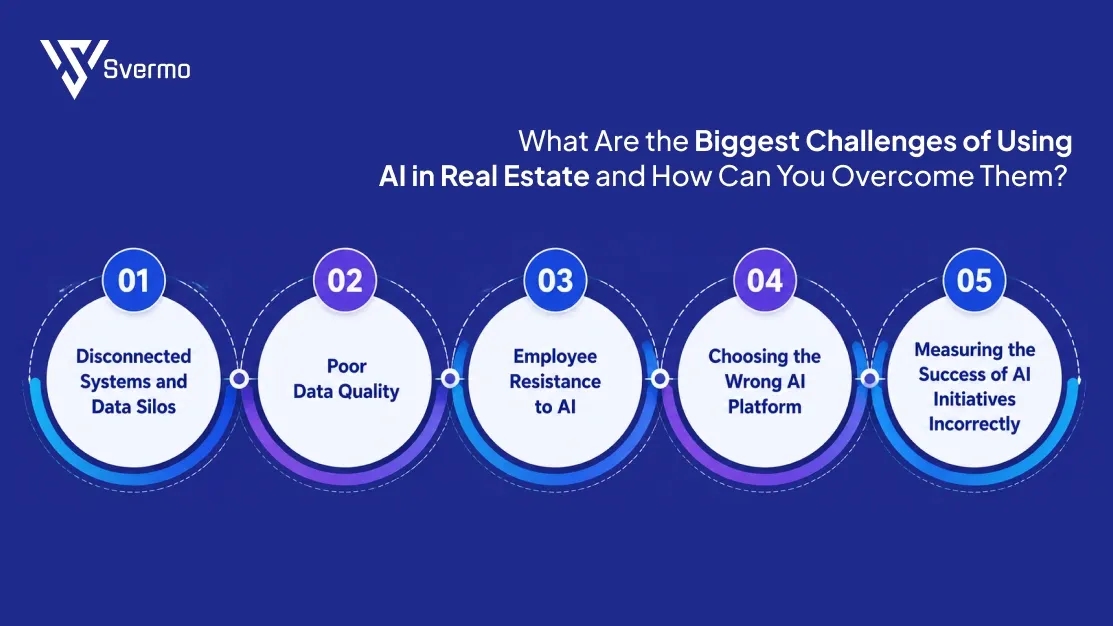
While the benefits of AI for real estate are significant, successful adoption isn't without challenges. Many organizations struggle because they focus on technology before addressing people, processes, and data. Recognizing these obstacles early allows you to build a stronger implementation strategy and achieve better long-term results.
1. Disconnected Systems and Data Silos
Many real estate businesses rely on separate systems for CRM, property management, leasing, marketing, and reporting. When these systems don't communicate with each other, AI has limited access to the information it needs to automate workflows and generate meaningful insights.
How to overcome it:
Choose an AI-powered real estate software for business automation that integrates with your existing technology stack. Connected systems improve data consistency, reduce duplicate work, and enable AI to support end-to-end business workflows.
2. Poor Data Quality
AI depends on accurate and well-structured data. Duplicate customer records, outdated property information, and incomplete documents can reduce the quality of recommendations and automated decisions.
How to overcome it:
Before implementing AI, clean your CRM, standardize business documents, and establish data governance practices. High-quality data improves the accuracy of AI-powered property operations and helps teams trust AI-generated insights.
3. Employee Resistance to AI
Employees often worry that AI will replace their jobs or make existing processes more complicated. Without proper communication, adoption can slow down even when the technology delivers clear value.
How to overcome it:
Position AI as a productivity tool that eliminates repetitive work rather than replacing employees. Provide hands-on training, involve teams during implementation, and highlight early successes to encourage adoption across the organization.
4. Choosing the Wrong AI Platform
Selecting a platform based only on features or price can create long-term operational challenges. Businesses often discover later that the platform doesn't support their workflows or integrate with existing systems.
How to overcome it:
Evaluate platforms based on business fit, integration capabilities, scalability, security, and long-term vendor support. Choosing a platform that aligns with your operational goals reduces implementation risks and supports future growth.
5. Measuring the Success of AI Initiatives Incorrectly
Many organizations introduce AI without defining how success will be measured. As a result, it's difficult to demonstrate business value or justify additional investment.
How to overcome it:
Track metrics that reflect real business outcomes, such as lead response time, conversion rates, occupancy, maintenance resolution time, customer satisfaction, and operational cost savings. Measuring performance consistently helps you understand how AI is transforming real estate operations and property management over time.
Every AI implementation comes with challenges, but each one can be addressed through careful planning, realistic expectations, and continuous improvement. Organizations that treat AI as a long-term operational capability are better positioned to achieve sustainable growth and measurable business results.
After addressing these challenges, you must know which AI company is helping real estate businesses put these strategies into practice?
Why Are Real Estate Businesses Turning to AI Products Offered by Svermo?

Choosing the right AI products is just as important as choosing the right AI strategy. Real estate businesses need solutions that fit existing workflows, improve operational efficiency, and scale as business needs evolve.
Svermo is a U.S.-based product-led AI company focused exclusively on the real estate industry. It offers purpose-built AI products that help brokers, agencies, property management companies, commercial real estate firms, and portfolio managers automate high-impact business processes across the United States.
Brokerages and agencies focused on improving property discovery can benefit from a real estate AI property search engine that delivers faster and more relevant property recommendations. Organizations looking to modernize tenant operations can adopt AI for property management to streamline day-to-day property workflows.
Whether you're learning how to use AI for real estate, evaluating AI-powered property operations, or comparing the best AI tools for real estate business, Svermo's AI products are designed to support every stage of the real estate lifecycle, from lead management and customer communication to leasing, asset management, and property valuation.
Successful AI adoption starts with solving operational challenges one workflow at a time. With AI products built specifically for real estate, businesses can improve efficiency, simplify daily operations, and build a stronger foundation for long-term growth.
Looking for AI Products Built Specifically for Real Estate?
AI products that help real estate teams work smarter from day one.
Wrapping UP!
Learning how to use AI for real estate is no longer about experimenting with individual AI tools. The real opportunity lies in applying AI where it delivers measurable business value, whether that's improving lead management, streamlining property operations, enhancing customer communication, or supporting faster decision-making.
The businesses seeing the greatest impact aren't adopting AI all at once. They're identifying high-value workflows, implementing AI with a clear roadmap, and expanding adoption as results become measurable. This practical approach helps reduce manual work, improve operational efficiency, and build a more scalable real estate business.
Svermo continues to build AI products that address everyday operational challenges across the industry. From intelligent customer engagement through an AI chatbot virtual assistant to workflow automation, its product ecosystem is designed to help real estate businesses adopt AI where it creates the greatest operational impact.
The future of real estate belongs to businesses that spend less time managing repetitive work and more time building relationships, closing deals, and growing their portfolios.
Your next competitive advantage might already be waiting in your workflow. So contact us now.
 https://www.linkedin.com/in/saanvi-verma-38711a36a
FAQs
The cost of implementing AI for real estate depends on the type of AI products used, the number of workflows automated, and the scale of operations. Many businesses start with a single use case such as AI-powered lead management or customer communication and expand gradually, which helps manage costs while delivering measurable value.
Yes, small real estate businesses can benefit from AI in real estate business operations by automating repetitive tasks, improving response times, and managing leads more efficiently. AI helps smaller teams operate with greater productivity without increasing headcount.
Most modern AI tools for real estate agents and property managers are designed to integrate with existing CRM, property management, and communication systems. Choosing AI solutions with strong integration capabilities helps ensure smoother adoption and reduces disruption to current workflows.
Businesses can start seeing results within a few weeks when AI for real estate automation is applied to high-impact workflows such as lead response, customer communication, or document processing. Larger operational improvements typically become visible over a few weeks as adoption expands.
AI platforms designed for real estate data management and property operations follow strict security and compliance standards to protect sensitive customer, financial, and property data. It is important to evaluate data privacy policies, encryption practices, and compliance certifications before selecting an AI product.
AI is designed to support real estate professionals, not replace them. It handles repetitive and time-consuming tasks, allowing agents and property managers to focus on client relationships, negotiations, and strategic decision-making while improving AI-powered property operations.
Before investing in AI for real estate business, businesses should evaluate their operational needs, identify high-impact workflows, assess integration requirements, and choose AI products that align with long-term business goals. A clear implementation plan helps ensure successful adoption and measurable outcomes.