

AI Single-Family Rental (SFR) Operations Platform: Coordinate Communication & Tasks Across Scattered Homes


Get a summary of this article with your favorite AI





AI Summary
- •Centralize SFR operations: An AI single family rental operations platform connects tasks, communication, vendors, and exceptions.
- •Extend the PMS: An AI SFR operations platform adds follow-ups, stalled-work tracking, and completion checks.
- •Coordinate scattered teams: AI task coordination for single-family rental operators keeps vendors and teams aligned across markets.
- •Scale with control: Choose an AI operations platform for growing single-family rental portfolios based on workflow fit, integration, and measurable results.
- •Keep context connected: Svermo’s property-management AI experience highlights the importance of connecting PMS records, messages, vendor updates, and task status.
Managing scattered SFR homes means keeping track of more than open work orders. An operator may have a resident waiting for an update at one property, a vendor who has gone quiet at another, and a completed task that still needs supporting information at a third. Each situation calls for a different decision: follow up, escalate, or verify before closing it.
An AI single-family rental operations platform connects those decisions to the communication and task activity behind each property. It brings the relevant updates together, identifies exceptions, and gives operators the context needed to prioritize work across markets.
This is the practical role of property operations automation: keeping communication, tasks, follow-ups, and status checks connected as the portfolio grows.
Svermo is an AI product company based in Orlando, U.S. Its real estate AI products cover tenant communication, maintenance coordination, workflow automation, and integrations with existing property management systems, giving the company direct experience with the fragmented workflows this platform needs to coordinate.
Want to Cut the Chase in SFR Operations?
Identify repetitive follow-ups, stalled tasks, and communication gaps your team can automate across the portfolio.
What Does an AI Operations Platform Do for a Scattered SFR Portfolio?
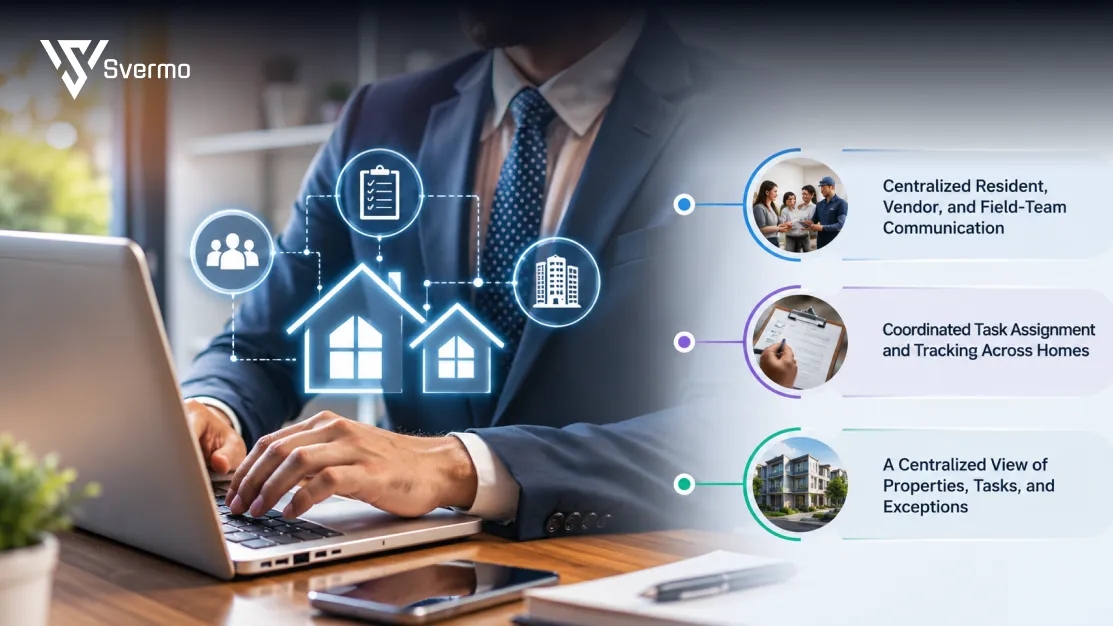
An AI single-family rental operations platform connects resident communication, vendor updates, field activity, and property tasks across a scattered SFR operations portfolio.
It links each issue to the property, task history, and current status, giving operators the context needed to manage work across markets. That same portfolio-level visibility is explored in AI-powered asset management for real estate, particularly where operational information is spread across multiple properties.
Centralized Resident, Vendor, and Field-Team Communication
Resident communication, vendor replies, and field updates stay connected to the related property and task. Operators can review the latest messages before responding to a resident, following up with a vendor, or escalating an unresolved issue.
Coordinated Task Assignment and Tracking Across Homes
Task management keeps each job tied to an owner, status, and next action. Operators can see whether work is waiting on a vendor, resident access, approval, or an internal team member across different markets.
This supports consistent property operations without requiring teams to rebuild task history from separate conversations and records.
A Centralized View of Properties, Tasks, and Exceptions
Portfolio management becomes easier when unanswered messages, missed vendor follow-ups, stalled tasks, and completion updates needing verification appear in one operational view. This is closely related to how AI real estate operations automation system connects maintenance, communication, follow-ups, and task handoffs across property workflows.
The property management system continues to hold core property and work-order records, while the AI layer supports workflow automation, exception management, and follow-up across those records. Operators can focus on the specific action each exception requires: reply, follow up, escalate, or verify.
Do You Need an AI Layer if Your Property Management System Already Tracks Work Orders?
You need an AI layer when the PMS tracks the work order but the operator still has to chase the activity around it. The PMS records the job, while the AI layer handles communication, follow-ups, stalled work, and completion checks connected to that job.
| PMS | AI Operations Layer |
|---|---|
Stores the property and work-order record | Connects communication and task activity to that record |
Assigns and tracks work orders | Tracks follow-ups and stalled activity |
Records status changes | Flags status changes that need attention |
Keeps operational history | Connects messages and updates to the task history |
Shows open and completed work | Surfaces exceptions that need operator action |
Existing PMS Capabilities for Work Orders and Property Operations
A PMS handles the core record: property, work order, assignment, status, and completion. That is enough when work moves through the existing workflow without frequent manual follow-up.
Additional Coordination Provided by a Dedicated AI Layer
SFR operators often need to determine whether their existing PMS provides enough operational visibility or needs an additional coordination layer. Their queries look like:
“We are trying to decide whether our current property management system already gives us enough visibility across our scattered homes, or whether we actually need a separate AI layer focused specifically on coordinating communication and tasks across a portfolio this spread out. I need to understand what this would actually add that we do not already have.”
A dedicated AI layer adds coordination around existing PMS records by connecting communication, follow-ups, stalled activity, and completion checks to the relevant work order. The PMS can remain the source for core property and work-order data while the AI layer handles the coordination around it.
The AI layer adds coordination around the work order. It connects resident and vendor messages to the task, identifies unanswered communication, tracks stalled follow-ups, and brings completion updates into the operator's review.
Working Alongside the Existing PMS and Vendor Network
The existing PMS remains the source for property and work-order data. The AI layer works with that data and the communication around it, while existing vendors and field teams continue using their established workflows.
Situations Where the Current PMS May Be Enough
The PMS may cover the need when teams have reliable visibility into vendor responses, overdue work, resident follow-ups, and completion status. An AI layer becomes relevant when operators spend significant time checking those items manually across properties and markets.
How Does AI Catch Ignored Messages and Stalled Tasks Before Residents Escalate?
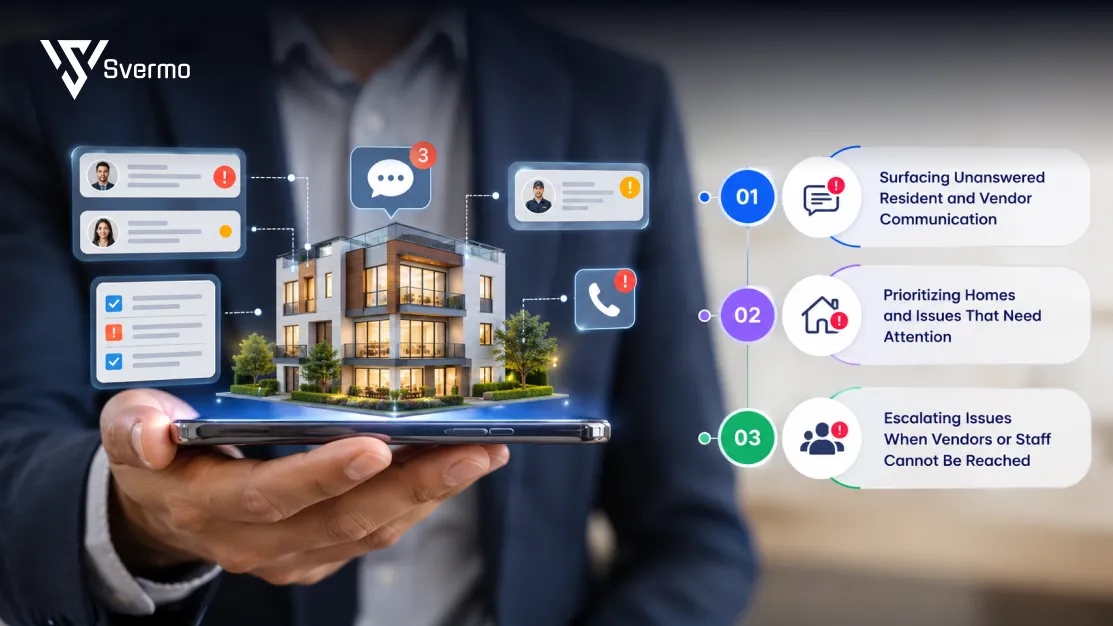
An AI single family rental operations platform catches ignored messages and stalled tasks by tracking response gaps, task inactivity, and missed follow-ups. This AI task coordination for single-family rental operators connects those gaps to the property and task, giving operators a clear exception to act on before a delay becomes a resident escalation.
Surfacing Unanswered Resident and Vendor Communication
A common question among SFR operators managing scattered homes is:
“I manage a portfolio of scattered single-family rental homes, and I usually only find out a tenant issue has been ignored for days once the resident escalates it into a complaint, so I want something that surfaces unanswered communication before it becomes a problem.”
An AI workflow can flag unanswered resident messages based on response windows and connect the conversation to the related property and task. Operators can address the exception before the resident has to escalate it.
Resident message: No response arrives within the required response window. The platform flags the conversation and links it to the property and active task.
Vendor message: A vendor receives a task but does not respond or provide the expected update. The platform keeps the missed response attached to the task instead of leaving it buried in the communication history. This creates an AI communication platform for scattered rental properties where resident and vendor conversations stay connected to the work.
For a deeper look at this resident-facing workflow, see how AI resident communication systems for property managers handle requests, maintenance updates, and staff handoffs.
Tenant communication can carry important operational signals long before an issue becomes a formal escalation. That is one reason Svermo has worked on Tenant AI interactions as part of property-management workflows, where the useful output is the right context reaching the right workflow.
Prioritizing Homes and Issues That Need Attention
Active resident issue: A repair affecting an occupied home has no recent vendor activity. The exception receives higher priority.
Routine follow-up: A non-urgent vendor update remains outstanding. The exception stays visible without competing with higher-priority resident issues.
The priority comes from the task status, elapsed time, communication history, and type of issue.
Escalating Issues When Vendors or Staff Cannot Be Reached
First missed response: The assigned person receives the follow-up.
Repeated missed responses: The issue moves to the next escalation step.
No progress after escalation: The operator reviews the history and decides whether to reassign the task, contact another vendor, or escalate internally.
This creates consistent Vendor and task coordination across properties while keeping the operator in control of the final escalation decision.
How Can AI Prevent "Task Done" Blind Spots Across Multiple Markets?
An AI single family rental operations platform checks completion status against the communication, updates, and records attached to each task. The operator gets the context needed to accept the completion, request more information, or reopen the task.
Automated Status Check-Ins Instead of Manual Follow-Ups
SFR operators often ask about reducing the manual effort involved in tracking vendor and field-team updates:
“My team manually checks in with local vendors and field staff across more than a dozen markets every week just to confirm which tasks are actually done, and I want to know how AI can automate that status tracking so we are not chasing updates constantly.”
AI can trigger status requests when an update is due and flag missing responses automatically. The operator sees which tasks need attention instead of manually contacting every vendor and field team.
Status check-ins happen when a task reaches a point where an update is expected. The response, or lack of response, stays attached to the task instead of becoming a separate follow-up for the operator.
- Example: A resident reports a leaking kitchen faucet in a Phoenix home. The vendor accepts the work order but does not provide a scheduled-visit update by the expected time. An AI operations assistant for single-family rental portfolios flags the missing update, and the operator follows up before the resident has to ask again.
Status Updates Backed by Communication and Task History
Operators overseeing homes across different markets often want more context behind the status shown for each property. So, they ask questions like:
“I do not fully trust a dashboard that tells me a property is "on track" if I cannot see the actual communication or task history behind that status, especially when I cannot physically check on homes spread across different markets myself. I need a system where every status update links back to what actually happened at that property.”
An AI workflow can keep status changes connected to the communication and task history behind them. Operators can review the supporting activity before accepting a status or deciding that more action is needed.
A completion status needs supporting activity. The operator can review vendor messages, field updates, previous follow-ups, and status changes before closing the task.
- Example: A vendor marks an HVAC repair complete at a Tampa property. The history shows the original resident report, the vendor's appointment update, and the completion message. The operator reviews that sequence before accepting the status.
Completion Verification Through Available Evidence and Records
A common concern among operators managing scattered properties sounds like:
“We once had a vendor confirm a task was done at one of our homes, but it turned out nothing had actually happened, and nobody at our office caught it for weeks because we had no visibility into that property. I want to understand how AI can prevent that kind of blind spot across a scattered portfolio.”
AI can compare completion status with available communication, task updates, timestamps, and other records. Missing supporting activity can keep the task open for operator review instead of treating the reported completion as final.
Completion review brings together the available timestamps, communication, status changes, and task updates. Missing supporting activity keeps the task open for further review.
- Example: A vendor marks a broken water heater as repaired at an Atlanta home. The task shows a completion status, but no vendor message confirms the repair and no follow-up appears after the appointment. The operator requests confirmation before closing it.
Consistent Workflows Across Markets and Vendor Networks
Single-family rental portfolio coordination keeps the same completion and verification process across different properties and markets. The workflow does not change because a different vendor handles the job.
- Example: A plumbing vendor in Dallas and an HVAC vendor in Orlando use different teams and communication channels. Both tasks still move through assignment, progress update, completion, and verification before closure.
How Can You Scale SFR Operations Without Adding Proportional Headcount?
Scaling SFR operations without proportional headcount requires automation of repetitive coordination work while keeping operators responsible for exceptions and decisions.
AI operations platform for growing single-family rental portfolios supports that model by handling routine follow-ups, status checks, and task coordination across properties.
Repetitive Coordination Automated While Teams Retain Accountability
Routine work moves to automation:
- Check whether a vendor responded
- Send a scheduled status request
- Flag an overdue task
- Route an unresolved issue
- Record communication against the task
Operator work stays focused on decisions:
- Escalate a vendor
- Reassign a task
- Respond to a resident
- Approve an exception
- Verify a reported completion
Workflow Expansion Across Properties and Markets
Growth becomes easier when each new property enters the same operating workflow. Scattered-site rental portfolio management stays consistent across markets, even when vendors, field teams, and local processes differ.
At 50 homes: operators can manage exceptions within a defined market workflow.
At 150 homes: the same workflow handles additional vendors and properties without creating separate tracking processes.
At 300+ homes: operators can organize work by exception type, market, vendor, or urgency instead of manually reviewing every property.
A Staged Path from Pilot to Production and Broader Rollout
Start with one workflow that creates a measurable coordination burden, such as vendor follow-ups. Validate detection, routing, response quality, and operator workload before adding more workflows.
A practical rollout sequence is:
Pilot -> Measure -> Fix -> Expand
The next stage can add resident communication, overdue task monitoring, completion verification, or additional markets after the initial workflow performs reliably.
How Do You Implement an AI Operations Platform Across an SFR Portfolio?
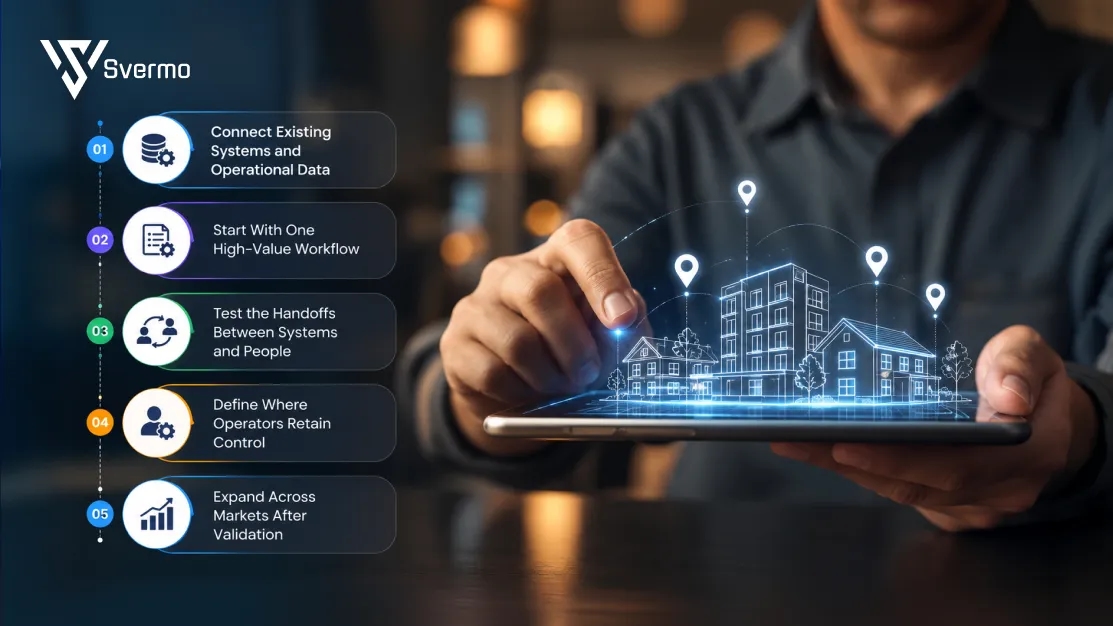
An AI single family rental operations platform should be implemented around the workflows operators already use. The rollout connects property data, communication channels, task records, and vendor activity, then validates how information moves between those systems before expanding across the portfolio.
Connect Existing Systems and Operational Data
The first implementation step is connecting the AI workflow to the systems that contain the information needed for each task. The setup should give the AI enough context to identify the property, issue, responsible party, current status, and relevant history.
- Property and unit records
- Work orders and task status
- Resident communication
- Vendor information and updates
- Property-level task history
Existing property workflows rarely live in one system. Leasing operations, for example, can span property records, CRM data, communication, scheduling, and documents. Building Leasing AI around those connected workflows has given Svermo practical exposure to the integration and context-preservation issues that also matter when coordinating scattered SFR operations.
Start With One High-Value Workflow
A defined workflow gives the team a controlled way to test the AI before introducing more operational scenarios. Vendor follow-up, overdue task monitoring, and unanswered communication are practical starting points because each has a clear trigger and expected next action.
- Vendor accepts a work order but misses the expected update
- Resident message remains unanswered beyond the response window
- Task remains open after the expected completion date
- Vendor marks work complete without sufficient supporting information
Test the Handoffs Between Systems and People
The AI needs to preserve context as information moves between residents, vendors, field teams, the PMS, and operators. Testing should follow complete scenarios from the initial request through the final resolution.
- Confirm the correct property stays attached to the task
- Check that vendor responses remain connected to the work order
- Verify status changes are reflected in the operational history
- Confirm operators receive the information needed for the next action
Property teams also have to deal with information that arrives by phone, where the original request is conversational rather than structured like a work order. Work on Voice AI for property management at Svermo has involved this kind of handoff, making the transition from conversation to actionable workflow an important implementation detail.
Define Where Operators Retain Control
Implementation should establish clear boundaries for automated actions and human decisions. Operators should remain involved when an issue requires judgment, additional context, or a decision that affects the resident or vendor relationship.
- Vendor reassignment
- Escalation of unresolved work
- Resident-sensitive responses
- Completion disputes
- Exceptions involving incomplete information
Expand Across Markets After Validation
Once the workflow performs consistently, operators can extend it to more properties, vendors, and markets. Expansion should use the same core workflow while accounting for differences in local vendor networks and operating practices.
- Add additional properties within the same market
- Introduce additional vendor groups
- Extend the workflow to another market
- Add related workflows such as completion verification or resident communication
A controlled rollout gives operators a clear record of what works before the workflow becomes part of daily portfolio operations.
How Do You Measure ROI From an AI Operations Platform?
Measure ROI by establishing a baseline before rollout, then comparing the same operational metrics after implementation. For SFR operators, the strongest measures show whether communication moves faster, fewer tasks become overdue, and teams spend less time on manual coordination.
Response Time and Unanswered Communication
Track two numbers: average response time and the percentage of resident or vendor messages that remain unanswered beyond the expected response window.
A useful comparison looks at the same request types before and after rollout. This avoids mixing routine questions with urgent maintenance communication.
Task Completion and Overdue Work
Track the percentage of tasks completed within the expected timeframe, along with overdue and stalled tasks.
Before rollout: 120 tasks opened, 24 overdue.
After rollout: 130 tasks opened, 15 overdue.
The change in overdue-task rate provides a clearer measure than the raw number of completed tasks.
Operational Efficiency Across the Portfolio
Measure the time operators spend checking messages, chasing vendors, reviewing task status, and finding exceptions. AI task coordination for single-family rental operators will reduce this manual workload. Track hours spent on these activities per week and compare the results across similar operating periods.
Baseline Performance Before Rollout
Capture the baseline before changing the workflow. Keep the definitions, reporting period, property sample, and request types consistent during the post-rollout measurement.
| Metric | Baseline | Post-Rollout |
|---|---|---|
Average response time | Record | Re-measure |
Unanswered messages | Record | Re-measure |
Overdue task rate | Record | Re-measure |
Stalled task rate | Record | Re-measure |
Manual coordination hours | Record | Re-measure |
Properties managed per operator | Record | Re-measure |
ROI becomes easier to assess when these operational changes are connected to the team's actual workload and service targets. The measurement should show what improved, by how much, and whether the improvement continued as the portfolio expanded.
How to choose an AI operations platform as a single-family rental operator?
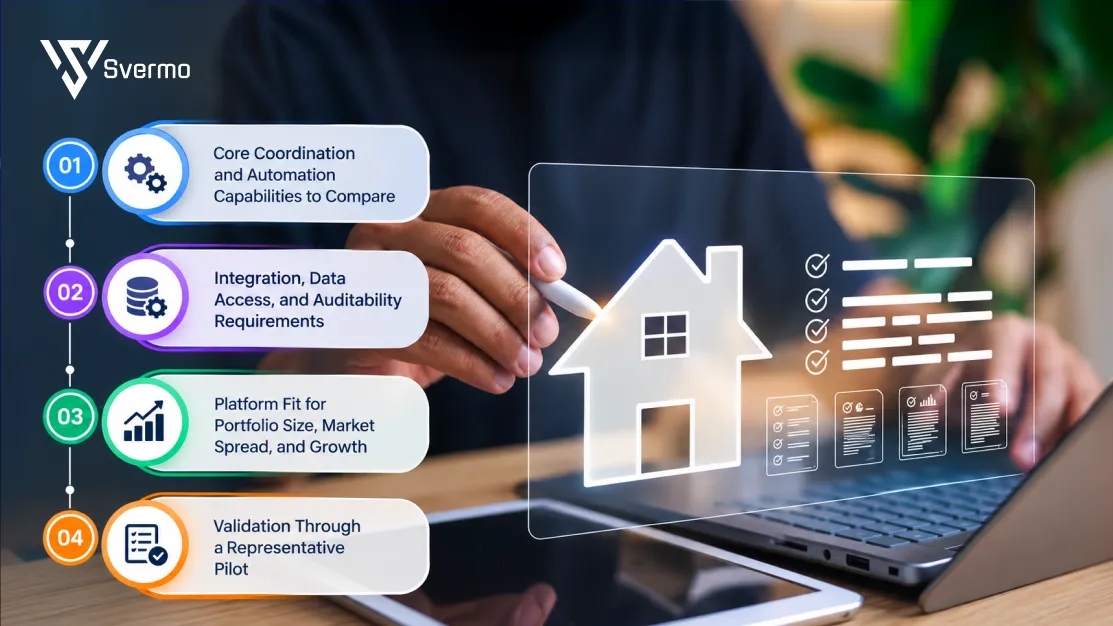
Choosing an AI single family rental operations platform starts with the workflows your team needs to improve. Compare how each option handles communication, task coordination, vendor follow-up, PMS data, exception handling, and completion verification, then test those workflows against real portfolio activity.
Core Coordination and Automation Capabilities to Compare
Focus on the work the AI handles during daily operations:
- Resident and vendor message tracking
- Task assignment and follow-up
- Detection of stalled work
- Status check-ins
- Completion verification
- Exception prioritization
- Escalation workflows
For teams managing scattered homes, AI task coordination for single-family rental operators should reduce manual checking across properties while keeping operators responsible for decisions that require judgment.
If you are comparing broader AI property management platforms for landlords, look at how each option handles communication, maintenance, integrations, workflow actions, and human handoffs.
Integration, Data Access, and Auditability Requirements
Check how an AI SFR platform that works with my property management system connects to existing property records and communication channels.
Before choosing a platform, check:
- PMS data access
- Connected communication channels
- Data refresh frequency
- Task and communication history
- Status-change records
- Information available to the operator before taking action
The audit trail should show what happened, when it happened, who handled it, and what followed.
Platform Fit for Portfolio Size, Market Spread, and Growth
Portfolio size is only one part of the decision. Market spread, vendor count, communication volume, and workflow differences also affect platform fit.
An AI operations platform for growing single-family rental portfolios should support additional properties and markets without requiring a separate process for every location.
Validation Through a Representative Pilot
Test the AI platform for managing scattered single-family rental homes against real operating scenarios before expanding it across the portfolio.
Use a sample that includes:
- An active resident maintenance request
- A vendor that stops responding
- An overdue task
- A completion update that needs verification
- Properties handled by different markets or vendors
Evaluate each scenario for:
- Exception detection: Did the AI identify the missed response, stalled task, or incomplete status?
- Context accuracy: Did it connect the issue to the correct property, task, resident, vendor, and communication history?
- Prioritization: Did it distinguish an urgent resident issue from a routine follow-up?
- Action routing: Did it identify the appropriate next step?
- Auditability: Can the operator trace the messages, status changes, and actions behind the result?
- False positives: How often did it flag work that actually required no intervention?
This matters in property-management AI because operational data rarely lives in one clean record. Svermo's experience with AI products in this space makes those data handoffs and workflow gaps important considerations when testing an AI operations platform. The pilot should show how the system handles those conditions with the data available in the operator's actual environment.
Ready to Get More from Every Property Manager?
See how coordinated AI workflows can reduce manual task chasing and give your team more time for high-value decisions.
Final Thought!
Running a scattered SFR portfolio can sometimes feel like playing whack-a-mole. One vendor needs a follow-up, a resident is waiting for an update, and somewhere else, a task has quietly gone overdue. An AI single family rental operations platform can bring those moving pieces together and help your team stay on top of what actually needs attention.
Svermo offers AI products with real property-management workflows in mind, where PMS records, resident messages, vendor updates, and task statuses often live in different places. That practical experience matters when AI for real estate needs to keep the right context and leave important decisions with your team. Wondering where AI could fit into your SFR operations? Talk to us and let’s figure it out.
 https://www.linkedin.com/in/saanvi-verma-38711a36a
FAQs
Yes. An AI communication platform for scattered rental properties can organize resident, vendor, and field-team conversations around the relevant property and task. This gives operators a portfolio-wide way to find active conversations and follow-ups without manually checking each home.
An AI operations platform for decentralized rental portfolios coordinates work through shared digital workflows rather than relying on everyone being in one location. Property teams, vendors, and field staff can receive tasks, provide updates, and move work forward from different markets while keeping activity tied to the right property.
Yes. An AI platform for managing vendors across scattered homes can organize vendor assignments, communication, follow-ups, and task activity across multiple markets. Operators can maintain a consistent workflow while still working with different local vendors and field teams.
An AI platform to centralize SFR operations can bring attention to exceptions that deserve review, such as unusual activity, missing updates, or tasks requiring intervention. This gives operators a way to focus their time on properties that need attention instead of reviewing every home equally.
Useful AI SFR operations features for rental operators include workflow triggers, communication monitoring, task routing, exception handling, escalation rules, and activity history. The right combination depends on which operational bottlenecks become harder to manage as the portfolio grows.
Yes. Remote property oversight automation can give distributed teams a shared operational view while properties remain physically spread across different locations. This is particularly useful when local vendors, field teams, and internal operators all contribute updates to the same property workflow.
Look for an AI assistant for coordinating SFR communication and tasks that understands property and task context, connects related conversations, handles routine follow-ups, and gives operators enough history to make decisions. It should fit the team's existing workflows instead of creating another disconnected place to manage work.