
AI Property Management Platform for Landlords: Features, Automation, and Buying Guide


Get a summary of this article with your favorite AI





AI Summary
- •AI property management platforms automate leasing, maintenance, communication, and follow-ups.
- •AI property management tools for landlords interpret requests and trigger the right actions.
- •Key AI platform features include 24/7 communication, tour scheduling, integrations, and analytics.
- •Successful adoption requires clean data, reliable integrations, permissions, and human oversight.
- •Choose an AI rental property management platform around your portfolio and biggest workflow bottlenecks.
- •Svermo offers voice AI, tenant AI, and leasing AI for distinct property management workflows.
Are tenant messages, maintenance requests, rent follow-ups, and lease paperwork taking up more of your day than managing your properties?
An AI property management platform for landlords can automate these repetitive tasks and keep your rental operations moving without adding more manual work.
The pressure extends beyond internal workloads. According to the U.S. Department of the Treasury, about 90% of families earning below $20,000 annually spend more than 30% of their income on housing costs, exceeding the 30% affordability threshold.
This housing cost burden puts added pressure on property managers and housing providers to improve efficiency, transparency, and compliance. The challenge grows with your portfolio. A few scattered requests can become hundreds of conversations, follow-ups, documents, and status updates across multiple properties.
What happens when a tenant needs an answer after business hours? Who follows up when a maintenance request remains unresolved? How much time does your team spend finding information that should already be available?
Svermo's AI products built for property management operations in the US address these day-to-day challenges. The AI property management system helps landlords, property managers, and rental teams automate tenant communication, leasing workflows, service requests, and phone interactions while keeping people involved when a situation needs human attention.
The key is knowing where AI fits into your existing rental operations and where human judgment should remain.
But what exactly makes a property management platform “AI-powered,” and how is it different from the tools you already use?
Still Managing Every Rental Task Manually?
See how Svermo helps automate everyday property management workflows and reduce the busywork.
What Is an AI Property Management Platform for Landlords?
An AI property management platform combines property management workflows with AI that can understand requests, use relevant property data, and trigger the next action.
For landlords and property managers, this can reduce manual work across tenant communication, maintenance, leasing, documents, and follow-ups.
But you must be thinking, “what makes a property management platform AI-powered?” It can do more than store information or track tasks. It can understand a request, use the right context, and move the workflow forward.
- Understands natural language: Tenants can describe an issue in their own words instead of selecting rigid categories.
- Uses property context: The platform can connect a request with the relevant tenant, property, lease, or previous interaction.
- Takes workflow actions: AI can send responses, create tasks, route requests, schedule follow-ups, or update records based on defined rules.
- Knows when to escalate: Sensitive, urgent, or unclear situations can be routed to your property team instead of handled automatically.
- Keeps an activity record: Your team can see what happened, what action was taken, and what still needs attention.
Here you should also know, “who can benefit from an AI property management platform? The value depends on how much repetitive rental work your team handles each day.
- Independent landlords: Automate repetitive tenant communication without adding administrative hours.
- Small property management companies: Standardize recurring workflows across multiple properties.
- Multifamily operators: Handle higher volumes of tenant requests while maintaining consistent response processes.
- Professional property managers: Reduce manual coordination across tenants, vendors, leases, and internal teams.
- Growing rental portfolios: Increase operational capacity without scaling administrative work at the same rate.
The practical difference is simple: traditional tools help you record and manage work, while AI can also understand the work and move it forward.
So, how does an AI property management platform compare with the traditional tools you may already use?
How Do AI Property Management Platforms Compare with Traditional Property Management Tools?
Traditional property management tools remain useful for storing records, tracking payments, managing leases, and organizing property data. The difference appears when you need those systems to handle repetitive work, not just document it.
The table below shows where the operating model changes for landlords and property teams.
| Property management task | Traditional property management tools | AI property management platform |
|---|---|---|
Tenant communication | Your team reads messages and writes routine responses manually. | Tenant AI interprets tenant intent and handles routine responses based on available context. |
Maintenance requests | Tenants submit requests, then staff review, categorize, assign, and follow up. | AI captures the request, identifies the issue, routes it, and tracks follow-ups through the workflow. |
Rent follow-ups | Staff identify overdue accounts and send reminders manually. | AI rental property management platform triggers appropriate reminders and follow-ups based on defined conditions. |
Lease administration | Your team searches records, tracks dates, and manages follow-ups. | AI connects lease information with relevant tasks, reminders, and tenant interactions. |
Tenant records | Information sits in structured records that staff access when needed. | AI uses relevant tenant and property context when handling requests or workflows. |
After-hours requests | Calls and messages wait until someone becomes available. | AI handles routine inquiries outside business hours and routes issues requiring human attention. |
Operational follow-ups | Staff maintain task lists and manually check outstanding work. | AI tracks workflow progress and triggers the next defined action. |
Human involvement | Most tasks require direct staff handling from start to finish. | AI handles defined steps while sensitive, urgent, or complex situations move to your team. |
For AI property management tools for landlords, this distinction matters most when repetitive tasks consume hours every week.
That shift also changes how you evaluate rental portfolio management. The question is no longer only where your property information lives. You also need to ask how much routine work happens automatically around that information.
What happens behind the scenes when AI receives a tenant request and needs to decide what happens next?
How Does an AI Property Management Platform Work?
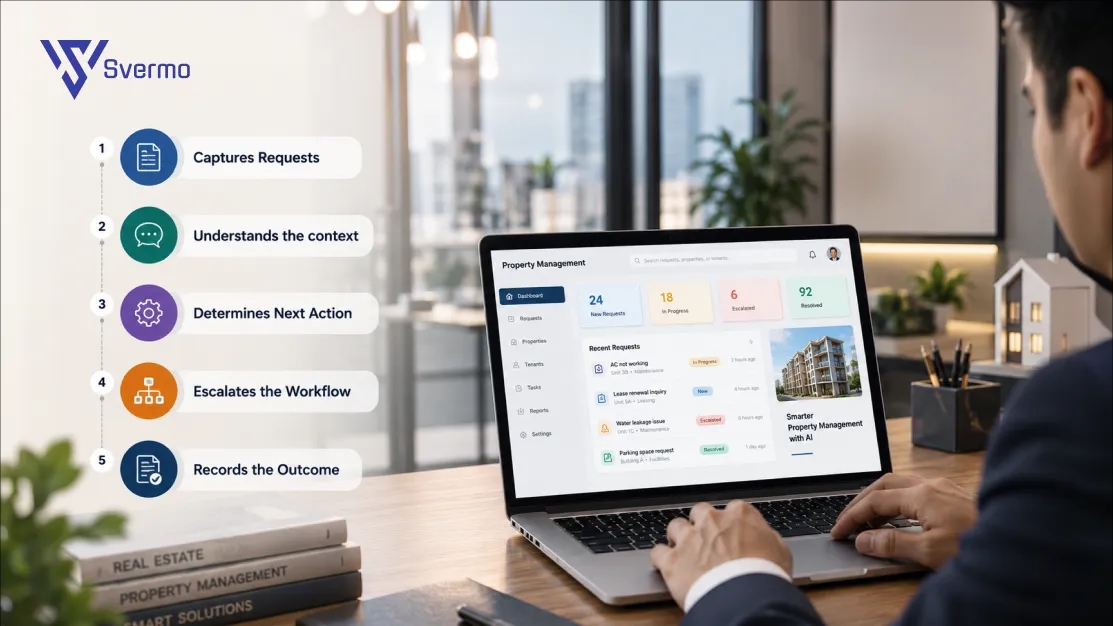
The process starts when a tenant, prospect, owner, or team member sends a request. An AI property management platform for tenant and rental operations connects that request with relevant property data, workflow rules, and the next action.
For landlords managing multiple properties, this creates a connected process instead of another inbox that requires constant monitoring.
1. AI Captures a Tenant or Property Request
An AI property management platform for rental properties receives requests through channels your rental operations already use, such as chat, email, forms, or phone. It identifies the request type and connects it to the relevant property or tenant record.
For example, a tenant reporting a leaking faucet receives a different workflow from someone asking about a lease renewal.
Useful capabilities at this stage include:
- Multi-channel intake: Tenant requests enter through communication channels that fit your existing rental operations.
- Request classification: AI separates maintenance, leasing, payment, lease, and general inquiries.
- Record matching: Each interaction connects with the relevant property, tenant, or lease information.
- Duplicate detection: Related requests receive appropriate handling instead of creating unnecessary tasks.
2. AI Understands the Request and Its Context
An AI platform for managing rental properties analyzes what the person needs and retrieves relevant information. This context helps generate responses based on the actual situation rather than a generic script.
For example, a lease question requires different information from a maintenance request involving an occupied unit.
This stage typically involves:
- Intent recognition: AI identifies the purpose behind a tenant's message.
- Context retrieval: Relevant lease, property, tenant, or previous conversation details inform the response.
- Priority assessment: Urgent issues receive different treatment from routine requests.
- Information validation: Required details are checked before the workflow proceeds.
3. AI Determines the Appropriate Next Action
Once the request is understood, AI property management tools for landlords follow the workflow assigned to that situation. The next step might involve answering a question, creating a task, sending a reminder, or routing the issue to a team member.
This is where an AI platform for automating property management moves beyond information retrieval and starts coordinating operational work.
The workflow might include:
- Automated responses: Routine questions receive immediate answers using approved information.
- Task creation: Actionable requests become trackable work for the appropriate person or team.
- Conditional routing: Requests move to different workflows based on property, urgency, or request type.
- Scheduled follow-ups: Outstanding items trigger reminders according to predefined timelines.
4. AI Completes or Escalates the Workflow
Not every property management task belongs with AI. AI property management solutions for landlords handle straightforward requests through defined workflows, while sensitive, unusual, or unresolved situations move to your team.
This keeps automation practical without removing human judgment from rental property operations.
A well-configured workflow provides:
- Human approval points: Your team retains control over decisions that require judgment.
- Escalation rules: Defined conditions determine when AI hands an issue to a person.
- Exception handling: Unclear or incomplete requests receive additional review.
- Status visibility: Team members see which tasks remain open and why they need attention.
5. The Platform Records the Outcome
An AI rental property management platform records what happened after each workflow. Relevant activity history remains connected to the property, tenant, lease, or task, so your team does not have to reconstruct the interaction later.
This creates a clearer operational trail across properties, tenants, and recurring workflows.
The resulting record supports:
- Activity tracking: Teams see actions taken across tenant and property workflows.
- Conversation history: Previous interactions remain available for future requests.
- Workflow accountability: Staff see where a task started, what happened, and what remains open.
- Operational reporting: Managers gain a clearer view of recurring requests, response activity, and unresolved work.
The strongest starting points are repetitive tasks that follow clear rules and consume staff time every day.
The workflow explains how AI handles a request from intake through completion or escalation. The next question is where this process delivers the most value in your rental operations.
What Property Management Tasks Can Landlords Automate With AI?
The best starting point is work that happens repeatedly, follows a defined process, and still requires staff to perform the same steps manually. These use cases cover leasing, tenant service, maintenance, payments, documents, and day-to-day rental property operations.
1. Leasing and Lead Follow-Ups
Leasing teams spend significant time answering inquiries, qualifying prospects, scheduling tours, and following up with prospects. An AI property management platform for landlords handles routine leasing communication and keeps prospects moving through the process.
Example: A prospect asks about a two-bedroom unit through a website form. AI answers basic questions, qualifies the prospect, schedules a tour, and sends a reminder before the appointment.
For leasing-heavy portfolios, an AI leasing agent for property management supports these recurring activities without requiring staff to manage every message manually.
2. Maintenance Request Management
How can AI help landlords manage tenant communication and requests? It handles routine questions, captures maintenance details, provides status updates, and routes requests to the right person or workflow. This reduces unnecessary back-and-forth when tenants report problems or need information about an ongoing request.
Example: A tenant reports that the air conditioner stopped working. AI identifies the property and unit, collects relevant details, creates the maintenance request, and routes it to the appropriate team. The tenant also receives updates without the property manager responding to every status question.
3. Rent Follow-Ups
Rent collection involves more than recording payments. Staff often spend time identifying outstanding balances, sending reminders, answering payment questions, and following up with tenants.
AI rental management tools for landlords automate routine reminders according to payment status and established communication rules. Your team remains involved when an account requires individual attention.
Example: A tenant misses the monthly rent deadline. The workflow identifies the outstanding balance, sends the appropriate reminder, and creates a follow-up task if payment remains unresolved.
4. Lease and Document Follow-Ups
Lease administration involves recurring dates, signatures, renewals, notices, and document requests. An AI platform for managing rental properties keeps these activities connected to the relevant tenant and property instead of relying on separate spreadsheets or manual reminders.
This becomes especially useful when your portfolio contains different lease terms and renewal dates.
Example: A lease approaches its renewal window. AI identifies the upcoming date, triggers the required follow-up, and keeps the renewal activity associated with the tenant record.
5. Move-In and Move-Out Coordination
Turnover creates a sequence of tasks that must happen in the right order. AI organizes reminders, document collection, inspections, tenant communication, and internal follow-ups around the move-in or move-out date.
A defined workflow also reduces the risk of missed steps during busy turnover periods.
Example: A tenant gives notice to move out. AI starts the relevant workflow, sends required instructions, schedules follow-ups, and tracks outstanding turnover tasks.
6. Internal Property Management Tasks
Not every automation involves direct tenant interaction. AI property management tools for landlords also support internal work such as task assignment, deadline reminders, request tracking, and activity records.
This helps property teams spend less time coordinating routine administrative work across multiple properties.
Example: A property manager has 40 open tasks across several buildings. AI tracks deadlines, routes tasks to assigned team members, and triggers follow-ups when items remain incomplete.
These use cases show where an AI property management platform for rental properties fits into everyday operations. The next step is understanding the features that make these automated workflows reliable for landlords and property teams.
Ready to Automate Your Rental Workflows?
See how Svermo handles routine leasing, tenant, maintenance, and communication tasks.
What Features Are Included in AI Property Management Platforms?
Business owners ask, “I am running a real estate rental business and want to improve efficiency without adding more staff as my portfolio grows, so can you recommend reliable AI property management platforms for landlords and explain what features I should look for?
The AI property management platform features you should evaluate fall into two groups. Core features support everyday rental operations, while advanced features provide deeper analysis for leasing, pricing, risk, and portfolio decisions.
Core Features Landlords Already Expect
Most modern AI property management tools for landlords include features that cover routine tenant and property administration:
- 24/7 instant response: Responds to routine tenant and prospect questions outside normal business hours.
- Automated tour scheduling: Lets prospects select available tour times without back-and-forth with leasing staff.
- Maintenance request routing: Sends maintenance requests to the appropriate team, vendor, or workflow.
- Multi-channel communication: Keeps tenant and prospect interactions available across channels such as chat, email, SMS, and phone.
- Application status tracking: Shows where each rental application stands and identifies pending steps.
- Centralized resident records: Keeps tenant information, interactions, documents, and property associations in one place.
- Lease renewal tracking: Tracks upcoming renewals, important dates, and required follow-ups.
- Move-in/move-out automation: Organizes recurring turnover steps around scheduled move dates.
- Custom workflows: Lets teams configure processes around their own policies, approval steps, and portfolio structure.
- CRM & PMS integration: Connects AI workflows with existing customer relationship and property management systems.
These features handle the operational foundation. The bigger difference between AI property management platforms for residential properties often appears in the advanced features that turn property data into forward-looking insights.
Advanced Features That Deserve Closer Evaluation
| Advanced feature | What it does | Why it matters for landlords |
|---|---|---|
AI fraud/document screening | Reviews applications and property documents for inconsistencies, suspicious information, or potential fraud indicators. | Adds another review layer before your team spends time processing questionable applications or records. |
Predictive lead scoring | Ranks rental prospects based on signals such as engagement, inquiry activity, application behavior, and leasing history. | Helps leasing teams focus attention on prospects with stronger conversion potential. An AI leasing agent for property management also brings lead qualification and leasing interactions into the same workflow. |
Vacancy forecasting | Uses occupancy, lease dates, renewal patterns, and historical property data to estimate upcoming vacancy risk. | Gives you earlier visibility into potential vacancies and more time to plan pricing, marketing, and leasing activity. |
Call/lead analytics | Analyzes call volume, lead sources, response activity, conversion patterns, and leasing interactions. | Shows which channels generate serious prospects and where your leasing process loses opportunities. This becomes particularly useful when voice interactions form a significant part of your leasing or tenant operations. |
Portfolio analytics | Combines property-level data into a broader view of occupancy, revenue, performance, and operational trends. | Helps portfolio managers identify underperforming properties and compare results across assets. |
Context-aware AI decisions | Uses relevant tenant, property, lease, operational, and historical context when generating recommendations or taking defined actions. | Produces decisions that reflect the specific rental situation instead of applying the same rule to every property. This context is particularly important for an AI tenant platform for property management, where responses depend on the tenant, property, lease, and previous interactions. |
For landlords comparing an AI property management platform for rental properties, these advanced features deserve particular attention when the portfolio becomes large enough for manual analysis to slow decision-making.
The strongest platforms do not simply add more AI features. They connect those features to the property, tenant, leasing, and financial data already used to manage the portfolio.
How Do You Integrate an AI Property Management Platform with Existing Systems?
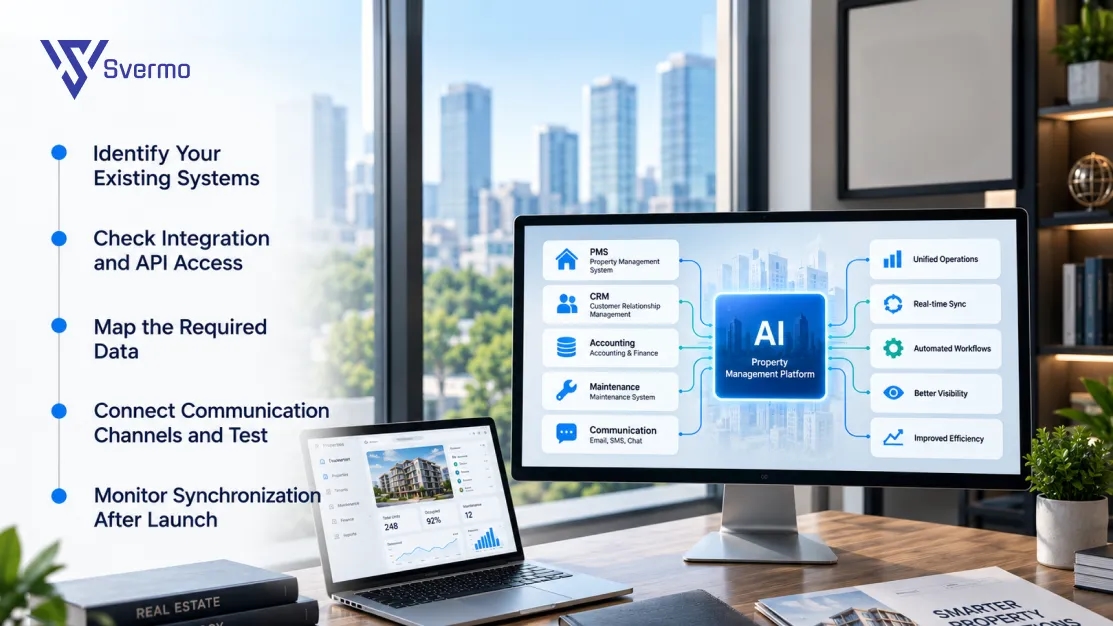
Integrating an AI property management platform for landlords starts with the systems already used to manage your rental portfolio. The process should connect relevant data, define permissions, configure workflows, and verify that information moves correctly between systems.
1. Identify Your Existing Systems
Start by listing the systems that hold the data your AI property management platform for rental properties workflows needs. Depending on your setup, this may include a PMS, CRM, leasing system, communication tools, accounting software, and document storage.
- Property data: Properties, units, occupancy, and availability.
- Tenant data: Contact details, leases, requests, and communication history.
- Leasing data: Leads, applications, tours, and application status.
- Operational data: Maintenance requests, payments, documents, and tasks.
2. Check Integration and API Access
Before connecting anything, verify that your existing systems support the required integration. The key question is whether the AI property management tools for landlords only retrieves information or also creates and updates records in your PMS or CRM.
- Integration method: Check for native integrations, APIs, webhooks, or other supported connections.
- Read access: Confirm which property and tenant records the AI platform can retrieve.
- Write access: Verify whether it can create tasks, update statuses, add notes, or trigger other actions.
- System limits: Review API limits and restrictions that might affect high-volume rental operations.
3. Map the Required Data
Once the connections are confirmed, map the fields between systems. This ensures the AI property management platform for rental properties associates the right tenant, property, unit, lease, and workflow information.
- Tenant records: Match tenant IDs, contact information, and unit assignments.
- Property records: Match property IDs, unit numbers, addresses, and occupancy status.
- Lease records: Connect lease terms, expiration dates, renewal status, and rent information.
- Lead records: Match prospects with their inquiries, applications, and leasing activity.
4. Set Permissions and Configure Workflows
Decide what information each AI workflow needs and what actions it is allowed to perform. A maintenance workflow requires different data and permissions from a leasing workflow.
This gives your AI platform for managing rental properties clear boundaries around sensitive information and automated actions.
- Access controls: Restrict sensitive tenant, financial, and identity information.
- Workflow actions: Define which systems AI may update and which actions require staff approval.
- Escalation rules: Specify when a request moves from automation to a property manager.
- Approval points: Keep decisions involving exceptions, disputes, or sensitive situations with your team.
5. Connect Communication Channels and Test
Connect the communication channels used by your tenants and prospects, then test the complete workflow before applying it across your portfolio. Testing should use realistic rental scenarios rather than simple connection checks.
This step verifies that your AI property management platform for tenant and rental operations maintains the right context across communication and property records.
- Tenant inquiry: Verify that a new message reaches the correct tenant or prospect record.
- Maintenance request: Check that the property, unit, issue, and assigned workflow remain linked.
- Leasing activity: Confirm that inquiries, applications, and scheduled tours update the right records.
- Human handoff: Test whether staff receive the conversation and relevant context when escalation occurs.
6. Monitor Synchronization After Launch
Integration requires ongoing monitoring because rental records and connected systems change over time. Review synchronization regularly to catch problems before they affect tenant service or property operations and maintain reliable rental property management workflows after deployment.
- Failed updates: Identify records that did not transfer or update correctly.
- Duplicate records: Check for repeated tenant, property, or prospect entries.
- Stale information: Look for records that have not synchronized within the expected timeframe.
- Workflow errors: Review automated actions that failed, stopped, or produced unexpected results.
A properly integrated AI property management platform for rental properties should work with your existing PMS, CRM, and communication stack rather than creating another isolated system.
Before adopting AI across your portfolio, you also need to assess the operational, data, and decision-making challenges that come with greater automation.
What Challenges Should Landlords Consider Before Adopting AI Property Management?
AI adoption creates real operational risks when your rental data, workflows, or approval rules are not ready. These are the issues landlords and property management teams should evaluate before deploying an AI property management platform for landlords.
| Challenge | What it means in practice | Practical solution |
|---|---|---|
Poor-quality rental data | Duplicate tenant records, outdated phone numbers, missing lease dates, and incorrect unit assignments lead to unreliable AI responses and workflow actions. | Clean and standardize your PMS and CRM data before connecting them. Establish one authoritative record for tenants, properties, and leases. |
PMS integration limitations | Some property management systems provide limited API access or support data retrieval without allowing external systems to create or update records. | Verify API permissions before selecting an AI rental property management platform. Confirm which records it reads, creates, and updates. |
Incorrect automation rules | A poorly configured workflow might send a renewal reminder at the wrong time, route maintenance incorrectly, or escalate routine requests unnecessarily. | Start with narrowly defined workflows and test them against real rental scenarios before expanding automation across the portfolio. |
Sensitive tenant information | Tenant applications, identification documents, payment information, lease records, and communication histories require controlled access. | Use role-based permissions, limit AI access to required data, and establish clear retention and audit policies. For document-heavy operations, an AI document management application helps keep property records organized and accessible within defined controls. |
AI errors and unsupported answers | AI may produce an incorrect response when a lease record is incomplete, a policy is unclear, or the required information is unavailable. | Restrict AI responses to approved data and defined workflows. Route uncertain, disputed, or sensitive requests to property staff instead of allowing unsupported answers. |
Loss of human oversight | Fully automated handling of disputes, payment issues, accommodation requests, or other sensitive tenant matters creates unnecessary operational and compliance risk. | Define mandatory human approval and escalation points for decisions that require judgment or policy interpretation. |
Inconsistent tenant experience | Different workflows may produce different answers across email, SMS, chat, and phone if they use different information or rules. | Maintain shared tenant and property context across communication channels and test responses against the same approved information. |
Measuring the wrong outcomes | Faster responses alone do not prove that an AI property management platform for rental property owners is improving operations. | Track operational measures such as response time, unresolved requests, leasing conversion, follow-up completion, staff workload, and escalation rates. |
Over-automation of low-value processes | Automating a process that occurs rarely or requires frequent exceptions adds configuration work without meaningful savings. | Prioritize high-volume, rule-based rental workflows where automation removes repeated manual steps and produces measurable time savings. |
The main issue is not whether AI fits into property management. It is whether your AI property management tools for landlords have reliable data, appropriate integrations, defined controls, and measurable workflows behind them.
Now, how should landlords should choose an AI property management platform?
What Should Landlords Consider When Selecting a Property Management Platform?
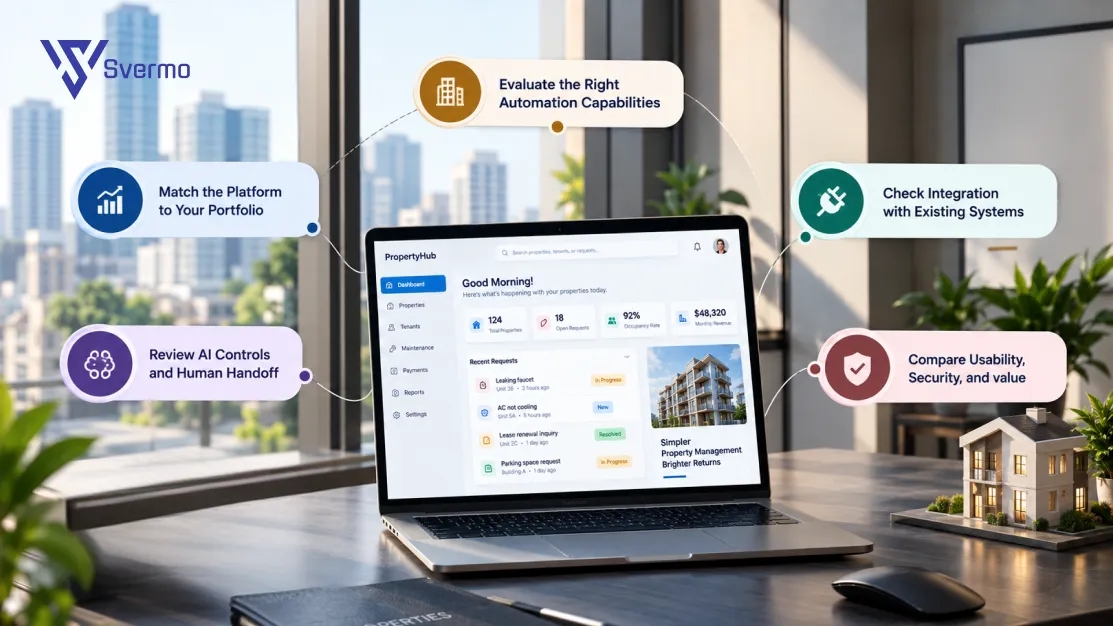
If you're asking, “how do I choose the right AI property management platform for my rental portfolio?”, start with the workflows that consume the most time, then evaluate how well each platform fits your existing operations.
1. Match the Platform to Your Portfolio
Your needs differ based on property count, unit types, and management structure. An AI property management platform for rental property owners should support your current portfolio without creating unnecessary complexity.
For smaller portfolios, prioritize simple workflows and fast setup. Larger portfolios need stronger automation, integrations, permissions, and portfolio-level visibility.
2. Evaluate the Right Automation Capabilities
Look for AI property management tools for rental properties that address your highest-volume tasks. Tenant communication, maintenance requests, leasing follow-ups, document handling, and routine administrative work are strong starting points.
The goal is an AI platform for automating property management, not another system that simply stores information.
3. Check Integration with Existing Systems
Your AI property management platform should fit into the systems your team already uses. Review PMS and CRM integrations, API access, data synchronization, and write permissions before making a decision.
This becomes especially important when your rental property management workflows already span several systems.
4. Review AI Controls and Human Handoff
A reliable AI property management platform for tenant and rental operations needs clear boundaries around automated actions.
Review escalation rules, approval points, permissions, and exception handling. Routine work should stay automated while disputes, emergencies, and sensitive decisions remain with your team.
5. Compare Usability, Security, and Measurable Value
Your AI platform for property management should be easy for landlords and property managers to adopt. Review the interface, user permissions, data controls, activity records, and support available during implementation.
Then define measurable outcomes such as response time, administrative hours saved, leasing follow-up speed, and unresolved requests.
The best AI property management platform for landlords is the one that fits your portfolio, integrates with your existing systems, and improves your rental property operations without adding unnecessary complexity.
Before making a final decision, compare your shortlisted platforms against these criteria and the specific workflows you need to automate.
What Is the Best AI Property Management Platform for Landlords?
Property owners often ask, “I own multiple residential rental properties and struggle to keep track of tenants, leases, maintenance, and day-to-day tasks, so can you recommend an AI property management platform that can help me manage everything more efficiently?”
The right AI platform for property management depends on where the operational bottleneck sits. If phone calls consume staff time, prioritize voice automation. If tenant operations need broader automation, look at resident workflows. If vacancies and lead follow-up are the priority, focus on leasing.
Here is a quick comparison to help you choose without sorting through overlapping features:
| Column 1 | Voice AI | Tenant AI | Leasing AI |
|---|---|---|---|
Primary focus | Phone-based property communication | End-to-end tenant operations | Lead-to-lease workflows, |
Best suited for | Missed calls, maintenance calls, leasing inquiries, after-hours support | Tenant requests, screening, leases, move-in/out, and resident workflows | Lead response, qualification, tour booking, and follow-ups |
Key capabilities | 24/7 call handling, request routing, tour scheduling, call analytics | Tenant communication, screening, service requests, lease lifecycle, task management | Lead qualification, property matching, tour scheduling, application follow-up |
Choose this when | Phone volume is creating delays or missed opportunities | You need broader automation across tenant and property operations | Vacancy reduction and faster leasing are the priority |
The three products address different operational needs rather than competing for the same role. Voice automation focuses on conversations, AI leasing automation focuses on prospects, and AI for tenant management covers a wider set of resident and property workflows.
For a landlord choosing an AI property management platform for landlords, this distinction makes the decision simpler: start with the workflow creating the most manual work, then choose the product that addresses it directly.
Found the Workflow You Want to Automate?
Get a closer look at the Svermo AI product that fits your property management needs.
Put AI to Work
How Svermo’s AI Prodcucts Support Tenant and Rental Operations?
Svermo's property management AI portfolio is designed around the operational needs of independent landlords, property management companies, multifamily operators, regional managers, and growing rental portfolios. Each product addresses a distinct stage of rental operations, from handling property calls and tenant service to managing leasing activity.
For landlords and property managers, that separation makes the buying decision easier. A team dealing with high call volume has a different priority from one focused on tenant service or vacancy reduction. The right starting point depends on the workflow creating the greatest operational burden.
For multifamily and regional property teams, the same distinction matters at portfolio scale. The priority shifts toward consistent processes, faster response times, and less manual coordination across properties.
Beyond property management, Svermo's AI portfolio also supports other stages of the US real estate lifecycle. Investment AI focuses on investment analysis and opportunity evaluation, valuation AI supports property valuation and analysis, while deal AI addresses deal-related workflows.
Together with the property management products above, these offerings cover distinct operational needs across the real estate lifecycle, rather than positioning one AI product as a fit for every real estate function.
Wrapping Up!
The right AI property management platform for landlords should do more than add AI to your existing tools. It should reduce repetitive work, connect with your rental systems, improve response times, and keep your team in control of sensitive decisions.
Svermo takes a product-led approach to US real estate, with AI products built for distinct workflows across leasing, tenant operations, and broader property management.
Its approach to conversational workflows also extends to the use cases of conversational AI agents, particularly where tenant and prospect communication requires timely responses and consistent handling.
For teams managing broader real estate operations, its best AI platform for real estate agents provides additional context on AI adoption across real estate workflows.
For landlords, property managers, and growing rental portfolios, identify your biggest operational bottleneck, then contact us to see how AI fits into your workflow.
 https://www.linkedin.com/in/saanvi-verma-38711a36a
FAQs
Pricing varies by portfolio size, units, features, and usage. Some AI property management tools for landlords use subscriptions, while others charge by property, unit, or workflow. Compare pricing against the time and administrative work the platform removes.
AI reduces repetitive work across communication, maintenance, follow-ups, and routine administration. It also speeds up request handling and keeps workflows moving without constant manual intervention. Track response times, hours saved, and unresolved requests to measure results.
An AI property management platform handles routine tenant messages across phone, chat, email, and SMS. It identifies requests, retrieves relevant information, provides responses, creates tasks, and routes issues requiring human attention.
Yes. An AI property management platform for small landlords suits owners who spend significant time on repetitive administrative tasks. Start with simple workflows such as tenant communication, maintenance requests, or follow-ups.
Implementation depends on portfolio size, data quality, integrations, and workflow complexity. Smaller portfolios with straightforward systems typically require less setup. A phased rollout helps teams test one workflow before expanding automation.
Security depends on the platform's controls and data practices. Review encryption, role-based access, authentication, audit logs, data retention, and vendor policies before adoption. Limit sensitive tenant information to workflows and users that require it.
AI handles defined, repetitive workflows, while landlords and property managers retain control over sensitive decisions, disputes, emergencies, and exceptions. The practical model is AI for routine execution and people for judgment.
Track metrics tied to your automated workflows, including response time, administrative hours saved, maintenance resolution time, missed calls, and unresolved requests. These measures show whether your AI property management platform for rental properties is improving daily operations.