

10 Ways AI Is Improving Tenant Management: Efficiency, Cost Savings, and ROI


Get a summary of this article with your favorite AI





AI Summary
- •AI for tenant management automates communication, support, leasing, payments, inspections, and tenant workflows.
- •Tenant management automation reduces repetitive work, response times, and administrative costs.
- •Tenant management AI can improve tenant experience optimization through faster, more consistent service.
- •Successful AI adoption requires reliable data, integrations, security, compliance, and human oversight.
- •Measure ROI through time saved, productivity, costs, response times, and tenant outcomes.
- •Svermo helps real estate teams automate tenant operations and turn AI into measurable business value.
Are repetitive tenant questions, follow-ups, and service requests consuming your property management team’s time every day?
AI for tenant management can reduce this workload by handling routine communication, organizing requests, triggering follow-ups, and moving repetitive workflows forward with less manual effort.
The potential impact is already measurable. McKinsey reports that agentic AI workflows helped home builders improve lead response times by more than 90%, while after-hours AI agents captured additional home sales.
But where should you start?
Which tenant processes are worth automating first?
How much administrative time can AI realistically save your team?
And how do you prove that the investment is delivering ROI?
The answers depend on more than adding an AI chatbot. Your best results come from connecting AI to specific workflows, existing systems, business rules, and human oversight.
At Svermo, we build AI-powered products that help property management companies, PropTech and real estate technology decision-makers in USA automate workflows, reduce manual work, and improve operational efficiency. For property management teams, that means applying AI to the areas that create the most repetitive work.
From tenant communication and onboarding to maintenance, documentation, renewals, and support, the right AI tenant management automation system can help your team handle more work without adding the same level of administrative effort.
Our approach to AI tenant management focuses on practical workflows that support your team rather than replace human judgment where it matters. The result is a more efficient tenant operation with clearer opportunities to measure time savings, cost reduction, service improvements, and ROI.
But before you decide what to automate, do you know what AI for tenant management actually includes?
Still spending hours on tenant busywork?
See what AI can take off your team's plate and where it can create measurable efficiency.
What does AI for tenant management actually look like in practice, and how is it different from the automation you already use today?
AI for tenant management refers to using artificial intelligence to handle, support, or improve the workflows involved in managing tenant relationships and day-to-day property operations.
It can work across the tenant lifecycle, from onboarding and service requests to renewals, communication, and move-out.
The important distinction is that AI does not simply mean sending automated messages. AI tenant management automation for property managers in US can understand tenant requests, retrieve relevant property or lease information, decide what workflow should happen next, and trigger actions across connected systems.
AI Tenant Management vs. Traditional Automation
Traditional automation follows predefined instructions. AI can handle information that is less predictable, such as a tenant describing a maintenance issue in their own words.
| Traditional automation | AI-powered tenant management |
|---|---|
Follows fixed rules | Interprets context and intent |
Requires structured inputs | Can work with natural language |
Triggers predefined actions | Can select the next workflow step |
Handles predictable tasks | Handles variable but bounded tasks |
Usually needs separate rules for each scenario | Can process multiple related scenarios |
The two approaches work better together than separately.
For example, AI can understand that a tenant reporting "water dripping from the ceiling" is a maintenance issue. A rules-based workflow can then assign the ticket, apply emergency criteria, notify the right team, and update the property management system.
But what does this tenant workflow automation with AI look like?
How does an AI for Tenant Management Workflow Actually Operate from Message to Resolution?
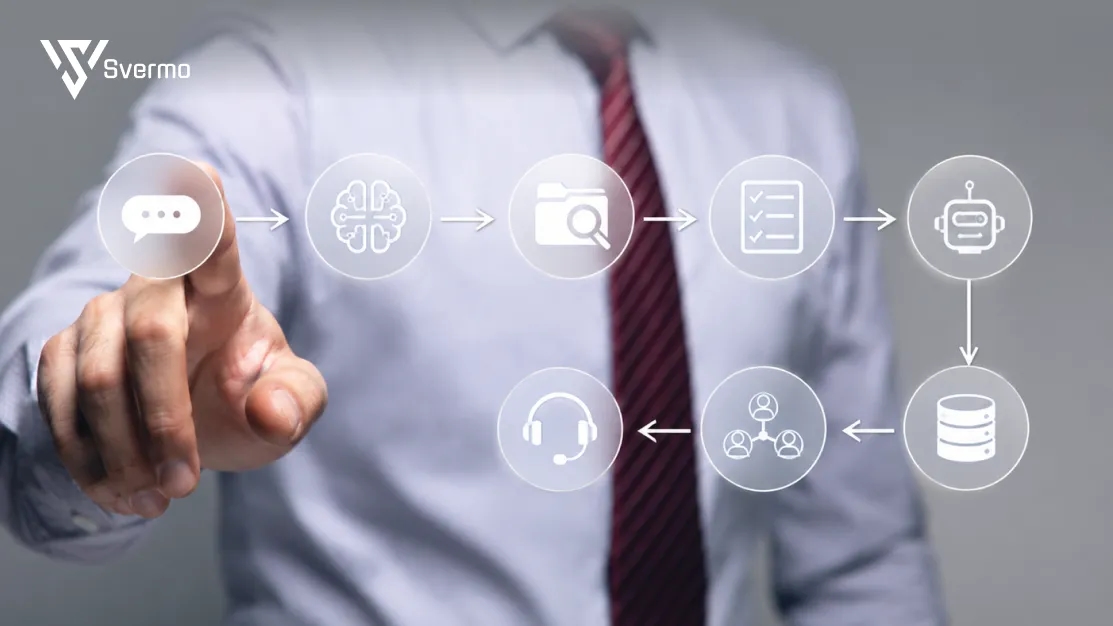
This flow represents how AI actually operates inside a tenant management system.
Instead of reacting to each message in isolation, an AI tenant management system follows a structured decision path. It ensures everything is logged properly so your team always has full visibility and control. here is the full workflow:
1. Tenant Message
A tenant reaches out through SMS, email, chat, voice, or a portal. This is the starting point of every workflow. The tenant communication system like voice AI captures the message in real time so no request is missed or delayed.
2. AI Identifies Intent
The AI reads the message and determines what the tenant actually needs. It can distinguish between a maintenance issue, a billing question, a lease inquiry, or a general support request, even if the wording is unclear.
3. Retrieves Relevant Information
Once the intent is clear, the AI tenant management pulls the right context. This may include lease details, past service requests, property data, or tenant history from your property management system or connected databases.
4. Applies Business Rules
Your predefined rules guide what the system is allowed to do. These rules can vary by property, urgency, tenant type, or request category. This ensures responses stay aligned with your operational policies.
5. Takes Permitted Action
The system then executes approved actions. This could include sending a response, creating a maintenance ticket, scheduling a follow-up, or updating a tenant record without manual intervention.
6. Updates the System
Every action and interaction is logged back into your system. This keeps records accurate, ensures visibility for your team, and maintains continuity across all tenant communications.
7. Escalates When Necessary
If the request is complex, sensitive, or outside defined rules, the AI for tenant management routes it to a property manager or relevant team member. This ensures human oversight where judgment is required.
This workflow is what turns AI from a simple messaging tool into a real operational layer for tenant management. Instead of scattered responses and manual follow-ups, you get a structured system that moves every request forward with clarity, consistency, and control.
It also gives your team something more important than speed. It gives them visibility into every tenant interaction from start to finish. Now that you understand how the workflow operates in practice, the next step is to look at where it fits into your day-to-day operation.
Where Can AI Make the Biggest Difference in Tenant Management?
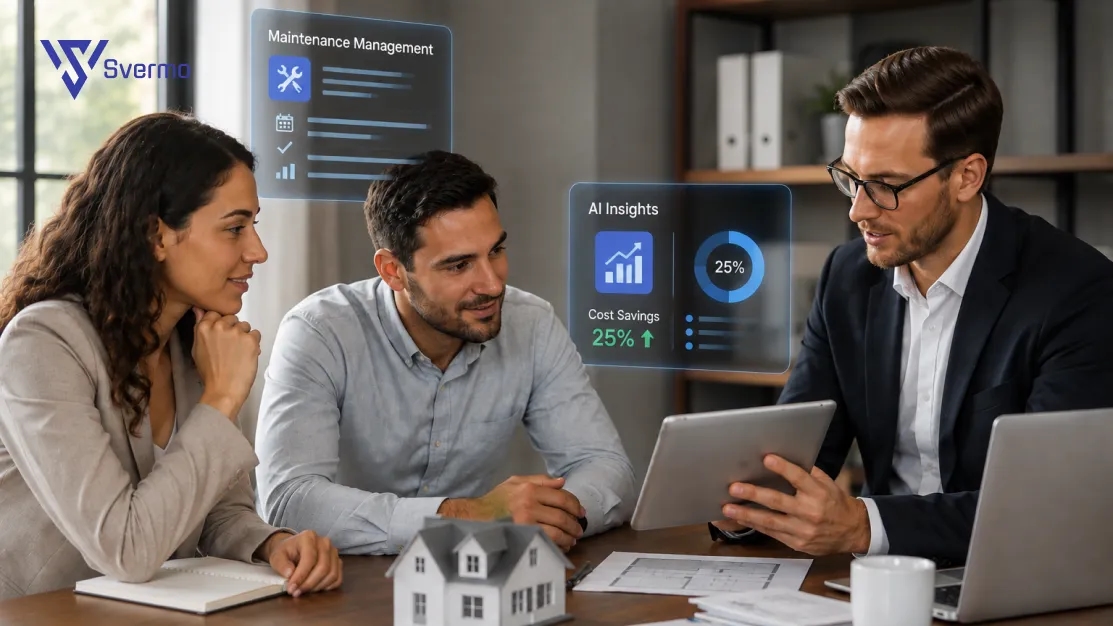
AI becomes valuable when it solves specific operational problems rather than adding another layer of technology. For property managers, those opportunities often appear in communication, maintenance, onboarding, documentation, renewals, and tenant support.
A common question from property management teams is: “What are the best ways for property managers to use AI for tenant onboarding, communication, support, and engagement?”
The answer depends on your workflow, portfolio size, existing systems, and the level of human involvement each task requires.
The following 10 use cases focus on practical areas where AI can reduce repetitive work, improve response times, and give your team more capacity without sacrificing control.
1. Automate Tenant Communication and Follow-Ups
Tenant communication rarely consists of one message and one reply.
A tenant asks about a maintenance request. Your team checks the property record, finds the work order, contacts the vendor, and sends an update. If the vendor does not respond, someone has to follow up again.
Multiply that process across hundreds of tenants, and communication becomes a significant administrative burden. AI-powered tenant communication can handle much of this coordination.
For example, when a tenant asks, “Has anyone been assigned to fix the AC yet?”, an AI system can:
- Identify that the tenant is asking for a maintenance status update.
- Retrieve the related work order and current status.
- Check approved information about the assigned vendor or technician.
- Respond with the latest available update.
- Create a follow-up task if the request has exceeded your response threshold.
- Escalate the conversation if the information is missing or the tenant reports an urgent issue.
- Record the interaction for your property management team.
This is more useful than simply generating a polite response. The AI is connected to the workflow behind the conversation.
Example:
A regional property manager has hundreds of tenants approaching lease expiration each quarter. Instead of manually tracking who received a renewal message, who responded, and who needs another follow-up, an AI workflow can identify the relevant tenants, send approved communications based on the renewal stage.
It records responses, and create tasks for property managers when a tenant asks about pricing, terms, or other matters requiring human attention.
It can also manage routine communication such as:
- Move-in instructions
- Appointment confirmations
- Maintenance updates
- Rent reminders
- Renewal follow-ups
- Document requests
- Inspection reminders
- Post-service check-ins
For teams evaluating AI-powered tenant communication for property managers, the goal should be fewer manual handoffs, not fewer human interactions.
Your team should still handle complaints, disputes, sensitive situations, and requests that require judgment.
The strongest implementations connect communication directly to your existing systems. That way, a tenant's message can trigger the next operational step instead of creating another task for your team.
2. Automate Maintenance Requests and Service Triage
Maintenance is one of the clearest areas where tenant workflow automation with AI for tenant management can reduce back-and-forth work.
A tenant may write, “The ceiling is leaking near the bedroom light.” That single message contains several pieces of information your team needs to act on.
AI can extract the issue, identify the likely category, assess urgency based on your rules, and ask for missing details when needed.
A well-designed workflow can then:
- Classify the request as plumbing, electrical, HVAC, appliance, structural, or another category.
- Detect indicators that may require immediate attention.
- Ask targeted follow-up questions instead of sending a generic maintenance form.
- Create a structured service request with the relevant tenant and property details.
- Route the request to the appropriate maintenance team or vendor.
- Send the tenant confirmation and status updates.
- Flag requests that remain unresolved beyond your service-level target.
Example:
A tenant submits a maintenance request at 11:30 p.m. describing water pooling beneath a kitchen sink. The AI system identifies the issue, asks whether water is still actively leaking, applies the property's emergency-maintenance rules, and routes the request according to the configured escalation path.
The tenant receives confirmation immediately, while the on-call team receives the information needed to decide the next step.
This matters because maintenance teams often lose time interpreting and routing requests, not just completing repairs.
AI can handle that administrative layer while your maintenance staff focuses on diagnosis, repairs, vendor coordination, and exceptions.
3. Automate Tenant Onboarding and Move-In Workflows
Your team may need to collect documents, confirm lease details, share move-in instructions, coordinate access, explain property policies, and follow up on incomplete tasks.
When these steps depend on manual reminders, small delays can create unnecessary work for your property management team. AI-powered tenant onboarding for property management can turn these scattered tasks into one coordinated workflow.
Example:
A property management company overseeing ~1,200 residential units across three cities was struggling with inconsistent move-in coordination. New tenants were frequently calling to ask about key pickup, utility setup, and move-in timing, while staff were manually tracking onboarding progress across spreadsheets and email threads.
After implementing an AI-driven resident engagement workflow:
- As soon as a lease was signed, tenants received a structured onboarding message with property-specific instructions (parking access, utility providers, and building rules).
- The system automatically checked whether ID verification, deposit confirmation, and insurance documents were complete.
- If a tenant had not submitted required documents within 48 hours, the AI triggered a reminder tailored to the missing item (not a generic follow-up).
- For one property, where access cards were required, the system created internal tasks for the front desk and confirmed readiness before move-in day.
- Tenants asking questions like “Can I move in after 6 PM on Friday?” received instant answers based on building policy and lease terms.
Within two months, the company reduced onboarding-related inbound calls and eliminated most manual follow-ups for missing documents. More importantly, property managers reported fewer last-minute move-in issues and less coordination overhead during peak leasing periods.
Build onboarding around milestones
A better workflow does not send every tenant the same sequence of messages. Instead, communication should respond to what has already happened.
Example:
Lease signed → Welcome message → Documents collected → Move-in instructions sent → Access confirmed → Move-in completed → Post-move-in follow-up
Each milestone can trigger the next approved action. This creates a smoother tenant experience while giving your team visibility into incomplete onboarding tasks.
Measure onboarding performance
Useful metrics include:
- Average onboarding completion time
- Percentage of documents collected before move-in
- Manual follow-ups per new tenant
- Percentage of onboarding tasks completed automatically
- Number of support questions during onboarding
- Move-in issues reported after handover
The real value comes from removing the repeated coordination work around each new tenant, while keeping your team available for exceptions and requests that require personal attention.
4. Process Lease and Tenant Documents Faster
Lease administration creates a different kind of workload. The problem is rarely the number of documents alone. It is finding specific information inside them and keeping important dates, obligations, and tenant records aligned.
This is where tenant workflow automation with AI becomes more useful than simple document storage. For property management companies, AI for tenant operations and property management can make these records easier to search, organize, and use inside daily workflows.
A tenant lifecycle automation workflow can use AI to:
- Extract lease start and end dates.
- Identify renewal and notice deadlines.
- Pull tenant names, unit numbers, rent amounts, and other defined fields.
- Summarize lease terms in plain language.
- Locate specific provisions when staff need to answer a tenant question.
- Flag missing or inconsistent information for review.
- Create reminders for upcoming lease events.
- Connect extracted information with approved tenant or property records.
This is particularly useful when your portfolio contains leases created at different times or using different templates. For companies using leasing AI, the transition can be part of a connected workflow that carries approved information from leasing into onboarding and ongoing tenant operations.
Example:
A mid-sized property management company in Texas managing over 1,200 residential units struggled with lease renewals because dates were tracked manually across spreadsheets and PDFs.
Renewal notices were often sent late, leading to tenant confusion and rushed negotiations.
After implementing an AI document processing workflow, the system automatically extracted lease end dates and notice periods from uploaded agreements. It then triggered renewal reminders 120, 90, and 60 days before expiration and created tasks for property managers only when tenant responses were required.
Keep legal judgment with people
AI can extract, organize, and summarize lease information. It should not independently interpret ambiguous contractual language or make legal decisions on behalf of your organization.
A safer approach is to let AI surface the relevant information, identify uncertainty, and route the matter to the appropriate person for review.
This distinction is important when automating tenant management processes with AI because efficiency should not come at the expense of oversight.
Measure document workflow efficiency
Track:
- Average time to locate lease information
- Manual data-entry hours per lease
- Percentage of key fields extracted correctly
- Time spent preparing renewal reminders
- Number of document-related tenant inquiries
- Percentage of requests requiring manual document searches
The objective of AI tools for improving tenant management efficiency is straightforward: make reliable lease information available when your team needs to act, while reducing the manual work required to find and process it.
5. Reduce Repetitive Property Management Administration
Property managers often spend more time moving information between systems than acting on it.
A tenant request arrives by email. Someone copies the details into the property management system. Another person updates a spreadsheet. A follow-up gets added to a task list. Later, someone checks whether the task was completed.
None of these steps requires a property manager's judgment. AI for reducing property management administrative tasks can handle much of this coordination when the underlying systems are connected.
A well-designed workflow can:
- Read incoming emails and messages and identify the required action.
- Extract tenant, property, unit, and request details.
- Create or update records in the appropriate system.
- Draft internal notes and case summaries.
- Generate routine reports from existing operational data.
- Create follow-up tasks based on deadlines or unresolved cases.
- Summarize a tenant's recent interactions before a staff member responds.
- Flag records that need attention instead of forcing staff to review every record manually.
The important distinction is between doing the work and moving the work forward.
AI property management applications do not need to approve a sensitive tenant decision. It can prepare the information, complete the routine steps, and send the case to a person when approval is required.
Example:
A property management company was spending significant time manually processing tenant emails and maintenance requests across multiple inboxes and systems.
Before AI, a simple request like “my heater is not working” required a coordinator to read the email, identify the property, check the tenant record, create a work order in the maintenance system, notify the vendor, and then send a confirmation back to the tenant. This process often took 15–25 minutes per request.
After implementing an AI-driven workflow, incoming tenant messages were automatically classified, linked to the correct unit, and converted into structured maintenance tickets. The system also generated a draft response for tenant communication and updated the internal property management system without manual input.
As a result, the company reduced administrative handling time per request by more than 60%, and property managers were able to focus more on vendor coordination and tenant escalations rather than data entry and system updates.
6. Automate Lease Management and Renewal Workflows
Lease renewals can become a recurring administrative bottleneck when property managers track dates, notices, tenant responses, and follow-ups manually.
The problem becomes harder across a large portfolio. A regional multifamily operator may have hundreds of leases reaching different milestones every month.
AI tenant lifecycle automation can help turn renewal management into a structured workflow rather than a spreadsheet-driven process.
For each lease, an AI-enabled system can:
- Identify the lease expiration date and applicable notice period.
- Create renewal milestones based on your predefined timeline.
- Generate personalized renewal communication using approved information.
- Track whether the tenant has opened, responded to, or ignored a message.
- Schedule follow-ups when no response is received.
- Summarize tenant communication before a property manager steps in.
- Flag tenants who need direct human attention.
- Update the relevant system after a renewal decision is recorded.
This makes lease management and renewal automation particularly useful for multifamily and BTR operators managing large numbers of similar lease events.
Example:
Imagine a 2,000-unit multifamily portfolio with 150 leases approaching expiration each month. Instead of asking property managers to monitor 150 separate renewal timelines, the system can organize each lease by its current stage.
A tenant who has already responded can move to the next step automatically. A tenant who has not responded can receive the next approved follow-up. A tenant with unresolved issues can be routed to a property manager before the renewal conversation continues.
Measure renewal performance
Track:
- Renewal communication completion rate
- Average days from first notice to tenant response
- Follow-ups completed on schedule
- Renewal conversion rate
- Percentage of renewals requiring manual intervention
- Average staff time per renewal
- Vacancy days following non-renewal
The strongest tenant lifecycle automation programs connect renewal communication with the underlying tenant record, rather than treating each message as a separate task.
7. Automate Rent Collection and Payment Follow-Ups
Rent collection involves more than sending a payment reminder.
Your team may need to monitor upcoming payments, identify missed payments, answer payment questions, send follow-ups, and document communication. Across a large portfolio, those small tasks can consume substantial staff time.
Automated tenant communication and engagement can handle routine payment-related interactions while keeping your team in control of exceptions.
An AI-enabled payment workflow can:
- Identify upcoming or overdue payment events from approved system data.
- Send reminders based on your predefined communication schedule.
- Answer routine questions about payment dates, methods, or account status using verified information.
- Track whether a tenant has responded to a reminder.
- Trigger the next approved follow-up when payment remains outstanding.
- Create an internal task when a case requires staff attention.
- Record communication and actions in the appropriate tenant record.
- Escalate disputes, hardship requests, or other sensitive situations to a designated team member.
Separate routine follow-ups from sensitive cases
Not every overdue payment should follow the same path. A routine reminder may be suitable for automation. A tenant disputing a charge, reporting a payment error, or requesting an accommodation requires a different workflow.
AI can identify the nature of the conversation and route it accordingly. Your business rules should determine what communication can be sent automatically and when a person must review the case.
This makes AI tenant management automation for property managers more controlled than simply sending the same reminder to every tenant.
Example:
A tenant whose payment is due in three days. The system can send the approved reminder before the due date. If the payment remains outstanding, it can send the next permitted message according to your policy.
If the tenant replies, "I already paid this yesterday," the workflow should not continue sending automated collection messages.
Instead, the system can identify the payment-status question, retrieve the available transaction information, and route the case for verification if the records do not match.
Poorly designed automation can create more tenant complaints. Well-designed intelligent tenant operations reduce unnecessary back-and-forth.
8. Analyze Tenant Sentiment and Feedback at Scale
Tenant feedback often contains useful operational data, but it is scattered across surveys, emails, reviews, support conversations, and service requests. The harder problem is finding the pattern.
One complaint about a noisy hallway may be isolated. Fifty similar complaints across three properties point to something your operations team should investigate.
AI can organize this feedback by topic, property, frequency, and urgency so managers can identify recurring problems without manually reviewing every conversation.
Example:
Imagine a multifamily operator receives 2,000 tenant messages in a month.
Instead of reading each conversation individually, the AI for property management team could identify that:
- 18% of maintenance-related conversations mention delayed vendor arrival.
- Most complaints come from two properties.
- Those properties also have longer average work-order completion times.
- Complaints increase during weekends.
- Tenants who receive proactive status updates submit fewer follow-up messages.
That is more useful than a generic sentiment score. It gives your team evidence about where an operational problem may exist.
Connect feedback with property performance
AI-driven resident engagement becomes more useful when tenant feedback is connected with actual property data.
Your team can compare feedback against:
- Maintenance response time
- Work-order completion time
- Support response time
- Renewal rates
- Service-request volume
- Communication frequency
- Property-level complaint volume
This can reveal relationships worth investigating.
This is a practical application of tenant experience optimization, where tenant feedback becomes one input into broader property-management decisions.
Prioritize problems by business impact
Not every negative comment deserves the same response.
A useful prioritization model considers:
Frequency × severity × affected tenants × operational cost
A recurring issue affecting 300 residents should receive more attention than an isolated complaint with no wider pattern.
AI can surface these patterns and summarize the evidence. Your property and operations teams still decide what action to take.
For operators evaluating AI-powered tenant management for multifamily properties, this distinction matters. AI should help managers see where attention is needed, not make subjective judgments about individual residents.
9. Turn Tenant Data into Actionable Operational Insights
Your property management systems already contain valuable information across tenant interactions, maintenance records, payments, lease events, and service requests.
The challenge is turning that data into decisions without spending hours preparing reports. AI for property management in USA can identify patterns, surface exceptions, and summarize what deserves attention.
For example, a regional operator might discover that one property has:
- 22% more maintenance requests than comparable properties.
- Longer evening response times.
- More repeat service requests.
- Higher tenant follow-up volume.
These patterns can point to staffing, vendor, or process issues that may not appear in routine reports.
Move from reports to action
Traditional reporting tells you what happened. The property management system with AI can help connect the evidence and highlight what changed.
A practical workflow looks like:
Data collected → Pattern identified → Exception flagged → Context summarized → Manager reviews → Action initiated
The manager still makes the decision. Tenant management automation for property management companies reduces the time required to find the information behind it.
Example:
A property management company overseeing 4,000 rental units.
An AI workflow flags a 28% increase in service requests at one property. Most involve the same appliance, with several units reporting repeat failures.
The operations manager reviews the work orders and finds that multiple appliances are nearing the end of their expected service life.
Instead of continuing with individual repairs, the team replaces the affected units together.
The benefit of AI-driven tenant operations for rental properties comes from identifying a portfolio-level pattern before it becomes a larger operational problem.
What to measure
Track:
- Reporting hours saved
- Recurring issues identified
- Time from issue detection to action
- Resolution time after intervention
- Property-level performance changes
- Manager workload per property
The goal is simple: move from scattered tenant data to a specific decision and measurable action.
10. Automate Property Inspections and Move-Out Workflows
Move-out can create a concentrated burst of work for property management teams.
A tenant gives notice. Someone schedules the inspection, sends instructions, documents the property's condition, identifies repairs, coordinates vendors, and tracks whether the unit is ready.
When those steps are handled separately, delays can extend vacancy and create unnecessary coordination.
AI-driven tenant operations can connect these steps into one workflow, giving property managers better visibility from move-out notice through property turnover.
A typical property management workflow automation process can:
- Identify the move-out date from the tenant record.
- Trigger inspection scheduling and tenant reminders.
- Generate a property-specific inspection checklist.
- Organize inspection photos, notes, and documents.
- Identify visible issues from inspection images for staff review.
- Compare current inspection information with previous records.
- Categorize issues as maintenance, cleaning, damage, or follow-up items.
- Create tasks for the appropriate internal team or vendor.
- Track outstanding turnover work.
- Flag units that are not ready by the target date.
Use AI to document property condition
Inspection documentation can become difficult to manage when teams rely on photos, handwritten notes, and separate spreadsheets.
Computer vision can identify visible conditions in inspection images, such as damaged flooring, wall marks, broken fixtures, or other predefined property issues.
This can support AI-powered tenant management for multifamily properties, where teams may need to process dozens of inspections during busy turnover periods.
The AI output should support the inspection process, not replace it.
A property manager or inspector should verify findings before they are used for repairs, tenant charges, or other consequential decisions.
Example:
Consider a property manager overseeing 1,500 rental units.
During peak move-out periods, dozens of inspections may occur each week. Without a structured workflow, staff may spend hours sorting inspection photos, writing reports, creating repair tasks, and following up with vendors.
An AI-assisted inspection process can organize evidence from each unit, group similar issues, prepare draft reports, and create relevant follow-up tasks.
Staff then verify the findings instead of starting each inspection record from scratch. That can reduce administrative effort while giving maintenance and turnover teams clearer information about what needs to happen next.
These use cases are only the starting point; the real value comes when AI becomes part of the workflows your team relies on every day. Now do you have any idea what tenant management processes can be improved or automated using AI?
Which tenant workflow is costing you the most time?
Turn repetitive tenant operations into streamlined, measurable workflows with AI.
What Are the Measurable Benefits and Cost Savings of AI in Tenant Management?

The value of AI in tenant management comes down to a simple question: can your team serve more tenants, handle more properties, and respond faster without increasing administrative workload at the same rate?
For property management companies, the benefits can show up across four areas:
| Business benefit | What can improve | What you can measure |
|---|---|---|
Lower operating costs | Less manual administrative work | Staff hours, cost per request, overtime |
Higher team productivity | More work handled by existing teams | Requests handled per employee, cases per property manager |
Better tenant experience | Faster and more consistent service | Response time, resolution time, repeat complaints |
Stronger financial performance | Fewer avoidable vacancies and operational inefficiencies | Renewal rate, vacancy days, operating cost per unit |
The potential savings are not purely theoretical. Deloitte reports that AI can deliver 10% to 40% cost savings in some real estate functions, alongside benefits such as stronger portfolio performance and better tenant experience.
That range matters because the result depends heavily on the workflow being automated, the quality of the underlying data, and how deeply AI is integrated into your operations.
The strongest AI investment is not the one that automates the most work. It is the one that creates measurable improvements without introducing new operational problems.
But what risks and implementation challenges should you consider before bringing AI into your tenant operations?
What Challenges Should Property Managers Consider Before Implementing AI for Tenant Operations?
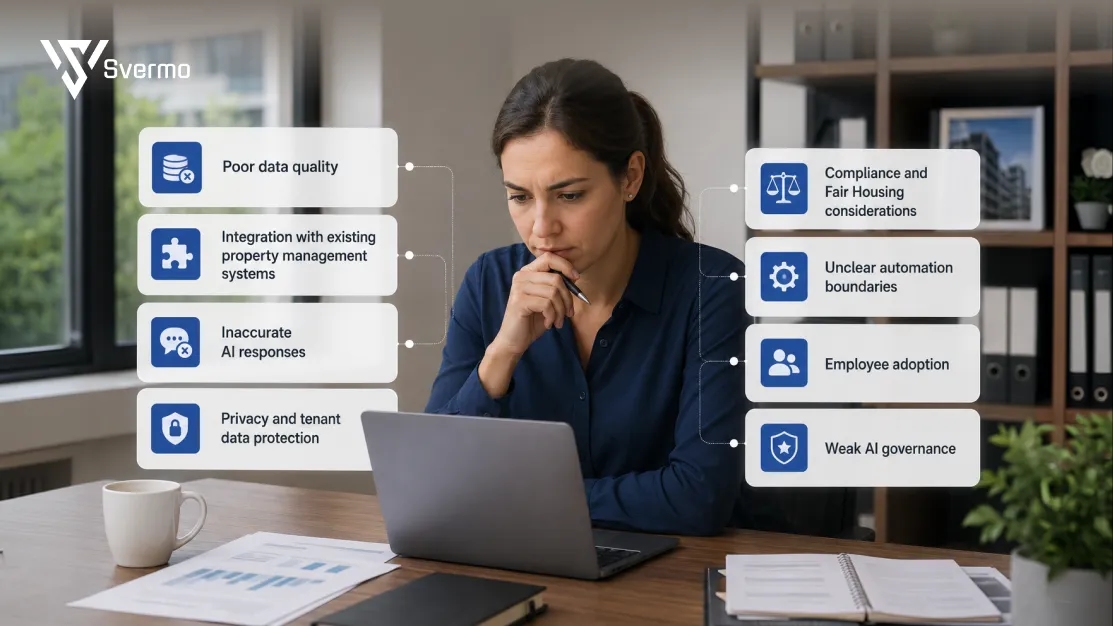
AI can improve tenant operations, but implementation problems can quickly reduce its value.
The technology is only one part of the equation. Your data, workflows, integrations, policies, and people all affect how well an AI system performs.
Here are the main challenges to address before deploying AI across your tenant operations.
1. Poor data quality
AI needs reliable information to give reliable results.
If tenant records contain outdated contact details, incomplete lease information, duplicate records, or inconsistent property data, automation can produce incorrect actions or responses.
How to solve it: Start by identifying the systems that contain your tenant, lease, maintenance, and property data. Remove duplicate records, establish ownership for important fields, and define which system is the authoritative source for each type of information.
This is particularly important when implementing AI tenant management automation for property managers across multiple properties or legacy systems.
2. Integration with existing property management systems
An AI tool that operates separately from your property management software can create another information silo.
Your team may still need to copy tenant information, update work orders, or check payment status manually.
How to solve it: Prioritize AI products that can connect with the systems your team already uses through supported integrations or APIs. Start with one workflow and verify that information moves correctly between systems before expanding.
3. Inaccurate AI responses
Generative AI can produce an answer that sounds convincing but is incorrect.
That creates a serious problem when the response involves rent, lease terms, maintenance status, policies, or other tenant information.
How to solve it: Restrict the AI to approved information sources for operational answers. Use retrieval-based workflows where appropriate, define what the system can access, and require escalation when the required information is unavailable or uncertain.
For AI-powered tenant management, accuracy should be measured using real tenant scenarios rather than generic AI benchmarks.
4. Privacy and tenant data protection
Tenant operations involve sensitive information, including contact details, lease records, payment information, identification documents, and communication history.
Sending this information to an AI system without understanding how it is stored, processed, or accessed can create unnecessary risk.
How to solve it: Review the vendor's security practices, data-processing terms, access controls, retention policies, encryption, and data-use policies before deployment. Limit access according to employee roles and only provide the AI with information required for the workflow.
5. Compliance and Fair Housing considerations
Some tenant decisions carry legal and regulatory consequences.
AI should not independently make decisions that could create discriminatory outcomes in areas such as housing eligibility, accommodations, or other protected activities.
How to solve it: Keep consequential decisions under appropriate human control. Document the criteria used by the workflow, test for inconsistent outcomes, maintain audit records, and involve qualified legal or compliance professionals when necessary.
The safest approach is to use AI for administrative support and information processing while keeping sensitive decisions subject to established policies and human review.
6. Unclear automation boundaries
Not every task should be fully automated.
A routine maintenance-status question may be suitable for automation. A dispute involving a tenant, an emergency, or an unusual lease situation may require immediate human involvement.
How to solve it: Define three categories before deployment:
- Automate: AI can complete the task independently.
- Assist: AI prepares information or recommendations for staff.
- Escalate: AI must transfer the case to a person.
This simple framework makes tenant workflow automation with AI easier to control.
7. Employee adoption
Your property managers may resist an AI system if they see it as another tool that creates work rather than removing it.
Adoption problems often appear when employees have to monitor multiple dashboards, correct poor outputs, or duplicate work that AI was supposed to eliminate.
How to solve it: Involve the people who perform the workflow before deployment. Show exactly which steps will change, train staff on exceptions and escalation, and measure whether the new process actually reduces their workload.
8. Weak AI governance
As AI expands across tenant operations, different teams may begin using different tools, prompts, data sources, and approval rules.
That can create inconsistent processes and make it difficult to understand who is responsible when something goes wrong.
How to solve it: Establish basic AI governance covering:
- Approved AI tools
- Permitted data access
- User permissions
- Human approval requirements
- Escalation rules
- Audit trails
- Performance monitoring
- Incident handling
This becomes increasingly important as intelligent tenant operations expand across multiple properties.
The objective is to build reliable AI for tenant operations and property management around workflows where the technology can produce a clear operational improvement without compromising tenant service, security, or control.
Which AI Platforms Help Property Management Companies Improve Tenant Operations, Efficiency, and ROI?
Choosing an AI platform is not simply about finding the tool with the most features.
You need a platform that fits your existing property management processes and can improve the work your team already performs.
Look for these capabilities:
| What to evaluate | Why it matters | What to look for |
|---|---|---|
Workflow automation | Reduces manual handoffs between teams and systems | Automated actions, follow-ups, routing, and task creation |
Tenant communication | Helps teams manage high message volumes | AI-powered email, chat, SMS, or voice communication |
Property management integrations | Keeps tenant and property information connected | PMS, CRM, leasing, maintenance, payment, and document integrations |
AI permissions and controls | Prevents inappropriate automated actions | Role-based access, approval rules, escalation paths |
Data security | Tenant information can be highly sensitive | Encryption, access controls, retention policies, and clear data handling |
Reporting and analytics | Helps prove operational improvements | Workflow-level performance and ROI reporting |
Scalability | Your requirements change as the portfolio grows | Support for multiple properties, teams, workflows, and higher volumes |
A strong platform should do more than generate responses.
For example Svermo's approach focuses on AI products built around specific real estate workflows rather than treating AI as a generic add-on. Its tenant AI has also demonstrated measurable operational improvements:
- 80% faster tenant response times
- 60% reduction in manual tasks
- 40% increase in team productivity
- 24/7 resident support availability
These figures illustrate what measurable improvement can look like when AI is applied to tenant operations.
Ready to turn tenant operations into a competitive advantage?
Svermo helps property teams automate high-impact workflows, improve efficiency, and scale operations with AI.
Wrapping Up!
AI for tenant management can help property management teams reduce manual work, respond faster, and manage growing portfolios without adding the same level of administrative workload.
The biggest opportunity is not automating every tenant interaction. It is building intelligent tenant operations around the processes where your team loses the most time.
That can include tenant communication, workflow coordination, document handling, service requests, inspections, and other repetitive operational tasks.
Svermo offers AI products specifically for real estate workflows, helping property managers and real estate businesses connect information, automate processes, and improve operational efficiency. Its broader AI real estate platform approach brings workflow automation, data analysis, document processing, and decision support into connected real estate operations.
For teams looking to improve resident engagement, use cases of conversational AI agents can also provide practical opportunities to automate routine conversations while routing more complex matters to the right people.
The right approach is straightforward: identify a costly workflow, establish a baseline, automate where the rules are clear, keep people involved where judgment matters, and measure the outcome.
Let AI handle the busywork while your team gets back to managing the business. Contact us and put your next tenant workflow to work.
 https://www.linkedin.com/in/saanvi-verma-38711a36a
FAQs
AI for can handle repetitive work such as routine tenant questions, follow-ups, information retrieval, document processing, and request routing. This reduces the number of manual steps property managers handle each day and gives teams more time for tenant issues that require judgment.
Property management companies can use AI tenant platforms, conversational AI agents, voice AI, and workflow automation tools. These systems can understand tenant requests, retrieve approved information, send routine responses, create follow-ups, and route complex service requests to employees.
AI for tenant management can reduce the time employees spend on repetitive administrative work across multiple properties. AI-driven tenant operations for rental properties can also standardize routine workflows, reduce manual data entry, and help teams manage higher request volumes without increasing administrative workload at the same rate.
Start with high-volume processes that follow clear rules. Common opportunities include document collection, tenant questions, service-request routing, appointment coordination, follow-ups, and resident engagement. Measure response time, staff workload, and resolution time before expanding automation.
AI can provide consistent support across properties while connecting tenant interactions with operational workflows. Automating tenant management processes with AI can reduce delays caused by manual handoffs and help regional teams maintain consistent service standards as their portfolios grow.
ROI depends on the workflow, transaction volume, labor costs, and implementation model. Companies should measure changes in staff hours, response times, cost per request, productivity, vacancy days, and tenant service outcomes. The strongest business case comes from comparing these metrics against a clear pre-AI baseline.
Property managers should evaluate data quality, system integrations, security, privacy, compliance, AI accuracy, employee adoption, and escalation processes. AI automation for tenant support and service requests should also include clear boundaries for situations that require human intervention.
AI can take care of repetitive information-processing and coordination tasks while property managers retain control over decisions involving disputes, exceptions, sensitive tenant situations, and complex operational issues. This creates a practical balance between automation and human expertise.