
AI Property Management Platform for Scaling Portfolios: Manage More Units Without Proportional Staff Growth


Get a summary of this article with your favorite AI





AI Summary
- •AI property management platforms automate repeat resident communication, maintenance coordination, follow-ups, and status checks as unit volume grows.
- •Scaling portfolios does not have to mean proportional headcount growth when routine workload is automated and staff focus on exceptions and decisions.
- •Property management operational efficiency starts with identifying where staff time goes, which workflows consume the most capacity, and where automation fits first.
- •The right AI platform for scaling property management operations needs strong PMS integration, clear escalation controls, workload reporting, security, and human oversight.
- •Svermo’s view of AI in real estate focuses on the small, repeated staff touches across property operations and how those touches change as portfolios grow.
You’ve added 200 more units. The problem is, the work didn’t just increase by 200 units. Your team now has more messages to answer, more maintenance requests to chase, more follow-ups to remember, and more small tasks getting stuck between people.
That’s where an AI property management platform for scaling portfolios makes a real difference. Instead of hiring every time the portfolio grows, you can use AI to take over the repetitive work that keeps your team busy and leave people to handle the situations that actually need their judgment.
The bigger question is whether an AI platform to manage more units without adding staff can actually keep up as your portfolio grows. Does it work with your existing property management system? Can it handle routine work without constant staff intervention? And when something falls outside the normal workflow, does it get to the right person?
Svermo as an AI product company working towards U.S. property operations also points to an important practical detail: AI is most useful when it works inside the workflows your team already uses, rather than forcing them to work around another tool.
Is Your Portfolio Growing Faster Than Your Team?
See where AI can take repetitive property management work off your staff’s plate.
How Does AI Reduce the Day-to-Day Workload That Normally Scales with Unit Count?
An AI property management platform for growing portfolios takes over repeatable steps that appear across resident and property interactions: collecting information, sending updates, following up on open requests, and checking whether the next step happened. Staff handle the exceptions instead of manually moving every routine request forward.
Property management leaders often want to see the actual staff workload AI removes before adding another platform to their operation. A common question from teams considering AI is:
“I am skeptical that AI can actually reduce the workload that comes with more units, rather than just adding another tool my team has to manage on top of everything else, so I need to see what specifically gets lighter for my staff, not just a general promise.”
The platform handles routine information requests, resident updates, appointment confirmations, vendor follow-ups, and status checks. Staff no longer need to manually move each routine interaction forward. Exceptions and decisions stay with the appropriate team member.
Reduce Repetitive Resident Communication and Follow-Up
A resident reports a maintenance issue but leaves out the preferred access time. An AI resident communication system for property managers requests the missing detail, records the response, and sends the next update without staff handling each message.
The same workflow applies to routine questions, appointment confirmations, document requests, and outstanding responses. The conversation stays active until the request reaches its next step or requires staff intervention.
This is also the kind of workflow Svermo has worked through in building its Tenant AI platform for property management. The product brings resident communication, service requests, task routing, and escalation into one workflow, giving Svermo a practical view of where automation removes repeated staff touches and where a request still needs a person.
Reduce Maintenance Coordination and Follow-Up
A maintenance request moves through several routine touchpoints: issue details, access information, appointment confirmation, resident updates, and completion follow-up.
An AI real estate operations automation system handles those touchpoints as the work progresses. The resident receives the appointment confirmation, the open request receives a follow-up when an update is due, and completed work triggers the next resident communication.
A missed appointment, unresolved issue, or unusual request moves to staff.
Reduce Routine Tasks, Handoffs, and Status Checks
A vendor does not confirm an appointment. A work order remains open. A resident is waiting for an update.
An AI operations platform for property management company owners tracks the pending action, sends the required follow-up, and flags the item when it remains unresolved. This removes repeated inbox checks and status searches from daily operations and supports staff-to-unit ratio optimization.
Shift Staff Time Toward Exceptions and Higher-Value Work
The automated workflow handles the normal path. Staff receive the work that falls outside it: a resident dispute, repeated vendor failure, complicated maintenance issue, owner escalation, or request requiring a decision.
That is the practical difference between adding units and adding workload. More units still create more activity, but routine activity no longer requires a staff member to personally handle every step, supporting portfolio growth without headcount growth at the same rate.
Can the AI Platform Handle the Operational Load of Additional Units Without Requiring Proportional New Hires?
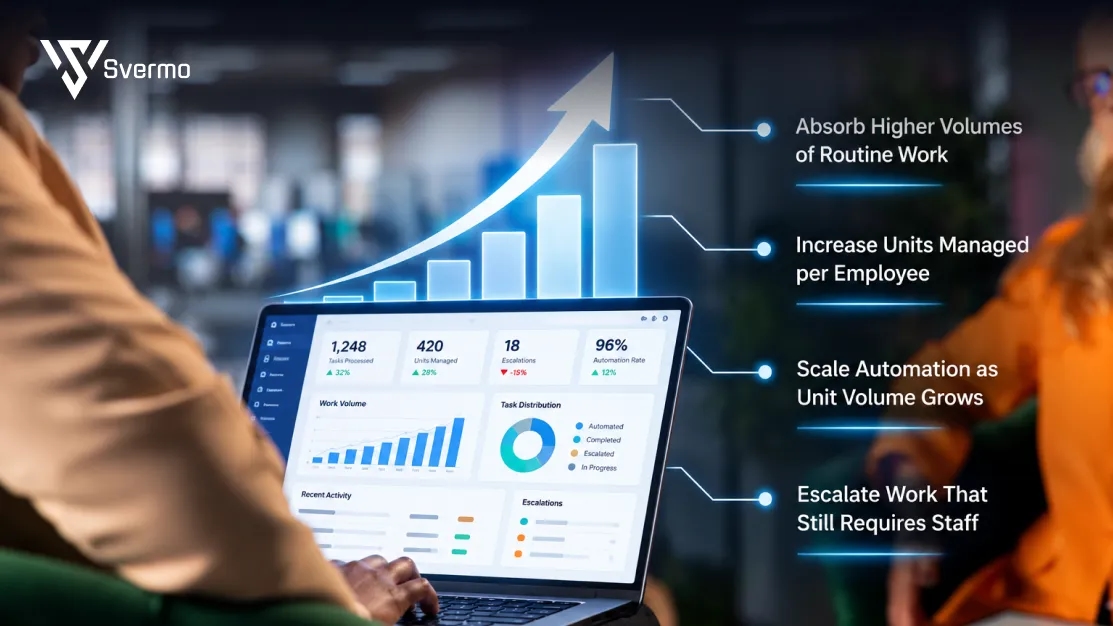
The staffing impact comes down to capacity per employee. If 4 property managers handle 800 units, the current ratio is 200 units per employee. If those same 4 employees handle 1,000 units after routine work moves into automated workflows, the ratio becomes 250 units per employee. The remaining measures are response times, open work, exception volume, and service quality.
A common question among property management is:
“Every time we add 200 to 300 units to our portfolio, I end up hiring several more staff just to keep service levels where they were, and I want to understand how AI can break that pattern so growth does not automatically mean proportional headcount.”
AI handles repeatable resident communication, follow-ups, maintenance coordination, and routine status checks as unit volume grows. Staff stay focused on exceptions, approvals, disputes, and decisions that require judgment. This shifts more routine work away from the team as the portfolio expands.
Absorb Higher Volumes of Routine Work
Adding 200 units creates more resident messages, maintenance updates, appointment reminders, document requests, and follow-ups. At 2 routine interactions per unit each month, those 200 units add 400 interactions.
An AI platform that manages more units without adding staff keeps those routine interactions inside automated workflows. Staff receive the requests that need judgment instead of manually processing all 400 additional interactions.
Increase Units Managed per Employee
Units managed per employee provides a direct capacity measure:
- 800 units ÷ 4 employees = 200 units per employee
- 1,000 units ÷ 4 employees = 250 units per employee
The ratio rises only when routine workload stays controlled. Response time, unresolved work, escalations, and service quality show whether the higher portfolio load is actually being absorbed.
Scale Automation as Unit Volume Grows
The same workflows apply across additional properties, residents, work orders, and recurring requests. Adding a property does not require a separate manual process for every resident interaction or follow-up.
An AI property management scaling platform applies the configured workflow across the larger portfolio while routing exceptions to staff.
Escalate Work That Still Requires Staff
Automation handles the normal path. Staff receive exceptions such as resident disputes, repeated vendor failures, complicated maintenance issues, and owner escalations.
For example, 2,000 monthly interactions with 150 exceptions leave staff handling 150 cases rather than all 2,000. If the portfolio grows and exception volume rises to 190, the staff workload grows with those exceptions rather than with every routine interaction.
That is the staffing equation to track: units per employee, exception volume per employee, unresolved work, response times, and service quality.
Where Is Your Staff Time Actually Going? How to Find Out Before Choosing AI?
Before choosing a platform, map the work your team actually performs. This gives you a clearer starting point for AI for tenant management, especially across tasks that take the most staff time, happen repeatedly, and increase as unit count rises.
A common question from teams under capacity pressure is:
“My team is already stretched managing our current unit count, and I do not have visibility into which parts of our day-to-day operations are actually consuming the most staff time, so I do not know where AI would even help first.”
Start by mapping staff time across resident communication, maintenance, follow-ups, handoffs, and exception handling. Measure task volume, staff touches, and time spent on each workflow. The highest-volume workflows with the most staff time become the clearest automation priorities.
| Workflow | What Staff Actually Do | What to Measure | Scalability Signal |
|---|---|---|---|
Resident communication | Answer questions, request missing details, send updates, follow up | Messages and staff touches per unit | High volume + repetitive responses |
Maintenance | Review requests, collect details, coordinate access, chase vendors, update residents | Staff minutes per work order | More units create more open requests |
Follow-ups | Check unanswered messages, overdue tasks, pending documents | Follow-ups per employee | Backlog grows with portfolio size |
Handoffs | Pass work between leasing, maintenance, vendors, and managers | Handoffs per request | More people involved as volume rises |
Exceptions | Handle disputes, unusual requests, escalations, and decisions | Exceptions per employee | Work requires judgment rather than repetition |
Map Staff Time Across Core Workflows
Track actual staff touches rather than simply counting tasks.
A maintenance request that takes five separate staff interactions is five pieces of capacity, even if the property management system shows it as one work order. The same applies to a resident question that generates an email, internal check, vendor inquiry, and second resident response.
Separate Work That Scales with Unit Count
Split the workload into two groups:
Unit-driven work: resident messages, maintenance requests, appointment coordination, document follow-ups, and status updates.
Portfolio-level work: reporting, team meetings, policy reviews, and other tasks that do not increase with every additional unit.
The first group directly affects property management capacity planning because its volume rises with the portfolio.
Identify the Biggest Capacity Constraints
Look for the work consuming the most staff hours, not the work that simply looks important.
If a team spends 15 hours a week answering routine resident questions and another 10 hours chasing maintenance updates, those 25 hours represent a larger capacity constraint than an occasional complex case.
Prioritize Communication, Maintenance, and Coordination Bottlenecks
Rank workflows using three measures: volume, staff time per task, and frequency.
A workflow that happens 1,000 times a month, takes two minutes each time, and follows the same steps deserves attention before a workflow that happens 20 times and requires specialist judgment.
That gives property management owners a clear starting point for evaluating an AI operations platform for property management company owners: automate the high-volume work that consumes capacity first, rather than buying features without knowing where the team actually spends its time.
How Does the Platform Identify Which Tasks Can Be Automated Versus Which Still Need Staff Attention as We Grow?
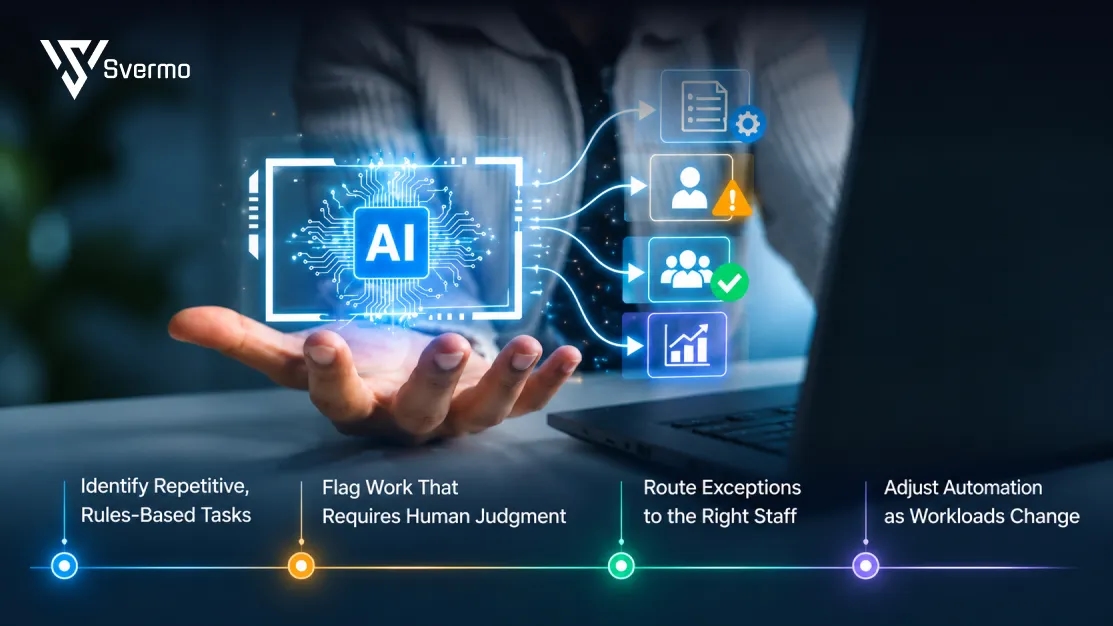
The platform applies escalation rules at each stage of a request. If the request meets the normal workflow rules, it continues automatically. If it hits an exception rule, the workflow stops and sends the case to the designated staff member.
Identify Repetitive, Rules-Based Tasks
Start with a routine maintenance request:
Resident: “My bathroom faucet is leaking.”
Step 1: The platform identifies the request as maintenance.
Step 2: It asks for the required details, such as the location and issue description.
Step 3: It collects access information and any required photos.
Step 4: It creates or updates the maintenance request.
Step 5: It sends the appointment or status update to the resident.
Step 6: It follows up while the request remains open.
The request stays automated because each step matches the defined workflow.
Flag Work That Requires Human Judgment
Now the resident adds:
“The leak damaged my cabinets, and I want reimbursement.”
The escalation rules detect that the request now involves a damage claim.
Step 1: The maintenance workflow identifies the damage claim.
Step 2: The automated path stops.
Step 3: The case is marked for staff review.
Step 4: The resident conversation and request history stay attached to the case.
The platform does not make the reimbursement decision. That decision remains with staff.
Route Exceptions to the Right Staff
The escalation rule then determines where the case goes.
Maintenance issue only: maintenance queue.
Resident complaint: property manager.
Owner-related issue: assigned property or account lead.
Safety-related concern: designated escalation team.
The routing rule uses the request type and property context to send the case to the appropriate queue instead of leaving staff to sort through the full workload.
Adjust Automation as Workloads Change
Escalation data also shows where the workflow needs attention.
If the same type of request repeatedly leaves the automated path, that pattern becomes visible in the exception history. For example, repeated maintenance escalations caused by missing access details point to a gap in the intake workflow.
The workflow gets updated to collect that information earlier, while genuinely unusual cases continue to escalate. This keeps AI property management scaling features for portfolio owners focused on the work that actually repeats as the portfolio grows.
Can the Platform Work Alongside Our Existing Property Management System and Current Staff Structure?
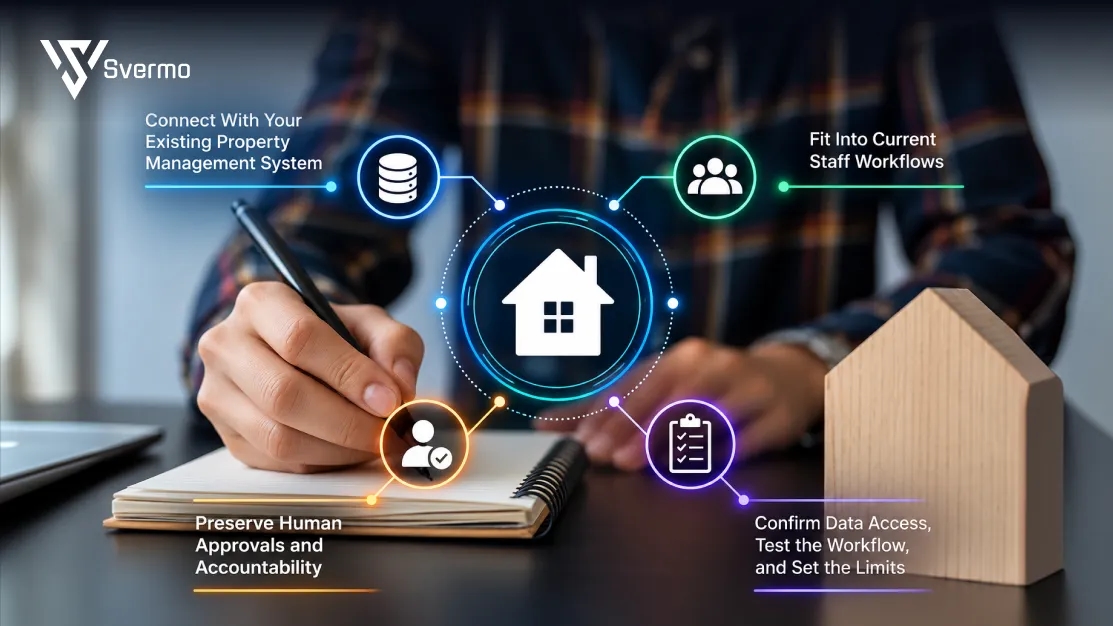
Yes. An AI property management platform fits alongside an existing property management system when it uses the records already in place, follows the team’s existing responsibilities, and keeps defined approval points with staff.
The important part is knowing exactly what gets connected, automated, escalated, and left manual before the workflow goes live.
Connect With Your Existing Property Management System
Start with the records the workflow depends on: resident profiles, unit details, leases, work orders, property assignments, vendor information, and communication history.
For an AI platform that works with my existing property management system, check:
- Which records the platform reads
- Which fields it writes back to the system
- Whether updates sync in both directions
- How property, unit, and resident records are matched
- Whether work orders remain in the existing system
For a maintenance request, the workflow should identify the resident, unit, property, and existing work order from the connected system before sending updates or triggering the next action.
Fit Into Current Staff Workflows
The platform follows the responsibilities already assigned to the team.
If maintenance owns work orders, maintenance receives maintenance exceptions. If property managers handle resident escalations, those cases go to the assigned property manager. Routine follow-ups stay automated rather than creating another handoff for staff.
That means checking:
- Who owns each workflow today
- Which tasks require a staff handoff
- Where staff approvals already exist
- Which notifications go to which role
- Which automated tasks replace manual follow-ups
This keeps an AI platform for property management companies adding units inside the existing operating model instead of creating a separate process around it.
Preserve Human Approvals and Accountability
Automation stops at defined decision points.
A disputed charge goes to the property manager. A lease decision stays with the designated leasing staff. An unusual maintenance issue goes to the responsible team member. The platform records the conversation, request details, and escalation history so the employee taking over has the necessary context.
The approval structure also needs clear ownership:
- Lease and resident decisions stay with designated staff
- Financial or charge disputes follow existing approval rules
- Safety-related issues follow the established escalation path
- Staff actions remain attributable to the person who made the decision
- Automated actions retain a record for review
Confirm Data Access, Test the Workflow, and Set the Limits
Before expanding automation, test the complete workflow with real operating scenarios.
Check that the platform reads the right property and resident records, updates the correct work order, sends the right communication, assigns exceptions correctly, and stops for required approvals.
A practical test covers:
- A normal request that stays fully automated
- A request missing required information
- A request that triggers an escalation
- A request requiring staff approval
- A request involving an unavailable or restricted data field
- A completed request that needs the final status recorded
Also document what the platform cannot access or change. Those gaps remain manual and belong in the staffing plan rather than being treated as automated work.
What Happens to Service Quality and Response Times as Units Increase if Staffing Stays Flat?
When unit volume grows without additional staff, service quality usually shows up first in the operational queues: slower first responses, older maintenance requests, delayed vendor coordination, and more resident follow-ups. The key is to track where those delays appear as the portfolio grows.
Identify Where Service Quality Breaks Down
Compare the same workflow at two portfolio sizes and look for where the extra units create delays.
At 800 units:
- Resident submits a maintenance request -> staff reviews it the same day.
- Vendor receives the assignment -> appointment is confirmed.
- Resident receives the update -> request moves forward.
- Completed work -> resident receives the closing communication.
At 1,000 units with the same staff:
- More requests enter the queue -> some wait longer before review.
- Vendor assignments take longer -> appointments remain unconfirmed.
- Residents send follow-ups -> staff spend additional time checking existing requests.
- Open work orders age -> the team handles more status questions alongside the original requests.
The change in service quality is not simply "more work." It appears as longer queues, additional resident follow-ups, older open requests, and delayed handoffs.
Absorb Surges from New Properties
New properties create concentrated periods of activity rather than a smooth increase in workload.
During a new-property onboarding period, the team may receive:
- Move-in questions
- Access and key requests
- Initial maintenance reports
- Lease and account questions
- Vendor scheduling requests
- Resident profile and property updates
The service impact becomes visible when this new volume starts competing with existing portfolio work. Existing residents experience slower responses, maintenance queues age, and staff spend more time switching between new-property requests and established properties.
For property management operational efficiency, measure the existing portfolio separately during each onboarding period. That shows whether service levels remain stable while additional units enter the operation.
Maintain Consistent Response Times
Response time needs to be measured by workflow rather than as one portfolio-wide number.
| Workflow | Measure | Service-quality signal |
|---|---|---|
Resident communication | First-response time | Messages remain unanswered longer |
Maintenance | Time to assignment | Requests sit unassigned |
Vendor coordination | Time to confirmation | Appointments take longer to finalize |
Open work orders | Average age | Unresolved requests accumulate |
Resident follow-ups | Follow-up rate | More residents ask for status updates |
If unit volume rises while staffing stays flat, these measures show exactly where service begins to deteriorate. A stable unit count per employee means little if response times and open-work aging continue to rise.
Protect Service Quality with Human Oversight
Flat staffing requires clear human ownership for requests where a delayed response has a direct service impact.
- Resident complaint or dispute -> property manager
- Repeated or unresolved maintenance issue -> maintenance lead or property manager
- Vendor failure affecting a resident -> maintenance coordinator or property manager
- Lease or account issue -> responsible leasing or property management staff
- Owner escalation -> property manager or account lead
- Safety-related issue -> designated emergency or property operations contact
Routine requests continue through their defined workflow. Service-critical cases move directly to the responsible staff member with the relevant request history and previous communication attached.
The result to watch is straightforward: as units increase, response times, open-work aging, follow-up rates, and unresolved requests remain stable rather than rising with portfolio size.
Svermo has seen the same pressure point while building Voice AI for property management. Handling a property call involves more than answering the phone: the system needs to understand the request, capture the details, route it to the right team, and keep the interaction connected to the property's existing workflow. That experience reinforces a simple point: response time depends on how many manual steps sit between a request and the next action.
What Should Property Management Companies Compare When Evaluating AI Platforms for Scalability?
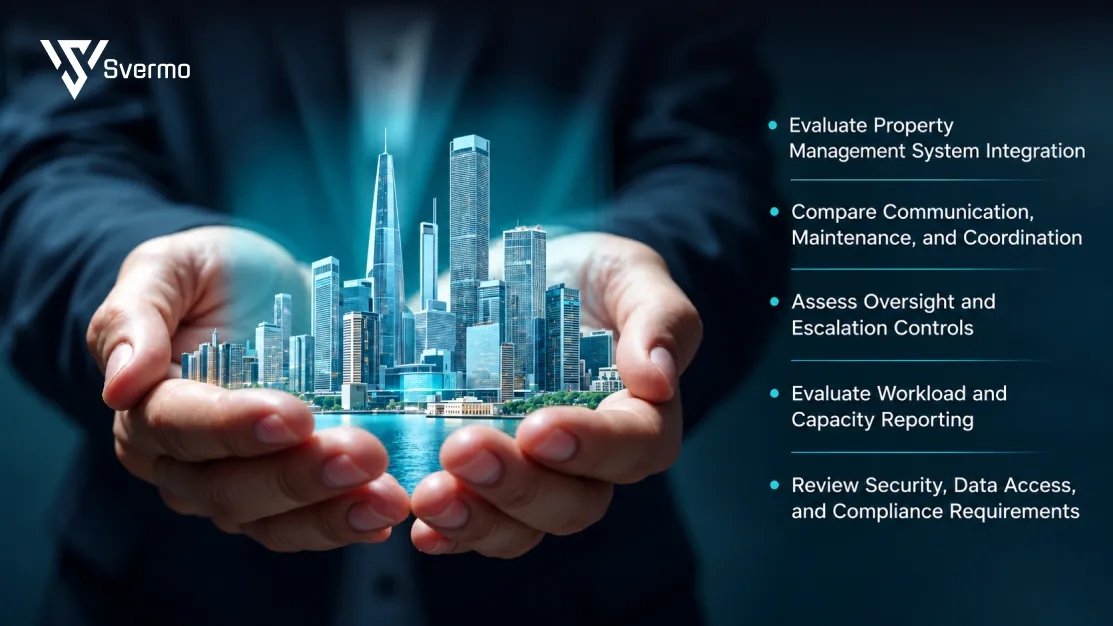
Look at how each platform fits into your current operation, handles growing workloads, and keeps your team in control. The real test is what happens when you add more properties, residents, maintenance requests, and daily follow-ups.
Evaluate Property Management System Integration
Start with the property management system your team already uses. The AI platform needs the right information from that system to handle work without creating another manual process.
Check:
- Which resident and property details it pulls in
- Whether it reads lease and work order information
- Which updates go back to the property management system
- How records stay matched across both systems
- Whether staff still need to copy information from one system to another
- Where the official record of each request stays
For an AI platform that works with my existing property management system, the practical question is simple: how much work still falls back on your staff because the systems do not stay connected?
Compare Communication, Maintenance, and Coordination
Look at the everyday work that grows as you add units.
- For resident communication, compare how each platform handles routine questions, follow-ups, confirmations, and status updates.
- For maintenance, compare request intake, missing information, appointment updates, and follow-up on open requests.
- For coordination, compare vendor follow-ups, pending actions, and handoffs between team members.
Then look at volume. A platform that handles 500 routine requests needs to keep those workflows running when the portfolio produces 1,000 or 2,000 requests.
That gives AI property management scaling features for portfolio owners a real operational test.
Assess Oversight and Escalation Controls
Some requests need a staff member to step in. Compare how each platform handles those situations.
Check:
- What sends a request to staff
- Who receives the request
- What information appears with the escalation
- Which actions require staff approval
- How automated actions are recorded
- How staff take control of an active request
For example, a routine maintenance request follows its normal workflow. A request involving a resident dispute moves to the property manager with the conversation and request history attached.
That distinction matters as the portfolio grows. Staff need a clear view of the work that needs their attention.
Evaluate Workload and Capacity Reporting
Ask what the platform actually shows about your team's workload.
Useful numbers include:
- Units managed per employee
- Routine requests handled automatically
- Staff-handled exceptions
- Open work orders
- Average age of open work
- Response times
- Resident follow-up volume
- Escalations by property or team
These numbers show whether staff-to-unit ratio optimization is actually happening as the portfolio grows.
For example, adding 300 units while keeping the same team looks positive on paper. If response times rise and open work keeps piling up, the operation is still under pressure.
Review Security, Data Access, and Compliance Requirements
The platform will work with resident, property, lease, maintenance, and communication data. Review exactly how that information is handled before expanding its use across the portfolio.
Check:
- Who gets access to resident and property information
- Which data each workflow uses
- What actions the platform records
- How user activity is tracked
- What data the integrations can access
- Which actions require staff approval
- How data is stored and retained
- Which privacy and compliance requirements apply
For companies comparing the best AI platforms for scaling a property management portfolio, these checks give the evaluation a practical structure. The focus stays on five things: how well the platform fits the current system, how much recurring work it handles, how staff stay involved, how workload changes are measured, and how company data stays controlled.
How Should Property Management Companies Balance AI and Hiring as the Portfolio Grows?
Use AI for property management for repeat work that keeps growing with the portfolio. Hire when the work left for people starts taking more time than the team has available. That balance supports AI platform to manage unit growth without proportional headcount while keeping people focused on work that needs judgment.
Identify Capacity Gaps AI Can Address
Look at the tasks taking up staff time every week. Routine resident messages, follow-ups, appointment reminders, status checks, and similar work add up quickly as units increase. These are the first areas to review for automation.
- Example: Staff spend time every morning checking which maintenance requests need a resident update. The platform sends those routine updates automatically, removing that daily task from the team's queue.
Svermo's work on Leasing AI has also shown how quickly small staff touches add up. A lead needs a response, qualification, tour scheduling, reminders, and application updates. Building AI around these steps gives the team a practical view of how much routine work sits between the initial inquiry and the next meaningful decision.
Hire for Work That Needs Human Judgment
Keep people focused on work that needs a decision, a conversation, or a deeper review. Resident disputes, complicated maintenance problems, owner concerns, lease issues, and unusual situations still need someone who understands the property and the situation.
- Example: A resident disputes a charge and raises a lease concern in the same conversation. The property manager reviews the account, speaks with the resident, and decides what happens next.
Combine AI With Targeted Hiring
A question many growing teams ask is:
“We are trying to decide whether to keep hiring at the same pace as we grow, or whether investing in an AI platform now would actually let us absorb portfolio growth without scaling our team at the same rate. I need to understand what this would realistically change for us.”
AI takes routine workload out of the staffing equation, including messages, follow-ups, reminders, and status checks. Hiring remains focused on work that needs human judgment, such as disputes, complex maintenance, owner concerns, and unusual resident situations. This gives portfolio growth a clearer staffing model.
Set a clear hiring trigger: hire when the staff-owned workload stays above the team's available capacity and service starts slipping. Longer response times, growing unresolved queues, and repeated overload in one role are strong signals that the team needs another person.
- Example: AI handles routine resident messages, while complex resident cases continue going to property managers. If that case queue stays above the team's normal capacity for several weeks and response times keep rising, add property management staff.
For companies focused on AI platform to reduce staff-to-unit ratio in property management, the staffing decision comes down to the work people still handle. Track that workload as the portfolio grows and add headcount when it consistently exceeds the team's capacity.
Adding Units or Adding Headaches?
See how your current workflows could handle more units with less manual follow-up.
What We’ve Learned from Property Management Operations?
At Svermo, our work with U.S. property operations keeps raising a few practical questions: How much time does one “quick” resident follow-up really take? How many times does your team check the same maintenance request? And what happens when those small tasks multiply across hundreds of new units?
Those questions shape Svermo’s view of AI in real estate. In property management, the value sits in the small pieces of work that repeat across the portfolio. A maintenance request might need information collected, a vendor contacted, an appointment confirmed, and a resident updated. Looking at those repeated staff touches gives a clearer picture of where AI fits into the operation and where people still need to stay involved.
Closing Remarks!
Portfolio growth looks good on a spreadsheet. The harder question is what happens inside the operation when those extra units start generating more conversations, decisions, and exceptions. An AI property management platform for scaling portfolios gives property management companies another way to absorb that growth without turning every increase in unit count into a staffing exercise.
From Svermo’s perspective, the interesting part is what happens after implementation: Does the team spend less time keeping work moving? Do managers have more room for decisions that actually need them? Does adding units change the team's day in a meaningful way? Those are better measures of scalability than an automation count. If you're asking the same questions about your portfolio, book an appointment with Svermo to explore them.
 https://www.linkedin.com/in/saanvi-verma-38711a36a
FAQs
Yes. Portfolio size alone does not determine whether an AI property management platform for growing portfolios makes sense. The stronger indicator is the amount of repetitive work handled by the team. A smaller portfolio with high communication volume, frequent maintenance coordination, or heavy administrative follow-up has a clear use case for automation.
Training usually centers on the workflows staff interact with, the information they receive, and the situations that require their attention. Teams need clear guidance on reviewing escalations, correcting workflow issues, and taking over conversations when required. A focused rollout keeps AI property management staffing efficiency from becoming another administrative project.
Yes. The underlying automation applies across both portfolio types, with workflows configured around the operating model. Single-family portfolios often involve property-specific coordination across dispersed homes, while multifamily operations generate higher volumes of resident interactions within shared properties. An AI platform for property management companies adding units needs workflows that reflect those differences.
Language support matters when a portfolio serves residents who communicate in different languages. Look for an AI property management platform with clear language handling across incoming and outgoing communication, along with staff visibility into the conversation. The platform's supported languages, translation quality, and escalation process need review before deployment.
Incorrect information needs a defined correction process. Staff need access to the conversation, the information used to generate the response, and the ability to correct the underlying workflow or response rule. Companies evaluating AI platforms for property management staffing efficiency should also review how errors are logged and prevented from recurring.
Acquisitions often create a short-term spike in resident communication, onboarding activity, property information updates, and operational requests. An AI platform to manage more units without adding staff needs workflows that accommodate the additional volume without requiring a separate manual process for every newly acquired property.
Yes. AI in real estate also covers areas such as leasing, investment analysis, asset management, marketing, underwriting, and transaction workflows. Property management has a particularly direct operational use case because recurring resident, maintenance, and coordination activity generates measurable workflow volume across a portfolio.