

How Much Does It Cost to Develop AI Property Management Software? Cost Factors & Optimization Strategies

Get a summary of this article with your favorite AI




AI Summary
- •The cost to develop AI property management software typically ranges from $40,000 to $300,000+ based on features, AI complexity, and scalability.
- •The biggest factors affecting development cost include AI capabilities, integrations, infrastructure, team structure, and long-term maintenance.
- •An MVP-first strategy helps reduce the cost of developing custom AI property management software while allowing faster market validation.
- •Hidden expenses like cloud hosting, API usage, AI retraining, and ongoing support should always be included in your property management AI software budget planning.
- •Svermo helps businesses build scalable and ROI-focused property management AI software solutions with practical development roadmaps and cost-efficient AI implementation.
What if your property management operations could run with 60% fewer errors and handle most routine tasks without human intervention?
That is exactly where the industry is heading.
Property managers across the US are under pressure to do more with less. More properties, more tenant requests, more data to manage. Yet the tools many teams rely on are still manual or outdated. That gap is pushing companies to seriously evaluate the cost to develop AI property management software and whether it is worth the investment now.
The shift is already happening.
Reports state that workflow automation reduces errors by 62%, and AI-powered inspections are completed 3X faster. According to the same report, robotic process automation can handle up to 80 percent of routine tasks. On top of that, 48 percent of property managers say AI is their top technology priority.
So the real question becomes simple. If AI can deliver this level of efficiency, what does it actually cost to build it?
When you start exploring AI property management software development cost, you will see estimates ranging from $40,000 to $300,000+. That range alone creates confusion. What drives the difference? What are you really paying for? And how do you avoid overspending?
Many companies begin this journey by looking into real estate AI software solutions only to realize that pricing varies widely depending on complexity, features, and AI capabilities.
If you are trying to plan your budget or compare vendor quotes, you are not alone. The next sections will break this down in a way that actually helps you make a confident decision.
Still Unsure What Your AI Property Management Software Should Actually Cost?
A rough estimate is easy. A realistic roadmap is what saves you from overspending later.
Why Is Understanding AI Property Management Software Development Cost Important Before You Start?
Building AI software without understanding the real cost structure often leads to budget overruns, delayed launches, and unnecessary feature expansion. Many property management companies jump into development with unclear expectations, only to realize later that infrastructure, integrations, and long-term scaling require far more planning than expected.
Knowing the AI property management software development cost early helps you make smarter business and technical decisions before development begins.
- Helps define a realistic budget based on your business size and operational goals
- Prevents overspending on unnecessary features during the initial development phase
- Makes it easier to compare vendor proposals and pricing models accurately
- Supports better planning for scalability, maintenance, and future AI upgrades
- Improves ROI by prioritizing high-impact automation features from the beginning
Businesses that understand their cost structure early are more likely to build scalable platforms that support long-term operational growth without unnecessary financial pressure.
Next, before getting the full breakdown, you should have an overview of the development cost based on the intelligence level of the AI property management software.
What is the Full Cost Overview Develop AI Property Management Software in 2026?
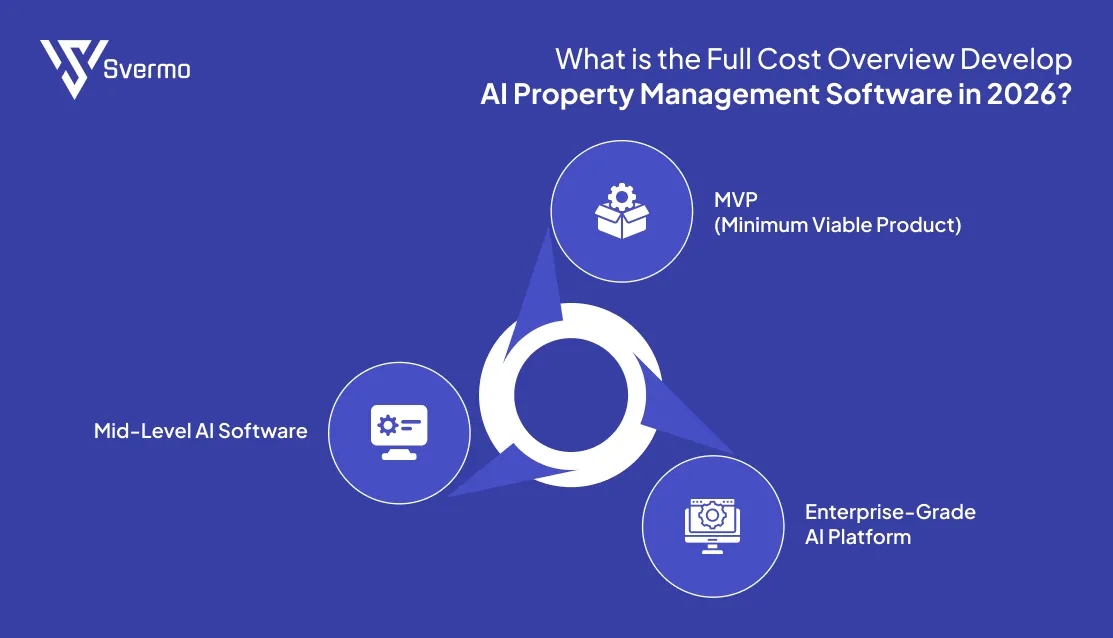
If you’re trying to plan your budget, this is likely your biggest question, “I want to know the cost difference between MVP and full-scale AI property management software development”. The answer depends on how advanced you want your system to be and how much automation you need from day one.
Before we break down the numbers, it helps to understand that the AI property management software development cost is not just about building features. It reflects the level of intelligence, integrations, and scalability you want in your platform. Here is a practical breakdown to help you understand what you actually get at each level.
Software Level | Estimated Cost (USD) | Features and Functionality |
|---|---|---|
MVP (Minimum Viable Product) | $40,000 – $80,000 | Core features like tenant management, basic dashboards, limited automation, simple AI-driven responses, basic integrations (payment gateway or CRM), and early-stage reporting. Ideal for testing product market fit. |
Mid-Level AI Software | $80,000 – $180,000 | Advanced tenant communication, automated rent collection, maintenance workflows, AI-powered insights, multiple integrations, improved UI/UX, and partial AI models such as chatbots or predictive analytics. Suitable for growing property portfolios. |
Enterprise-Grade AI Platform | $180,000 – $300,000+ | Full-scale automation including AI IVR systems, predictive maintenance, advanced analytics, real-time reporting, multi-property scalability, deep integrations (CRM, IoT, accounting), custom AI models, and high-level security and compliance. Built for large-scale operations. |
At this stage, it is also helpful to understand how this aligns with overall real estate AI software development investments, since broader real estate platforms often follow similar cost patterns depending on complexity and AI capabilities.
This breakdown gives you a starting point. Next, we will look at what actually drives these costs up or down.
What Factors Impact the Budget of AI Property Management Software Development the Most?
If you have already received multiple quotes, you have likely noticed something. Pricing is not just different, it is drastically different. That happens because the cost of developing custom AI property management software for real estate businesses depends on several moving parts, not just development hours.
So when you ask, “I am planning to develop AI property management software and need a detailed cost breakdown including development and maintenance”. The answer lies in how each component is designed, built, and scaled.
See the step by step break down, starting with one of the biggest cost drivers.
1. Feature Scope and Platform Capabilities
The more features you include, the higher your cost goes. But it is not just about the number of features. It is about how advanced each feature is. For example, if your goal is to automate tenant communication, then real estate AI chatbot development will get you an intelligent chatbot.
But if you want a system that understands intent, handles voice calls, and responds intelligently, you are moving into advanced AI territory.
Here is a detailed breakdown of how different features impact the AI property management software development pricing.
Feature | Estimated Cost (USD) | What It Does |
|---|---|---|
Tenant management system | $5,000 to $15,000 | Stores tenant data, lease details, and communication history in one place |
Rent collection system | $8,000 to $20,000 | Automates rent payments, reminders, and transaction tracking |
Maintenance request management | $10,000 to $25,000 | Allows tenants to raise issues and automates task assignment and tracking |
AI-powered tenant communication | $15,000 to $40,000 | Uses AI to handle tenant queries, automate replies, and improve response time |
AI IVR system (voice automation) | $20,000 to $60,000 | Handles incoming calls, routes queries, and provides voice-based responses |
Predictive maintenance AI | $15,000 to $35,000 | Analyzes data to predict maintenance issues before they occur |
Analytics and reporting dashboard | $10,000 to $25,000 | Provides insights on occupancy, revenue, and operations |
Multi-property management system | $15,000 to $30,000 | Enables management of multiple properties from a single platform |
Integration with third-party tools | $5,000 to $20,000 | Connects with CRM, accounting, and payment systems |
Overbuilding early can increase cost unnecessarily, while underbuilding can limit your growth. This is why feature planning is one of the most important steps in controlling your overall budget.
2. AI Model Complexity and Intelligence Level
Not all AI is built the same. This is one of the biggest reasons why two vendors can quote completely different prices for similar-looking platforms.
Some systems rely on simple rule-based automation. Others use machine learning models that learn from data. Then you have advanced systems powered by natural language processing and voice AI that can handle conversations in real time.
The more intelligent and adaptive your system needs to be, the higher the development cost. Here is how different levels of AI complexity impact the AI property management software development cost.
AI Type | Estimated Cost (USD) | What It Does |
|---|---|---|
Rule-based automation | $5,000 to $15,000 | Executes predefined workflows such as auto-replies, reminders, and basic task automation |
Machine learning models | $15,000 to $40,000 | Learns from historical data to improve predictions like rent trends or maintenance needs |
Natural language processing (NLP) | $20,000 to $50,000 | Understands and processes tenant messages, emails, and queries in human language |
Conversational AI (chat + voice) | $30,000 to $80,000 | Enables real-time conversations through chatbots and voice assistants |
Advanced AI decision systems | $50,000 to $120,000+ | Handles complex decision-making, automation, and adaptive workflows across operations |
This is where solutions like agentic AI development for real estate start to come into play, where systems can take actions, make decisions, and continuously improve over time.
Businesses looking to build a custom AI real estate automation system often invest in advanced AI capabilities that combine predictive analytics, conversational AI, workflow automation, and intelligent decision-making within a single platform.
So when evaluating costs, it is not just about adding AI. It is about deciding how smart you want that AI to be.
3. Third-Party Integrations
Your software will not operate in isolation. It needs to connect with payment gateways, CRMs, accounting tools, and sometimes IoT devices. Each integration adds development effort, testing time, and ongoing maintenance.
This is where many teams ask, “I want to know the cost of integrating third-party APIs into AI property management platforms.” The answer depends on how many systems you connect and how complex those integrations are.
Here, see how integrations impact the AI property management software development cost.
Integration Type | Estimated Cost (USD) | What It Does |
|---|---|---|
Payment gateway integration | $3,000 to $10,000 | Enables online rent collection, recurring payments, and transaction tracking |
CRM integration | $5,000 to $15,000 | Syncs tenant data, communication history, and lead management systems |
Accounting software integration | $5,000 to $12,000 | Automates financial reporting, expense tracking, and bookkeeping |
IoT integration (smart devices) | $10,000 to $25,000 | Connects smart locks, sensors, and energy systems for automated property control |
Communication tools integration | $3,000 to $8,000 | Links email, SMS, and notification systems for tenant communication |
API aggregation or middleware setup | $8,000 to $20,000 | Manages multiple integrations through a unified system for smoother data flow |
If your system includes voice automation, integrating telephony and CRM becomes even more critical. Here integrating AI IVR system with real estate CRM platforms plays a key role in creating a seamless tenant experience across channels.
The more systems you connect, the more powerful your platform becomes. But it also increases both upfront and long-term costs. Planning integrations carefully can help you avoid unnecessary complexity.
4. Data Requirements and Training
AI systems depend heavily on data. Without the right data, even the most advanced models will not perform well. This is one of the most underestimated factors affecting the AI property management software development cost.
Many teams assume AI will work out of the box. Data needs to be collected, cleaned, labeled, and sometimes continuously updated. That process directly adds to your budget.
Here is how data-related requirements impact your overall cost.
Data Component | Estimated Cost (USD) | What It Does |
|---|---|---|
Data collection setup | $5,000 to $15,000 | Gathers data from tenant interactions, maintenance logs, and property records |
Data cleaning and preprocessing | $5,000 to $12,000 | Removes inconsistencies and prepares structured datasets for AI models |
Data labeling and annotation | $8,000 to $25,000 | Tags and categorizes data so AI models can learn patterns accurately |
Model training and fine-tuning | $15,000 to $50,000 | Trains AI models using your data to improve predictions and automation |
Continuous learning pipelines | $10,000 to $30,000 | Keeps AI models updated with new data for better long-term performance |
If you want an AI system that understands tenant requests accurately, it needs access to past conversations, categorized issues, and outcomes. Without that, responses will feel generic and unreliable.
This is also why solutions like AI assistant development for real estate often include a strong focus on training data and continuous improvement, not just initial deployment.
If you plan this part early, you can avoid unexpected costs later and build a system that actually improves over time.
5. Development Team Structure
The team you choose to build your product has a direct impact on both cost and outcome. This is not just about hourly rates. It is about how the team is structured, how they collaborate, and how efficiently they deliver.
Teams often ask “I am comparing hiring an in-house team versus outsourcing for AI property management software development costs”. Because many companies struggle here because they are unsure whether to hire in-house, outsource, or go with a hybrid model.
This decision can significantly change your cost to develop AI property management software. Here is a clear comparison of different team structures and how they affect your budget.
Team Structure | Estimated Cost (USD) | What It Means for Your Project |
|---|---|---|
In-house team | $150,000 to $400,000+ annually | Full control over development, but higher long-term costs including salaries, benefits, and infrastructure |
Offshore development team | $40,000 to $150,000 | Lower upfront cost, but may require more coordination, time zone management, and quality control |
Hybrid team (in-house + offshore) | $80,000 to $250,000 | Balanced approach with cost efficiency and better control over critical components |
Specialized AI development partner | $100,000 to $300,000+ | Access to experienced teams, faster delivery, and better alignment with complex AI requirements |
Building internally gives you full ownership, but it requires hiring AI engineers, product managers, and designers. That takes time and adds ongoing costs.
6. Compliance, Security, and Infrastructure
As your platform handles tenant records, payment information, lease agreements, and communication data, security becomes a major part of development. This is especially important for property management companies operating at scale.
Many businesses underestimate how much infrastructure and compliance requirements contribute to the AI property management software development pricing. But these are essential investments if you want a stable and secure platform.
Here is how compliance and infrastructure requirements affect the overall budget.
Infrastructure Component | Estimated Cost (USD) | What It Does |
|---|---|---|
Cloud infrastructure setup | $8,000 to $25,000 | Hosts applications, databases, AI models, and storage systems |
Data encryption and security layers | $5,000 to $20,000 | Protects sensitive tenant and financial data from breaches |
Role-based access controls | $3,000 to $10,000 | Restricts system access based on user permissions |
Compliance implementation | $5,000 to $15,000 | Helps meet data privacy, payment, and security standards |
Backup and disaster recovery systems | $5,000 to $12,000 | Ensures business continuity and data recovery during failures |
Performance and scalability optimization | $10,000 to $30,000 | Supports growing user loads and high-volume operations |
Automation needs stronger infrastructure than a simple single-property system. As usage grows, hosting costs, storage requirements, and AI processing demands also increase.
Strong infrastructure may increase upfront cost, but it prevents larger operational and security issues later.
7. Custom Development vs Off-the-Shelf Software
One of the biggest budget decisions is choosing between a fully custom platform and an existing off-the-shelf solution. Many property managers ask, “I am comparing the cost of custom AI property management software versus off-the-shelf solutions, what should I expect?”
The answer depends on how much flexibility, automation, and scalability your business actually needs.
Solution Type | Estimated Cost (USD) | What It Means for Your Business |
|---|---|---|
Off-the-shelf software | $5,000 to $50,000 annually | Faster setup with standard features, but limited customization and scalability |
Custom AI software | $40,000 to $300,000+ | Built around your workflows, operations, integrations, and long-term growth goals |
Hybrid customization approach | $30,000 to $120,000 | Combines existing platforms with custom AI modules for better flexibility |
Off-the-shelf tools work well for basic operations. But as your portfolio grows, limitations around automation, integrations, and AI capabilities often become a challenge.
8. Platform Scalability and Multi-Property Support
Building software for 50 units is very different from building software for thousands of properties across multiple locations. Scalability directly impacts architecture, database design, AI processing, and system performance.
As operations grow, your platform needs to handle more users, more tenant interactions, and larger volumes of real-time data without slowing down.
Here is how scalability requirements influence the custom property management software cost estimation.
Scalability Requirement | Estimated Cost (USD) | What It Does |
|---|---|---|
Single-property architecture | $10,000 to $30,000 | Supports basic operations for smaller portfolios |
Multi-property management support | $20,000 to $60,000 | Centralizes operations across multiple properties and teams |
High-volume tenant handling | $15,000 to $40,000 | Manages large numbers of tenant requests and automated workflows simultaneously |
Real-time analytics processing | $10,000 to $35,000 | Processes operational and financial data instantly for better decision-making |
Scalable AI processing infrastructure | $20,000 to $70,000 | Supports growing AI workloads, automation, and intelligent system responses |
For growing real estate firms, scalability is not something to think about later. Rebuilding infrastructure after expansion usually costs far more than planning for growth from the beginning.
This is especially true when implementing advanced systems like AI IVR system development for property management, where increasing call volumes and real-time AI responses require strong backend performance.
9. UI/UX Complexity and User Experience
A property management platform is used daily by property managers, tenants, maintenance teams, and sometimes even property owners. If the interface feels confusing or slow, adoption becomes a challenge no matter how advanced the AI is.
This is why UI/UX design is more than just visual appearance. It directly affects usability, operational efficiency, and development cost.
UI/UX Component | Estimated Cost (USD) | What It Does |
|---|---|---|
Basic dashboard design | $5,000 to $12,000 | Provides standard navigation, reporting, and user workflows |
Custom tenant portal | $8,000 to $20,000 | Creates a personalized experience for payments, maintenance, and communication |
Mobile-responsive interface | $5,000 to $15,000 | Ensures smooth access across phones, tablets, and desktops |
Advanced workflow design | $10,000 to $25,000 | Simplifies complex operational tasks and automation flows |
AI-driven conversational interface | $15,000 to $40,000 | Enables interactive experiences through AI chat and voice systems |
For example, a platform with AI-powered communication tools needs intuitive conversation flows so tenants can quickly resolve issues without frustration.
This is one reason many companies investing in top 10 AI chatbot development companies for real estate focus heavily on user experience, not just backend AI capabilities.
A clean and efficient interface may increase initial design costs, but it improves adoption, reduces training time, and creates a smoother experience for everyone using the platform.
10. Ongoing Maintenance and Product Evolution
Launching the software is only the beginning. AI systems need regular updates, monitoring, optimization, and support to keep performing reliably over time.
This is one of the most overlooked parts of the property management AI software budget planning process. Many businesses focus only on development cost and forget about long-term product maintenance.
Maintenance Component | Estimated Annual Cost (USD) | What It Does |
|---|---|---|
Bug fixes and system updates | $5,000 to $20,000 | Resolves technical issues and keeps the platform stable |
AI model monitoring and optimization | $10,000 to $30,000 | Improves AI accuracy and adapts models based on new data |
Security updates and compliance checks | $5,000 to $15,000 | Protects the system against vulnerabilities and regulatory risks |
Cloud infrastructure maintenance | $8,000 to $25,000 | Supports hosting, storage, and system performance |
Feature enhancements and scaling | $10,000 to $40,000 | Adds new capabilities and supports business growth |
If your platform includes AI-powered tenant communication, the models will need continuous improvements as tenant behavior and operational patterns change.
That is why businesses planning advanced automation often review the broader AI real estate assistant development cost early in the budgeting process to better understand long-term investment requirements.
Choosing the right combination of features, AI capabilities, integrations, and team structure can significantly impact your final budget. The better you plan each factor early, the easier it becomes to control costs without limiting long-term growth.
Too Many Variables Affecting Your Development Budget?
The right feature and AI strategy can save thousands in unnecessary development costs.
What Should You Budget for Each Step of Building AI Property Management Software?
Many real estate companies jump straight into development without understanding where the budget goes at each stage. That often leads to delays, scope changes, and unexpected expenses later.
That is why many decision-makers ask, “I am planning a phased development approach for AI property management software and need cost estimates for each phase.” Breaking the project into stages makes budgeting more manageable and helps reduce unnecessary spending early on.
Look at how the complete AI property management software development pricing breakdown for real estate companies is typically structured.
1. Discovery and Planning Phase
Every successful project starts with planning. At this stage, the development team defines business goals, user workflows, feature priorities, and technical requirements. Proper planning helps avoid delays, unnecessary features, and budget overruns later.
Key activities include:
- Requirement gathering
- Market and competitor analysis
- Technical architecture planning
- Feature prioritization for MVP
- Timeline and roadmap creation
Estimated Cost: $5,000 to $15,000
2. UI/UX Design Phase
A clean interface improves adoption and daily usability. Property managers and tenants both expect smooth navigation and mobile-friendly experiences, especially when automation tools are involved.
Key activities include:
- Dashboard design
- Tenant portal interface
- Mobile responsiveness
- Workflow optimization
- User experience testing
Estimated Cost: $8,000 to $25,000
3. MVP Development Phase
The MVP phase focuses on building the core version of your platform with essential features only. The goal is to launch quickly, validate your idea, and reduce initial investment before scaling further.
Key activities include:
- Tenant management setup
- Basic dashboards and workflows
- Rent payment functionality
- Maintenance request management
- Initial AI automation features
For many businesses evaluating the real estate AI software development cost, starting with an MVP helps reduce financial risk while testing operational impact early.
Estimated Cost: $40,000 to $80,000
4. AI and Automation Integration Phase
AI capabilities are added during this stage to automate communication, operations, and decision-making. The cost depends on how advanced the AI functionality needs to be.
Key activities include:
- AI chatbot implementation
- Predictive maintenance models
- Tenant communication automation
- Workflow intelligence setup
- AI-powered reporting systems
Estimated Cost: $20,000 to $80,000
5. AI IVR and Voice System Integration Phase
Voice automation helps property management companies handle large call volumes efficiently. AI IVR systems can route calls, answer common questions, and reduce pressure on support teams.
Key activities include:
- Voice AI setup
- Call routing automation
- Speech recognition integration
- CRM synchronization
- Tenant voice support workflows
Many top AI IVR system development companies for real estate in USA prioritize this phase to improve tenant communication and reduce manual support workloads.
Estimated Cost: $15,000 to $60,000
6. Testing and Quality Assurance Phase
Before launch, the platform must go through extensive testing to ensure stability, security, and performance across devices and user scenarios.
Key activities include:
- Functional testing
- Security testing
- Performance optimization
- AI response validation
- Bug fixing and refinements
Estimated Cost: $8,000 to $20,000
7. Deployment and Launch Phase
After testing is complete, the platform is deployed to production environments and prepared for real users. Proper deployment planning minimizes downtime and operational disruptions.
Key activities include:
- Cloud deployment
- Server configuration
- Data migration
- Go-live monitoring
- Initial support setup
Estimated Cost: $5,000 to $15,000
A phased development approach gives you better control over both cost and scalability. Instead of overinvesting upfront, you can launch strategically, validate results, and expand the platform as your operational needs grow.
What Are the Hidden Development Costs Most Teams Miss When Building AI Property Management Software?
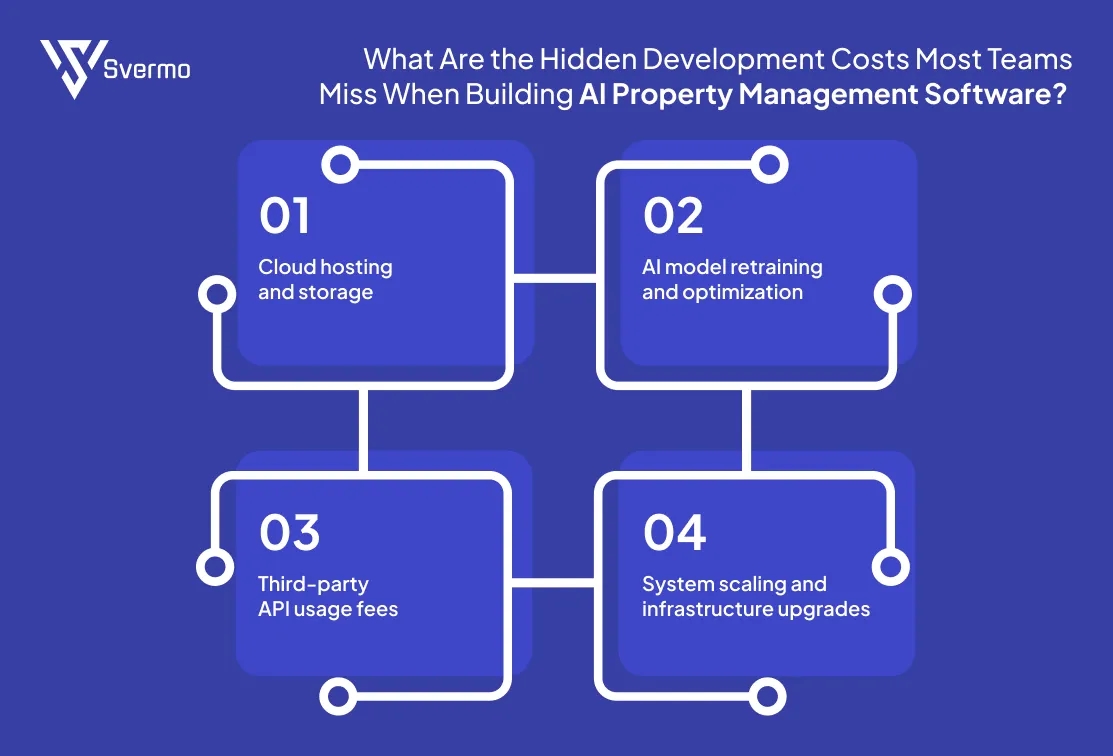
Most companies prepare for development expenses. What catches them off guard are the costs that appear after development starts or even after launch.
That is why many property managers ask, “what hidden costs should a property management firm know before starting AI software development?” These expenses can quietly increase your total investment if they are not planned early.
Understanding the hidden side of the cost of developing custom AI property management software for real estate businesses helps you budget more accurately and avoid unexpected financial pressure later.
Here are the most common hidden costs businesses should prepare for.
Hidden Cost Area | Estimated Cost (USD) | What It Includes |
|---|---|---|
Cloud hosting and storage | $500 to $5,000+ per month | Server hosting, AI processing infrastructure, database storage, backup systems, and bandwidth usage |
AI model retraining and optimization | $10,000 to $30,000 annually | Updating AI models with new data, improving response accuracy, performance monitoring, and continuous learning improvements |
Third-party API usage fees | $2,000 to $20,000 annually | Ongoing costs for payment gateways, mapping services, telephony APIs, CRM integrations, and communication tools |
System scaling and infrastructure upgrades | $10,000 to $40,000+ | Expanding server capacity, improving application performance, handling larger user volumes, and database optimization |
AI voice and IVR usage costs | $3,000 to $25,000 annually | Speech-to-text processing, voice call handling, telephony charges, and AI conversation processing |
For example, businesses implementing advanced automation and voice support often underestimate how quickly usage-based AI costs can grow. Understanding these hidden costs early helps you avoid budget gaps and build a more sustainable long-term investment plan.
Want to Avoid Cost Surprises After Development Starts?
Hidden expenses usually appear when planning is weak. We help you identify them before they impact your budget.
What Are the Smartest Ways to Reduce AI Property Management Software Costs While Maintaining Quality?
High development costs do not always mean better software. In many cases, businesses overspend because they build too much too early, choose the wrong architecture, or invest in features they do not actually need.
The smarter approach is cost optimization. Many real estate firms now focus on reducing unnecessary expenses while still building scalable and high-performing AI systems. If you are wondering “how to reduce AI property management software development cost without compromising quality,” the strategies below can make a significant difference.
1. MVP-First Development Approach
Starting with an MVP can reduce initial development costs by 30% to 50%. Instead of building every feature upfront, you focus only on the most important operational capabilities first. This helps validate user needs early and prevents overspending on features that may not deliver real value.
Many businesses managing the AI property management platform development investment use phased rollouts to scale gradually instead of committing to a full enterprise build immediately.
2. Pre-Trained AI Models
Using pre-trained AI models can reduce AI development expenses by 25% to 40%. Building AI systems completely from scratch requires large datasets, model training, and continuous testing. Pre-trained models shorten development time and improve deployment speed while still supporting advanced automation capabilities.
3. Smart Feature Prioritization
Prioritizing high-impact features early can lower development costs by 20% to 35%. Many companies try to include every possible feature in the first version, which increases complexity and delays launch timelines. Focusing on automation areas that directly improve operations creates faster ROI and better budget control.
For example, tenant communication automation and rent management usually deliver stronger operational impact before advanced analytics modules.
4. Hybrid Development Teams
Hybrid development models can reduce overall project costs by 30% or more compared to fully in-house teams. This structure combines internal business oversight with external technical expertise, helping companies balance quality, speed, and cost efficiency.
Businesses comparing how much do companies charge for AI property management software development in USA often find hybrid teams more practical for long-term scalability and budget management.
5. Scalable Architecture Planning
Planning scalable infrastructure early can reduce future redevelopment costs by 40% to 60%. Many businesses build systems only for current needs, then struggle when operations grow. A scalable architecture supports increasing tenants, properties, and AI workloads without requiring major rebuilds later.
Reducing the AI property management software development cost is not about limiting innovation. It is about making strategic decisions that improve scalability, speed, and long-term ROI without wasting resources.
Which Emerging AI Trends Are Increasing Property Management Software Development Costs in 2026?

AI in property management is evolving quickly. Beyond standard automation and tenant management, companies are now investing in more advanced technologies to improve efficiency, decision-making, and operational control. These innovations create new opportunities, but they also increase the overall AI property management software development cost.
Here are some of the major AI trends shaping development budgets in 2026.
1. Digital Twin Technology
Digital twins create virtual replicas of buildings and property operations using real-time data. Property managers can monitor asset performance, occupancy patterns, and maintenance conditions more accurately.
Estimated Cost: $3,000 to $10,000+
2. Computer Vision for Property Monitoring
Computer vision systems use AI to analyze images and video feeds for security monitoring, property inspections, and damage detection. These systems reduce manual inspections and improve operational visibility.
Estimated Cost: $5,000 to $15,000+
3. AI-Powered Energy Optimization
AI-driven energy management systems analyze utility consumption and optimize heating, cooling, lighting, and energy usage automatically. This helps reduce operational costs across large property portfolios.
Estimated Cost: $2,000 to $8,000+
4. Predictive Occupancy Analytics
Predictive occupancy systems use AI to forecast vacancy risks, leasing trends, and tenant behavior patterns. This helps property managers make more accurate operational and investment decisions.
Estimated Cost: $3,000 to $12,000+
5. Autonomous Workflow Orchestration
Advanced AI systems can now automate multi-step operational processes without constant manual input. These platforms coordinate leasing, maintenance scheduling, approvals, and reporting workflows automatically.
Estimated Cost: $5,000 to $18,000+
As AI capabilities continue to evolve, property management companies are shifting from basic automation toward more intelligent and predictive systems. Understanding these emerging trends helps you plan a smarter AI property management platform development investment that stays competitive in the long run.
Looking to Optimize AI Property Management Software Costs? How Can Svermo Help?
At Svermo, we focus on building AI systems that solve operational problems without inflating development budgets. Every project starts with understanding your workflows, growth plans, and automation goals so the investment stays aligned with business outcomes.
For most businesses, the cost to develop AI property management software ranges between $40,000 to $300,000+. The final cost depends on the level of automation, AI capabilities, integrations, and scalability requirements. Our approach focuses on identifying which features create the highest operational impact first, so you avoid paying for unnecessary complexity early in the process.
We also use phased development strategies to reduce upfront investment. Instead of building everything at once, we help companies launch faster with essential functionality and expand strategically as operations grow. This approach improves budget control and shortens time-to-market.
Our experience with property management AI software solutions allows us to build systems that combine tenant automation, AI-powered communication, workflow management, analytics, and scalable infrastructure within a practical development roadmap.
For businesses planning advanced automation, we also help integrate AI assistants, voice systems, and intelligent workflows without creating disconnected tools or expensive redevelopment cycles later.
The goal is simple. Build software that supports long-term operational growth while keeping the AI property management software development pricing practical, scalable, and ROI-focused.
Closing Remarks!
AI-powered property management software development is not just a technology decision. It is an operational investment that affects how efficiently your business scales, serves tenants, and manages daily workflows.
The AI property management software development cost can range from $40,000 to $300,000+, depending on the level of customization, AI complexity, integrations, and scalability requirements. Understanding what drives that cost helps you make smarter decisions and avoid unnecessary expenses later
Whether you are planning an MVP or a full-scale enterprise platform, the right strategy can help you control costs while building software that continues delivering value as your operations grow.
At Svermo, we work closely with real estate and property management businesses to build AI-driven systems that are practical, scalable, and aligned with real operational needs. From automation workflows to advanced AI integrations, our focus stays on creating solutions that improve efficiency without unnecessary complexity.
If you are planning to invest in custom AI software and want a realistic roadmap, budget estimate, or development strategy tailored to your business, contact us.
 https://www.linkedin.com/in/sanjeev1975/
FAQs
The development timeline usually depends on the project scope and AI complexity. A basic MVP can take around 2 to 4 weeks, while a fully customized enterprise platform may require 6 to 8 weeks. Integrations, AI training, and scalability requirements also affect the timeline.
In most cases, yes. AI-powered platforms rely on cloud infrastructure for data storage, AI processing, scalability, and real-time automation. Cloud environments also make it easier to manage updates, backups, and remote access across multiple properties.
The average budget for developing AI property management software in 2026 typically ranges from $40,000 to $300,000+. Smaller MVP solutions fall on the lower end, while enterprise platforms with advanced AI automation, analytics, and integrations require higher investment. The final budget depends on customization, AI complexity, scalability, and long-term operational goals.
Property management platforms commonly use machine learning, natural language processing, predictive analytics, and conversational AI. These technologies help automate tenant communication, maintenance management, reporting, and operational workflows.
Yes, especially with an MVP-first approach. Smaller firms often begin with limited automation features and expand gradually as operational needs grow. This helps reduce upfront investment while still improving efficiency and scalability.
Most platforms require regular updates for security, performance, and AI optimization. Minor updates may happen monthly, while larger feature improvements and AI model refinements are usually planned quarterly or biannually depending on business needs.
Not always. Many businesses work with external AI development partners for maintenance, updates, and infrastructure management. However, larger enterprises sometimes maintain internal technical teams for operational oversight and system management.
Ready to Build an AI Property Management Platform That Actually Scales?
From MVPs to enterprise AI systems, we help property management companies build smarter without overcomplicating development.