
AI Underwriting for Residential Real Estate: What Gets Automated and What Analysts Still Own


Get a summary of this article with your favorite AI





AI Summary
- •AI can automate the repetitive parts of underwriting: intake, cleanup, cross-checks, comparisons, first-pass models and memo drafting.
- •Analysts still own the assumptions, the exceptions and the investment decision.
- •Every assumption should carry a source, a date, an owner and a change log, so nothing is a black box.
- •AI can pull and compare rent data, but the analyst decides which comps are fair and what rent to underwrite.
- •AI-assisted valuation is a cross-check, not an appraisal. Test its accuracy before relying on it.
- •Evaluate a tool on transparency first: sources, overrides, rent data provenance, valuation method and audit trails.
AI underwriting for residential real estate should do the grunt work and leave the judgment calls to people. Most of an underwriter's first hours go to collecting rent rolls, operating statements and market data, not to deciding whether a deal makes sense. AI can take over that collection and cleanup, run the first-pass model and flag what doesn't add up, while analysts stay responsible for the assumptions and the final call.
In AI real estate deal underwriting, the split is simple: software prepares, people decide. This guide shows what to automate, what analysts keep, and how to tell whether an AI underwriting tool earns your trust. It builds on the AI real estate deal analysis guide.
How does AI underwriting work for residential real estate?
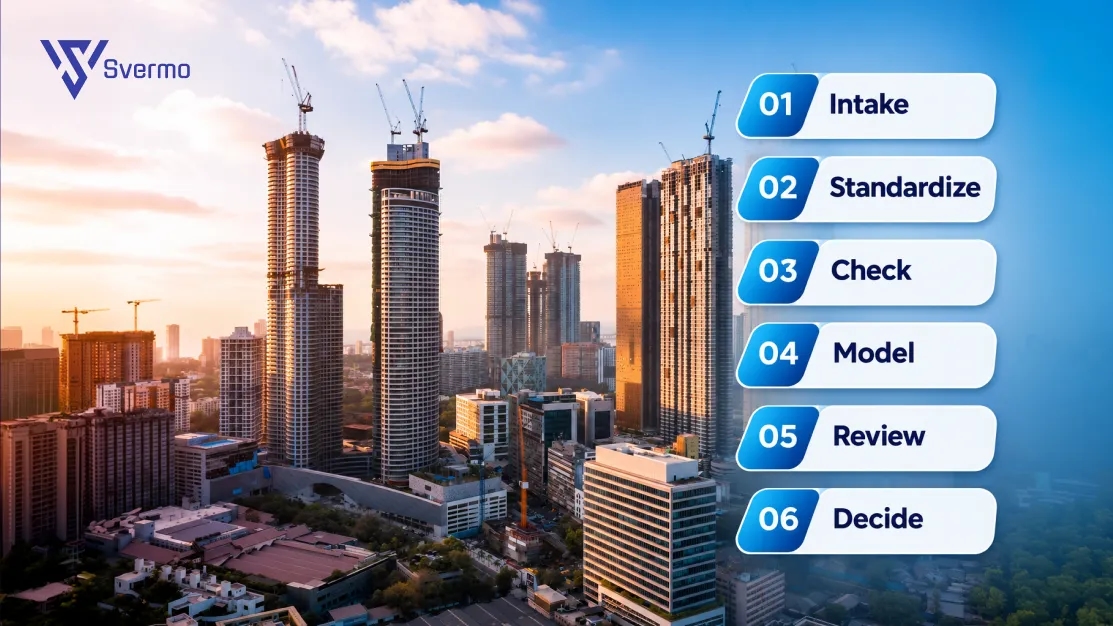
AI real estate underwriting reads the deal's documents, pulls out the numbers, standardizes them, builds a first-pass model, and shows an analyst what it found and where each number came from. It is AI-powered real estate underwriting in the sense that the software prepares the work, and the analyst reviews, adjusts and approves it.
In practice, AI property underwriting follows a simple loop:
- Intake: the AI reads the offering memorandum, rent roll, trailing-12 statement and supporting files.
- Standardize: it maps the numbers into your template so every deal looks the same.
- Check: it flags missing items and numbers that disagree across documents.
- Model: it drafts a first-pass model from inputs and assumptions.
- Review: the analyst accepts, edits or rejects each assumption.
- Decide: people decide, with the AI's output and its sources attached.
What can AI automate in real estate underwriting?
AI underwriting for real estate can automate the repetitive, rules-based and data-heavy tasks: extraction, cleanup, cross-checks, comparisons and drafting. Real estate underwriting automation works best on work that is tedious but not judgmental.
| Task | What AI can do | What the analyst owns |
|---|---|---|
Data collection | Pull figures from rent rolls, T-12s and offering memorandums | Confirming the source documents are complete |
Normalizing financials | Map line items to your template | Deciding how to treat unusual items |
Consistency checks | Flag numbers that disagree across documents | Resolving the conflicts |
Rent and market comparison | Compare in-place rents with benchmarks | Choosing which comps are fair |
First-pass model | Build a draft with default assumptions | Setting the assumptions that matter |
Sensitivity runs | Re-run the model under different inputs | Deciding which scenarios are realistic |
Memo drafting | Summarize deal facts and flags | Verifying figures and writing the recommendation |
Underwriting leads often lose hours collecting financials, rent data and operating assumptions before modeling even starts. To automate that without handing over the decision, let AI handle intake, cleanup and the first-pass model, and put a human approval step on every assumption and on the decision itself. Automated real estate underwriting should shorten the time to a reviewable draft, not skip the review. The same goes for automated real estate financial analysis, such as standardizing statements and running sensitivities: it prepares the numbers, and the analyst questions them.
What parts of AI real estate underwriting should analysts still handle?
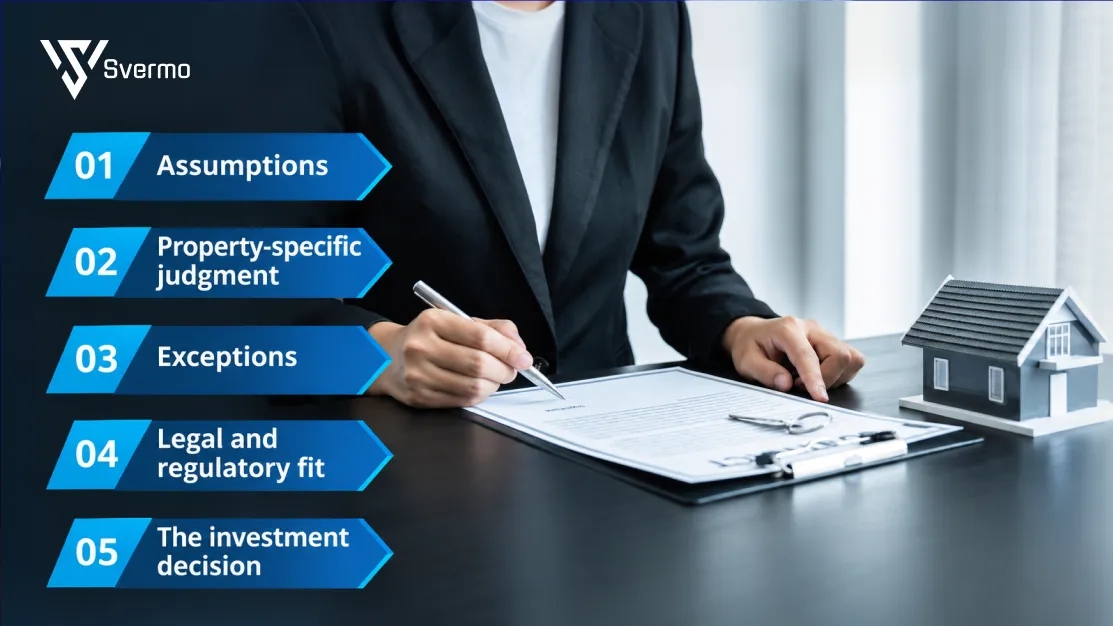
Analysts should own the assumptions, the exceptions and the decision. AI investment decision support for real estate is support, not a verdict. AI can propose, but these calls depend on context, risk appetite and accountability that software doesn't carry:
- Assumptions: rent growth, vacancy, expenses, capital spending, financing terms and exit value.
- Property-specific judgment: condition, location quirks and what the documents don't show.
- Exceptions: unusual leases, off-market terms and anything the template doesn't fit.
- Legal and regulatory fit: single-family deals may need an eligibility check under the ROAD to Housing Act, with counsel making the call.
- The investment decision, including its risk.
When there are more deals than review time, screen first and underwrite only what passes. The deal screening guide shows how to sort the pipeline so analysts' limited time goes to the deals worth modeling, with analysts still controlling the assumptions that matter.
How can an AI underwriting system show where its assumptions come from?
By attaching a source, a date and an owner to every assumption, and letting the analyst change any of them with a record of the change. An AI underwriting system that can't show where a number came from is a black box, however good its output looks.
Here's a worry teams voice often: "I worry that automated underwriting could use inaccurate rent or expense assumptions and make a deal look more attractive than it really is. How can an AI underwriting system show where its assumptions come from and let analysts review or change them?"
Short answer: keep an assumption register. Each line should show:
| Field | Example |
|---|---|
Assumption | Vacancy of 6% |
Source | Trailing-12 statement, or market data, or analyst judgment |
Compared with | Broker's figure, with the gap highlighted |
Status | Proposed, approved or overridden |
Changed by and why | Analyst name, date and reason |
Three controls make it work. Flag differences from the broker's numbers so the optimistic ones stand out. Lock approved assumptions so they don't shift silently when the model re-runs. Keep a change log so anyone can see what moved and why.
How does AI analyze rent data for residential real estate underwriting?
AI compares three rent figures and highlights the gaps: what tenants pay now, what the market suggests, and what is realistic for each unit. That comparison drives income projections, so it is where rent data matters most.
- In-place rent, from the rent roll.
- Market rent, from comparable listings and benchmarks.
- Achievable rent, the analyst's judgment after adjusting for condition, unit mix and timing.
The difference between in-place and market rent is where upside or risk sits, but only if the market figure is sound.
Here's what teams ask about this step: "We often spend too much time pulling rental market data and comparing current rents with potential market rents. Can AI help analyze rent data and incorporate realistic rental assumptions into our residential real estate underwriting process?"
Short answer: yes for the pulling and comparing, and no for the final rent assumption. AI can gather comps, line them up against the rent roll and show the gap unit by unit. The analyst decides which comps are fair and what rent to underwrite.
Check the rent data itself. For a public benchmark, HUD's Fair Market Rents are estimates of 40th percentile gross rents, updated yearly, with ZIP-level figures available. They're a sanity check, not a market-rent estimate. Record the source and date of every rent input.
Data provenance matters for another reason. Federal antitrust enforcement has targeted rent-setting software built partly on nonpublic data from competing landlords.
Underwriting for acquisition is a different activity from setting rents, but the safe habit is the same: know where each rent figure came from, and have counsel review any data source that includes competitor information.
Let Analysts Spend Time on Judgment, Not Data Entry
See how Deal AI reviews documents and flags inconsistent assumptions before underwriting begins.
Can AI improve residential property valuation and underwriting accuracy?
It can add a faster, data-backed cross-check on price, but it doesn't guarantee a more accurate answer. Residential property valuation AI estimates value from comparable sales and property data, which gives underwriters a quick reference point against the asking price and the model's exit assumptions. Treat it as an estimate, not an appraisal, and test its accuracy on sales you already know before relying on it. Valuation AI is Svermo's separate product for this.
How can AI underwriting for multifamily and rental properties stay standardized without losing deal-specific judgment?
Standardize the frame, not the answer. Use one template, one set of definitions and one assumption register for every deal, and leave room for each deal's own adjustments. That way AI deal analysis for real estate makes deals comparable, automated property investment analysis stays consistent from deal to deal, and analysts still apply what they know about each one.
- Fixed core: the same line items, definitions and outputs for every deal.
- Flexible overlay: deal-specific assumptions, each with a source and a reason.
- Side-by-side view: compare deals on the same outputs, with the assumptions that differ shown.
This is how AI underwriting for multifamily real estate and AI underwriting for rental properties stay consistent across a pipeline of different assets, and how AI real estate investment underwriting stays comparable across a portfolio.
What should real estate teams look for in AI underwriting software?
Look for transparency first and automation second. AI underwriting tools for real estate investors vary widely, and AI real estate deal analysis software that hides its assumptions saves time only until the first surprise. Here's the worry behind most buying decisions: "We want to use AI to speed up residential real estate underwriting, but I do not want a black-box recommendation telling my team whether to invest. What should we look for in an AI underwriting solution that provides transparent assumptions, valuation analysis, and analyst oversight?"
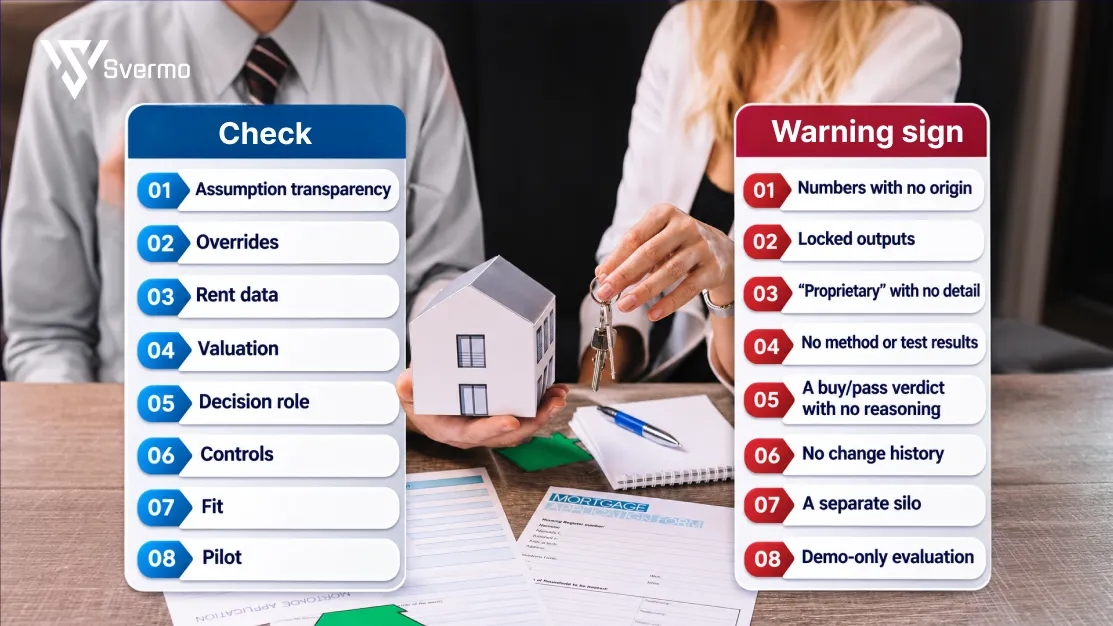
Check these before you buy.
| Check | Ask | Warning sign |
|---|---|---|
Assumption transparency | Can I see each assumption's source? | Numbers with no origin |
Overrides | Can analysts change inputs and log why? | Locked outputs |
Rent data | Where does the rent data come from, and how current is it? | "Proprietary" with no detail |
Valuation | How is value estimated, and how was it tested? | No method or test results |
Decision role | Does it recommend, or support the analyst? | A buy/pass verdict with no reasoning |
Controls | Are access and audit trails built in? | No change history |
Fit | Does it work with your models and documents? | A separate silo |
Pilot | Can it run a completed deal as a test? | Demo-only evaluation |
For context, Deal AI describes document review, flagging of inconsistent financial assumptions, configurable evaluation criteria, audit trails and integration with underwriting tools. Its page doesn't say it builds the underwriting model, and it doesn't describe its rent data sources, valuation method or explainability, so put these same questions to any AI underwriting software for real estate, Svermo's included. A pilot on a completed deal shows quickly whether the numbers hold up.
No Black Boxes in Your Underwriting
Ask how assumptions are sourced, shown and overridden.
Want an Underwriter Who Never Gets Tired, but Never Gets the Last Word?
Think of AI underwriting as the world's most diligent intern: first to the data, never bored by a rent roll, and still not allowed to sign the check. Let it do the collecting, comparing and drafting, and keep the assumptions, the exceptions and the decision with your team.
Want to see how that split could work on your deals? Contact AI experts at the Svermo team today!.
 https://www.linkedin.com/in/saanvi-verma-38711a36a
FAQs
No. AI speeds up data gathering, cleanup and drafting. Analysts still set assumptions, handle exceptions and make the investment decision.
It can support both by extracting data and standardizing models. Each asset type still needs its own assumptions and an analyst's review.
It is only as accurate as its data and assumptions. Test any tool on a closed deal and compare its figures with what actually happened before you trust it on a live one.
Most use it to screen faster, build a first-pass model, check assumptions against sources and prepare committee materials, with analysts approving each step.