
Real Estate Deal Screening With AI: Cut First-Pass Review from Hours to Minutes


Get a summary of this article with your favorite AI





AI Summary
- •Use the broker’s package and written buy box to screen deals before detailed underwriting.
- •Set firm-specific real estate deal kill criteria for market, unit count, deal size, price per unit, cap rate, occupancy, collections, and expenses.
- •Assign every deal a go, hold, or pass outcome with a clear next step and documented reason.
- •Review inconsistent data and borderline deals, and audit rejected deals to catch missed opportunities.
- •Track analyst time per deal, broker response time, and screening accuracy. Svermo’s Deal AI applies a team’s criteria to incoming deals as part of this workflow.
Acquisitions analysts spend hours sorting through broker deals, only to find many fall outside the firm’s buy box. Real estate deal screening with AI brings the initial checks upfront, so the team quickly sees which deals fit its acquisition criteria and which need further review.
The process starts with clear rules for target markets, unit count, deal size, and operating performance. Each deal gets a go, hold, or pass outcome, with a clear reason behind the decision. Missing details get flagged for review, and analysts decide which opportunities move forward to underwriting.
Still Giving Bad Deals Your Best Analysts?
Spend less time sorting broker packages and more time reviewing deals that fit your buy box.
What Information Does a First-Pass Screen Need, and What Can Wait for Underwriting?
A first-pass screen uses two inputs: the broker’s package and the firm’s written buy box. It’s the starting point for AI real estate deal analysis, checking basic acquisition fit before anyone digs into projected returns.
A common concern among acquisitions teams is:
"We review hundreds of deals a year, and most die at first look, yet each one still costs an analyst hours before anyone says no. How much of that first pass could AI take over?"
AI handles initial checks against a written buy box, including market, deal size, unit count, and operating criteria. Analysts focus on missing information, exceptions, and deals that qualify for further review.
Use the Broker’s Package and Written Buy Box
Start with the asking price, market, unit count, occupancy, collections, and available operating figures. Compare them with the firm’s actual buy box criteria for real estate acquisitions, such as target markets, deal-size limits, price per unit, and minimum operating requirements.
The key is to distinguish a failed criterion from missing information. A deal outside the firm’s target markets fails that rule. A package with no occupancy figure needs review, not an automatic pass or rejection.
Reserve Detailed Underwriting for the Next Stage
Keep cash flow projections, financing assumptions, and detailed expense validation out of the initial filter. Once a deal meets the basic criteria, the team moves into deeper analysis, including the work needed to analyze an offering memorandum.
The first-pass result stays practical: go for further review, hold for missing or unclear information, or pass for a defined buy box mismatch. That boundary keeps AI screening focused on deal fit rather than pretending it has completed the investment analysis.
Which Kill Criteria Belong in a First-Pass Screen?
The right real estate deal kill criteria are the rules that make a deal an immediate mismatch for your investment strategy. Set them around location, property size, deal limits, and operating performance, with thresholds tailored to your buy box.
Acquisitions professionals often question:
"We spend hours on comps and a model for deals that die because the seller’s price is out of range, a fact we could have caught in the first ten minutes. Can AI check price against our criteria before an analyst opens a model?"
Yes. AI compares the asking price against the firm’s purchase-price limits and flags deals outside the buy box before detailed modeling begins. Accuracy depends on reliable price extraction and clearly defined criteria.
Set Buy Box Criteria for Market, Unit Count, and Deal Size
Start with hard limits: target and excluded markets, minimum or maximum unit count, and deal-size range. These rules quickly filter out properties that fall outside the firm’s acquisition strategy.
Keep thresholds specific to your strategy. A small multifamily investor and an apartment-community buyer have different target deal sizes, so one firm’s limits are not universal screening standards.
Check Price per Unit, In-Place Cap Rate, Occupancy, Collections, and Expense Ratio
Use the figures in the broker’s package to check whether a deal meets the firm’s requirements:
- Price per unit: Compare the asking price with the firm’s target range.
- In-place cap rate: Check it against the firm’s minimum, using the reported net operating income and asking price.
- Occupancy and collections: Compare reported occupancy and rent collection with the firm’s minimums.
- Expense ratio: Flag figures that fall outside the firm’s expected range for the asset type.
These are screening checks, not universal benchmarks. Missing or questionable figures belong in hold for review; a confirmed breach of a hard requirement triggers pass.
Adapt Criteria for Single-Family Rentals and Apartment Communities
The same AI deal screening criteria do not fit every asset type. For single-family rentals, focus on property-level price, target market, and the firm’s acquisition limits for individual homes or portfolios. For apartment communities, unit count, property-level occupancy, collections, and operating expenses carry more weight.
Keep the rules tied to the firm’s actual buy box. AI applies those rules consistently, while analysts review unclear data and exceptions before a promising deal is ruled out.
How Does AI Apply a Buy Box to Incoming Deals?

AI screening turns a written buy box into deal-level checks. For each incoming property, the screen matches broker-provided figures to the firm’s criteria and separates confirmed mismatches from details that still need verification.
A recurring challenge for acquisitions teams is:
"We keep our buy box in a few people’s heads, so different analysts pass on different deals and nobody can say why a deal was killed. I want to know how AI can apply a written buy box the same way every time and record the reason."
AI applies documented criteria to each incoming deal and records which rule was met or failed. This creates a consistent decision trail across analysts and broker submissions.
Apply the Same Written Criteria to Every Incoming Deal
A written rule needs a defined input and a clear outcome. For example, a maximum purchase price is checked against the asking price; an occupancy minimum is checked against reported occupancy. If the package lacks the required figure, the result stays unresolved rather than becoming an automatic rejection.
This is the core of AI to screen incoming deals against a buy box: the same rule applies across submissions, even when different brokers present the information differently.
Record the Criteria Behind Each Pass Decision
A useful screening record goes beyond a pass label. It connects the decision to the specific rule and the deal information behind it. For each rejected deal, retain:
- Failed criterion: the exact buy box rule the deal missed.
- Observed value: the asking price, unit count, occupancy, or other figure that triggered the decision.
- Source and status: where the figure came from and whether it was verified or broker-reported.
- Exception or override: whether an analyst changed the result and why.
These records also support a practical quality check: revisit passed-over deals and compare their outcomes with the original rejection reasons. If viable acquisitions repeatedly fail the same threshold, the team has evidence to review that rule instead of loosening the entire buy box.
How Should a Team Tier Deals into Go, Hold, and Pass, and What Happens to Each Tier?
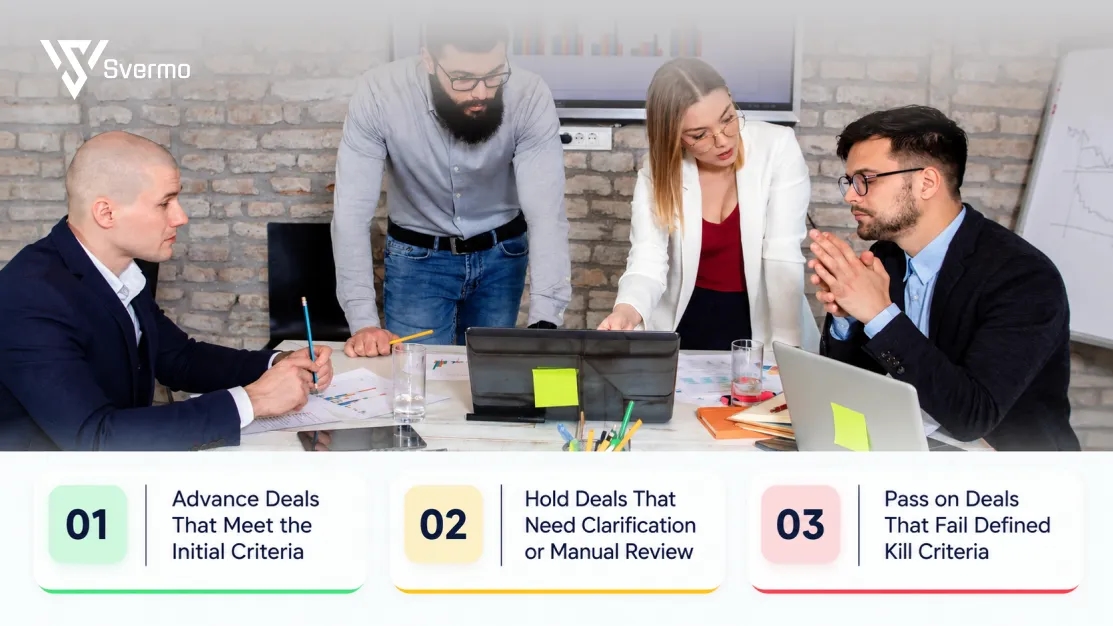
AI real estate deal triage assigns each incoming deal one of three outcomes: go, hold, or pass. Each outcome needs a clear next step and an owner.
Advance Deals That Meet the Initial Criteria
Go: Move the deal to underwriting and assign an analyst. Carry forward the screening results, including the buy box criteria the deal met, so the analyst knows what has already been checked.
Hold Deals That Need Clarification or Manual Review
Hold: Identify the missing or conflicting information, assign someone to resolve it, and set a follow-up date. For example, if rent collections are missing, request the figures from the broker. Reassess the deal when the information arrives.
Pass on Deals That Fail Defined Kill Criteria
Pass: Record the failed criterion, the supporting figure, and the reason for rejection. Remove the deal from the active pipeline unless an authorized exception applies. Periodically audit passed deals to identify false rejections and rules that need review.
Deals marked go move into underwriting, where the acquisitions team tests the financials and decides whether the opportunity merits further pursuit.
Where Can AI Screening Go Wrong, and What Should an Analyst Always Check Before Passing a Deal?
AI real estate deal screening risks rejecting viable deals when broker data is incomplete, figures conflict, or screening thresholds are too rigid. Analysts need to verify the reason behind a rejection before closing the deal.
One concern with automated screening is:
"I worry that a rule that kills deals automatically will also kill ones we would have wanted, and we would never see them. What would it take for AI to show us what it passed on so we can check our own criteria?"
Keep a record of rejected deals, the rule each one failed, and the figures behind the decision. Periodic audits reveal false rejections and highlight criteria that need closer review.
Account for Incomplete or Inconsistent Broker Package Information
Broker packages don't always present financial and property details consistently. One might report occupancy but omit collections; another might list expenses that conflict with the summary.
Before rejecting a deal, check:
- Missing data: Is a required figure absent, or does the deal actually fail the criterion?
- Conflicting figures: Do the summary and supporting details agree?
- Unclear inputs: Has AI interpreted the figure, units, and reporting period correctly?
Flag unresolved issues for analyst review rather than treating them as automatic failures.
Review Borderline Deals That Rigid Filters Could Eliminate
A deal just outside a threshold deserves a closer look if the data is uncertain or the breach is marginal. For example, a reported cap rate slightly below the firm's minimum warrants verification before rejection.
Identify the failed rule, verify the source figures, and have an analyst decide whether the deal remains a pass or qualifies for an exception. Record the reason for any override so the team can review the rule later.
Pre-Pass Analyst Checklist
Before marking a deal as pass, verify:
- Buy box breach: Does the deal clearly fail a defined acquisition criterion?
- Source data: Does the broker package support the figure behind the rejection?
- Missing information: Is a required figure absent rather than an actual failure?
- Conflicting figures: Do the summary and supporting details agree?
- Borderline result: Is the deal close enough to a threshold to warrant manual review?
- Decision record: Is the failed rule and supporting evidence documented?
If information is incomplete or the result is borderline, send the deal for review rather than rejecting it automatically. Reserve pass for confirmed breaches of the firm's defined criteria.
How Can a Team Measure Screening Speed and Accuracy, Such as Time per Deal and Good Deals Passed by Mistake?
Measure the real estate deal screening process using three metrics: analyst time per deal, time to respond to brokers, and the rate of viable deals wrongly rejected. Together, they show whether deal screening speeds up first-pass reviews without sacrificing decision quality.
Track Analyst Review Time and Time to Respond to the Broker
Compare first-pass real estate deal screening time before and after introducing AI. Track analyst time per deal and the time between receiving a broker package and communicating the next step.
Compare similar asset types and deal volumes. Faster screening is not a real improvement if analysts spend the saved time correcting extraction errors or reviewing misclassified deals.
Audit Passed Deals to Identify Overly Restrictive Criteria and Missed Opportunities
Periodically review rejected deals against the original broker package and the firm’s buy box. Check whether each rejection followed a valid rule or resulted from an incorrect figure, missing information, or an overly restrictive threshold.
| Audit finding | What to investigate |
|---|---|
Incorrect figure | Data extraction or interpretation |
Missing information triggered rejection | Rules for incomplete packages |
Viable deal narrowly missed a threshold | Whether the threshold still fits the buy box |
Rejection followed a valid hard rule | Keep the criterion unchanged |
Use a deal screening checklist for acquisitions teams to standardize these audits. Track errors over time and correct screening rules or data-handling issues when the evidence supports a change. The goal is to catch missed opportunities without loosening valid acquisition criteria.
Ready to Cut the First-Pass Busywork?
See how Svermo’s Deal AI screens incoming deals against your acquisition criteria.
Closing Remarks!
Your acquisitions team has better things to do than spend hours reviewing deals that never fit the buy box. Real estate deal screening with AI puts the basic checks upfront, so analysts spend less time sorting broker packages and more time on deals worth a closer look.
That’s the idea behind Svermo’s Deal AI screen incoming deals against your criteria and keep the reasons behind each decision clear. Want to see how it fits your acquisitions workflow? Book an appointment and talk through your team’s screening process.
 https://www.linkedin.com/in/saanvi-verma-38711a36a
FAQs
Use AI for the initial checks against your buy box, then route unclear or borderline deals to an analyst. The real estate deal screening process ends with a recommendation for the next step, not an automated investment decision.
Standardize the required deal fields and apply the same acquisition rules across submissions. For multifamily deals, keep unit count, asking price, occupancy, collections, and operating figures in a consistent format so analysts spend less time reconciling different broker presentations.
For single-family rental deal screening, define criteria for target markets, purchase price, property type, and portfolio size where relevant. Keep property-level and portfolio-level requirements separate so a single home and a package of homes are evaluated against the right rules.
A practical deal screening checklist for acquisitions teams includes required deal fields, written buy box rules, data-quality checks, go/hold/pass outcomes, rejection reasons, and an escalation path for exceptions. The checklist also identifies who owns unresolved questions.
Compare tools based on how well they handle your actual broker packages, apply firm-specific criteria, flag missing information, explain screening results, and fit your existing workflow. Test them on previously reviewed deals before relying on their results.