

How Much Does Real Estate AI Automation Software Development Cost in 2026?


Get a summary of this article with your favorite AI




AI Summary
- •The AI real estate automation software development cost ranges between $30,000 and $200,000+, based on complexity and AI capabilities.
- •Your total cost of developing an real estate ai automation software depends on features, data, integrations, and infrastructure choices.
- •Starting with an MVP helps control the development budget of real estate ai automation software and reduces upfront risk.
- •Hidden costs like cloud usage, APIs, and maintenance directly impact the real estate automation software development cost integrating AI over time.
- •Svermo helps optimize your real estate automation platform development cost with AI integration by aligning cost with business outcomes and scalable architecture.
Are you losing deals because your competitors respond faster, qualify leads better, and automate everything you still handle manually?
That’s the shift happening across real estate in 2026. Teams that once relied on manual follow-ups and scattered systems are now running on intelligent automation that works around the clock.
This is exactly where the conversation around Real Estate AI Automation software development cost starts to matter. Because once you see what AI can actually do for your pipeline, the next step is understanding what it will take to build it.
Right now, the cost to make Real Estate AI Automation software typically ranges between $30,000 and $200,000+. But the real challenge is not just the number. It’s understanding why two similar-looking solutions can have completely different price points.
So naturally, you start asking. What am I actually paying for?
And more importantly, will this investment translate into measurable growth?
The impact of AI is already very clear.
- Firms using AI report up to 300% increase in leads and over 40% improvement in conversion rates
- AI-powered engagement enables 24/7 client interaction, pushing conversions even higher
What this means for you is simple. More qualified leads enter your pipeline without increasing marketing spend. Your response time drops from hours to seconds. And your team spends less time chasing leads and more time closing them.
This is why more businesses are moving toward real estate AI software solutions. Not because it sounds advanced, but because it directly improves revenue, efficiency, and client experience.
Getting clarity on the cost of developing an Real Estate AI Automation software early helps you avoid wasted budget and make decisions that actually support long-term growth.
Wondering What Your AI Automation Could Actually Cost?
If you’re unsure where your budget should land, we can break it down based on your exact use case.
What's the Real Cost of Real Estate AI Automation Software Development in 2026? A Budget Overview
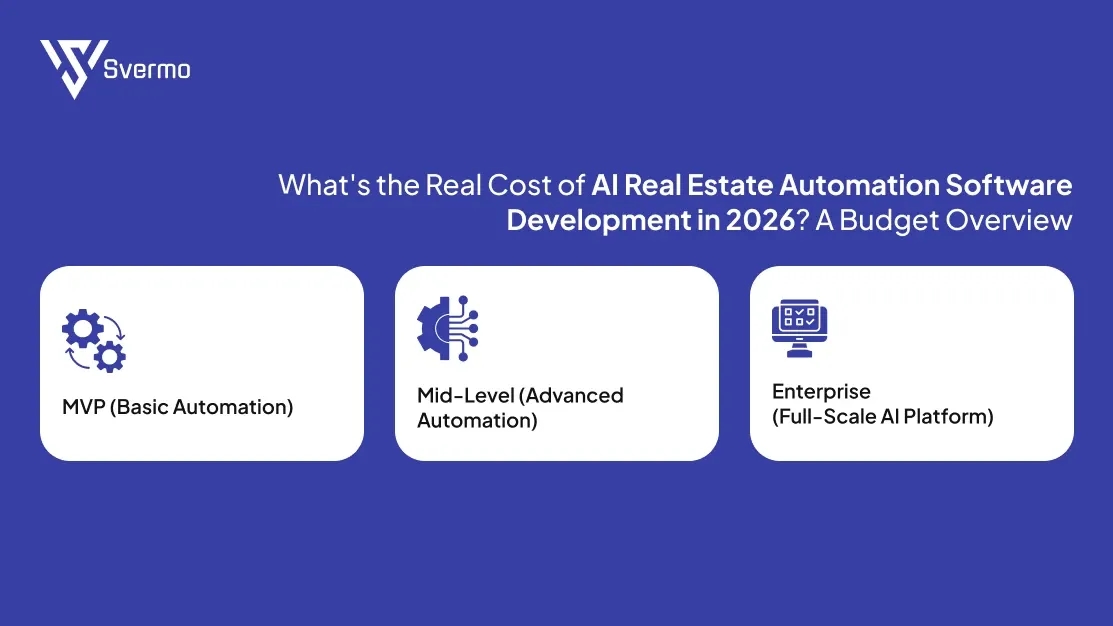
If you’re planning your investment, this is probably the first question on your mind: “I am budgeting for AI tools in my real estate company, how much should I expect to spend?”
The answer depends on how advanced you want your system to be and how much automation you actually need. The Real Estate AI Automation software development cost is not fixed. It scales with features, AI capabilities, and system complexity.
At a high level, most projects fall into three tiers. Understanding these tiers helps you align your budget with your business goals instead of overbuilding or underinvesting.
Software Level | Estimated Cost Range | Features & Functionality Included |
|---|---|---|
MVP (Basic Automation) | $30,000 – $70,000 | Core workflow automation, basic CRM integration, simple lead capture, rule-based automation, limited AI features like chatbots or basic recommendations. Ideal for startups testing automation. |
Mid-Level (Advanced Automation) | $70,000 – $150,000 | Advanced CRM automation, AI-powered lead scoring, property recommendations, chatbot with NLP, integration with MLS and third-party APIs, analytics dashboards. Suitable for growing real estate teams. |
Enterprise (Full-Scale AI Platform) | $150,000 – $200,000+ | End-to-end automation across listings, lead management, predictive analytics, AI-driven decision-making, multi-system integrations, scalable cloud infrastructure, custom dashboards, and advanced reporting. Built for large firms and proptech platforms. |
The cost to make Real Estate AI Automation software increases as you move from basic automation to intelligent, data-driven systems.
For example, adding predictive analytics or real-time decision-making significantly impacts the real estate automation software development cost integrating AI.
This is why businesses often start with an MVP and then scale. It reduces upfront risk while giving you real insights into what features actually drive ROI.
Real Estate: Real estate AI software development cost
What Factors Influence the Real Estate Automation Software Development Cost Integrating AI?
When you start comparing quotes, the biggest confusion usually comes from one place. Two vendors promise similar outcomes, but the pricing is miles apart.
That happens because the real estate automation software development cost integrating AI is not driven by one single factor. It’s a combination of multiple layers, and each layer adds its own cost.
If you are thinking, “why is my quote higher than expected?” or “what exactly is increasing my cost?”, this section will give you clarity.
Let’s break it down one factor at a time.
1. Feature Set & Functional Capabilities
This is the biggest cost driver. The more workflows you automate and the more intelligence you add, the higher the cost. Most businesses underestimate this. They start with “basic automation” in mind but quickly add features like lead scoring, smart recommendations, and CRM automation. That’s where costs scale.
Here’s a clear breakdown of how different features impact the custom real estate automation software development cost:
Feature | Estimated Cost Impact | What It Does |
|---|---|---|
Lead Capture & Management | $5,000 – $15,000 | Captures leads from websites, portals, and ads. Stores and organizes them inside your system. |
CRM Integration | $8,000 – $20,000 | Connects your system with existing CRMs to manage contacts, deals, and communication. |
Property Listing Automation | $10,000 – $25,000 | Automates listing uploads, updates, and synchronization across platforms. |
AI Chatbot (Basic NLP) | $10,000 – $30,000 | Handles inquiries, qualifies leads, and responds instantly to customer questions. |
AI Lead Scoring | $15,000 – $40,000 | Ranks leads based on behavior, likelihood to convert, and engagement patterns. |
Property Recommendation Engine | $20,000 – $50,000 | Suggests properties to users based on preferences, behavior, and historical data. |
Workflow Automation | $10,000 – $30,000 | Automates follow-ups, reminders, task assignments, and internal processes. |
Analytics Dashboard | $8,000 – $25,000 | Provides insights into leads, conversions, agent performance, and system usage. |
Predictive Analytics | $25,000 – $60,000 | Forecasts trends, pricing, and customer behavior using historical data. |
Multi-Platform Integration (MLS, APIs) | $15,000 – $40,000 | Connects with MLS systems, third-party tools, and external data sources. |
If you only need basic automation, your cost to make Real Estate AI Automation software stays on the lower side. But once you start adding intelligence and automation across multiple workflows, the cost increases quickly.
For example, adding conversational AI or automated lead handling often requires deeper work like real estate AI chatbot development, which directly impacts your budget.
The key here is prioritization. Not every feature needs to be built on day one. The smartest approach is to focus on features that directly impact revenue first, then expand gradually.
2. AI Capability & Intelligence Level
Once your feature set is defined, the next cost driver is how intelligent those features actually are.
Two systems may offer automation, but one relies on fixed rules while the other uses learning models that improve over time. That difference directly impacts the real estate automation platform development cost with AI integration.
Here’s how different AI capabilities influence the development cost of Real Estate AI Automation system:
AI Capability | Estimated Cost Impact | What It Does |
|---|---|---|
Rule-Based Automation Logic | $5,000 – $15,000 | Executes predefined actions based on fixed conditions. No learning involved. |
Natural Language Processing (Advanced) | $15,000 – $40,000 | Understands user intent from messages and queries with higher accuracy. |
Machine Learning Models (Custom) | $25,000 – $70,000 | Learns from historical data to improve predictions and automate decisions. |
Computer Vision (Image Analysis) | $20,000 – $60,000 | Analyzes property images for tagging, quality checks, and visual insights. |
Voice AI & Conversational Systems | $20,000 – $50,000 | Enables voice-based interactions for inquiries, bookings, and support. |
Predictive Modeling (Custom Training) | $30,000 – $80,000 | Forecasts pricing trends, demand patterns, and customer behavior. |
Recommendation Engine (AI-Driven) | $25,000 – $60,000 | Suggests properties based on behavioral data and user preferences. |
Autonomous Decision Systems (Agentic AI) | $40,000 – $100,000+ | Enables systems to take actions independently based on goals and data inputs. |
The more advanced the AI, the more data, training, and fine-tuning it requires. That’s why the cost of developing an Real Estate AI Automation software increases significantly when you move beyond basic automation.
For example, systems built using agentic AI development for real estate can make independent decisions and adapt over time, but they require deeper architecture and higher investment.
3. Data Infrastructure & Management
AI systems are only as effective as the data they rely on. This is where many projects run into unexpected costs.
If you are thinking, “we already have data, so this should be simple,” it rarely works that way. Most real estate data is scattered, inconsistent, or incomplete. This layer directly impacts the real estate automation software development cost integrating AI because it involves building the foundation that AI depends on.
Here’s how data-related components affect the cost of developing an Real Estate AI Automation software:
Data Component | Estimated Cost Impact | What It Does |
|---|---|---|
Data Collection & Aggregation | $10,000 – $30,000 | Gathers data from multiple sources like CRM, listings, and third-party platforms into one system. |
Data Cleaning & Structuring | $8,000 – $25,000 | Removes duplicates, fixes inconsistencies, and organizes data for AI processing. |
Data Warehousing Setup | $15,000 – $40,000 | Stores large volumes of structured and unstructured data for analysis and model training. |
Data Pipeline Development | $20,000 – $50,000 | Automates the flow of data between systems in real time or scheduled intervals. |
Data Labeling & Annotation | $10,000 – $35,000 | Prepares datasets for machine learning by tagging and categorizing information. |
Data Security & Access Control | $10,000 – $30,000 | Ensures secure handling of sensitive customer and property data. |
Real-Time Data Processing | $20,000 – $60,000 | Enables instant updates and decision-making based on live data streams. |
Without proper data infrastructure, even advanced AI features will underperform. That often leads to rework, which increases your total cost later.
If your system involves tenant handling or operational workflows, data integration becomes even more critical. For example, solutions built around property management AI software solutions rely heavily on real-time, structured data to function effectively.
4. System Integrations & External Dependencies
No AI system works in isolation. Your automation platform needs to connect with multiple tools that your business already uses. If you are thinking, “we just need to connect a few tools,” it often involves deeper work like handling data sync, API limitations, and system compatibility.
This is where integration complexity starts affecting the real estate automation platform development cost with AI integration. The more systems you connect, the more effort is required to ensure everything works smoothly together.
Here’s how integrations impact the Real Estate AI Automation system development cost:
Integration Type | Estimated Cost Impact | What It Does |
|---|---|---|
CRM System Integration | $10,000 – $30,000 | Syncs customer data, deal stages, and communication across your CRM and automation platform. |
MLS Integration | $15,000 – $40,000 | Connects property listings, updates, and availability from MLS databases in real time. |
Third-Party API Integration | $10,000 – $35,000 | Links external tools like payment systems, marketing platforms, or analytics services. |
Communication Tools Integration (Email/SMS) | $8,000 – $25,000 | Enables automated communication through email campaigns and SMS notifications. |
Payment Gateway Integration | $5,000 – $15,000 | Supports transactions, booking payments, and financial workflows within the platform. |
Calendar & Scheduling Systems | $5,000 – $12,000 | Automates appointment booking, property visits, and meeting coordination. |
Document Management Systems | $8,000 – $20,000 | Handles contracts, agreements, and document workflows digitally. |
Voice & IVR System Integration | $15,000 – $40,000 | Enables automated call handling, routing, and voice-based interactions. |
Each integration adds dependencies. If one system changes its API or data format, your platform needs to adapt. That’s why integration costs are not just about setup, but also long-term stability.
For example, when you start integrating AI IVR system with real estate CRM platforms, the complexity increases because both systems must exchange data in real time without delays or errors.
If your goal is to control the development budget of Real Estate AI Automation software, prioritize integrations that directly impact operations or revenue first. Everything else can be added in phases.
This approach helps you avoid unnecessary upfront costs while keeping your system scalable.
5. UI/UX Design & User Experience
Design is not just about how the platform looks. It directly affects how efficiently your team works, how quickly leads are handled, and how users interact with your system. This makes it an important factor in the real estate automation software development cost integrating AI.
Many businesses overlook this early, then end up redesigning later. That increases both cost and timeline. Here’s how design components impact the cost to make Real Estate AI Automation software:
Design Component | Estimated Cost Impact | What It Does |
|---|---|---|
User Research & Journey Mapping | $5,000 – $15,000 | Defines how users interact with the system from first touch to task completion. Identifies friction points and improves flow. |
Wireframing (Low-Fidelity Design) | $3,000 – $10,000 | Creates basic layouts of screens to structure features and navigation before visual design begins. |
UI Design (Visual Interface) | $8,000 – $25,000 | Designs the look and feel of the platform including colors, typography, and layout for better usability. |
Interactive Prototyping | $5,000 – $15,000 | Builds clickable prototypes to simulate real interactions and validate user flows before development. |
Dashboard Design | $6,000 – $20,000 | Structures how data, insights, and reports are displayed for quick understanding and decision-making. |
Mobile Responsiveness Design | $5,000 – $15,000 | Ensures the system works smoothly across devices like phones and tablets without usability issues. |
Design System & Component Library | $8,000 – $20,000 | Creates reusable UI components to maintain consistency and speed up future development. |
UX Optimization & Testing | $5,000 – $15,000 | Improves usability based on real user behavior and feedback after initial design implementation. |
Good design reduces training time, improves adoption, and helps your team use the system without friction. For example, if you are building solutions like AI assistant development for real estate, the interface needs to feel intuitive. Users should understand how to interact with the system without instructions.
If your goal is to control the development budget of Real Estate AI Automation software, investing in the right design early prevents costly redesigns later. It also ensures your system delivers value from day one instead of creating confusion for your team.
6. Development Team & Engagement Model
Even with the same scope and features, your total cost can vary significantly based on who builds your system and how the engagement is structured.
This is one of the most practical factors affecting the custom real estate automation software development cost. Many businesses compare quotes without realizing they are comparing completely different team structures.
If you are deciding between agencies, freelancers, or in-house teams, the choice directly impacts the cost.
Here’s how different team models influence development cost:
Team Model | Estimated Cost Impact | What It Means for Your Project |
|---|---|---|
Freelancers (Individual Developers) | $20,000 – $60,000 | Lower upfront cost, but limited scalability, higher coordination effort, and risk of delays or inconsistency. |
Offshore Development Team | $30,000 – $120,000 | Cost-effective for development, but may require strong management and clear communication to maintain quality. |
Mid-Sized Agency | $70,000 – $180,000 | Structured process, balanced cost, and access to designers, developers, and AI specialists in one team. |
Specialized AI Development Company | $100,000 – $250,000+ | Deep AI expertise, scalable architecture, and long-term reliability, but higher initial investment. |
In-House Team (Hiring + Setup) | $120,000 – $300,000+ annually | Full control over development, but requires hiring, onboarding, and ongoing operational costs. |
This is where many businesses pause and ask, “should we hire freelancers or work with a dedicated AI partner?” Freelancers can work for small, well-defined tasks. But when your system involves multiple AI components, integrations, and scalability, coordination becomes a challenge.
That’s why companies often evaluate options like the best agentic AI development companies for real estate in USA when they need long-term reliability and structured execution. Getting this right helps you control risks, timelines, and ultimately the total development budget of Real Estate AI Automation software.
7. Infrastructure & Hosting Environment
Your platform needs a reliable environment to run, scale, and handle data securely. This layer directly impacts performance, uptime, and long-term cost.
Infrastructure decisions affect the Real Estate AI Automation system development cost more than most teams expect. Choices around cloud setup, scalability, and performance determine how well your system handles growth.
Here’s how infrastructure components influence the real estate automation platform development cost with AI integration:
Infrastructure Component | Estimated Cost Impact | What It Does |
|---|---|---|
Cloud Hosting Setup (AWS, Azure, GCP) | $10,000 – $30,000 | Provides servers and environments where your application runs, ensuring availability and scalability. |
Compute Resources (CPU/GPU Instances) | $15,000 – $50,000 | Powers data processing and AI workloads, especially for training and running models efficiently. |
Storage Systems (Databases & Object Storage) | $8,000 – $25,000 | Stores structured and unstructured data such as listings, user activity, and system logs. |
Load Balancing & Auto Scaling | $10,000 – $30,000 | Distributes traffic and automatically scales resources during peak usage to maintain performance. |
Content Delivery Network (CDN) | $5,000 – $15,000 | Speeds up content delivery across locations by caching data closer to users. |
Monitoring & Logging Systems | $5,000 – $20,000 | Tracks system health, detects issues, and helps maintain uptime through real-time alerts. |
Backup & Disaster Recovery Setup | $8,000 – $20,000 | Protects data by creating backups and ensures recovery in case of system failure. |
Security Infrastructure (Firewalls, Encryption) | $10,000 – $25,000 | Safeguards sensitive data and prevents unauthorized access across the platform. |
Infrastructure is what allows your system to perform consistently as your business grows. If you plan to scale, investing in the right infrastructure early helps control long-term costs and prevents performance bottlenecks.
8. Maintenance, Updates & Continuous Improvement
Once the system is live, it needs ongoing updates, fixes, and improvements to stay relevant and efficient.
This factor plays a major role in the Real Estate AI Automation software development cost over time. Many businesses plan only for development and underestimate what it takes to keep the system running smoothly.
Here’s how ongoing maintenance impacts the development budget of Real Estate AI Automation software:
Maintenance Component | Estimated Cost Impact | What It Does |
|---|---|---|
Bug Fixes & Issue Resolution | $5,000 – $15,000 annually | Identifies and resolves technical issues that arise after deployment. |
Feature Enhancements | $10,000 – $40,000 annually | Adds new capabilities based on business needs and user feedback. |
System Performance Optimization | $8,000 – $25,000 annually | Improves speed, stability, and overall system efficiency as usage grows. |
AI Model Monitoring & Tuning | $15,000 – $50,000 annually | Refines AI performance to maintain accuracy and relevance over time. |
Third-Party Updates & Compatibility | $5,000 – $20,000 annually | Ensures integrations continue working as external platforms update. |
Security Updates & Patches | $5,000 – $15,000 annually | Protects the system from new vulnerabilities and threats. |
User Feedback Implementation | $8,000 – $20,000 annually | Adjusts workflows and features based on real user behavior. |
Without consistent updates, even a well-built system can become outdated quickly. Features stop performing as expected, integrations break, and AI accuracy drops.
Understand it here, if your platform includes conversational tools similar to those discussed in AI automation tools for real estate brokers regular updates are required to maintain response quality and user experience.
Each factor adds a different layer to the overall investment, and even small changes can shift your total budget significantly. Clarity on these components helps you plan smarter and avoid unexpected cost escalations later.
Still Comparing Quotes and Not Getting Clear Answers?
If pricing feels inconsistent, it usually means key factors are being missed. We can help you map them clearly.
What Does the Step-by-Step Cost Breakdown for Building Real Estate AI Automation Software Actually Look Like?
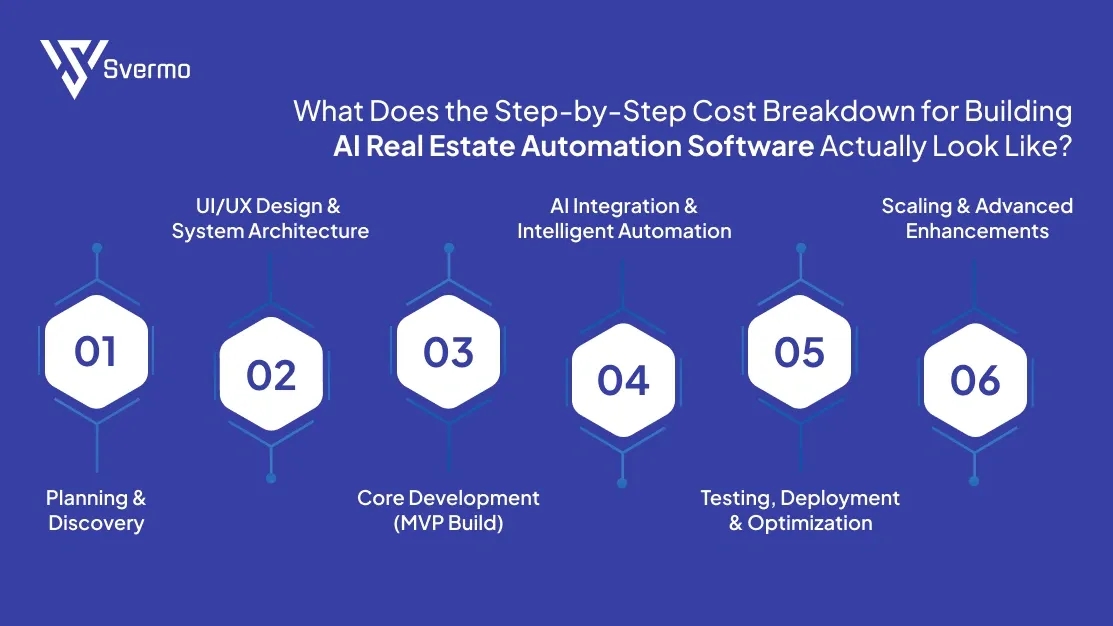
Understanding the total cost becomes easier when you break it down into stages. Each phase has a clear purpose, cost range, and impact on your final product.
If you are thinking how much does it cost to build Real Estate AI Automation software, then looking at development step by step helps you allocate budget more accurately and avoid overspending early.
1. Planning & Discovery
Every successful project starts with clarity. In this phase, you define business goals, identify automation opportunities, and map system requirements. Skipping or rushing here often leads to scope creep and higher costs later.
- Define business objectives and automation goals
- Identify target users and workflows
- Finalize feature list for MVP or full product
- Create technical roadmap and timelines
Estimated Cost: $5,000 – $15,000
2. UI/UX Design & System Architecture
Once requirements are clear, the focus shifts to how users will interact with the system and how the backend will support it. Strong design improves usability and reduces friction in daily operations.
- Create user journeys and interface layouts
- Design dashboards and workflows
- Define system architecture and scalability plan
- Build interactive prototypes for validation
Estimated Cost: $10,000 – $30,000
3. Core Development (MVP Build)
The MVP phase focuses on building essential functionality without overloading the system. The goal is to launch quickly, test real usage, and validate ROI before scaling further.
- Develop backend logic and frontend interfaces
- Implement core automation workflows
- Set up databases and APIs
- Enable basic integrations and system functionality
Estimated Cost: $20,000 – $60,000
4. AI Integration & Intelligent Automation
After the MVP, AI capabilities are introduced to enhance automation and decision-making. The level of intelligence added here directly impacts the Real Estate AI Automation system development cost.
- Integrate AI models for lead scoring and recommendations
- Implement conversational systems and assistants
- Enable predictive analytics for business insights
- Train and fine-tune models using real data
Estimated Cost: $30,000 – $80,000
5. Testing, Deployment & Optimization
Before launch, the system goes through testing to ensure stability, performance, and security. After deployment, continuous optimization improves efficiency and user experience.
- Perform functional, performance, and security testing
- Fix bugs and optimize workflows
- Deploy system on cloud infrastructure
- Monitor performance and refine based on usage
Estimated Cost: $10,000 – $30,000
6. Scaling & Advanced Enhancements
Once the system proves its value, additional features and scalability improvements are added. This phase supports long-term growth and advanced automation.
- Add advanced AI capabilities and integrations
- Improve system performance for higher user loads
- Expand automation across departments
- Introduce advanced analytics and reporting
Estimated Cost: $20,000 – $50,000+
Breaking development into stages gives you better control over the development budget of Real Estate AI Automation software while ensuring each investment delivers measurable value.
What Hidden Costs Should You Keep in Mind for Real Estate AI Automation Software Development?

If you’ve ever thought, “I want to understand hidden costs in AI development for real estate businesses,” you’re asking the right question. These costs often don’t appear in initial quotes but still impact your total Real Estate AI Automation software development cost.
Ignoring them leads to budget overruns, delays, and sometimes incomplete systems. Knowing them upfront helps you plan realistically and avoid surprises. Here’s a breakdown of the most common hidden costs involved in the cost of developing an Real Estate AI Automation software:
Hidden Cost Area | Estimated Cost Impact | What It Includes |
|---|---|---|
Data Acquisition & Licensing | $5,000 – $25,000 annually | Costs for accessing property data, third-party datasets, and paid data sources required to train and run AI models effectively. |
AI Model Retraining & Optimization | $10,000 – $40,000 annually | Continuous improvement of AI models based on new data, performance tuning, and accuracy enhancement over time. |
Cloud Usage Scaling | $8,000 – $50,000 annually | Increasing infrastructure costs as user traffic, data volume, and AI processing grow over time. |
API Usage & Rate Limits | $5,000 – $30,000 annually | Charges based on usage of external services like AI APIs, messaging services, and data providers. |
System Maintenance & Updates | $10,000 – $35,000 annually | Regular updates, bug fixes, feature improvements, and system monitoring after deployment. |
Integration Adjustments | $5,000 – $20,000 annually | Ongoing changes required when third-party tools or APIs update their systems or formats. |
Security Monitoring & Compliance Updates | $8,000 – $25,000 annually | Continuous security checks, updates for regulatory compliance, and risk management. |
User Training & Onboarding | $3,000 – $15,000 | Training internal teams to use the system effectively and reduce adoption friction. |
Hidden costs are not optional expenses. They are part of running a functional system. If you want accurate budgeting, include these costs from the beginning. It gives you a clearer picture of how much investment is required for Real Estate AI Automation platform development and helps you avoid unexpected financial pressure later.
Want to Avoid Budget Surprises Later?
Hidden costs can quietly increase your total investment. A quick discussion now can save you from that later.
How Can You Optimize the Development Budget of Real Estate AI Automation Software Without Compromising Results?
Cost control means making the right decisions at the right stage. If you are thinking, “I am evaluating whether AI automation is affordable for a small real estate agency,” the answer depends on how you approach development.
The development budget of Real Estate AI Automation software can be optimized significantly with the right strategy. Small adjustments in planning, technology choices, and execution can reduce costs without affecting performance.
1. Start with an MVP Instead of a Full-Scale Build
Building everything at once increases risk and upfront investment. Starting with a focused MVP helps you validate what actually works before scaling. An MVP typically reduces initial development cost by 30% to 50% because you only invest in essential features. It also gives you real user feedback, which prevents spending on features that do not deliver value.
2. Use Pre-Built AI APIs Instead of Training Models from Scratch
Custom AI model development requires data, training, and ongoing optimization. That adds both time and cost. Using pre-built APIs for language processing, recommendations, or automation reduces effort significantly. This approach can lower AI-related costs by 25% to 40% while still delivering strong performance. It also speeds up development timelines.
3. Adopt a Phased Development Approach
Trying to build everything in one phase often leads to budget overflow. A phased approach allows you to prioritize high-impact features first and expand gradually. This method can improve budget efficiency by 20% to 35% because resources are allocated based on actual performance and business needs rather than assumptions. It also reduces the risk of investing heavily in features that may not be required immediately.
4. Choose the Right Development Partner
The team you work with has a direct impact on cost efficiency. A structured development partner brings better planning, fewer errors, and faster execution. Working with experienced teams can reduce rework and delays, leading to 15% to 30% cost optimization over the project lifecycle.
Many businesses compare vendors by reviewing insights from sources like AI real estate assistant development cost to understand how teams approach cost, quality, and scalability.
5. Build vs Buy Decisions Carefully
Not every feature needs to be built from scratch. Some components can be integrated using existing tools, while others should be custom-built for better control. Making the right build vs buy decisions can reduce overall development cost by 20% to 40%. It also helps you avoid long-term dependency on expensive third-party services.
The key is to build what gives you a competitive advantage and integrate what does not. Optimizing cost is not about reducing investment. It is about directing your budget toward areas that deliver measurable impact. When done right, you can build a scalable system without overspending.
How Can Svermo Optimize Your Real Estate AI Automation Software Development Cost?
Most companies struggle to balance cost, quality, and scalability when planning Real Estate AI Automation software development costs. Svermo approaches this differently by aligning your business goals with a practical build strategy, so you invest only where it creates measurable impact.
Instead of pushing a full-scale build upfront, Svermo helps you define a focused roadmap. This reduces unnecessary spending and keeps your cost to make Real Estate AI Automation software within a controlled range. For most projects, this approach helps bring initial development closer to $30,000–$80,000 for a well-defined MVP, with clear scaling paths toward enterprise systems.
Svermo also optimizes AI implementation by selecting the right mix of pre-built models and custom development. This avoids overengineering and keeps the real estate automation software development cost integrating AI efficiently without compromising performance.
Integration planning is handled early to prevent rework.
Whether it involves CRM systems, communication tools, or advanced automation layers, the focus stays on building a stable and scalable foundation. This directly improves long-term cost control and reduces maintenance overhead.
If you want to build a custom Real Estate AI Automation system and evaluate pricing, then you need to know that our goal is not just to reduce cost but to ensure every dollar supports growth, efficiency, and long-term scalability.
Final Takeaways
The Real Estate AI Automation software development cost in 2026 typically ranges from $30,000 to $200,000+, but the actual investment depends on your goals, system complexity, and level of AI integration. A basic MVP can deliver quick wins, while a full-scale platform requires deeper investment in AI, infrastructure, and scalability.
What matters is not just the cost, but how you plan it. When you understand the cost of developing an Real Estate AI Automation software, factor in hidden expenses, and follow a phased approach, you avoid overspending and build a system that grows with your business.
Svermo works closely with real estate businesses to design, build, and scale AI-driven automation systems with clarity and cost control. From MVP to enterprise platforms, the focus stays on delivering measurable results while keeping your investment efficient.
If you are planning your next move in AI automation, now is the time to act. Contact us to discuss your requirements and get a clear cost estimate tailored to your business.
 https://www.linkedin.com/in/saanvi-verma-38711a36a
FAQs
Timelines depend on complexity and scope. A basic MVP can take 8 to 16 weeks, while a mid-level system may take 2 to 4 weeks. Enterprise-grade platforms with advanced AI and integrations can take 6 to 8 weeks. Faster timelines are possible when using pre-built components instead of full custom development.
Yes, many businesses start by integrating AI into their existing CRM or listing platforms. This approach reduces the initial cost to make Real Estate AI Automation software and allows gradual adoption. However, older systems may require upgrades to support advanced AI capabilities.
AI automation is widely used across residential brokerage, commercial real estate, property management, and proptech platforms. Teams dealing with high lead volume, listing updates, or tenant interactions typically see the fastest return on investment.
Not always. While large datasets improve accuracy, many systems can start with smaller datasets and improve over time. Pre-trained AI models and APIs can also reduce the need for extensive data during early stages of real estate automation platform development cost with AI integration.
It is both. Initial development covers building the system, but there are ongoing costs for maintenance, updates, infrastructure, and AI improvements. Planning long-term expenses is important when estimating how much investment is required for Real Estate AI Automation platform development.
Look for a partner with experience in both AI and real estate workflows. Evaluate their past projects, technical expertise, and ability to scale solutions. Many businesses compare vendors through various to understand capabilities before making a decision.
Yes, especially with an MVP-first approach. Smaller agencies can start with limited features and scale gradually. This makes affordable Real Estate AI Automation software solutions for startups achievable without large upfront investment.
Ready to Turn Cost Estimates into a Clear Plan?
If you have clarity but need direction, we can help you move from idea to execution without guesswork.