
AI Leasing Platform for Leasing Operations Managers: Automate the Workflow from Rental Inquiry to Scheduled Tour

Get a summary of this article with your favorite AI





AI Summary
- •An AI leasing platform handles repetitive questions across supported channels, reducing manual work for leasing teams.
- •Connect AI to property management system data to provide accurate unit information and flag outdated or conflicting records.
- •AI leasing automation streamlines bookings, confirmations, reminders, and schedule changes while tracking attendance and no-show rates.
- •Apply fair housing safeguards, review AI responses, and establish clear handoff rules for questions that need human judgment.
- •Svermo’s work as an AI product company focused on real estate workflows provides relevant context for evaluating the inquiry-to-tour process.
A renter asks about an apartment. The unit’s availability needs checking, questions need answering, and a tour time needs confirming. How much of this process still depends on your leasing team handling each step manually?
An AI leasing platform for leasing operations managers connects these tasks, from answering rental inquiries to checking unit availability and booking tours. You must know how well it handles changing availability, scheduling conflicts, and questions that need a leasing agent’s attention.
Svermo's work as an AI product platform addresses the same stages, from handling rental inquiries to matching unit availability and scheduling tours. These steps depend on accurate property information and clear handoffs when a conversation needs human attention. That connection matters when evaluating an AI leasing platform: the focus is on how the workflow operates from the renter’s first question to a confirmed tour.
Still Chasing Inquiries Instead of Booking Tours?
See where AI fits into your rental inquiry-to-tour workflow and cuts repetitive work.
How Does an AI Leasing Platform Automate the Process from Rental Inquiry to Scheduled Tour?
AI-driven property leasing workflows brings rental inquiries, property questions, unit availability checks, and tour bookings into one workflow, with leasing agents stepping in when a question needs a person’s attention.
Leasing operations managers often ask how AI handles repetitive inquiries across multiple channels without losing track of renter preferences.
A common question among leasing teams is:
“My leasing team handles rental inquiries from listing sites, our website, texts, and phone calls, and the same questions about availability, move-in dates, and pet policies get typed out dozens of times a day. I want to know how AI can handle that routine so my team spends their time with prospects who are ready to tour.”
An AI leasing platform answers routine property questions using approved information and records prospect preferences across supported channels. This reduces repetitive manual responses and leaves agents to focus on conversations that need personal attention.
Handling inquiries across listing sites, website chat, text, and phone calls
Renters contact properties through listing sites, website chat, text messages, and phone calls. An AI leasing assistant handles inquiries through the channels connected to the platform.
Before choosing a tool, check which channels it supports, whether conversations stay connected when a renter switches channels, and how leasing agents take over a conversation. Some platforms support website chat and text but require separate integrations for phone calls or listing sites.
Communication is a distinct part of the inquiry workflow because spoken questions need to be understood, recorded, and routed correctly. Svermo’s Voice AI agent for Property Management is one example of its work in this area, with product features described for leasing call handling and tour scheduling. For leasing operations managers, the relevant evaluation is whether voice interactions preserve the renter’s details and connect reliably with the team’s existing systems.
Collecting prospect preferences without repetitive back-and-forth
The assistant gathers details such as the renter’s preferred floor plan, move-in date, parking needs, and preferred tour time. It uses information already shared in the conversation instead of asking the same questions again.
For example, if a renter asks about a two-bedroom apartment and wants to tour on Saturday, the assistant records those preferences and checks available units and tour times.
Answering common property questions with approved information
An AI leasing assistant answers common questions about rent, floor plans, amenities, parking, pet policies, and tour procedures using approved property information.
Unit availability needs current data from a connected property management system. If details are missing or conflict with other records, the assistant flags the issue or passes the question to a leasing agent rather than guessing.
Keeping conversation history connected across supported channels
When a renter switches from website chat to a phone call, the earlier conversation needs to remain available to the leasing team. Supported integrations connect conversation history, property preferences, and outstanding questions so agents have the context they need.
Check whether the platform links conversations to the same prospect, keeps previous answers available, and shows agents what still needs attention. Also confirm which channels share conversation history, since coverage varies by platform and integration.
Maintaining context across property-related conversations is also relevant beyond leasing inquiries. Svermo’s Tenant AI a tenant management platform describes centralized interaction history, multi-channel communication, and request routing for resident operations. Although resident support differs from prospect communication, both workflows depend on preserving context and directing requests to the right team.
How Does AI Verify Unit Availability Using Property Management System Data?
An AI leasing assistant connected to unit availability in your property management system retrieves unit details from an integrated PMS before sharing availability with prospects. Accuracy depends on which records the integration accesses and how often the data updates.
A common concern among leasing operations managers:
“A prospect toured a unit last week that had already been leased, because the availability our team quoted was out of date. It cost us credibility with that prospect, and I want to know whether AI can answer availability questions from current property management system data.”
An AI leasing assistant retrieves availability from a connected property management system, depending on the integration. Update frequency matters because a delayed sync can leave the assistant working with outdated unit status.
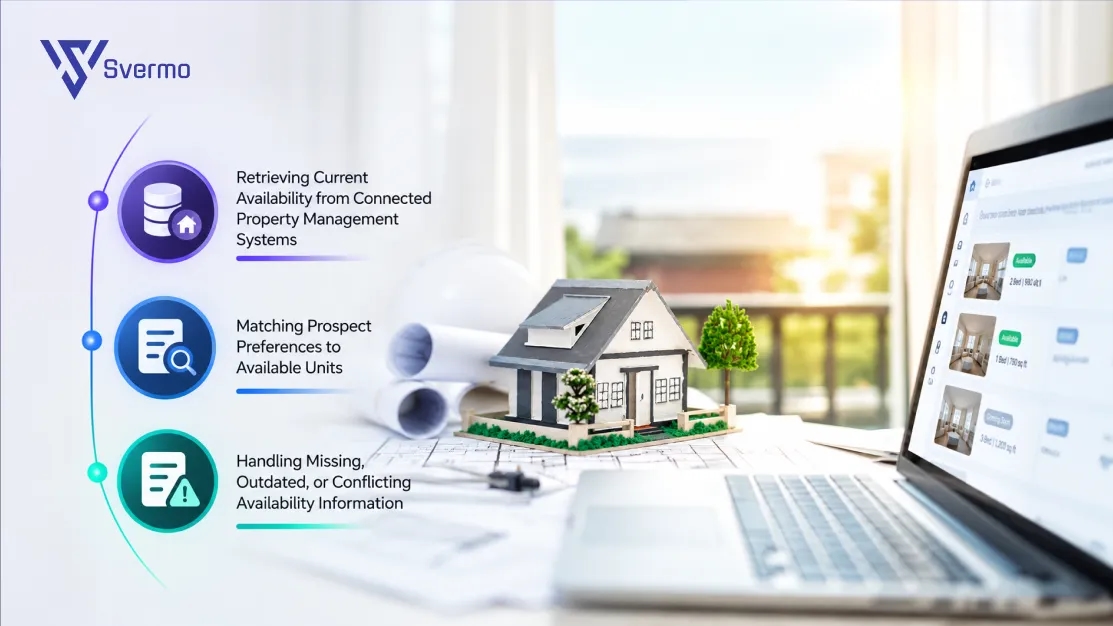
Retrieving Current Availability from Connected Property Management Systems
An AI leasing system retrieves unit details such as availability status, floor plan, rent, and expected availability date, depending on the integration. Some systems sync data on a schedule, while others update more frequently. A delay leaves the assistant working with older records.
Example: Apartment 204 is placed on hold after the morning sync. Until the next update, the system still shows it as available.
Matching Prospect Preferences to Available Units
Smart property automation compares available units with a prospect’s stated budget, preferred floor plan, move-in date, and requested features.
Example: A prospect wants a two-bedroom apartment within their stated budget, with parking, available in November. The assistant identifies matching units and flags any unverified details before recommending an option.
Handling Missing, Outdated, or Conflicting Availability Information
An AI platform for apartment leasing teams needs a defined process for incomplete or conflicting unit records. It flags discrepancies and routes them for verification rather than confirming unverified availability.
Example: The PMS lists Apartment 312 as available, but another connected record marks it as held. The assistant refers the discrepancy to a leasing agent before confirming the unit’s status.
How Does AI Book Tours and Help Reduce No-Shows?
An AI leasing platform automates tour booking by checking calendar availability, confirming appointments, and handling schedule changes. Attendance records also give leasing operations managers a way to measure tour completion and missed appointments.
One question that leasing managers comes up with is:
“Booking one tour takes several messages back and forth, and a good share of the prospects who do book never show up. Is there a way to automate scheduling and reminders so my team stops chasing confirmations?”
AI tour scheduling checks connected calendar availability, books appointments, and sends confirmations and reminders through supported channels. It also handles cancellations and rescheduling when those functions are integrated.
Checking Calendar Availability and Booking Tours Automatically
For apartment communities, AI tour scheduling connects a prospect’s preferred time with the leasing team’s available appointments. After the prospect selects a slot, the system books the tour and updates the connected calendar.
When evaluating this feature, check whether the platform:
- Updates calendars as soon as a tour is booked.
- Prevents double bookings and accounts for tour duration.
- Follows scheduling rules for different properties and tour types.
Sending Confirmations and Reminders and Managing Cancellations or Rescheduling
This stage of AI leasing workflow automation covers what happens after a booking: sending appointment details, issuing reminders, and updating records when a prospect reschedules or cancels.
Check whether the platform:
- Sends accurate appointment details through supported communication channels.
- Processes rescheduling and cancellation requests without creating conflicting bookings.
- Updates calendars and notifies leasing agents when appointments change.
Measuring Tour Attendance and No-Show Rates
To evaluate whether AI reduces tour no-shows for apartment leasing, managers need consistent records of scheduled tours, completed visits, cancellations, and missed appointments. Comparing these figures over time shows whether attendance patterns change after automation is introduced.
Track these metrics:
- Tour attendance rate: Completed tours divided by scheduled tours, using a consistent counting rule.
- No-show rate: Missed tours divided by scheduled tours, with cancellations and reschedules classified consistently.
- Cancellation and rescheduling rates: The share of bookings changed before the appointment.
- Attendance by property and time slot: Patterns that highlight recurring scheduling or communication issues.
How Does AI Stay Within Fair Housing Rules When Communicating With Prospects?
In the U.S., the Fair Housing Act prohibits housing discrimination based on race, color, national origin, religion, sex, familial status, and disability. For leasing teams, this means an AI assistant needs to answer property questions accurately, avoid assumptions about renters, and know when to pass a question to a leasing agent.
Keeping Answers Consistent With Approved Property Information
The assistant uses verified property details to answer questions about amenities, pet policies, occupancy rules, and accessibility. It does not guess or make assumptions about who belongs in a community.
For example, when someone asks whether a property accommodates families with children, the assistant shares the relevant property information without suggesting that the community suits certain household types better than others.
Handling Sensitive Questions and Escalating When Needed
Questions about disability-related accommodations need more than a standard policy response. The assistant provides factual information and passes individual requests to the leasing team.
For example, a request involving an assistance animal goes to a leasing agent for review rather than receiving an automatic rejection under the standard pet policy. The agent receives the conversation history and reviews the request under applicable requirements.
Reviewing Conversations for Potentially Discriminatory Responses
Leasing managers need to review actual AI responses, not just rely on a vendor’s compliance claims.
- Test similar questions: Check whether the assistant gives consistent answers to different prospects asking about the same property.
- Review sensitive scenarios: Test questions about families with children, accessibility, and assistance animals.
- Correct mistakes: Update inaccurate property information or response rules, then test the same scenario again.
- Keep review records: Document flagged responses, corrections, and recurring issues.
During a vendor demo, ask to see these scenarios in action. The responses and escalation process reveal more than a general claim of fair housing compliance.
How Does a Conversation Move from AI to a Leasing Agent?
An AI leasing assistant needs a clear handoff rule: when a question falls outside its verified information or a prospect requests an agent, it transfers the conversation with the unresolved issue identified. The goal is to give the agent a specific next step, not another conversation to investigate from scratch.
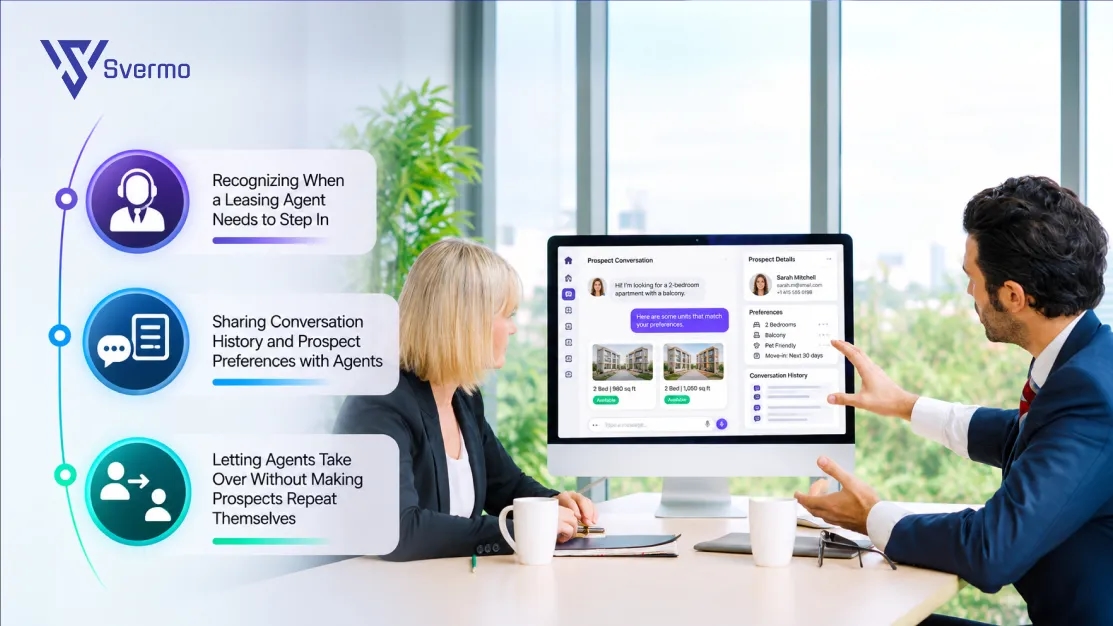
Recognizing When a Leasing Agent Needs to Step In
The handoff depends on what the assistant cannot resolve, not simply on how long the conversation lasts.
- Conflicting unit records: The property management system shows a unit as available, but another record marks it as held. The assistant pauses the availability claim and flags the conflict for the agent.
- A request outside standard policy: The prospect asks for an exception to a pet policy or a different tour arrangement. The assistant refers the request instead of promising an exception.
- A direct request for staff: The prospect asks to speak with a leasing agent. The system routes the conversation without forcing the prospect through more automated questions.
These rules need to be configured and tested for each property’s workflow.
Sharing Conversation History and Prospect Preferences with Agents
A transcript alone does not tell an agent what needs attention. AI rental inquiry management for apartment leasing teams needs to surface the details relevant to the next action:
- Unit of interest: The property, floor plan, or unit discussed.
- Prospect requirements: Stated budget, preferred move-in date, and requested features.
- What has already been answered: Property details shared by the assistant, so the agent does not contradict earlier information.
- What remains unresolved: The exact question, conflicting record, or request that triggered the handoff.
- Booking status: Any tour already scheduled, including its date and time.
For example, if a prospect asks whether a two-bedroom unit with parking is available in November and the records disagree, the agent sees both the preference and the availability conflict. They do not need to reconstruct the issue from the full chat.
Letting Agents Take Over Without Making Prospects Repeat Themselves
The key test for AI leasing workflow automation is what happens after the agent accepts the conversation. The system needs to identify who owns the reply, prevent the AI and agent from answering at the same time, and preserve the existing conversation.
During a demo, test this sequence:
- Ask the assistant about a unit with conflicting availability records.
- Confirm that the conversation is routed to an agent with the conflict clearly identified.
- Have the agent take over and send a reply.
- Check that the AI stops responding independently and the prospect’s earlier details remain visible.
If the agent receives only a notification or an unfiltered transcript, the handoff still leaves work for the leasing team.
How Do You Measure the ROI of Automation in Leasing?
To measure the ROI of automation in leasing, track inquiry response time, inquiry-to-lease conversion, tour attendance, and staff time saved. Compare results before and after introducing an AI leasing platform, using the same measurement rules for both periods.
Tracking Inquiry Response Time Across Channels
Rental inquiry response automation reduces manual handling of incoming questions. Track average response time separately for website chat, text, email, and phone to see where response delays change.
Calculation: Average response time = Total time to first response ÷ Number of inquiries answered.
Measuring Inquiry-to-Tour Conversion
AI leasing workflow automation aims to move more rental inquiries toward a scheduled tour without adding manual work at each step. Track how many unique inquiries result in a booked tour.
| Metric | Calculation |
|---|---|
Inquiry-to-tour conversion rate | Inquiries resulting in a booked tour ÷ Total eligible inquiries × 100 |
Change in conversion rate | Pilot rate − Baseline rate, in percentage points |
For example, if conversion rises from 20% to 25%, that is an increase of 5 percentage points, not 5%.
Comparing Tour Attendance and No-Show Rates
To assess AI tour scheduling for apartment leasing, compare attendance and missed appointments before and after automation. Use the same rules for cancellations and rescheduled tours in both periods.
| Metric | Calculation |
|---|---|
Tour attendance rate | Completed tours ÷ Scheduled tours × 100 |
Tour no-show rate | Missed tours ÷ Scheduled tours × 100 |
Measuring Staff Time Saved and Conversation Quality
An AI leasing assistant takes on routine inquiry handling and tour coordination. Measure the staff time spent on these tasks before and after implementation, then review conversation samples for inaccurate answers, unresolved questions, and handoff errors.
Calculation: Staff time saved = Baseline staff time − Staff time after automation.
Track conversation quality alongside time saved so faster handling does not hide errors or poor responses.
Comparing Pilot Results Against a Reliable Baseline
Compare pilot results with a pre-launch baseline using the same properties, channels, reporting period, and metric definitions. Account for changes in inquiry volume and staffing before attributing improvements to the platform.
Calculation: Percentage change = (Pilot result − Baseline result) ÷ Baseline result × 100.
For response time and no-show rate, a decrease is generally an improvement. For conversion and attendance rates, an increase is generally an improvement. These measures show operational changes; a full financial ROI calculation also requires the costs of the platform and its implementation.
How Should Leasing Operations Managers Choose an AI Leasing Platform?
Choosing an AI for property management comes down to how well it fits your properties, existing systems, and team's daily work. Focus on how it handles real leasing situations, not how many features appear on its sales page.
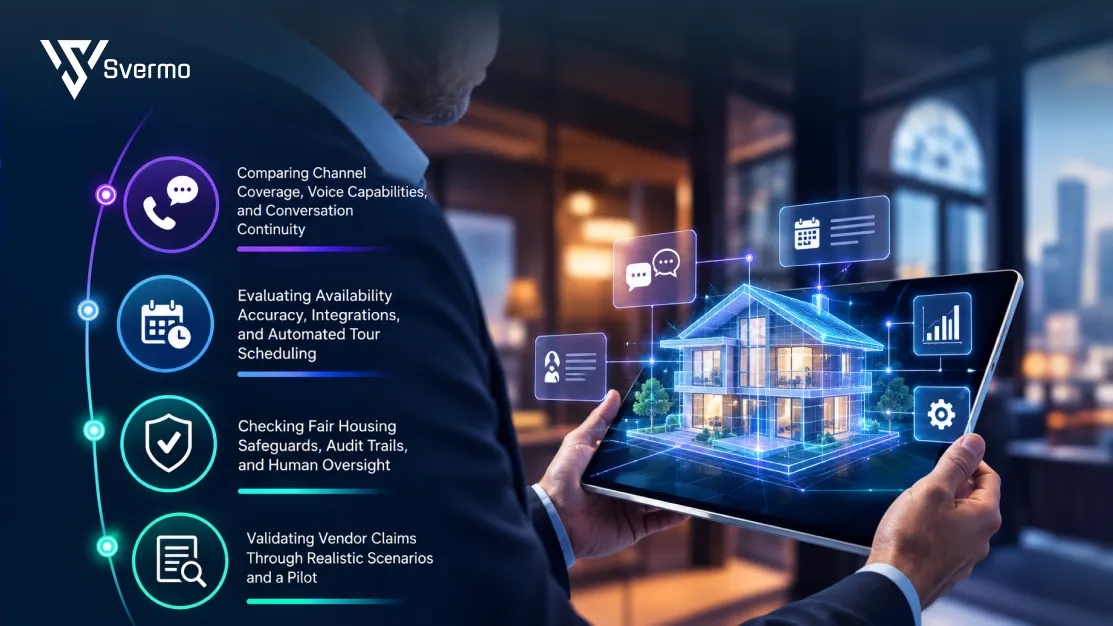
Comparing Channel Coverage, Voice Capabilities, and Conversation Continuity
Start with the channels your prospects use most. Check whether the platform keeps the conversation connected when someone switches from website chat to text or phone.
Look for three things:
- Channel coverage: Does it support the channels your leasing team actually uses?
- Voice accuracy: Does it capture the right property, floor plan, and tour preferences during calls?
- Conversation continuity: When an agent takes over, can they see what the prospect asked and what the assistant already answered?
For example, start an inquiry in website chat and follow up by text. If the prospect has to repeat the property and unit details, the conversation isn't truly connected.
Evaluating Availability Accuracy, Integrations, and Automated Tour Scheduling
Don't stop at checking whether the vendor supports your property management system. Find out what information the integration reads, how often it updates, and whether bookings sync with your calendar.
Before choosing, verify that the platform:
- Retrieves current unit availability and flags conflicting records.
- Records tour bookings in the correct calendar with the right date and time.
- Updates appointments correctly when prospects reschedule or cancel.
- Identifies integration gaps that still require staff intervention.
A useful test is to change a unit's status from available to held, ask the assistant about it, and then book and reschedule a tour.
Checking Fair Housing Safeguards, Audit Trails, and Human Oversight
Ask the vendor to demonstrate how the assistant handles questions about accessibility, families with children, and assistance animals. Don't rely on a general claim of fair housing compliance.
Check whether your team can:
- Review the exact conversation behind a questionable response.
- Identify the property information used to answer the question.
- Route individual accommodation requests to a leasing agent.
- Correct inaccurate information or response rules and test the answer again.
These checks reveal how the platform handles sensitive questions and gives your team a way to review problems.
Validating Vendor Claims Through Realistic Scenarios and a Pilot
A demo shows what a platform does under prepared conditions. A pilot shows how it performs in your leasing workflow.
Test scenarios such as:
- A unit's availability changes during an inquiry.
- A prospect asks a question the assistant cannot verify.
- A booked tour needs to be rescheduled.
- A prospect requests an agent and expects the conversation to continue without repeating details.
Track incorrect answers, booking errors, incomplete handoffs, and staff corrections. Compare those results with your existing process over the same period, alongside response time and inquiry-to-lease conversion.
For a solution such as Svermo’s leasing AI platform, apply the same criteria: assess the documented capabilities against your property setup and verify the key workflows before expanding use. The goal is to choose a system based on observed performance, not feature claims.
Final Words!
A rental inquiry rarely follows a neat script. Availability changes, a tour slot disappears, or a simple question turns into a request that needs a human answer. AI for real estate delivers practical value when it addresses specific operational needs rather than simply automating tasks. In leasing, that means handling changes accurately, preserving conversation context, and knowing when to hand control to the leasing team.
Svermo is an AI product company focused on real estate workflows, including the inquiry-to-tour process. The meaningful evaluation goes beyond automated replies: test how its product handles conflicting unit records, calendar changes, and agent handoffs using your actual operating rules. Does the workflow hold up when things get messy? Talk to our experts to discuss your requirements and the scenarios worth testing before you decide.
Ready to Give Your Leasing Team Its Time Back?
Talk through your workflow, bottlenecks, and where AI automation makes sense.
 https://www.linkedin.com/in/saanvi-verma-38711a36a
FAQs
A multilingual AI leasing workflow handles inquiries in supported languages, subject to its configuration. Before adopting one, test how it explains property-specific terms, amenities, and rental policies in each language your community serves.
Data ownership and usage rights depend on the vendor agreement and platform policies. Review who owns conversation records, who can access them, how long they are retained, and whether renter data is used to train AI models.
Ask vendors how their platform behaves during service interruptions. Look for documented outage notifications, recovery procedures, and a fallback process that directs incoming inquiries to your existing leasing channels instead of leaving renters without a response.
An AI leasing platform needs to maintain response quality when inquiry volumes rise. Ask vendors for documented capacity limits, service availability commitments, and performance results under heavy traffic rather than relying on demonstrations conducted under normal conditions.
A new property requires a defined onboarding process for its floor plans, amenities, policies, office hours, and approved property descriptions. Ask how information is imported, checked for accuracy, and approved before the assistant begins answering renter questions.
Some platforms support self-guided tour workflows through integrations with access-control or tour-management systems. Confirm whether the specific product supports identity verification, access instructions, tour time restrictions, and secure entry procedures. These capabilities are not standard across all platforms.
Leasing employees need practical training on reviewing AI-generated answers, correcting property information, handling unusual requests, and recognizing when human judgment is required. Assign clear responsibility for these tasks and document the procedures employees follow when the AI produces an incorrect or incomplete answer.