
10 Use Cases of AI Software for Real Estate: Real-World Applications Transforming Property Operations


Get a summary of this article with your favorite AI





AI Summary
- •AI software for real estate helps automate lead management, customer communication, property operations, and daily workflows.
- •Real-world AI use cases in real estate include document processing, lease automation, valuation, investment analysis, and property management.
- •Choosing the right AI platform requires evaluating workflow fit, integration, data security, scalability, and expected ROI.
- •Successful AI adoption depends on proper implementation, team alignment, and selecting solutions built for real estate operations.
- •Svermo helps businesses implement AI-powered property operations through practical AI solutions designed for brokers, agencies, and property teams.
Are your real estate teams spending more time managing repetitive tasks, chasing updates, and fixing workflow gaps than focusing on growth and customer experience?
AI-powered property operations platforms help brokers, agencies, and property management companies reduce this operational burden by automating critical workflows across lead management, leasing, maintenance, documentation, communication, and reporting.
The use cases of AI software for real estate are expanding because companies are moving beyond basic automation tools and looking for solutions that can handle complex operational challenges.
According to a report, 92% of commercial real estate teams have started piloting AI or plan to start this year, showing how quickly AI adoption is accelerating across the industry.
However, adoption is not without challenges. A study found that only 14% of commercial real estate organizations believe they have well-structured data collection, management processes, and privacy policies needed for AI adoption. This shows that businesses need practical AI solutions that fit into existing operations rather than adding another disconnected system.
At the same time, investment activity continues to create demand for better operational efficiency. Nearly 75% of global respondents plan to increase their investment levels in real estate assets over the next 12 to 18 months, making scalable technology adoption a priority for many organizations.
So, where should real estate companies begin with AI adoption?
Which workflows should be automated first to create measurable business impact?
How can brokers, property managers, and operations teams choose AI software without investing in disconnected tools?
And what type of AI platform can support multiple business functions as the company grows?
This is where product-led AI companies like Svermo fit into the market. Instead of building custom AI solutions for individual clients, Svermo offers ready-to-use AI real estate software designed to help businesses automate workflows, improve operational efficiency, and address specific business challenges through specialized AI products.
As more real estate companies begin experimenting with AI, the challenge is identifying where these technologies can create the most meaningful operational impact. But what is driving the growing need for AI software in real estate operations, and why are businesses prioritizing these solutions in 2026?
Ready to Find Where AI Fits Into Your Real Estate Operations?
See which workflows your team can automate first and where AI can create the biggest operational impact.
Why AI Software Has Become Essential for Modern Real Estate Operations in 2026?
Real estate companies are managing more data, more customer interactions, and more operational tasks than ever before. Manual workflows across leasing, maintenance, documentation, accounting, and reporting can slow down teams and increase operational costs.
Businesses are adopting AI software for real estate to handle these time-consuming processes with greater speed and consistency. AI-powered platforms help teams:
- Automate repetitive administrative tasks across property operations
- Reduce manual data entry and document processing work
- Improve response times for tenants, buyers, and prospects
- Identify operational issues through real-time data analysis
- Support faster decisions with accurate business insights
The shift is also changing how companies evaluate technology. Instead of adding separate tools for every department, many teams are looking for integrated solutions that connect workflows across the organization.
For example, an AI-powered property operations platform can help manage tenant requests, property documents, communication workflows, and operational reporting from a centralized system.
However, successful AI adoption depends on choosing solutions that fit existing business processes. Companies need platforms that are scalable, easy to integrate, and designed around real estate workflows.
For organizations handling large volumes of contracts, leases, and property records, AI document management software can help extract information, organize files, and reduce time spent searching through documents.
With the foundation for AI adoption becoming clearer, which real estate workflows offer the biggest opportunities for automation and efficiency gains?
What Are the Most Practical Use Cases of AI Software for Real Estate in 2026?
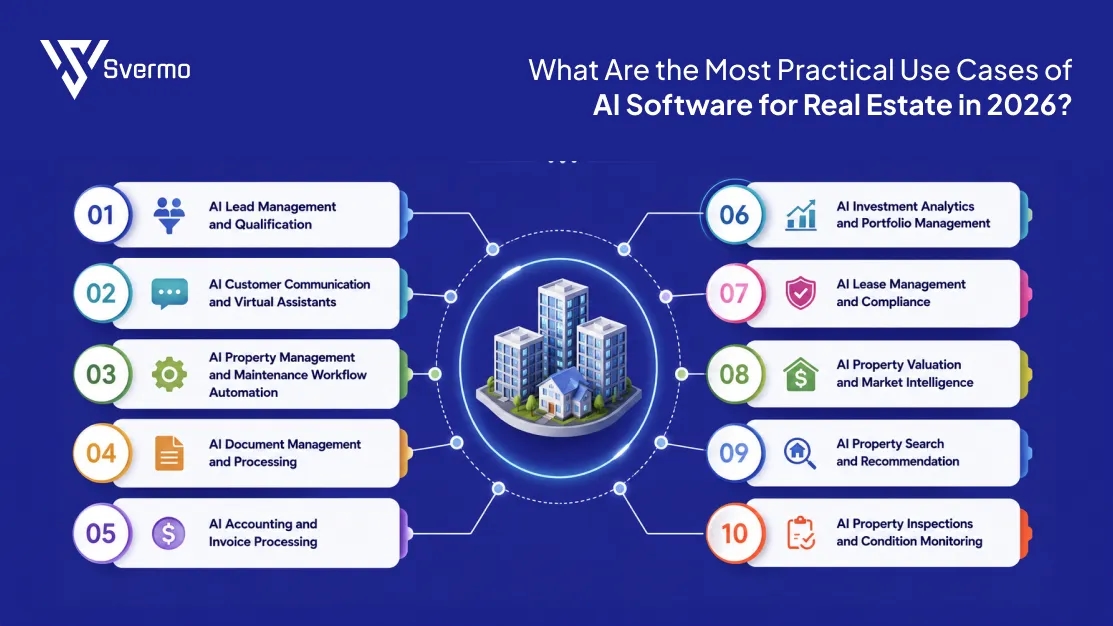
Real estate companies are adopting AI across sales, leasing, property operations, finance, and portfolio management. The highest-value applications are focused on reducing repetitive work, improving workflow accuracy, and helping teams make faster decisions.
From brokerages managing thousands of leads to property companies handling multiple buildings, AI software use cases in real estate business are becoming more practical and outcome-driven. The following use cases highlight where businesses are applying AI to solve everyday operational challenges.
1. AI Lead Management and Qualification
Real estate businesses receive leads from multiple channels, but not every inquiry is ready to convert. Manually reviewing and assigning every prospect slows down response times and increases the chances of missing high-value opportunities.
This is one of the most practical AI software use cases for real estate, helping businesses qualify, prioritize, and route leads automatically based on buyer intent and engagement.
Example:
A brokerage receives daily inquiries from its website, listing portals, and social media campaigns. An AI lead management system for real estate analyzes each lead's property preferences, budget, browsing behavior, and previous interactions. It identifies high-intent buyers, assigns them to the right agent, and automates follow-ups, while lower-intent leads continue through personalized nurturing until they're ready to engage.
Business Outcomes:
- Faster lead response and qualification
- Reduced manual CRM updates
- Improved sales team productivity
- Better visibility into lead performance
2. AI Customer Communication and Virtual Assistants
Real estate businesses handle constant communication with buyers, sellers, tenants, owners, and vendors. Delayed responses, missed inquiries, and inconsistent communication can negatively impact customer experience.
AI-powered communication software helps manage routine conversations through chat, voice, and automated messaging. These systems can answer common questions, schedule appointments, provide property information, and escalate complex requests to human teams when needed.
Using solutions such as an AI chatbot & voice assistant, real estate companies can provide faster responses while maintaining consistent communication across multiple channels.
Example:
A property management company receives hundreds of tenant questions every week about rent payments, maintenance requests, lease renewals, and community policies. An AI chatbot & virtual assistant instantly understands each request, provides accurate answers using property data, books maintenance appointments when needed, and transfers complex cases to the right staff member with the complete conversation history.
Business Outcomes:
- Faster customer response times
- Improved tenant and client experience
- Reduced workload for support teams
- Consistent communication across channels
3. AI Property Management and Maintenance Workflow Automation
Managing maintenance requests, tenant concerns, inspections, and vendor coordination requires continuous tracking. For property managers handling multiple properties, manual processes can lead to delayed repairs, missed updates, and inefficient resource allocation.
AI-powered real estate software for property management helps automate maintenance workflows by categorizing requests, prioritizing urgent issues, coordinating communication, and tracking resolution progress. It creates a smoother process from the initial complaint to final completion.
Example:
A property management company receives a tenant complaint about a water leak through its portal. An AI smart building management system identifies it as a high-priority issue, automatically creates a work order, assigns the nearest qualified vendor, notifies the tenant about the expected arrival time, and tracks the repair until completion.
Business Outcomes:
- Faster maintenance resolution
- Better vendor coordination
- Reduced administrative workload
- Improved property operations visibility
4. AI Document Management and Processing
Real estate businesses process thousands of leases, contracts, invoices, inspection reports, and compliance documents every year. Reviewing these files manually takes time and increases the risk of missed information.
One of the most widely adopted AI software use cases for real estate is automating document-intensive workflows to improve accuracy and reduce administrative effort.
Example:
A commercial real estate firm receives a new lease agreement for review. AI document management software automatically extracts tenant details, lease terms, renewal dates, payment schedules, and compliance clauses, then updates the relevant records without manual data entry.
Business Outcomes:
- Quick document search and retrieval
- Reduced manual data entry
- Improved document accuracy
- Better compliance tracking
5. AI Accounting and Invoice Processing
Managing invoices across multiple properties and vendors can quickly become time-consuming. Manual approvals, invoice matching, and data entry often lead to delays, duplicate payments, and accounting errors. An intelligent property management platform helps automate these financial workflows while improving accuracy.
Example:
A property management company receives hundreds of vendor invoices each month. HOA invoice processing AI agent extracts invoice details, matches them with work orders, flags pricing mismatches, and routes verified invoices to the right manager for approval. Once approved, the accounting records are updated automatically without manual data entry.
Business Outcomes:
- Speedy invoice approvals
- Reduced payment errors
- Lower administrative workload
- Improved financial accuracy
6. AI Investment Analytics and Portfolio Management
Managing a growing property portfolio requires more than reviewing spreadsheets and market reports. Investors and portfolio managers need faster insights to evaluate property performance, identify risks, and make confident investment decisions.
AI applications in commercial real estate management help transform large volumes of property and financial data into actionable recommendations.
Example:
A real estate investment firm evaluates three multifamily properties before making an acquisition. AI investment analytics software analyzes occupancy trends, rental income, operating expenses, neighborhood demand, and historical performance to compare the assets.
It highlights the property with the strongest long-term return while flagging potential investment risks.
Business Outcomes:
- Better investment decisions
- Improved portfolio visibility
- Early identification of investment risks
- More reliable financial planning
7. AI Lease Management and Compliance
Lease data often sits across multiple files, systems, and departments, making it difficult for teams to track important dates, clauses, and financial obligations. For commercial real estate operators, even a missed renewal notice or overlooked escalation term can impact revenue and tenant relationships.
Example:
A commercial real estate company managing hundreds of leases uses AI leaseFlow Automation to extract key lease details, identify upcoming renewals, track escalation clauses, and alert managers when action is required. Instead of reviewing every agreement manually, the team focuses on exceptions and important decisions.
Business Outcomes:
- Stronger lease compliance management
- Reduced risk of missed obligations
- Improved visibility into lease performance
- Less time spent reviewing agreements
8. AI Property Valuation and Market Intelligence
Accurately pricing properties requires analyzing market conditions, comparable properties, demand patterns, and financial data. Traditional valuation methods often depend on manual research and outdated reports, making it harder to react to changing market conditions.
Example:
A real estate investment firm evaluates a commercial property before acquisition. Real estate property valuation intelligence analyzes comparable sales, rental trends, location factors, and historical market data to estimate property value and highlight factors affecting future performance.
Business Outcomes:
- More accurate property valuations
- Improved investment analysis
- Better pricing decisions
- Reduced dependence on manual market research
9. AI Property Search and Recommendation
Finding the right property can be time-consuming when buyers and investors have specific requirements around location, budget, amenities, and investment goals. Real estate teams need smarter ways to match people with suitable properties.
Example:
A buyer searching for investment properties shares preferences for location, budget, expected rental income, and property type. A real estate AI property search engine analyzes available listings, filters relevant options, and recommends properties that align with the buyer’s criteria instead of requiring manual searches across multiple platforms.
Business Outcomes:
- More personalized property recommendations
- Improved buyer experience
- Reduced search time for agents and customers
- Higher-quality property matches
10. AI Property Inspections and Condition Monitoring
Property inspections require significant coordination, documentation, and manual reporting. For companies managing large portfolios, identifying maintenance issues early can prevent expensive repairs and operational disruptions.
Example:
A multifamily property manager schedules routine inspections across multiple buildings. AI property inspections software analyzes inspection images, identifies visible issues, organizes reports, and highlights properties requiring immediate attention.
Business Outcomes:
- Improved maintenance planning
- Better property condition tracking
- Reduced inspection workload
- Earlier identification of operational risks
AI is becoming a practical part of daily real estate operations, helping teams reduce manual work, improve workflows, and make better decisions. The key is identifying the processes where AI can create the most impact for your business.
But with so many AI solutions available, how can real estate companies choose the right AI software for their specific needs and goals?
Which Real Estate Workflow Is Stealing Your Team’s Time?
Turn repetitive tasks into automated workflows with AI built for real estate operations.
How Can Real Estate Companies Choose the Right AI Software for Their Needs?
Selecting AI software for real estate requires more than comparing features. Companies need solutions that fit their workflows, connect with existing systems, protect sensitive data, and deliver measurable business value.
Before investing, decision-makers should evaluate how the platform aligns with their operational goals and whether it can support future growth.
1. Identify High-Impact Workflows Before Choosing AI Software
Start by identifying repetitive processes that consume the most time across your business. These may include lead qualification, tenant communication, document processing, invoice management, property inspections, or reporting.
Prioritizing these workflows helps teams focus their AI investment on areas where automation can create meaningful improvements.
2. Evaluate Integration with Your Existing Real Estate Systems
AI software should work alongside the tools your teams already use, including CRMs, property management systems, accounting platforms, and communication channels.
A connected platform reduces manual data movement and supports smoother real estate workflow automation across departments.
3. Understand How the Platform Handles Real Estate Data
Real estate companies manage sensitive information, including lease agreements, tenant records, financial documents, and property data.
Before adoption, review how the AI platform manages data security, access controls, and information processing to ensure it meets your business requirements.
4. Measure Expected Business Impact Before Adoption
A successful AI investment should have clear outcomes. Define what you want to improve, such as reducing administrative workload, improving lead response, increasing operational visibility, or supporting better investment decisions.
Tracking these goals helps your team evaluate whether the platform is delivering real business value.
5. Choose Scalable AI Platforms Instead of Isolated Tools
Many businesses start with a single AI use case but eventually need automation across multiple departments. A scalable platform allows companies to expand AI capabilities without adding disconnected tools.
Solutions built around AI-powered property operations can support multiple workflows, from customer communication and document processing to property management and analytics.
6. Prioritize Real Estate-Specific AI Capabilities
Generic AI tools may handle basic tasks, but real estate operations require industry-specific workflows and data understanding.
Platforms designed for real estate can better support functions such as leasing, maintenance coordination, portfolio analysis, property search, and tenant services.
Choosing the right AI software starts with matching technology capabilities to your operational priorities. The goal is to adopt a platform that improves existing processes while creating room for future automation.
But after selecting the right AI solution, what steps should real estate companies follow to successfully implement it across their teams and workflows?
How Can Real Estate Companies Successfully Implement AI Software Across Their Operations?
Adopting AI software requires more than selecting a platform and switching it on. Real estate companies need a structured approach that considers business goals, existing workflows, employee adoption, and long-term scalability.
A phased implementation helps teams introduce AI software for real estate workflow automation where it can solve real operational challenges while creating a smoother transition for employees and customers.
1. Identify the Right Workflows for AI Automation
Before investing in AI, evaluate which processes create the biggest operational bottlenecks. Focus on tasks that are repetitive, involve large amounts of data, or require constant coordination between teams.
Starting with high-impact workflows helps companies understand where AI-driven real estate automation can create measurable improvements before expanding adoption.
Key areas to evaluate include:
- Reviewing processes that require frequent manual updates, approvals, or follow-ups
- Prioritizing workflows across leasing, property management, sales, and finance
- Identifying tasks where a smart real estate operations platform can reduce unnecessary manual effort
2. Select an AI Platform That Fits Your Business Needs
Real estate companies need AI solutions that align with their portfolio size, operational goals, and existing technology environment. A platform should support current needs while allowing businesses to add new capabilities over time.
A scalable AI-powered property operations platform can help connect different workflows, including customer communication, document processing, property management, and reporting.
Important factors to consider include:
- Checking compatibility with existing CRM, accounting, and property management systems
- Evaluating whether the platform supports multiple AI software use cases in real estate business
- Reviewing scalability, security controls, and ease of adoption
3. Prepare Your Data and Internal Processes
AI performance depends heavily on the quality and accessibility of business data. Real estate companies should organize their property records, customer information, contracts, and operational documents before implementation.
A strong data foundation helps intelligent AI software for real estate operations and portfolio management generate more accurate insights and support better decisions.
Preparation steps often include:
- Organizing property records, tenant information, and business documents
- Removing outdated or duplicate data from existing systems
- Defining permissions for sensitive financial and customer information
4. Start With a Controlled AI Rollout
Introducing AI across every department at once can create adoption challenges. A focused rollout allows teams to test workflows, measure outcomes, and adjust processes before expanding the technology.
Many companies begin with specific areas such as lead management, leasing, customer support, or property operations before scaling further.
A practical rollout usually involves:
- Testing AI solutions within a specific department or workflow
- Collecting feedback from employees and operations teams
- Measuring improvements in productivity, accuracy, and workflow efficiency
5. Train Teams and Monitor AI Performance
Technology adoption depends on how effectively teams use the platform in daily operations. Employees should understand how AI supports their responsibilities and where human judgment remains necessary.
Continuous monitoring ensures the best AI software for real estate companies continues delivering value as business requirements change.
Ongoing improvement includes:
- Tracking operational improvements and workflow performance
- Refining AI workflows based on employee feedback
- Expanding automation into additional business functions
Implementing AI successfully requires the right combination of technology, processes, and team adoption. Real estate companies that approach implementation strategically can build scalable AI-powered property operations while improving efficiency across their business.
But even with the right platform and implementation strategy, what challenges can real estate companies face during AI adoption, and how can they overcome them?
What Challenges Can Real Estate Companies Face When Adopting AI Software?
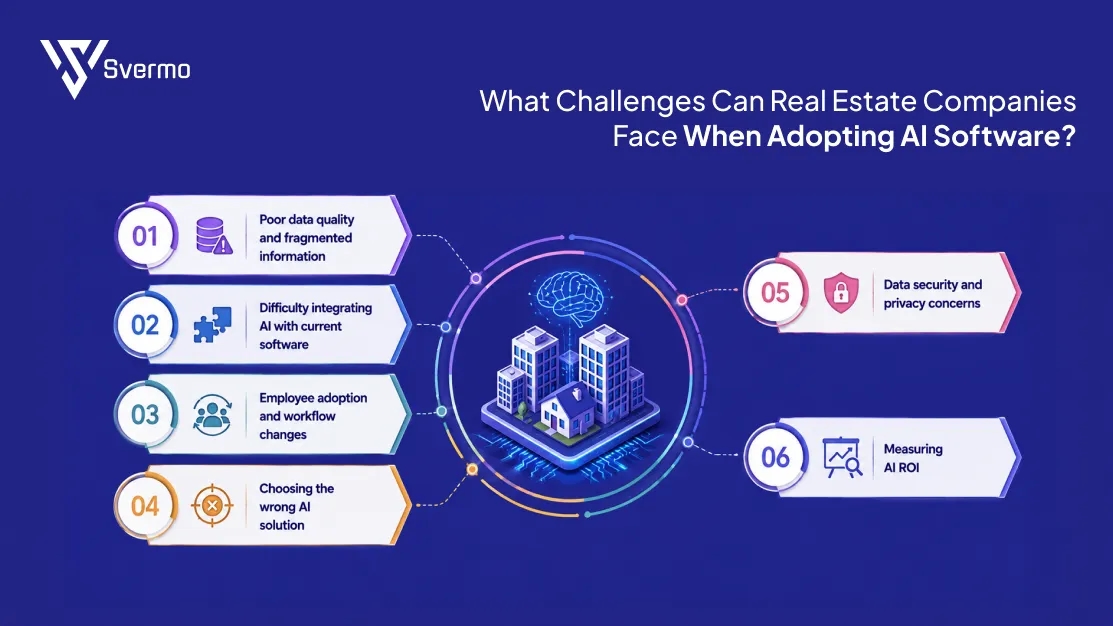
Adopting AI software can create major improvements in real estate operations, but companies may face challenges during planning, implementation, and scaling. Understanding these barriers helps decision-makers prepare better strategies and avoid costly mistakes.
| Challenge | Why It Happens | Solutions |
|---|---|---|
Poor data quality and fragmented information | Property data, tenant records, contracts, and financial information are often stored across different systems. This can limit AI accuracy and make automation harder to implement. | Companies should organize their data sources and prioritize AI solutions built around specific workflows. For example, property managers can use AI tenant screening software to standardize applicant evaluations and reduce manual review processes. |
Difficulty integrating AI with current software | Many real estate businesses already use multiple platforms for CRM, accounting, leasing, and property management. Disconnected systems can create additional work instead of reducing it. | Choose AI platforms that connect with existing technology and support seamless workflow automation across departments. |
Employee adoption and workflow changes | Teams may hesitate to adopt AI when they are unsure how it fits into their daily responsibilities or affects existing processes. | Teams may hesitate to adopt AI when they are unsure how it fits into their daily responsibilities or affects existing processes. |
Choosing the wrong AI solution | Some companies select AI tools based only on features instead of evaluating whether they solve their actual operational challenges. | Evaluate platforms based on scalability, industry fit, security, and their ability to support real estate-specific processes. |
Data security and privacy concerns | Real estate companies handle sensitive information, including tenant details, financial records, lease agreements, and property data. | Businesses should review security capabilities before adoption. Solutions such as AI fraud & risk management software for real estate can help identify unusual patterns and support stronger risk monitoring across operations. |
Measuring AI ROI | Companies may struggle to determine whether AI adoption is improving productivity, reducing costs, or creating measurable business value. | Define success metrics before implementation, such as reduced manual work, improved response handling, or better operational visibility. |
Addressing these challenges early allows real estate businesses to build a stronger foundation for AI software for real estate workflow automation. With the right strategy, companies can move from isolated automation tasks toward connected, scalable AI-powered property operations.
But before making an investment decision, what questions should real estate leaders consider when evaluating AI software for their business?
Looking for AI That Actually Fits Real Estate Workflows? Here’s How Svermo Helps

Real estate companies need AI solutions that fit into existing workflows and solve practical business challenges. Svermo provides ready-to-use AI property management software designed for property managers, brokerage firms, and real estate operators looking to automate daily processes without investing in custom AI development.
The platform approach helps businesses apply AI software for real estate workflow automation across areas such as property management, customer communication, document handling, lead management, and operational reporting. For agents, brokers, and operations teams comparing solutions, understanding what makes the best AI platform for real estate agents effective can help them choose platforms that support real-world business needs.
Svermo’s approach focuses on delivering practical AI-powered property operations through specialized products that address common challenges across the real estate industry.
Key advantages include:
- Real estate-focused AI solutions: Built around workflows used by property management companies, brokerage teams, commercial real estate firms, and operations leaders.
- Product-based approach: Businesses can adopt intelligent AI software for real estate operations without relying on lengthy custom development projects.
- Connected workflow automation: AI capabilities help streamline tasks across leasing, customer engagement, documentation, and property operations.
- Scalable technology: Companies can begin with specific AI use cases and expand their AI-driven real estate automation capabilities as operational needs grow.
From automating repetitive tasks to improving decision-making, Svermo helps real estate businesses build smarter operations with AI solutions designed for their industry requirements.
But before adopting AI software, what are the most common questions real estate leaders ask about AI capabilities, implementation, and business impact?
Still Managing Tomorrow’s Work with Yesterday’s Processes?
Build smarter property operations with AI solutions designed for modern real estate teams.
Final Insight!
AI is becoming a practical part of modern real estate operations, helping businesses improve workflows across lead management, customer engagement, property operations, documentation, and decision-making.
The challenge for real estate companies is finding AI solutions that understand the complexity of property workflows. Svermo brings expertise in developing AI solutions specifically around real estate processes, helping businesses apply automation where operational teams face the most friction.
Whether it is improving customer relationships through AI CRM software or supporting growth teams with smarter campaigns using AI real estate marketing Software, Svermo’s solutions are designed around real business functions rather than isolated AI features.
For property managers, brokers, agencies, and real estate technology leaders, the next step is identifying workflows where AI can create measurable improvements and building an automation strategy that scales with business needs.
Smarter workflows are already moving in to make sure your real estate operations have a front-row seat. So, contact us now.
 https://www.linkedin.com/in/saanvi-verma-38711a36a
FAQs
The main use cases of AI software for real estate include lead management, customer communication, property operations, document processing, lease automation, valuation, investment analysis, and workflow automation.
Real estate companies use AI to automate repetitive tasks like lead qualification, tenant communication, invoice processing, reporting, maintenance coordination, and document management through connected workflows.
Yes. Small agencies and property firms can use AI software for tasks like lead follow-ups, marketing, customer support, and administrative automation without needing large technology teams.
Companies should evaluate workflow compatibility, system integrations, data security, scalability, and whether the platform supports their specific real estate operations.
Yes. Many AI platforms can connect with CRMs, property management systems, accounting tools, and communication platforms to support smoother real estate workflow automation.
No. AI supports real estate professionals by handling repetitive tasks, analyzing data, and improving workflows while agents and managers continue managing relationships and strategic decisions.
Businesses measure AI ROI through improvements in productivity, reduced manual work, fewer errors, better customer experiences, and stronger operational visibility.