
Property Management Missed-Call Recovery with AI: What Unanswered Calls Cost and How an AI Phone Agent Closes the Gap

Get a summary of this article with your favorite AI





AI Summary
- •Missed-call recovery covers the step after a miss: detect the call, decide whether to respond, reach the caller, qualify and log the outcome.
- •In one vendor-published analysis of 20,506 rated multifamily calls, 52.93% went unanswered. Use your own call log as the real baseline.
- •Few people answer calls from unknown numbers, so callbacks need a recognizable number, a useful voicemail and often a second channel.
- •AI-voiced callbacks face consent rules: an inquiry can support a live callback for three months under FTC guidance, but automated and AI-voiced calls need consent. Have counsel review.
- •Set strict rules for who gets a callback and what the call says. Skip residents, vendors and spam.
- •Measure the path from miss to lease: missed-call rate, time to callback, contact rate, qualified leads, tours and recovered leases.
Property management missed-call recovery with AI starts with an uncomfortable number: in one vendor-published analysis of 20,506 rated multifamily calls, 52.93% went unanswered. The same report found that the average community took 36 hours to reach a first response in a 30-day secret shop, and nearly half stopped following up within 15 days. Those figures are vendor-reported and your own call log should replace them, but the pattern will be familiar to any regional manager or director of leasing: the phone rings, nobody picks up, and the prospect moves on to the next listing.
Missed leasing calls and property management calls going unanswered are rarely tracked as lost leads, so the loss stays invisible. This blog focuses on the gap between an unanswered call and a meaningful follow-up: how to spot missed calls, call back safely, qualify the caller and measure what you recover.
What is property management missed-call recovery with AI?
It is the use of an AI phone agent for property management to detect calls your team didn't answer, decide which ones deserve a response, reach the caller, answer basic questions, qualify them and route or log the outcome. AI missed-call recovery for property management covers the moment after the miss, which is where most leasing calls are lost. Missed-call recovery for leasing offices, sometimes called AI call recovery for property management or AI leasing call recovery, is a narrower job than answering every call as it arrives.
AI missed-call recovery for leasing targets the step after a miss, where follow-up often stalls. The recovery loop has six steps:
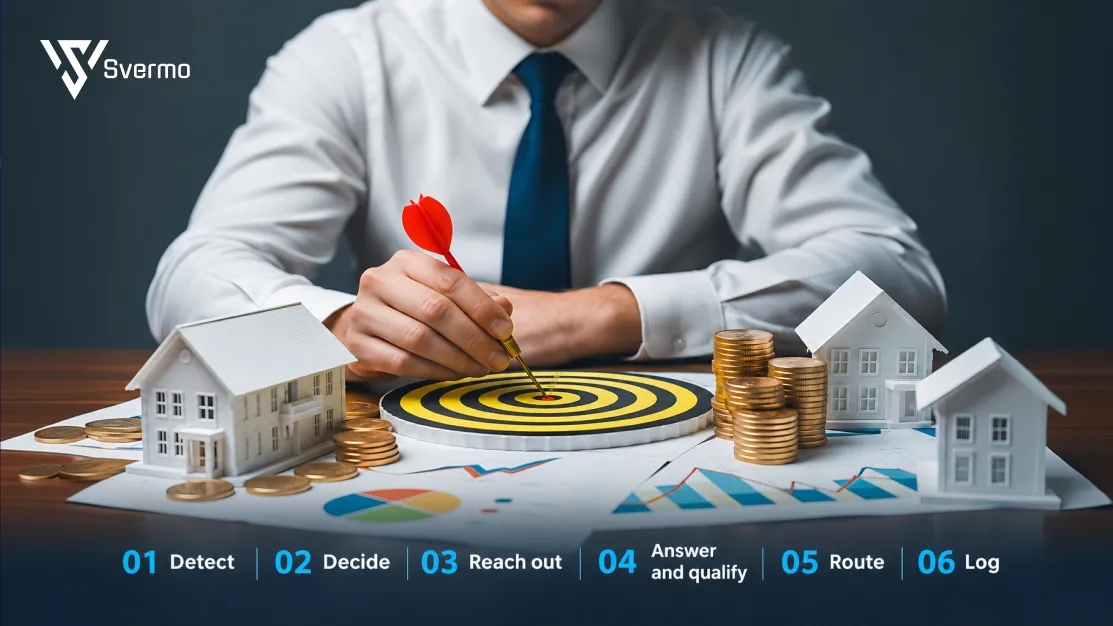
- Detect: every unanswered or abandoned call is captured with its time, property and number.
- Decide: rules filter out residents, vendors, known spam and repeat attempts.
- Reach out: the agent contacts the caller by a channel and at a time your rules allow.
- Answer and qualify: it answers basic property questions and asks what you need to know.
- Route: qualified prospects move toward a tour, and complicated cases go to a person.
- Log: the outcome is recorded, so the call shows up in your reporting.
It sits alongside the rest of an AI property management platform and doesn't require changing how your team handles live calls.
What happens when a leasing office misses a prospective renter's call?
Most of the time, nothing happens, and that is the problem. Leasing office missed calls rarely leave a trace, and missed calls in property management are easy to underestimate because the caller simply disappears. The call ends without a message, nobody knows who called, and the prospect keeps looking. In the call analysis above, unanswered rates were highest in early-morning, Monday and Saturday windows, though each of those windows rests on small call counts, so check your own pattern before staffing around it.
Managers with several communities see this most when staff are busy with other prospects and the phone keeps ringing.
Short answer: shorten the time between the miss and the next contact, and make sure no missed call is invisible. A missed call becomes recoverable when it is logged, ranked and followed up within a window you set, without anyone having to scan a call log by hand.
For the broader research on how fast a first response needs to be, see the first five minutes of lead response.
What do unanswered leasing calls cost?
The cost is the leases you would have signed from the callers you never reached. A simple model shows the size of the problem for one community. Treat every number below as hypothetical and replace it with your own:
| Step (illustrative) | Example |
|---|---|
Calls per month | 200 |
Unanswered at 50% | 100 |
Real prospects among them (60%) | 60 |
Would have toured (20%) | 12 |
Would have leased (20% of tours) | about 2.4 |
Annual rent at $1,500 a month, per lease | $18,000 |
Annual rent represented per month of misses | about $43,000 |
The conversion rates here are assumptions, not findings. What matters is the shape: a modest share of missed calls turns into real revenue, and it repeats every month. Your call log, your tour rate and your lease rate will give a more honest number.
Why don't callers leave voicemails, and why don't callbacks get answered?
Callers who are shopping for an apartment usually phone several communities, and calling the next listing is easier than leaving a message. That is a reasonable explanation, not a measured statistic, since no verified figure for how often renters skip voicemail in leasing was found for this guide.
Callbacks face a second hurdle. A 2020 Pew Research Center survey found that 19% of U.S. adults generally answer calls from unknown numbers, 67% generally don't but check voicemail, and 14% ignore both. A more recent vendor-published survey reports that 14% of consumers answer unrecognized numbers immediately. The practical lessons for recovery:
- Identify the caller: use a number and caller ID that prospects can recognize as the property.
- Leave a useful voicemail: name the property, say why you are calling and give a way to reply.
- Add a second channel: a text, where permitted, may get read when a call is ignored.
- Don't count on one attempt: a missed callback isn't a dead lead.
Here's the question teams raise: "We receive leasing calls throughout the day, but many callers do not leave voicemails when nobody answers. How can we identify those missed opportunities and use an AI phone agent to reconnect with prospects without requiring our team to manually call everyone back?"
Short answer: capture every missed number automatically, filter it, and let the agent make the first contact under rules you approve, so people only handle the conversations that respond.
Is Your Phone Ringing Into the Void?
Talk through where calls go unanswered, who should get a callback and how recovery would be measured.
How is missed-call recovery different from an AI receptionist?
An AI receptionist answers calls as they arrive, and missed-call recovery deals with the calls nobody answered. The two overlap, and some tools do both, but they solve different problems: one prevents misses and the other recovers the ones that still happen. For the wider range of what a voice agent handles, see the AI receptionist guide.
How does AI follow up on missed property management calls?
It works through a fixed sequence: log the miss, decide whether to respond, contact the caller, handle the conversation and record the result. Automated missed-call follow-up and AI phone lead recovery are the same idea at different points in that sequence. AI follow-up for missed property management calls works best when each stage has a rule your team set.
| Stage | What AI does | Rule you set |
|---|---|---|
Log | Captures every missed or abandoned call with time and property | Which lines and properties are covered |
Filter | Screens out residents, vendors, spam and repeats | Number lists and exclusions |
Prioritize | Ranks callers, such as first-time numbers or repeat callers | What counts as high priority |
Contact | Calls or texts within a window | Hours, attempts and channel |
Converse | Answers basic questions and asks qualifying ones | Approved answers and questions |
Route | Books a tour or passes the caller to a person | Handoff triggers |
Record | Logs the outcome and recording or summary | What is stored and who sees it |
Can an AI phone agent call back missed property management calls?
Yes, an AI phone agent for property management can call back, but whether and how you may do it depends on consent and calling rules, so have counsel review the design before launch. The rules treat an AI-voiced call more cautiously than a call from a person.
Two federal points are worth knowing:
- Inquiry-based callbacks: the FTC's Telemarketing Sales Rule guidance says an inquiry creates an established business relationship lasting three months, and that sellers can return an inquiring prospect's call in that window even if the number is on the National Do Not Call Registry. That exemption covers live calls from a sales agent. It does not cover automated or prerecorded calls, which require the consumer's prior signed written agreement. Whether the rule reaches a leasing callback is a question for counsel.
- AI voices: the FCC has ruled that the Telephone Consumer Protection Act's limits on artificial or prerecorded voice calls also cover AI technologies that generate human voices, so a call using one needs the called party's prior express consent.
Put together, an AI-voiced callback to a number that only rang and hung up may need consent you don't have. Options to discuss with counsel include capturing consent during the original call, such as a prompt offering a callback or text, using web forms and listing-site inquiries where the prospect shares a number, and routing the first callback to a person while AI handles the qualification and logging. Text and email carry their own consent and opt-out expectations.
How does an AI missed-call recovery system decide who to call back and what to say?
It follows your rules: call back likely prospects, skip numbers that aren't prospects, limit attempts and say only what you have approved. Here's the concern many managers have: "I worry that automatically calling back missed numbers could create a poor renter experience or contact people who were not actually leasing prospects. How should an AI missed-call recovery system determine who to call back and what it should say?"
Short answer: set a short, strict list of rules.
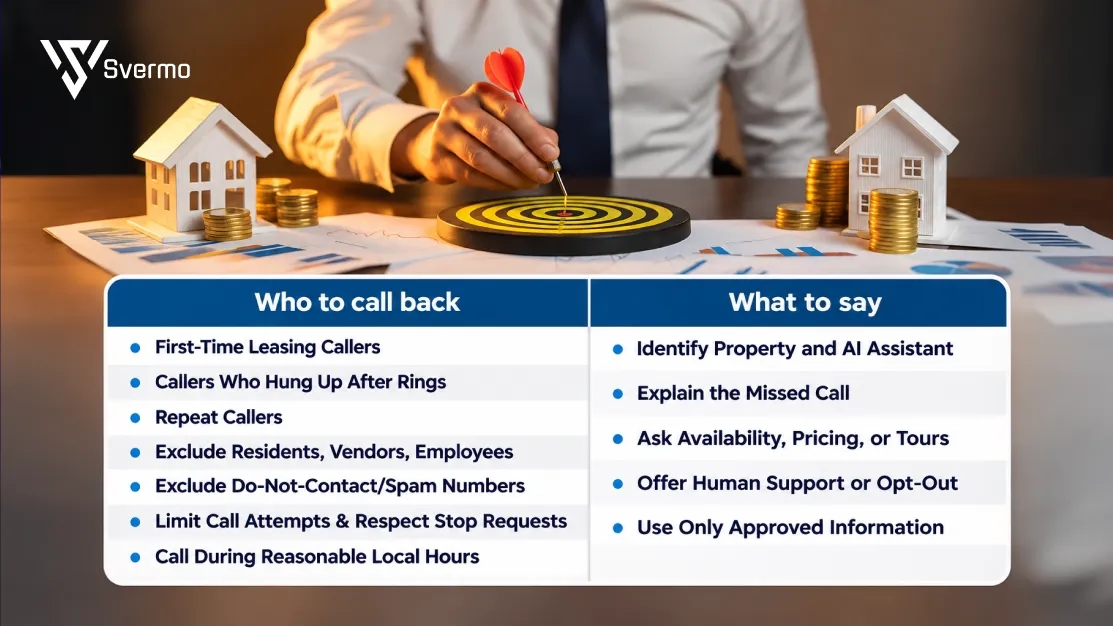
Who to call back
- Include: first-time callers to a leasing line, callers who hung up after a long ring, and repeat callers.
- Exclude: current residents, known vendors and employees, numbers on your internal do-not-contact list, and numbers flagged as spam.
- Limit: a small cap on attempts, with no contact after the caller asks to stop.
- Respect timing: reasonable hours for the caller's local time.
What to say
- Identify yourself: the property, and that this is an automated assistant.
- State the reason: "You called us earlier and we missed you."
- Ask one thing: whether they would like help with availability, pricing or a tour.
- Offer an exit: a person, a different channel or no further contact.
- Stay inside approved answers: no guesses about fees, policies or availability.
A recovery call that sounds like a polite return of a missed call works. One that sounds like a sales script doesn't.
How can AI handle after-hours missed calls for property management?
An AI phone agent answers after-hours and weekend calls, which is where after-hours missed calls in property management pile up. It gathers what the caller needs, answers basic property questions and moves qualified prospects toward a tour, handing anything it can't handle to your team. After-hours leasing call management matters because prospects call when the office is closed, and nobody is there to answer.
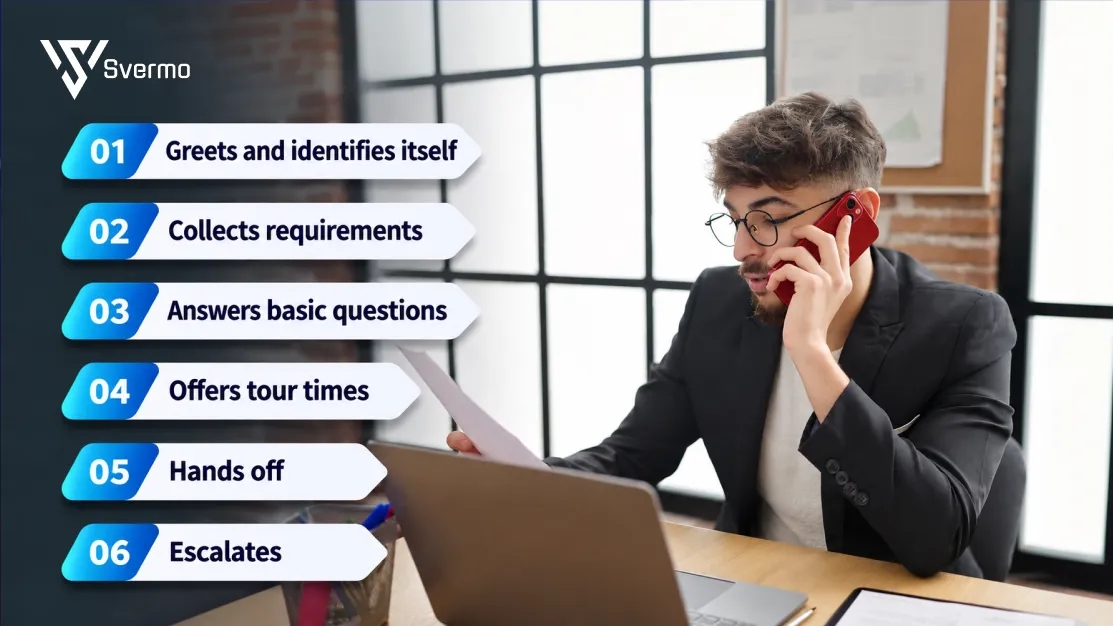
For after-hours calls, a good agent:
- Greets and identifies itself: the property, and that it is an AI assistant.
- Collects requirements: move-in date, bedrooms, budget and pets.
- Answers basic questions: from information you approve.
- Offers tour times: that are really open.
- Hands off: the full summary to the team for the next business day.
- Escalates: urgent or sensitive issues, such as emergencies, to the right person.
The agent also needs clear limits. It shouldn't decide on applicants, quote anything it can't confirm or discuss legal rights. Fair housing law applies to AI as it does to staff, and the Fair Housing Act protects people on the basis of race, color, national origin, religion, sex, familial status and disability. Approved scripts should give every caller the same information.
How should property managers track and recover unanswered leasing calls?
Track every missed call by property, hour and day, then follow each one through callback, conversation, tour and lease. You can't recover what you can't see, so the first job is a complete log. Here's what leasing leaders ask: "I am responsible for leasing performance across several communities, and I cannot tell how many prospective renters we are losing because their calls go unanswered. What should I track to measure missed-call volume, callback performance, and recovered leasing opportunities?"
Short answer: track the full path from miss to lease.
| Metric | What it shows |
|---|---|
Missed-call volume | How many calls went unanswered, by property, hour and day |
Missed-call rate | Unanswered calls as a share of all calls |
Time to first callback | How long callers waited for a response |
Callback attempt and contact rate | How many were tried, and how many were reached |
Qualified leads | Callers who met your criteria |
Tours booked from recovered calls | The first real commitment |
Recovered leases | The revenue effect |
Opt-outs and complaints | Renter experience and compliance |
Compare these before and after, by property and time window, and allow enough volume before drawing conclusions. Seasonality and marketing changes also move call volume, so a before-and-after gap is a clue, not proof. Regional managers usually want the missed-call rate and recovered leases by community. Directors of leasing want callback timing, contact rate and tour bookings.
How do you recover missed calls without overloading your leasing team?
To recover missed leasing calls with AI without burdening staff, let it handle the first contact and the routine questions, rank what comes back, and give your team a short list of conversations that need a person. Manually returning every unanswered call isn't realistic, so unanswered property management call handling needs priority rules and a clean log.
A simple priority scheme works:
- High: qualified prospects asking for a tour, or repeat callers.
- Medium: prospects with questions the agent couldn't answer.
- Low: callers who didn't respond to a first attempt.
- Excluded: residents, vendors, spam and opt-outs.
Every recovered call should end with a logged outcome, such as tour booked, needs a callback, not interested, wrong number or opted out. That log is how you tell whether recovery is working, and how your team picks up a conversation without asking the prospect to repeat themselves.
Who owns missed-call recovery, a regional manager or a director of leasing?
Both, for different questions. Regional managers own the portfolio view and the rules, and directors of leasing own the callback quality and the handoff to the team.
| Role | Main question | What they need |
|---|---|---|
Regional manager | Which communities lose the most calls, and when? | Missed-call rate and recovered leases by property and hour |
Director of leasing | Are callbacks fast, polite and converting? | Time to callback, contact rate, tour bookings and call summaries |
Agree on one definition of a missed call, one set of exclusions and one outcome list, so the two views describe the same calls.
What should you look for in AI phone answering for property managers?
Look for reliable call capture, approved-content control, callback and consent handling, clear escalation, and reporting by property. AI answering service for property management tools differ on whether they only answer calls or also recover missed ones, so ask directly.
Voice AI lists 24/7 call answering, leasing inquiry capture and qualification, tour scheduling, routing of urgent calls, call analytics and CRM logging.
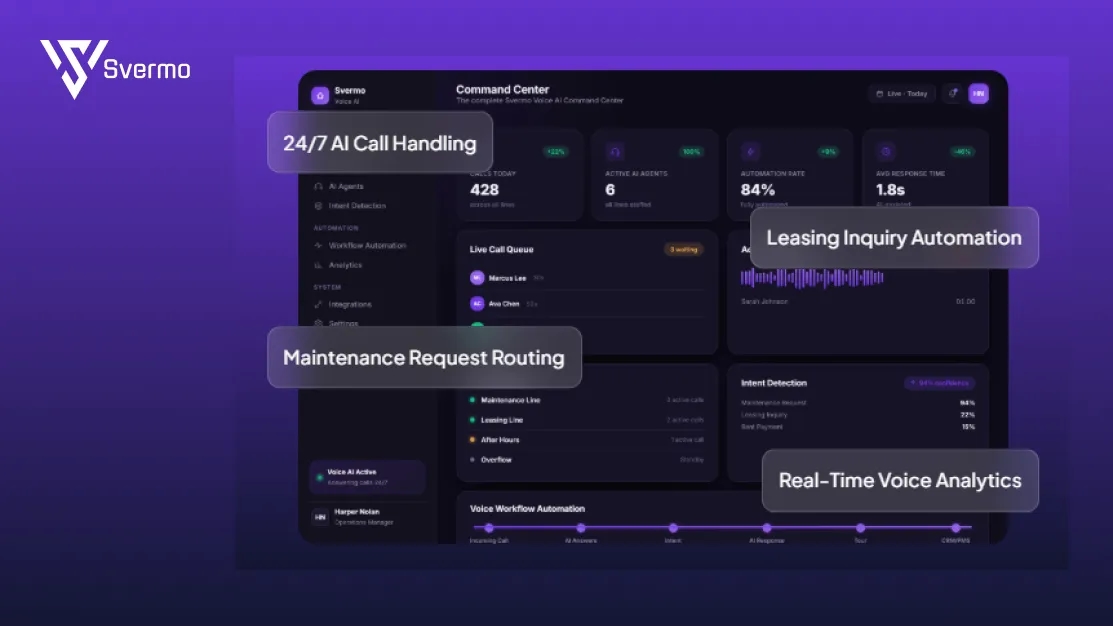
Its page doesn't describe callbacks, outbound calls or missed-call follow-up, and it doesn't cover consent handling, AI disclosure, supported languages or accuracy, so ask Svermo how it would handle missed-call recovery and pilot it on your own properties, as with any tool.
See How Voice AI Handles Calls, Routing and Logging
Walk through call answering, lead qualification, urgent routing and analytics, and ask how missed-call follow-up would work.
Is Your Phone Ringing Into the Void?
A missed call is a lot like a "back in five minutes" sign on a coffee shop: some people wait, but most go find coffee. Capture every miss, set strict rules for who gets a callback and what the call says, and measure the path from missed call to signed lease. Want to see how that could work across your communities?
 https://www.linkedin.com/in/saanvi-verma-38711a36a
FAQs
It logs every missed call, filters out numbers that aren't prospects, contacts the caller under rules you set, qualifies them and routes or logs the outcome.
It can, but consent and calling rules apply, and AI-voiced calls are treated more cautiously. Have counsel review who is called, how and when.
Respond fast through a channel the prospect will answer, use a recognizable number and a useful message, and log every outcome.
Rules vary by state and channel, and counsel should advise. Telling callers plainly is good practice.
Track missed-call volume and rate, time to callback, contact rate, qualified leads, tours booked and leases from recovered calls.