Conversational AI Voice Agent Development for Real Estate: A Complete Guide

Get a summary of this article with your favorite AI
AI Summary
- •Conversational AI voice agent development for real estate helps automate buyer inquiries, tenant communication, lead qualification, and scheduling workflows.
- •Successful AI conversational voice agent development for real estate depends on strong workflow planning, CRM integrations, AI infrastructure, and conversation design.
- •Modern AI voice agent development for real estate in USA requires both core voice capabilities and advanced AI orchestration systems.
- •The cost of custom conversational AI voice agent development for real estate companies usually ranges from $20,000–$200,000+ based on complexity and deployment scale.
- •At Svermo, we build end to end conversational AI voice agent development for real estate firms in USA focused on automation, scalability, and faster response workflows.
A missed real estate call in 2026 is no longer just a missed conversation. It is often a lost commission, an unqualified buyer, or a tenant who moves to another property before your team responds.
That is why choosing conversational AI voice agent development for real estate is quickly becoming a priority for brokerages, property managers, and leasing firms across the USA.
Here is the bigger problem most firms are dealing with right now.
Your agents cannot answer every inbound call instantly, and your leasing team gets buried in repetitive inquiries. The property management staff spend hours handling routine tenant communication instead of high-value work. Meanwhile, customers expect immediate responses.
Research shows that leads contacted within five minutes are dramatically 21x more likely to convert compared to leads contacted after 30 minutes.
In fact, 78% of real estate leads go to the agent who responds first. The average agent response time is 4 hours, while an AI chatbot can respond in under 5 seconds.
That gap alone explains why the requirement of AI conversational voice agent development for real estate is accelerating so aggressively in 2025 and 2026.
Modern AI voice agent for US real estate industry focuses on creating voice agents that can qualify buyers, schedule property showings, answer tenant questions, route calls intelligently, and integrate directly with CRMs and property systems without sounding robotic.
Many firms are now combining conversational voice automation with broader real estate AI software solutions to reduce operational pressure, improve response times, and scale communication without continuously increasing headcount.
The biggest shift happening right now is not simply automation. It is conversational automation that feels human, context-aware, and operationally reliable for real estate businesses handling hundreds of conversations every week.
So before you invest in a voice AI solution, it is important to understand what conversational AI voice agents actually are?
Still Losing Real Estate Leads After Business Hours?
Your next buyer might already be calling another brokerage while your team is offline. Let’s build a conversational AI voice system that responds instantly.
What Is Conversational AI Voice Agent for Real Estate and Why Are US Firms Investing in It in 2026?
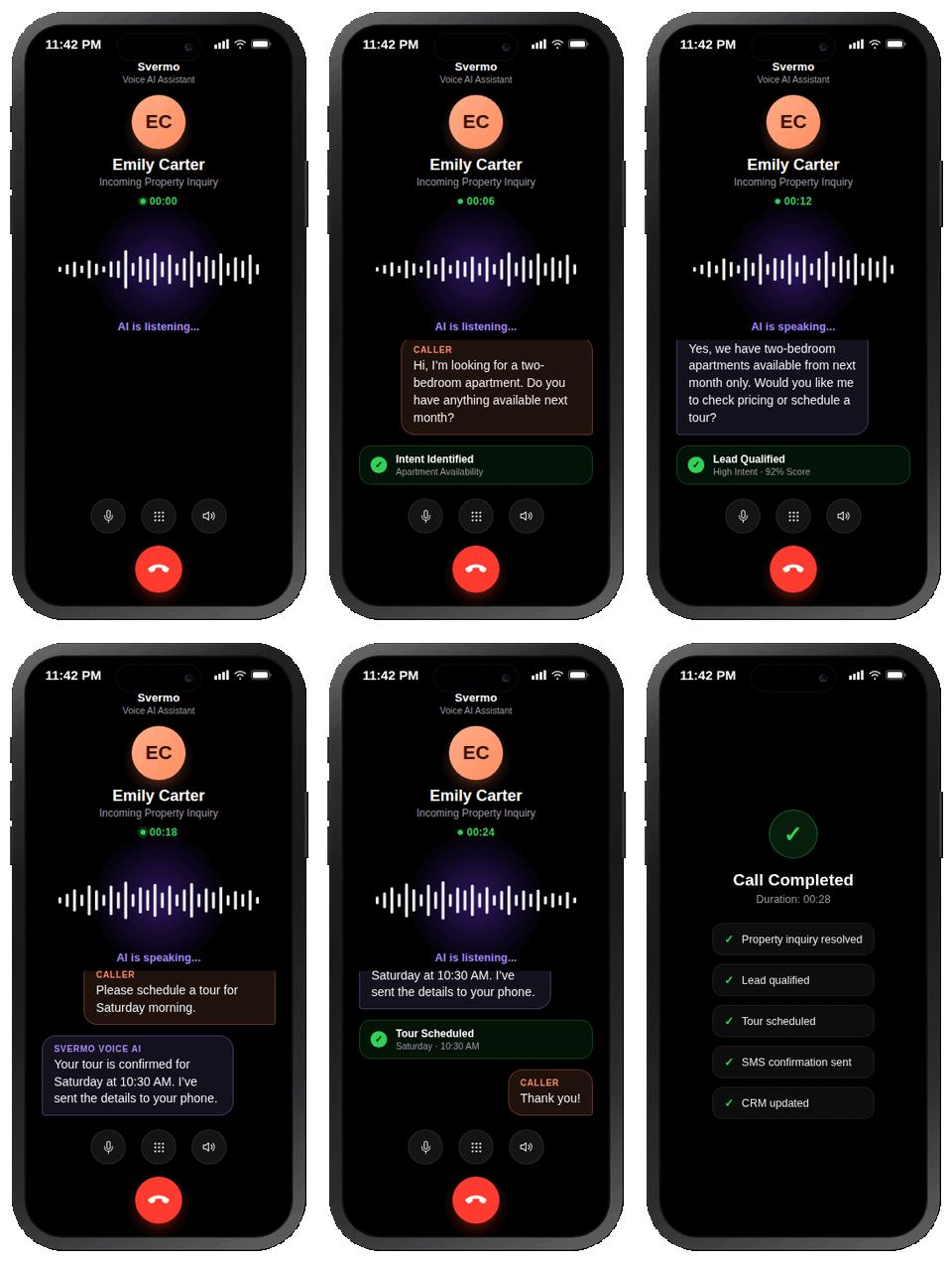
A conversational AI voice agent for real estate is an AI system that can speak with buyers, tenants, sellers, and prospects through natural voice conversations.
Unlike traditional IVR systems that rely on fixed menus, conversational AI can understand user intent, respond naturally, ask follow-up questions, and complete tasks during the call.
For example, a real estate AI voice agent can:
- Answer property inquiries
- Qualify leads
- Schedule showings
- Handle tenant requests
- Update CRM records
- Transfer calls to agents when needed
This is what makes conversational AI voice agent valuable for modern brokerages and property management firms.
The biggest reason businesses are investing in AI conversational voice agent for real estate is response speed. It helps businesses respond instantly instead of relying entirely on manual follow-ups.
Another major advantage is operational efficiency.
With AI voice agent real estate firms in USA can automate repetitive communication workflows like inbound call handling, lead qualification, appointment scheduling, tenant communication, and after-hours support.
This reduces workload on agents while improving customer response times.
Some key benefits of conversational AI for real estate include:
- 24/7 call handling
- Fewer missed leads
- Faster response times
- Lower operational workload
- Scalable communication workflows
- Multilingual support
- CRM and MLS integration
Choosing AI assistant development for real estate and integrating it with voice automation will help you automate both customer communication and backend operations.
So how does a conversational AI voice agent actually handle real estate conversations in real time?
How Does a Conversational AI Voice Agent for Real Estate Businesses Actually Work?

Modern AI conversational voice agent for real estate works through multiple AI and automation layers running together during a live call. The system listens, understands, processes information, retrieves data, and completes actions in real time.
1. Speech Recognition
The first step is converting the caller’s voice into text. The AI listens to the conversation and processes speech almost instantly. This layer helps the system capture real estate conversations accurately, even during fast or interrupted calls.
The voice engine handles:
- Background noise filtering
- Accent recognition
- Real-time speech conversion
- Interruption detection
- Multilingual conversations
2. Intent Detection
Once the speech is converted into text, the AI identifies the caller’s intent. Instead of relying on fixed scripts, the system understands conversational meaning and context. For example, the AI can identify whether the caller wants:
- Property availability details
- Rental pricing information
- Appointment scheduling
- Maintenance support
- Lease-related assistance
- Direct agent transfer
This layer powers the natural language processing voice agent for real estate operations by helping the AI understand what action needs to happen next.
3. Conversation Processing
After identifying intent, the AI generates a contextual response based on business workflows, property data, and previous conversation history. Unlike traditional IVR systems, the AI adjusts responses dynamically during the conversation.
At this stage, the system can:
- Ask follow-up questions
- Qualify buyer intent
- Collect tenant details
- Answer listing questions
- Confirm scheduling preferences
- Personalize responses using CRM data
This is one of the biggest advantages of conversational voice agent solutions for real estate businesses because conversations feel structured but not robotic.
4. System Integrations
The AI voice agent then connects with backend systems to retrieve or update information automatically. This layer is critical in real estate conversational AI voice technology integration and deployment because most real estate workflows depend on multiple software platforms working together.
Common integrations include:
- CRM platforms
- MLS databases
- Property management software
- Calendar systems
- Telephony infrastructure
- Lead management platforms
Also Read: Integrating AI IVR System with Real Estate CRM Platforms
5. Workflow Execution
Once the AI gathers enough information, it performs the required business action automatically. This reduces manual coordination across sales and operations teams.
The AI can:
- Schedule property showings
- Create CRM records
- Assign leads automatically
- Trigger follow-up workflows
- Send reminders
- Escalate urgent conversations
This is why many firms are building a conversational AI voice agent for real estate lead management and communication automation.
6. Human Escalation
Not every call should remain fully automated. Complex conversations and high-intent leads often require human involvement. Modern voice AI systems can transfer conversations smoothly while preserving call context.
The escalation layer supports:
- Live call transfers
- Smart agent routing
- Conversation summaries
- Priority escalation rules
- Fallback handling during failed responses
This helps businesses automate communication without losing the human side of customer interactions.
After this do you know where real estate firms are actually using conversational AI voice agents to create a measurable business impact?
What Are the Most Valuable Use Cases of AI Conversational Voice Agent for Real Estate?
The biggest advantage of AI conversational voice agent for real estate is that it solves operational problems that directly impact lead conversion, customer experience, and team efficiency. Instead of acting like a simple answering system, modern voice AI becomes part of the business workflow itself.
1. Buyer Inquiry Management
Real estate firms receive a large number of inbound buyer calls every day. Many of these leads are lost because agents cannot respond immediately. AI voice agents can answer calls instantly, collect buyer requirements, qualify intent, and schedule follow-ups automatically.
Example:
A buyer calls at 9:30 PM asking for 3-bedroom homes under $800K in Miami. The AI voice agent collects budget, location preference, timeline, and financing status, then schedules a showing for the next morning while updating the CRM automatically.
This is one of the biggest reasons firms are investing in building a conversational AI voice agent for real estate lead management.
2. Tenant Communication Automation
Property management teams spend a significant amount of time handling repetitive tenant calls related to maintenance requests, rent inquiries, and lease support. With intelligent voice bot for real estate lead and tenant communication, these conversations can be automated without increasing support workload.
Example:
A tenant calls to report a plumbing issue. The AI voice agent captures the issue details, creates a maintenance ticket, shares an estimated resolution timeline, and forwards the request to the maintenance team instantly.
3. Property Showing Scheduling
Coordinating property visits manually often creates delays, especially when multiple agents and calendars are involved. AI voice agents can handle scheduling automatically by checking agent availability, confirming time slots, and sending reminders.
Example:
A prospect calls asking to visit a rental property over the weekend. The AI checks calendar availability, confirms a suitable time, sends appointment details through SMS or email, and updates the broker’s scheduling system.
4. Lead Qualification and Routing
Not every lead has the same urgency or buying intent. AI voice systems help businesses prioritize high-intent conversations automatically. This improves response efficiency across brokerage teams.
Example:
An inbound caller mentions they are pre-approved for financing and planning to buy within 30 days. The AI flags the lead as high priority and routes the call directly to a senior sales agent.
This is becoming a major use case in conversational voice agent solutions for real estate businesses focused on improving conversion rates.
5. After-Hours Real Estate Support
Most real estate inquiries happen outside standard business hours. Without automation, these conversations often go unanswered until the next day. AI voice agents help businesses maintain continuous communication availability.
Example:
A renter calls late at night asking about pet policies, move-in dates, and lease terms. The AI handles the conversation instantly instead of sending the caller to voicemail.
6. Outbound Follow-Ups and Re-Engagement
AI voice agents are also used for outbound communication workflows such as lead follow-ups, appointment reminders, and inactive lead re-engagement. It reduces manual outreach workload for sales teams.
Example:
A brokerage uploads inactive leads from the CRM. The AI voice agent automatically calls prospects, asks if they are still looking for properties, collects updated preferences, and schedules callbacks for interested buyers.
Some brokerages now use these outbound workflows alongside agentic AI development for real estate systems that automate lead routing, follow-up coordination, and customer engagement across multiple channels.
So if conversational AI voice agents can already automate buyer inquiries, tenant communication, scheduling, and follow-ups, what features actually separate a production-ready real estate voice agent from a basic automation tool?
What If Your Real Estate Team Never Missed Another Inbound Call?
From buyer inquiries to tenant support, we help real estate firms automate conversations without making them sound robotic.
What Core Features Should Every Conversational AI Voice Agent for Real Estate Have?
Not every voice AI platform is designed for real estate operations. Many businesses deploy basic bots that can answer simple questions but fail when conversations become dynamic, property-specific, or operationally complex.
A scalable conversational AI voice agent for real estate must include core capabilities that support lead handling, tenant communication, scheduling, CRM workflows, and real-time decision-making without breaking the customer experience.
These are the foundational features that every production-ready real estate voice AI system should include.
Core Feature | What It Does | Why It Matters in Real Estate |
|---|---|---|
Natural Language Understanding (NLU) | Helps the AI understand conversational intent, property-related questions, buyer preferences, and follow-up requests without relying on rigid scripts or keyword matching. | Real estate conversations are rarely linear. Buyers change requirements mid-call, tenants explain issues differently, and sellers ask open-ended questions. A strong natural language processing voice agent for real estate operations is critical for handling these conversations naturally. |
Real-Time Speech Processing | Converts live voice conversations into text instantly and generates responses during the call without noticeable delay. | Long pauses or delayed responses make AI conversations feel robotic. In AI powered voice assistant for real estate firms, low-latency communication is essential for maintaining natural interactions with buyers and tenants. |
CRM Integration | Connects the AI voice system with platforms like HubSpot, Salesforce, Follow Up Boss, or custom brokerage CRMs to update lead records automatically. | Real estate businesses depend heavily on lead tracking and follow-up workflows. Without CRM integration, agents lose visibility into conversations, lead status, and appointment activity. |
Appointment Scheduling | Allows the AI voice agent to check availability, coordinate calendars, confirm bookings, and send reminders automatically. | Manual scheduling slows down lead conversion. Automated scheduling helps brokerages respond faster and reduce coordination delays during high inquiry periods. |
Lead Qualification Engine | Collects and evaluates information such as budget, financing status, move-in timeline, location preference, and buying intent during live conversations. | This feature is essential in building a conversational AI voice agent for real estate lead management because it helps teams prioritize serious buyers instead of manually filtering every inquiry. |
Human Escalation Workflows | Transfers calls to human agents while preserving conversation history and collected lead details. | Not every interaction should remain automated. High-value buyer conversations, legal discussions, and complex tenant issues still require human involvement. |
Multilingual Voice Support | Supports voice conversations across different languages and regional accents commonly used in US real estate markets. | Real estate firms operating in multilingual regions need voice systems that can communicate effectively with diverse buyer and tenant groups without creating friction. |
Conversation Memory | Maintains conversational context during the interaction, so callers do not need to repeat information repeatedly. | Buyers and tenants expect smooth conversations. Repeating information damages customer experience and reduces trust in the AI system. |
Tenant Communication Automation | Handles repetitive tenant workflows such as maintenance requests, rent-related questions, lease support, and basic property inquiries automatically. | Property management teams often spend significant time handling repetitive calls. This feature helps reduce operational workload while improving response consistency. Many firms implementing this workflow also invest property management AI software solutions to centralize tenant operations further. |
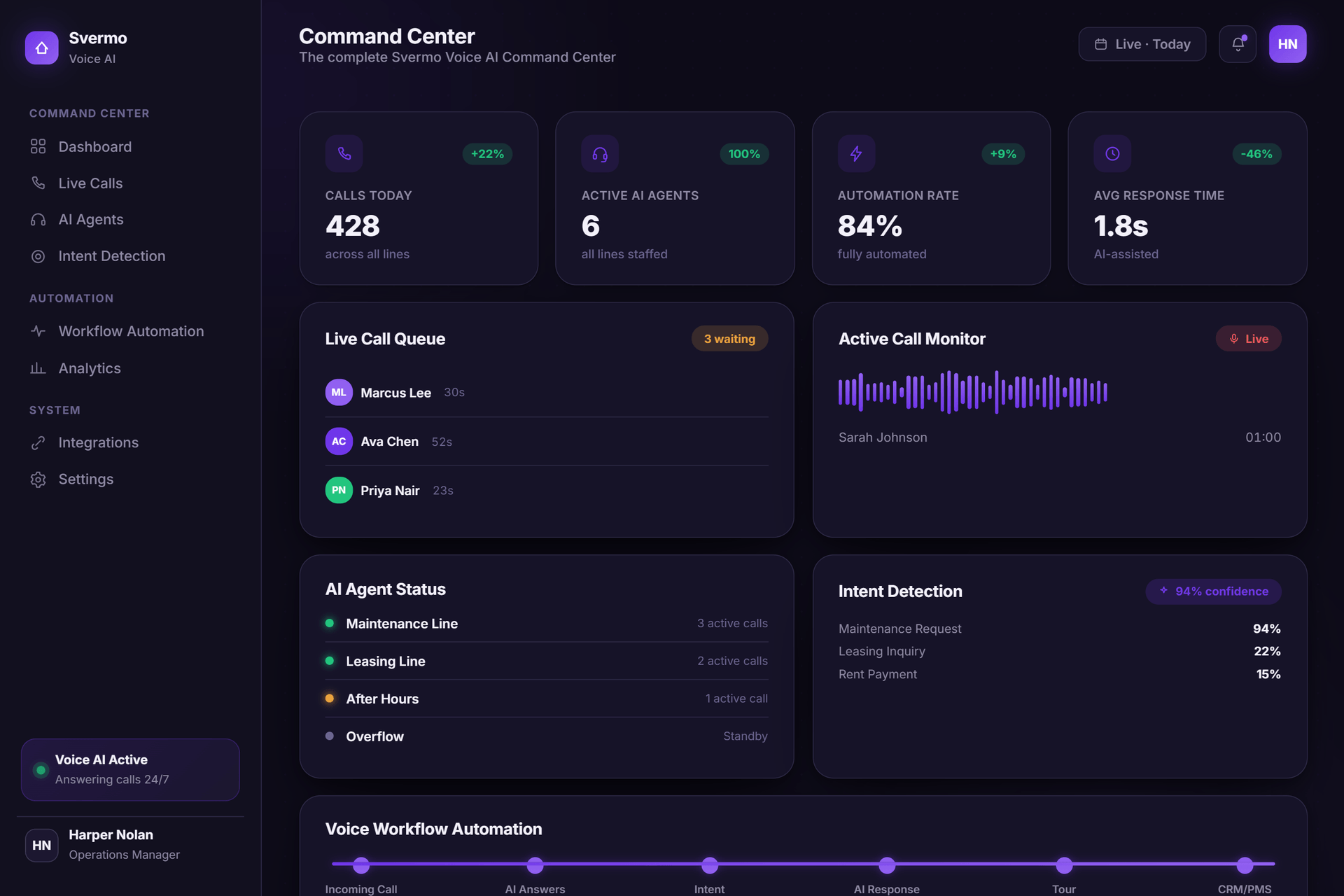
Analytics and Call Intelligence | Tracks conversation quality, lead conversion patterns, response times, escalation frequency, and operational performance metrics. | Businesses need visibility into how their voice AI system performs. Analytics help optimize call workflows, improve lead qualification accuracy, and identify operational bottlenecks. |
Security and Access Management | Protects customer information through encryption, access controls, authentication systems, and secure infrastructure layers. | Real estate businesses handle sensitive financial and personal data. Secure infrastructure is critical for compliance, customer trust, and operational reliability. |
MLS and Property Data Integration | Connects the AI voice agent with listing databases and property systems to retrieve live pricing, availability, and listing details. | Buyers expect accurate property information instantly during calls. Real-time MLS integration improves response accuracy and customer experience significantly. |
These core capabilities form the foundation of successful real estate conversational AI voice agent.
Without them, even advanced-looking voice systems struggle to support real brokerage, leasing, and property management workflows at scale.
What Advanced Features Give Modern Real Estate AI Voice Agents a Competitive Advantage?
Core capabilities help a voice AI system function properly. Advanced capabilities help the system scale reliably, improve decision-making, and support complex real estate operations without constant manual intervention.
This is where enterprise-grade AI conversational voice agent for real estate becomes very different from basic voice automation tools. These advanced capabilities focus more on intelligence infrastructure, operational scalability, AI orchestration, and long-term optimization.
Advanced Feature | What It Does | Why It Matters in Real Estate |
|---|---|---|
Contextual Memory Persistence | Maintains long-term conversational memory across multiple calls, sessions, and communication channels. | Buyers and tenants often interact with real estate businesses multiple times before making decisions. Persistent memory helps maintain continuity across long sales and leasing cycles. |
Retrieval-Augmented Generation (RAG) | Pulls live information from internal databases, property documents, leasing policies, and knowledge systems during conversations. | Real estate data changes frequently. RAG-based systems improve response accuracy by retrieving updated information dynamically instead of relying only on pre-trained AI responses. |
Adaptive Prompt Orchestration | Dynamically modifies AI prompts and response logic based on conversation type, business rules, and caller intent. | Different workflows require different communication behavior. Buyer inquiries, tenant complaints, and leasing conversations all need different response handling structures. |
Multi-Agent AI Coordination | Allows multiple AI agents or systems to work together during complex workflows. | A single real estate conversation may involve scheduling systems, CRM updates, maintenance workflows, and compliance checks simultaneously. Multi-agent coordination improves operational efficiency significantly. |
Conversation Replay Analytics | Stores and analyzes historical conversations to identify communication gaps, operational bottlenecks, and workflow failures. | Real estate firms handling high call volumes need visibility into why leads drop, where conversations fail, and which workflows create delays. |
AI Failover Architecture | Automatically switches workflows, models, or communication paths if the primary AI system fails during live conversations. | Downtime during buyer or tenant communication can directly impact revenue and customer experience. Failover systems improve operational reliability. |
Latency Optimization Infrastructure | Reduces processing delays across speech recognition, AI reasoning, and response generation layers. | Real-time responsiveness is critical in voice conversations. Even short delays can make AI systems sound unnatural during live calls. |
AI Governance and Control Layers | Applies operational policies, response restrictions, approval logic, and compliance controls across AI workflows. | Large brokerages and property management firms need tighter oversight over how AI systems communicate, escalate, and access sensitive operational data. |
Knowledge Synchronization Pipelines | Continuously updates AI systems using changing property listings, leasing rules, pricing updates, and operational policies. | Real estate information changes daily. Synchronization pipelines help maintain response accuracy across large property portfolios and distributed brokerage operations. |
AI Simulation and Stress Testing | Tests voice AI behavior across thousands of simulated conversation scenarios before deployment. | Real estate conversations are unpredictable. Simulation testing helps identify failures, edge cases, and conversation breakdowns before systems go live. |
These advanced capabilities are becoming increasingly important in end to end conversational AI voice agent for real estate firms in USA where businesses need scalable, reliable, and operationally intelligent communication systems instead of simple voice automation tools.
Once you know which features your AI voice agent needs, the next question becomes far more important: how do you actually build a production-ready system that works reliably inside real estate operations?
What Are the Steps to Build a Conversational AI Voice Agent for Real Estate Businesses?

Successful conversational AI voice agent development for real estate is not just about connecting a chatbot to a phone line. A production-ready system requires workflow planning, AI architecture design, backend integrations, testing, optimization, and operational alignment with real estate processes.
Here is how modern AI voice agent development for real estate in USA is typically executed step by step.
1. Discovery and Workflow Planning
The process starts by understanding how your business currently handles communication. Teams analyze buyer inquiries, tenant workflows, lead routing, scheduling operations, and support processes before building the AI system.
This phase helps identify which workflows should be automated first and where human involvement is still necessary. This stage usually includes:
- Operational workflow analysis
- Communication gap identification
- Call handling process mapping
2. MVP Scope Definition
Before building a large-scale system, most businesses start with a focused MVP. Instead of automating every workflow at once, the goal is to launch a smaller production-ready version that solves a high-impact operational problem first.
For most firms, the MVP focuses on inbound property inquiries, lead qualification, appointment scheduling, or tenant communication. The MVP planning phase normally defines:
- Priority automation workflows
- Initial deployment boundaries
- Success measurement metrics
This approach helps businesses validate ROI faster while reducing implementation risk during custom conversational AI voice agent development for real estate companies.
3. Conversation Flow Design
Once the MVP scope is finalized, conversation flows are designed for different real estate scenarios. This includes buyer conversations, tenant support interactions, scheduling logic, and escalation handling.
The objective is to create conversations that feel natural while still maintaining structured operational workflows. Conversation design generally focuses on:
- Intent-based dialogue paths
- Multi-step interaction logic
- Exception handling scenarios
This step is even during real estate AI chatbot development initiatives to maintain consistent customer communication across multiple channels.
4. AI and Voice Infrastructure Setup
At this stage, developers configure the AI stack that powers the voice agent. This includes speech processing systems, language models, telephony services, and orchestration frameworks. The infrastructure layer directly affects scalability, response quality, latency, and live conversation performance. Infrastructure setup commonly involves:
- Speech recognition engines
- Voice synthesis systems
- Cloud telephony configuration
This phase is critical in end to end conversational AI voice agent development for real estate firms in USA because infrastructure decisions affect long-term operational scalability.
5. CRM and Backend System Integrations
The voice AI system is then connected with operational tools such as CRMs, MLS platforms, scheduling systems, and property management software. Without backend integrations, the AI can answer questions but cannot perform operational actions during conversations.
This integration phase usually includes:
- CRM synchronization workflows
- Listing database connectivity
- Scheduling platform integration
6. AI Training and Optimization
After integrations are completed, the AI system is trained using real estate conversation patterns, operational terminology, and business-specific workflows. This stage improves conversational accuracy and reduces workflow failures during live calls.
Optimization work usually focuses on:
- Real estate terminology tuning
- Intent detection improvement
- Response accuracy refinement
7. Testing and Pilot Validation
Before large-scale rollout, the system is tested across multiple real-world conversation scenarios. Teams validate conversation quality, escalation handling, latency, and operational reliability. This phase helps identify workflow failures before the AI interacts with larger customer volumes.
Testing and validation typically include:
- Multi-scenario conversation simulations
- Workflow reliability testing
- Escalation path validation
Also Read: AI IVR System Development for Property Management
8. Deployment and Continuous Improvement
Once the pilot performs reliably, the AI voice agent is deployed across larger operational workflows and customer communication channels. The system is continuously monitored and optimized using live conversation data, operational analytics, and customer interaction patterns.
Post-deployment optimization generally includes:
- Conversation performance monitoring
- Workflow optimization cycles
- AI model performance updates
This ongoing refinement process is essential in how to build and deploy a conversational AI voice agent for real estate businesses because customer behavior, operational requirements, and property workflows continue evolving over time.
What Tech Stack Is Required for End-to-End Conversational AI Voice Agent Development for Real Estate Firms in USA?
A production-ready conversational AI voice agent for real estate project requires multiple technologies working together in real time. The system needs to process voice conversations, understand intent, retrieve property data, trigger workflows, integrate with operational systems, and maintain low response latency during live calls.
The exact stack varies depending on business requirements, scalability goals, and deployment complexity, but most modern process of AI voice agent development for real estate in USA include the following technology layers.
Technology Layer | Common Tech Stack | What It Does |
|---|---|---|
Frontend Interface | React, Next.js, Vue.js | Powers dashboards used by agents, operations teams, and administrators for monitoring conversations, reviewing leads, managing workflows, and accessing analytics. |
Backend Framework | Node.js, Python, FastAPI, Django | Handles API logic, workflow orchestration, authentication, integrations, conversation routing, and backend operational processing. |
Speech-to-Text (STT) | Deepgram, Google Speech-to-Text, Whisper, AssemblyAI | Converts live voice conversations into text during calls with low latency and high speech recognition accuracy. |
Large Language Models (LLMs) | OpenAI GPT-4o, Claude, Gemini, Llama | Processes conversational intent, generates contextual responses, handles reasoning, and manages multi-turn conversations. This layer is central to AI conversational voice agent development for real estate. |
Text-to-Speech (TTS) | ElevenLabs, Azure Neural Voices, PlayHT, Amazon Polly | Converts AI-generated responses into natural human-like voice output during live conversations. |
Telephony Infrastructure | Twilio, Retell AI, Vonage, Plivo | Manages inbound and outbound calls, call routing, SIP connectivity, and real-time voice streaming between users and AI systems. |
Conversation Orchestration | LangChain, LangGraph, Semantic Kernel, CrewAI | Coordinates prompts, workflows, memory handling, tool execution, and multi-step AI reasoning across conversations. |
Database Layer | PostgreSQL, MongoDB, Firebase | Stores customer records, conversation history, scheduling data, lead details, and operational workflows securely. |
Vector Database | Pinecone, Weaviate, ChromaDB, FAISS | Stores embeddings and conversational memory to help the AI retrieve contextual information during interactions. |
CRM Integration Layer | Salesforce API, HubSpot API, Follow Up Boss API | Synchronizes lead data, call records, scheduling updates, and communication workflows with brokerage CRM systems. |
MLS and Property Data Integration | RESO APIs, IDX feeds, MLS APIs | Connects the AI system with live property listings, pricing information, availability data, and listing updates. |
Scheduling Systems | Google Calendar API, Calendly API, Microsoft Graph API | Enables automated appointment scheduling, showing coordination, and reminder workflows during conversations. |
Authentication and Security | OAuth 2.0, JWT, Okta, Auth0 | Secures customer information, manages access permissions, and protects operational systems from unauthorized access. |
Cloud Infrastructure | AWS, Microsoft Azure, Google Cloud Platform | Hosts AI services, telephony infrastructure, databases, APIs, and operational workloads with scalable cloud resources. |
Monitoring and Analytics | Datadog, Grafana, Prometheus, Mixpanel | Tracks system uptime, response latency, workflow failures, conversation quality, and operational performance metrics. |
So once the technology stack is finalized, the next question most real estate firms ask is simple: how much does it actually cost to build and deploy a conversational AI voice agent?
Also Read: Build a Custom AI Real Estate Automation System
How Much Does Conversational AI Voice Agent Development for Real Estate Cost in USA?
The cost of AI conversational voice agent development for real estate depends heavily on workflow complexity, AI infrastructure, integrations, customization level, and deployment scale.
In most cases, AI voice agent development for real estate in USA typically ranges between $20,000–$200,000+.
A smaller MVP focused on inbound property inquiries and lead qualification will cost significantly less than a fully integrated enterprise system handling scheduling, tenant communication, CRM automation, outbound calling, analytics, and multi-location workflows.
This is why there is no fixed pricing model for custom conversational AI voice agent development for real estate companies. The final cost depends on the operational scope and technical complexity of the solution.
Feature-Wise Cost Breakdown of Conversational AI Development for Real Estate
AI Voice Agent Feature | Estimated Cost Range | What Impacts the Cost |
|---|---|---|
Inbound Property Inquiry Handling | $5,000–$15,000 | Conversation complexity, concurrent call volume, multilingual support |
AI Lead Qualification Workflows | $8,000–$20,000 | Qualification logic, CRM synchronization, scoring workflows |
Appointment Scheduling Automation | $3,000–$10,000 | Calendar integrations, reminder systems, scheduling rules |
Tenant Communication Automation | $7,000–$25,000 | Maintenance workflows, escalation logic, property management integrations |
CRM Integration and Lead Syncing | $5,000–$30,000 | Custom CRM architecture, API limitations, real-time synchronization |
MLS and Property Data Integration | $5,000–$20,000 | MLS provider complexity, data refresh frequency, listing volume |
Outbound AI Calling Workflows | $8,000–$25,000 | Call orchestration, campaign logic, compliance handling |
Multilingual Voice Support | $5,000–$15,000 | Number of supported languages, voice model complexity |
Analytics and Reporting Dashboards | $4,000–$18,000 | Custom reporting requirements, operational visibility needs |
Voice Infrastructure and Telephony | $5,000–$20,000 | Call concurrency, SIP setup, telephony provider pricing |
AI Model Orchestration | $10,000–$40,000 | LLM complexity, memory handling, workflow orchestration |
Frontend Admin Dashboard | $5,000–$20,000 | Workflow controls, reporting systems, team management features |
Backend Infrastructure Development | $10,000–$50,000 | API architecture, database systems, workflow execution layers |
Security and Compliance Systems | $5,000–$25,000 | Access controls, encryption, compliance monitoring |
Testing and AI Simulation | $3,000–$15,000 | Edge-case testing, workflow validation, stress simulations |
Many businesses evaluating these investments also compare real estate AI software development cost estimates to understand how conversational AI fits into larger operational automation strategies.
Factors Affecting the Conversational AI Voice Agent Development for Real Estate Costs
Several technical and operational variables directly impact the final cost of conversational AI voice agent for real estate. Some of the biggest cost-driving factors include:
- Workflow Complexity
Simple inquiry handling costs much less than multi-step automation involving scheduling, lead scoring, tenant workflows, and outbound communication. - CRM and MLS Integrations
Custom integrations with brokerage CRMs, MLS platforms, and property systems increase backend development effort significantly. - AI Model Complexity
Advanced reasoning, memory handling, and contextual conversation processing require more sophisticated AI orchestration layers. - Call Volume Requirements
Systems handling thousands of monthly conversations require larger telephony and cloud infrastructure capacity. - Multilingual Support
Supporting multiple languages and regional accents increases voice training and speech processing complexity. - Frontend Dashboard Requirements
Custom analytics dashboards, operational controls, and reporting systems add additional frontend and backend development work. - Compliance and Security Needs
Businesses handling sensitive customer or financial data often require stronger access control and monitoring infrastructure. - Deployment Scale
Multi-location brokerage deployments usually require more advanced orchestration, infrastructure management, and workflow coordination.
Hidden Costs in AI Voice Agent Development
Many businesses underestimate operational costs because they focus only on initial development pricing. Some common hidden costs include:
- LLM Usage Charges
AI model providers charge based on conversation volume, tokens processed, and reasoning complexity. - Telephony Costs
Inbound calls, outbound calls, SIP routing, and voice streaming generate recurring telephony expenses. - Voice Synthesis Pricing
High-quality text-to-speech providers often charge based on generated audio duration. - Cloud Infrastructure Scaling
Higher traffic and real-time processing require larger server and cloud infrastructure resources. - CRM API Limits
Some CRM platforms charge additional fees once API request thresholds are exceeded. - AI Retraining and Optimization
Real estate workflows change over time, requiring ongoing AI tuning and conversation refinement. - Monitoring and Analytics Tools
Enterprise-grade monitoring, observability, and logging platforms add recurring operational costs. - Compliance Management
Call recording compliance, audit systems, and data retention policies may require additional infrastructure.
Cost Optimization for Real Estate AI Voice Development
The most effective cost optimization strategy is controlled deployment instead of full-scale automation from day one. Some practical cost optimization approaches include:
- Start with an MVP
Focus first on one high-volume workflow such as buyer inquiry handling or appointment scheduling. - Use Existing Systems
Reusing current CRM and scheduling infrastructure reduces unnecessary backend development costs. - Deploy in Phases
Rolling out workflows gradually helps businesses optimize operational performance before scaling. - Use Managed AI Infrastructure
Managed speech and AI services reduce the need for maintaining complex in-house infrastructure. - Limit Over-Customization
Excessive custom workflows and dashboards often increase development cost without proportional operational value. - Optimize AI Usage
Efficient prompt orchestration and workflow design help reduce LLM processing costs over time.
After understanding the investment required you need to know what challenges real estate firms typically face while building and deploying conversational AI voice agents?
Want to Know What Your Real Estate AI Voice Agent Would Actually Cost?
The fastest way to avoid overbuilding is getting the right architecture plan before development starts.
Get Cost Estimate
What Challenges Do Real Estate Firms Face During Conversational AI Voice Agent Development?
Successful conversational AI voice agent development for real estate is not only about building intelligent workflows. Businesses also need to manage technical, operational, compliance, and scalability challenges during deployment.
Many real estate firms underestimate these challenges early in the process, which often leads to poor conversation quality, workflow failures, and operational inefficiencies after launch.
The good news is that most of these issues can be solved with proper architecture, workflow planning, and AI optimization strategies.
Challenge | Why It Happens | How Real Estate Firms Solve It |
High Response Latency | AI systems process speech recognition, reasoning, and response generation simultaneously during live calls. Poor infrastructure increases delays. | Businesses optimize latency during AI conversational voice agent development for real estate using faster speech engines, lightweight orchestration layers, and low-latency telephony infrastructure. |
Robotic or Unnatural Conversations | Poor conversation design and scripted workflows make AI interactions sound repetitive or unnatural. | Teams improve conversational quality in conversational AI development for real estate using contextual memory, dynamic prompts, and real conversation training datasets. |
CRM and MLS Integration Failures | Many real estate businesses use multiple disconnected systems with inconsistent APIs and workflows. | Development teams improve real estate conversational AI voice technology integration and deployment by building centralized synchronization and integration workflows. |
Inaccurate Property Responses | Outdated listing information or incomplete backend synchronization can generate incorrect property details during conversations. | Businesses implementing AI voice agent development for real estate in USA reduce this issue through real-time MLS synchronization and listing validation systems. |
Difficulty Handling Complex Conversations | Buyers and tenants often interrupt, change intent, or provide incomplete information mid-conversation. | Advanced orchestration frameworks used in conversational voice agent solutions for real estate businesses help AI systems adapt dynamically during live calls. |
Scaling Across Multiple Locations | Large brokerages often struggle to maintain communication consistency across offices and regional operations. | Centralized infrastructure and workflow orchestration improve scalability during end to end conversational AI voice agent development for real estate firms in USA. |
Compliance and Call Recording Risks | Real estate firms operating across states must manage different call recording and privacy regulations. | Businesses reduce compliance risks during custom conversational AI voice agent development for real estate companies using audit systems, consent workflows, and access controls. |
High Infrastructure Costs | AI processing, telephony systems, and cloud infrastructure costs increase rapidly at higher communication volumes. | Firms lower operational expenses in how to build and deploy a conversational AI voice agent for real estate businesses through phased rollouts and managed AI infrastructure. |
Low Lead Qualification Accuracy | Generic AI models often fail to identify motivated buyers or high-priority leads properly. | Businesses improve lead scoring accuracy during building a conversational AI voice agent for real estate lead management using real estate-specific training workflows and qualification logic. |
AI Hallucinations and Incorrect Responses | Large language models sometimes generate inaccurate or fabricated information during conversations. | Teams reduce hallucinations in AI powered voice assistant development for real estate firms using retrieval systems, controlled prompts, and restricted knowledge layers. |
Operational Resistance from Teams | Agents and operations teams sometimes view AI systems as disruptive instead of supportive. | Businesses implementing how to develop a conversational AI voice agent for real estate businesses improve adoption by positioning AI as a workload reduction tool instead of a replacement system. |
Maintaining Long-Term AI Accuracy | Real estate markets, workflows, and property information constantly change over time. | Continuous retraining and optimization help maintain performance in intelligent voice bot development for real estate lead and tenant communication systems over time. |
Firms handling large-scale inbound call automation across leasing and tenant workflows also evaluate specialized providers offering top AI IVR system development companies for real estate in USA when comparing telephony infrastructure and AI voice deployment capabilities.
At this point, the bigger question is how do you choose the right development approach and avoid building a system that creates more operational problems than it solves?
Why Do Real Estate Firms Choose Svermo for Conversational AI Voice Agent Development in USA?
Svermo builds conversational AI voice agent development for real estate solutions focused on real operational workflows, not generic AI demos.
We help brokerages, property management firms, and leasing teams automate buyer inquiry handling, tenant communication, lead qualification, appointment scheduling, outbound follow-ups, and CRM-driven communication workflows.
Our approach to AI conversational voice agent development for real estate focuses on scalability, workflow reliability, and faster response infrastructure for real estate operations.
We help businesses identify which workflows should be automated first, where human escalation is required, how to structure MVP deployment, and how to reduce operational overhead while improving lead response efficiency.
We as an AI product development company do real estate AI chatbot development and compare the top 10 AI chatbot development companies for real estate before finalizing the conversational AI deployment strategy.
If your business is planning how to build and deploy a conversational AI voice agent for real estate businesses, Svermo helps you design, deploy, and optimize the system end to end.
Ready to Build a Real Estate AI Voice Agent That Actually Works in Production?
We help brokerages and property management firms deploy scalable conversational AI systems built around real operational workflows.
Book a Meeting with Our Expert
Final Thoughts!
Real estate businesses are no longer competing only on listings, pricing, or marketing. They are competing on response speed, communication quality, and operational efficiency.
That is why developing a conversational AI voice agent for real estate is becoming a core investment area for brokerages, leasing firms, and property management companies across USA.
The firms adopting these systems early are reducing missed leads, improving tenant communication, automating repetitive workflows, and scaling operations without continuously increasing headcount.
But successful deployment requires more than plugging AI into a phone system.
Businesses need the right workflow strategy, AI infrastructure, integrations, deployment planning, and optimization approach aligned with real estate operations.
Whether you are planning AI voice agent development for real estate in USA, automating inbound buyer inquiries, improving lead qualification, or building scalable tenant communication workflows, the right implementation approach can create long-term operational advantages for your business.
If you are evaluating to develop a conversational AI voice agent for real estate businesses, contact us to plan, build, deploy, and optimize a production-ready AI voice solution dedicated to your real estate workflows.
FAQs
1. How long does conversational AI voice agent development for real estate usually take?
A basic MVP for conversational AI voice agent development for real estate typically takes 2-4 weeks. Enterprise-grade systems with CRM synchronization, MLS integrations, outbound workflows, analytics, and multi-location deployment can take 6-8 weeks.
2. What does it take to develop a custom AI voice agent for real estate?
Building a production-ready voice AI system requires conversation design, AI infrastructure, speech processing, backend integrations, workflow orchestration, testing, and ongoing optimization.
Most businesses implementing custom conversational AI voice agent for real estate companies also require CRM connectivity, scheduling workflows, and operational analytics.
3. Can AI voice agents handle real estate lead qualification automatically?
Yes. Modern voice AI systems can collect buyer requirements, budget ranges, financing status, property preferences, and move-in timelines during live conversations.
This is one of the biggest reasons firms are building a conversational AI voice agent for real estate lead management and sales automation.
4. Can conversational AI voice agents integrate with real estate CRM platforms?
Yes. Most systems integrate with CRMs such as Salesforce, HubSpot, Follow Up Boss, Zoho, and custom brokerage platforms.
Many firms implementing real estate conversational AI voice technology integration and deployment also connect MLS databases, scheduling systems, and property management platforms.
5. Is conversational AI voice agent development suitable for small real estate businesses?
Yes. Smaller brokerages and property management firms often start with focused MVP deployments covering one or two workflows such as inbound inquiries or appointment scheduling. This helps businesses validate ROI before scaling additional automation workflows.
6. Can AI voice agents support tenant communication workflows?
Yes. Modern systems can automate maintenance requests, lease inquiries, payment reminders, appointment coordination, and after-hours tenant support conversations. This is becoming a major use case in intelligent voice bot for real estate lead and tenant communication.
7. Which US company specializes in developing AI voice agents for real estate operations?
Several firms now offer voice AI solutions for real estate, but businesses should prioritize providers with real estate-specific workflow experience instead of generic AI development capabilities.
Companies evaluating implementation partners like Svermo because it offers end to end conversational AI voice agent development for real estate firms in USA before selecting a deployment partner.
Still Wondering If Conversational AI Voice Agents Will Work for Your Real Estate Business?
The best way to evaluate AI voice automation is by mapping it directly to your buyer, tenant, and lead management workflows.
Book a Strategy Call