
AI Leasing Agent for Property Managers: How It Converts Inquiries into Signed Leases in a Flat-Rent Market (2026 Guide)

Get a summary of this article with your favorite AI





AI Summary
- •When rents are flat, days vacant and inquiry-to-lease conversion are the levers you control. One national index showed rent down 0.4% year over year in September 2026, with a 34-day median to lease.
- •An AI leasing agent replies to every inquiry, answers common questions from approved content, qualifies prospects, books tours, follows up and hands off to your team.
- •Automate routine answers, scheduling and reminders. Keep screening decisions, accommodations, exceptions and disputes with people.
- •Fair housing law applies to AI as it does to staff, and consent rules apply to automated calls and texts. Have counsel review your setup.
- •Judge results on your own funnel: first reply, tours booked, show rate, applications, leases and days vacant.
- •Pilot at one property, compare with a baseline and read the conversations.
An AI leasing agent for property managers earns its keep at 10:47 on a Saturday night, when a renter asks whether the two-bedroom is still available and nobody is there to answer. The message sits until Monday, and by then that renter may have toured somewhere else. In a flat market, that silence costs more than it used to: one national rent index put median rent at $1,388 in September 2026, down 0.4% from a year earlier, and the median vacant unit took 34 days to lease.
With no rent increase to make up the difference, every empty day is rent you don’t get back. The catch is that an AI answering for your team can also say the wrong thing or treat prospects unevenly if nobody sets the limits. This blog covers what an AI leasing agent handles from first inquiry to signed lease, what your team keeps, and how to tell whether it is paying off.
What is an AI leasing agent for property managers?
It is an AI platform that handles the repeatable parts of leasing conversations: replying to inquiries, answering common questions, qualifying prospects, booking tours, following up and handing off to your team, while logging everything. Other names describe the same idea, including an AI leasing assistant for property managers, an automated leasing agent for property managers and an AI property management leasing agent.
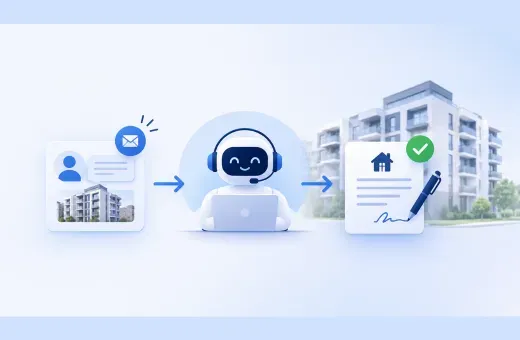
An AI leasing agent differs from a basic website chatbot because it covers the whole path from inquiry to lease, across channels, and connects to your systems. The path looks like this:
| Stage | What the agent does | What your team owns |
|---|---|---|
Inquiry | Replies on arrival, any hour | Setting what it may say |
Questions | Answers from information you approve | Keeping that information correct |
Qualification | Checks prospects against criteria you set | The criteria, and any decision about a person |
Tour | Offers open times and books | Running the tour |
Follow-up | Reminds and follows up | Personal outreach to serious prospects |
Application and lease | Tracks status and coordinates documents | Screening decisions, exceptions and signing |
How does an AI leasing agent work for property managers?

It watches every lead source, responds right away, gathers what it needs, moves qualified prospects toward a tour, and passes the conversation to a person when judgment is needed. Behind the scenes, an AI leasing agent for property management follows a loop:
- Capture: inquiries arrive from listing sites, your website, ads, texts, email and calls.
- Respond: the agent sends a specific reply, not a generic "we'll be in touch."
- Answer: it uses approved information about the unit, pricing, availability, pet rules and policies.
- Qualify: it asks the questions your criteria call for, such as move-in date and budget.
- Schedule: it offers real tour times from your calendar.
- Follow up: it reminds, nudges and re-engages prospects who go quiet.
- Hand off: it passes the full conversation to a person when a human is needed.
- Log: every message and action is recorded in your system.
The sequence is AI-powered leasing automation, but each step has a human setting the rules. The agent works inside your policies. It doesn't write them.
Why does a flat-rent market make an AI leasing agent worth considering?
When rents are flat or falling, vacancy time and conversion become the main drivers of revenue, because you can't count on price growth to cover slow leasing. A vacant day is lost rent you can't recover.
Here's the concern many operators raise: "We operate in a flat-rent market where increasing prices is not an easy way to improve leasing performance. How can an AI leasing agent help us reduce vacancy time by improving inquiry response, prospect engagement, tour bookings, and follow-up?"
Short answer: work the funnel you already pay for. Every inquiry that gets a fast reply, every prospect who gets a tour offer and every no-show who gets a follow-up is a chance to shorten the vacancy. Consider this illustrative math, with hypothetical numbers: a $1,500 unit loses about $49 of rent per vacant day. At the 34-day median above, that unit forgoes roughly $1,676 before a lease starts. If better handling cut vacancy by five days across 100 turns a year, the saved rent would be about $24,600. That is a thought experiment, not a promise, and your own data should replace every number.
Four levers matter in a flat market:
- Response: fewer inquiries lost to silence.
- Engagement: more prospects who keep talking.
- Tour conversion: more conversations that become scheduled visits.
- Follow-up: fewer prospects who vanish between tour and application.
How does an AI leasing agent handle rental leads and leasing inquiries 24/7?
It replies on arrival, answers common questions from approved information and moves interested prospects toward a tour, then hands off to your team when a person is needed. AI rental inquiry management means no inquiry waits for office hours.
Inquiry teams often ask: "I manage several rental properties, and every vacant day affects our revenue. My team cannot respond to every leasing inquiry quickly, especially after hours. How can an AI leasing agent help us capture and convert more prospects without creating a poor renter experience?"
Short answer: make the after-hours reply useful, honest and easy to hand off. A good reply does four things:
- Acknowledges the specific inquiry.
- Answers the question asked, from information you approve.
- Offers tour times that are actually open.
- Says it is an AI assistant and offers a route to a person.
Speed matters, but it isn't the whole story. The first five minutes of lead response are covered in their own guide. What counts here is what happens after the first reply: a fast answer that goes nowhere is just a faster dead end.
What does a day with an AI leasing agent look like?
Here is an illustrative example, not a measured result. A prospect submits an inquiry through a listing site at 10:47 p.m. on a Saturday:
- 10:47 p.m.: the agent replies with the unit's availability and two tour times, and mentions it is an AI assistant.
- 10:52 p.m.: the prospect asks about pets, and the agent answers from the approved pet policy.
- 10:55 p.m.: the prospect books Monday at 5 p.m., and the agent confirms by text and email.
- Sunday: a reminder goes out with directions and a reschedule option.
- Monday 8 a.m.: the leasing agent sees the full conversation and prepares the unit.
- Monday 6 p.m.: after the tour, the leasing agent follows up personally, while the AI sends application next steps.
Without automation, that inquiry would wait until Monday morning, and the prospect may have booked elsewhere. With it, the team arrives to a booked tour and a full record. The people still did the part only people can do: the tour and the relationship.
How does an AI apartment leasing agent differ across apartments, single-family and other rentals?
The core workflow is the same, but tours, availability and rules differ by property type, so set up each one on its own terms. An AI apartment leasing agent works from a unit list at a community with an on-site team. An AI leasing agent for rental properties spread across a city faces different tour logistics.
| Property type | What changes | What to watch |
|---|---|---|
Apartment communities | Many similar units, shared amenities, on-site staff | Keeping unit availability and pricing accurate |
Single-family rentals | Scattered homes, showings that need coordination | Calendars that reflect real travel time |
Build-to-rent | Phased availability and new-construction timelines | Move-in dates that shift |
Affordable and workforce housing | Eligibility rules and documentation | Handing eligibility questions to trained staff |
For an AI leasing agent for apartments, the biggest risk is stale unit data. For scattered rentals it is a calendar that promises times nobody can staff. Whatever the type, the agent should only state what your systems confirm. An AI rental leasing agent is only as reliable as the data it reads.
Can an AI leasing agent convert rental inquiries into signed leases?
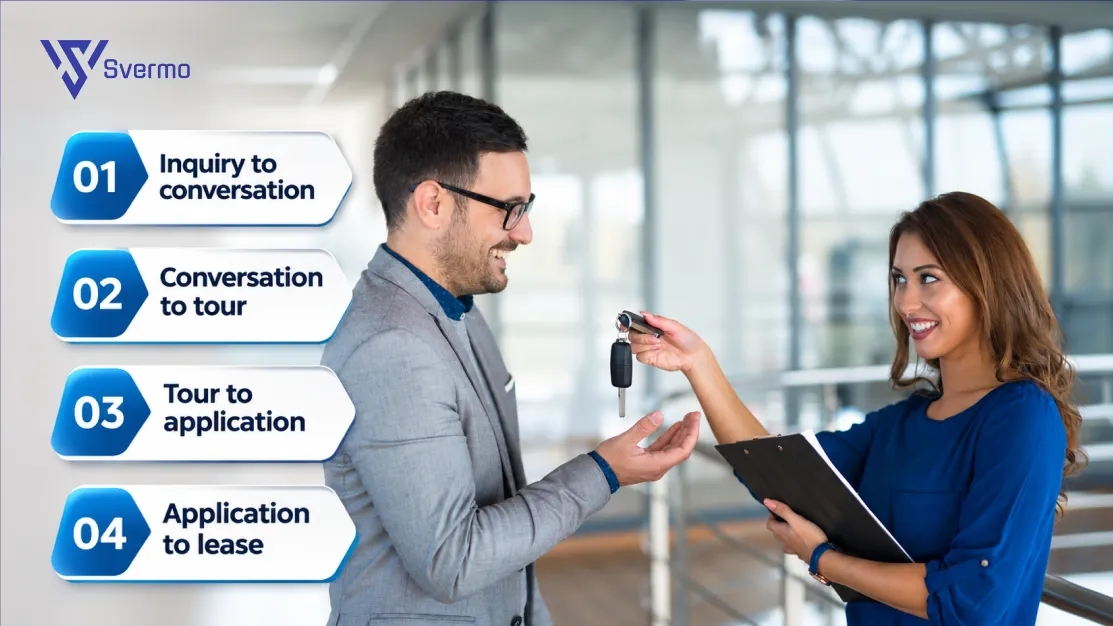
It can improve the steps that lead to a signed lease, but it doesn't sign leases or decide who qualifies. AI rental lead conversion works by removing the places where prospects slip away: slow replies, unanswered questions, tour times that never get booked and follow-ups that never happen.
The honest way to describe the effect is stage by stage:
- Inquiry to conversation: more prospects get a real answer.
- Conversation to tour: more tours are booked because times are offered immediately.
- Tour to application: follow-up keeps interest alive.
- Application to lease: status tracking and document coordination reduce stalls.
No independent figure verified for this guide says how much an AI leasing agent raises lease conversion, so measure it yourself. The metrics section below shows how. AI lead conversion for property management should be judged on your funnel, not on a headline number.
What does AI prospect engagement look like beyond the first reply?
It means keeping the conversation useful: remembering what the prospect said, answering the next question and suggesting the next step. AI prospect engagement for property management is where automated apartment leasing succeeds or fails, because a prospect who feels processed stops replying.
Good engagement has a few traits:
- Memory: it uses details the prospect already gave, such as move-in date, bedrooms and pets.
- Specific answers: it responds to the question asked and not with a generic brochure.
- A clear next step: every message ends with something the prospect can do, such as picking a tour time.
- Easy exits: it offers a person at any point and stops when asked.
The difference shows up in tone:
| Weak message | Stronger message |
|---|---|
"Thanks for your inquiry! We will contact you soon." | "Thanks for asking about the two-bedroom. It is available for a June 1 move-in, and tours are open Tuesday at 4 or Wednesday at 10. Which works?" |
A third identical nudge | A shorter check-in that asks one question |
"Please call the office." | "I can't answer that one. A leasing agent can. Want a callback today or tomorrow?" |
AI lease conversion and follow-up depends on this quality as much as on speed. Review real conversations regularly and rewrite the messages that fall flat.
How do AI lead follow-up and tour scheduling work for property management?
AI follows up by contacting prospects on a schedule you set, using the details they gave, and books tours from your live calendar. AI lead follow-up for property management fixes a familiar problem: prospects who inquire, hear back once and then fall through the cracks.
Leads come from many listing sites and channels, and some never get a timely reply. AI can follow up with every one of them consistently and move qualified renters toward a tour or application. A workable pattern:
| Moment | Automated action | Human step |
|---|---|---|
New inquiry | Instant reply with answers and tour times | None unless the prospect asks for a person |
Tour requested | Confirmation and a calendar entry | Prepare the unit |
Day before the tour | Reminder with directions and a reschedule option | None |
After the tour | Thank-you message and next-step prompt | Personal call for strong prospects |
Silence | A limited number of polite check-ins | Stop on request or after your cap |
Application started | Status updates and missing-document prompts | Review and decisions |
AI tour scheduling for property management works best when the calendar is accurate. A tool that books times your team can't staff creates the poor experience you were trying to avoid. Set a cap on follow-up messages and honor opt-outs immediately.
This is the workflow Leasing AI has: automated tour scheduling based on availability, reminders and confirmations, and lead qualification against criteria you set.
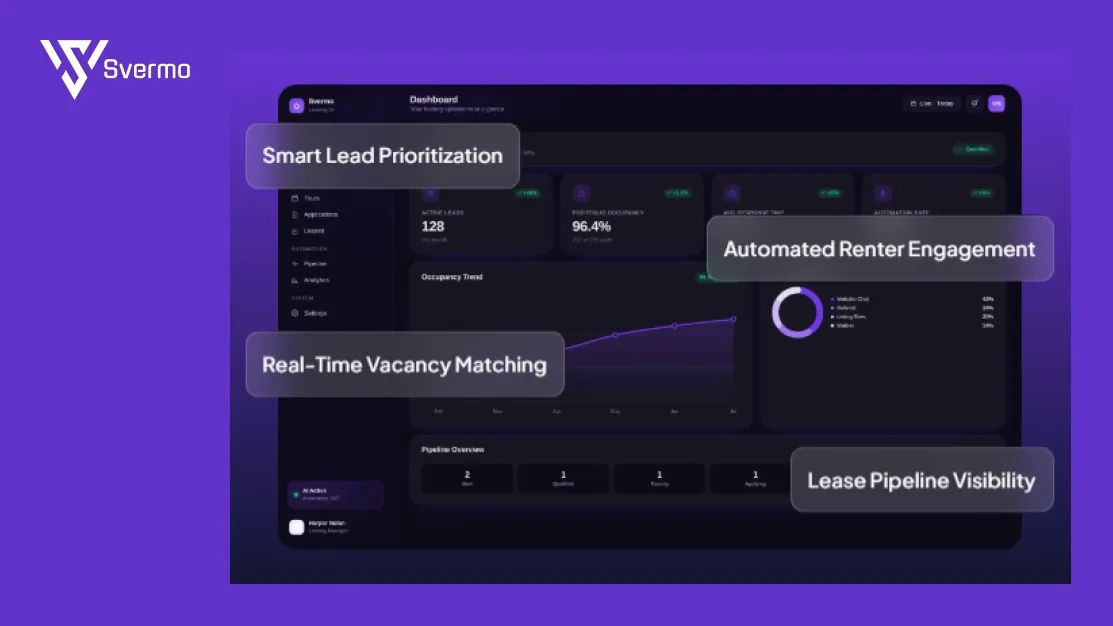
Whichever tool you use, test that its follow-up and scheduling behave this way on your own properties.
Pilot It at One Property Before You Commit
Compare replies, tours and days vacant against your own baseline, with your team reading every conversation.
What data and systems does an AI leasing agent need to work well?
It needs accurate unit availability, pricing, policies, calendars and a place to log every conversation. An AI leasing agent can only be as right as the information it reads, so fix the data before you switch it on.
| Input | Why it matters | Failure to avoid |
|---|---|---|
Property management system | Live availability, pricing and unit details | Quoting a unit that was leased yesterday |
Calendar | Real tour times and staff coverage | Booking slots nobody can staff |
Listing sources | Where inquiries arrive | Leads that never reach the agent |
CRM or lead records | Conversation history and status | Prospects asked the same question twice |
Approved content | Policies, fees, pet and parking rules | The agent improvising an answer |
Document tools | Applications and lease paperwork | Missing-document stalls |
Assign an owner for each input. When a price or policy changes, the person who owns it should update the source the same day, because the agent will repeat whatever it reads.
Renter data deserves care as well. Prospects share names, phone numbers, move dates and sometimes sensitive details. Limit who can see conversations, keep access logs, store only what you need and have your privacy counsel confirm how long to retain records.
What leasing tasks can property managers safely automate with AI?
Automate answering routine questions, scheduling, reminders and status updates. Keep people in charge of decisions about individual applicants, exceptions, legal matters and anything sensitive. Here's the worry behind most hesitation: "I want to automate repetitive leasing tasks, but I am concerned about letting AI make decisions or communicate information it should not. What should an AI leasing agent be allowed to handle, and when should a human leasing professional take over?"
Short answer: use three tiers.
| Tier | Examples | Rule |
|---|---|---|
Automate | Hours, availability, tour times, pet and parking policy from approved text, reminders, status updates | Approved content only, logged |
Automate with review | Qualification summaries, lead scoring, follow-up drafts for sensitive cases | A person reviews before action |
Keep human | Screening and approval decisions, fee waivers, reasonable accommodation requests, disputes, legal questions, complaints | Hand off immediately |
Set clear handoff triggers so the agent knows when to stop:
- The prospect asks for a person.
- The question involves disability, accommodation, discrimination or legal rights.
- The prospect is upset, confused or repeating themselves.
- The agent can't answer from approved information.
- A decision about a specific applicant is needed.
Leasing AI features human-in-the-loop overrides and audit trail logging among its controls, so the agent can hand a conversation to your leasing team whenever personal assistance is needed. It doesn't describe how triggers are configured, so ask how your rules would be set.
What should happen when the AI Leasing Agent for Property Managers doesn't know the answer? It should say so, avoid guessing and hand the question to a person with the conversation attached. A confident wrong answer about a fee, a policy or availability costs more than a short delay.
Build a simple quality routine so the rules stay honest:
- Daily at first: read a sample of conversations, especially handoffs.
- Weekly: review the questions the agent couldn't answer and add approved answers.
- Monthly: check for uneven treatment, complaints and opt-outs, and update scripts.
- After any policy change: update the approved content before the next conversation.
What do Fair Housing and consent rules mean for an AI leasing agent?
Fair housing law applies to AI exactly as it applies to your staff, and messaging rules apply to automated calls and texts. Have counsel review your setup, because rules vary by state and by how you communicate.
Fair housing is the first concern. The Fair Housing Act protects people on the basis of race, color, national origin, religion, sex, familial status and disability. The statute's rental provisions, at 42 U.S.C. § 3604, bar refusing to rent or negotiate, offering different terms or conditions, publishing statements or advertisements showing a preference or limitation, and telling someone a unit is unavailable when it isn't. For an AI agent, that means:
- Consistent answers: every prospect gets the same information about availability and terms.
- No steering: the agent must not suggest or discourage units, areas or communities based on a protected characteristic.
- Careful language: approved scripts should avoid statements that express a preference or limitation.
- Human handling of accommodations: requests related to disability go to a person.
- Testing: review conversations across different kinds of prospects to look for uneven treatment.
Messaging is the second. The FCC has ruled that the Telephone Consumer Protection Act's limits on artificial or prerecorded voice calls also cover AI technologies that generate human voices, so a call using such a voice needs the called party's prior express consent. Text and email carry their own consent and opt-out expectations. Record consent, honor opt-outs and have counsel confirm your practice.
Disclosure is the third. Some states regulate bots that communicate with consumers. California's bot law is one example, and other states have been adding AI disclosure rules. Whether they reach leasing messages depends on the law and the facts, so ask counsel. Telling prospects plainly that they are talking with an AI assistant is good practice either way.
How should property managers use AI without replacing their leasing team?
Let AI take the routine conversations and the first touch, and let your team spend time on tours, relationships and decisions. If your team spends too much time answering the same property questions and following up by hand, use the agent for that repeated work and move your people to where human judgment adds value:
- AI handles: the first reply, common questions, scheduling, reminders and routine follow-up.
- Leasing agents handle: tours, objections, negotiation within policy, difficult conversations and closing.
- Managers handle: rules, exceptions, quality review and results.
A good handoff includes the full conversation, what the prospect wants, what has been answered and what remains. Nobody should have to ask a prospect to repeat themselves.
Which metrics show whether an AI leasing agent is working?
Track the funnel from inquiry to signed lease, split by lead source and property, and compare before and after. The point of measuring is to learn whether AI is improving results or just answering questions.
| Metric | What it shows |
|---|---|
Time to first useful reply | Whether response gaps closed |
Share of inquiries that get a reply | Coverage, including after hours |
Prospect engagement rate | Whether the first message landed |
Tours booked per inquiry | Conversion to the first real commitment |
Tour show rate | Whether reminders and confirmations help |
Applications per tour | Whether follow-up keeps interest alive |
Leases per inquiry | The result that matters |
Days vacant | The revenue effect |
Handoff rate and reasons | Where AI stops and people step in |
Complaints and opt-outs | Renter experience and compliance |
Run a fair test. Compare like with like, such as the same lead source and property type. Compare the period before AI with the period after, or pilot at some properties while using others as a baseline. Allow enough volume before drawing conclusions, and remember that seasonality and market shifts also move the numbers.
How do you roll out AI leasing workflow automation?
Start with one property or portfolio, one set of approved answers and clear handoff rules, then expand as results come in. An AI Leasing Agent for Property Managers succeeds when the rules are settled before the technology goes live.
- Pick the pilot: a property with steady inquiry volume and a clear baseline.
- Write the approved answers: policies, pricing, availability, tour rules.
- Set handoff rules: when and to whom.
- Connect systems: property management, calendar, CRM and listing sources.
- Test internally: have your team try difficult questions.
- Go live with review: read conversations daily at first.
- Measure and adjust: compare funnel metrics with the baseline.
- Expand: add properties and workflows as trust builds.
Who uses AI leasing agents, and for what?
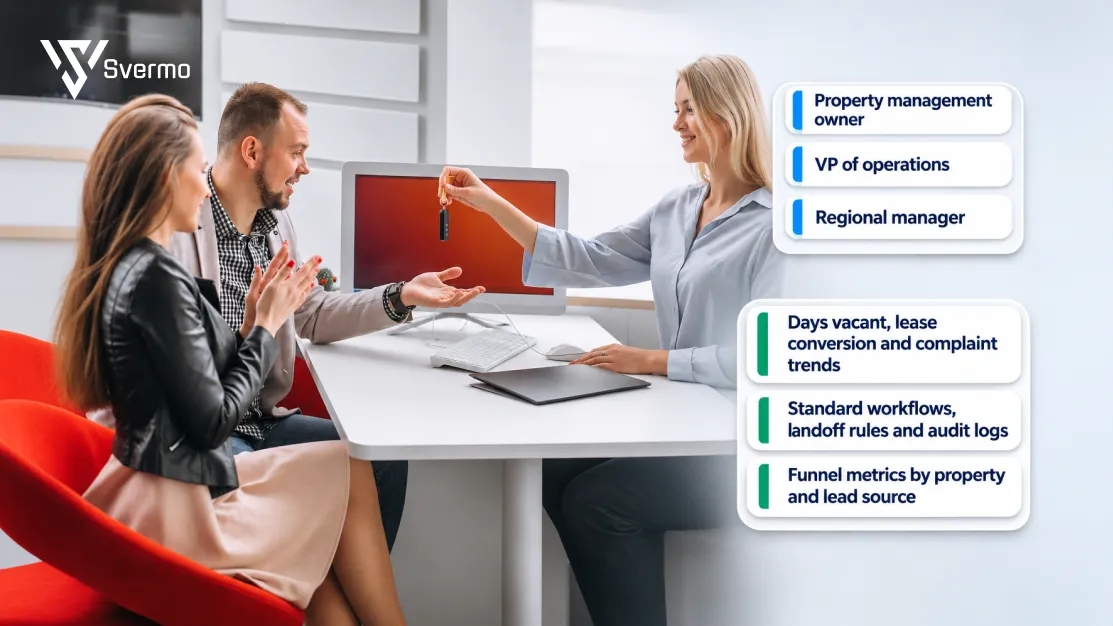
Owners, VPs of operations and regional managers use them for different goals, and each needs a different view of the results.
| Role | Main question | What they need |
|---|---|---|
Property management owner | Are we filling units faster without hurting reputation? | Days vacant, lease conversion and complaint trends |
VP of operations | Can we run consistent leasing across properties safely? | Standard workflows, handoff rules and audit logs |
Regional manager | Which communities are losing prospects, and why? | Funnel metrics by property and lead source |
Each role also carries a different risk. Owners worry about reputation, operations leaders about consistency and compliance, and regional managers about the community that quietly lags. A shared dashboard and one set of approved rules let all three look at the same facts.
What mistakes do property managers make with AI leasing agents?
Most problems come from rollout. Watch out for these:
- Skipping approved content: the agent says things nobody reviewed.
- No handoff rules: prospects get stuck in a loop.
- Unstaffed tour slots: the calendar offers times your team can't cover.
- Measuring only replies: a reply isn't a lease.
- Ignoring consent and disclosure: it creates legal and reputation risk.
- Never reading the conversations: problems stay hidden until a complaint arrives.
- Replacing people instead of freeing them: renters notice.
What should you look for in an AI leasing assistant for property management?
Look for approved-content controls, clear handoff, calendar and system integration, audit logs and evidence from a pilot. AI leasing automation for property management varies widely, so check these areas:
| Area | Ask | Warning sign |
|---|---|---|
Content control | Can I approve what the agent may say? | It improvises answers |
Handoff | Can I set triggers, and does the full conversation transfer? | A bare "contact us" |
Fair housing | How is consistent treatment tested? | A label with no detail |
Consent and disclosure | How are opt-outs and AI disclosure handled? | No answer |
Integration | Which property management, calendar and CRM systems connect? | Manual re-entry |
Channels | Which of SMS, email, chat and voice are supported? | One channel only |
Audit | Are conversations and actions logged? | No history |
Reporting | Can I see the funnel by source and property? | Reply counts only |
Pilot | Can I test it on my own properties? | Demo only |
Leasing AI lists responses to renter inquiries within minutes, 24/7, across SMS, email, chat and voice, automated tour scheduling with reminders, lead qualification against criteria you set, application status tracking, lease document coordination, human-in-the-loop overrides and audit trail logging.
The table below shows what it states against the checklist. The gaps are the questions to put to Svermo in a pilot, as with any tool.
| Checklist area | What Leasing AI states | Ask in a pilot |
|---|---|---|
Content control | Nothing on how approved answers are set | Can I approve and update what it may say? |
Handoff | Conversations can pass to your team; human-in-the-loop overrides listed | How are triggers set, and does the full conversation transfer? |
Fair housing | A "Fair Housing–aligned AI scoring" label, no method described | How is consistent treatment tested and reviewed? |
Consent and disclosure | Not stated | How are opt-outs and AI disclosure handled? |
Integration | Eight categories, including property management, CRM, listing portals, calendar, email, SMS and document tools; no named products | Which specific systems connect to mine? |
Channels | SMS, email, chat and voice | Which are live in my setup? |
Audit | Audit trail logging listed | What exactly is logged, and for how long? |
Reporting | Leasing pipeline visibility and vacancy insights listed | Can I see the funnel by source and property? |
Pilot | Not stated | Can I test it on my own properties first? |
See How Leasing AI Handles Inquiries, Tours and Handoffs
Walk through inquiry response, tour scheduling, lead qualification and human-in-the-loop overrides.
Is Your Vacancy Waiting on a Reply?
An unanswered rental inquiry is a lot like an open house with the lights off: the unit is there, but nobody can tell. Let AI Leasing Agent for Property Managers answer first and follow up consistently, keep people in charge of decisions and measure the funnel until the numbers say whether it is working.
Want to talk through how this could work at your properties? Reach out to the Svermo team.
 https://www.linkedin.com/in/saanvi-verma-38711a36a
FAQs
No. It handles routine conversations and follow-up. People handle tours, negotiation, decisions about applicants and sensitive situations.
A chatbot answers questions on a website. An AI leasing agent covers the path from inquiry to lease across channels, books tours, follows up and connects to your systems.
Yes, the workflow applies to apartments and other rental properties, though rules, availability and tour logistics differ. Test it on each property type.
It shouldn't decide on individual applicants. Keep screening and approval decisions with trained people following consistent criteria.
Yes. It can reply, answer common questions and offer tour times at any hour, then hand off to your team when needed.