

Best AI Real Estate Mobile Apps: Features, Benefits, Use Cases, and How They Transform Property Operations


Get a summary of this article with your favorite AI





AI Summary
- •The best AI real estate mobile apps centralize property operations, lead management, and customer communication.
- •Modern AI apps combine automation, mobile access, and real-time insights.
- •Choose apps based on features, AI capabilities, integrations, and scalability.
- •AI improves property search, leasing, workflows, and overall efficiency.
- •Investing in leading mobile AI platforms for modern real estate operations and management supports future growth.
- •AI product-led companies like Svermo help businesses adopt purpose-built AI solutions for automation and growth.
What is helping leading real estate businesses manage listings, leads, customer communication, property operations, and portfolio activities from anywhere?
Increasingly, the answer is the best AI real estate mobile apps.
Real estate professionals are no longer tied to office desks or fragmented software systems. Agents respond to prospects between showings. Brokers monitor pipelines on the move. Property managers coordinate maintenance requests and tenant communication. As a result, mobile-first technology has become a business necessity.
The shift is also driven by changing customer behavior. According to a report, 79% of buyers installed a real estate app during their homebuying journey, and 86% installed an app before contacting an agent, touring properties, or obtaining pre-approval.
That trend extends beyond property search. Today's best AI real estate mobile apps for property operations help businesses centralize listings, communication, lead management, workflow automation, and operational oversight in one platform. Instead of disconnected systems, teams work from a mobile-first environment that improves visibility, productivity, and responsiveness.
The industry's direction is reflected in Zillow CEO Jeremy Wacksman's perspective:
"We're connecting the entire housing journey with AI in a way that hasn't been possible before."
As organizations look for smarter ways to streamline operations and deliver better customer experiences, interest continues to grow in solutions recognized among the best AI platforms for real estate agents.
Svermo stands at the forefront of this transformation, combining advanced AI, mobility, automation, and operational intelligence to empower real estate professionals across every stage of the property lifecycle.
Its enterprise-focused approach helps agencies improve efficiency, accelerate decision-making, and deliver exceptional client experiences at scale.
So, what actually are these AI real estate mobile apps and why are they gaining popularity?
Ready to Simplify Your Real Estate Operations?
See how AI can reduce manual work and help your team operate more efficiently.
What are the AI Real Estate Mobile Apps and Why They Becoming Essential to Real Estate Firms in USA?
Most traditional real estate applications were designed to solve individual problems. One platform managed listings, another tracked leads. A separate system handled customer relationships, while property operations, reporting, and communication often lived elsewhere.
Unlike traditional applications, AI real estate mobile apps are built around workflows rather than functions. Instead of treating listings, customer communication, lead management, and property operations as separate activities, they connect them into a continuous process.
This is why many organizations now view these platforms as an AI-powered property operations platform rather than just another real estate application. Here is the clear comparison:
| Traditional Real Estate Apps | AI Real Estate Apps |
|---|---|
Built around individual functions | Built around end-to-end workflows |
Information stored across multiple systems | Centralized operational environment |
Manual follow-ups and task management | Automated workflows and intelligent actions |
Limited real-time visibility | Real-time updates and insight |
Reactive decision-making | Data-driven recommendations |
Desktop-first experience | Mobile-first experience |
The real advantage is not that these platforms work on a smartphone. The property management and automation advantages that AI real estate apps bring helps your team to manage listings, customer interactions, operational tasks, and property activities from a single environment without losing context.
For agents, that means fewer missed opportunities.
For brokers, it means greater visibility across teams and pipelines.
For property managers, it means smoother coordination across properties, tenants, vendors, and maintenance operations.
As mobile-first platforms continue to evolve, the next question becomes even more important: what actually happens behind the scenes?
Behind the Screen: How AI Real Estate Mobile Apps Power Smarter Property Operations?
If traditional real estate software focuses on storing information, how do best AI real estate mobile apps for property operations actually turn that information into real action?
The answer lies in a structured flow. Data is collected, analyzed, converted into decisions, and executed through automated workflows. Each step works together so teams spend less time coordinating systems and more time focusing on outcomes.
1. Data Collection and Unification
Every real estate business generates information from multiple touchpoints. The challenge is not availability of data but fragmentation across systems.
AI real estate mobile apps begin by consolidating all inputs into a single environment so nothing is missed or delayed. This creates the foundation of a mobile-first real estate operations platform where everything stays connected.
Typically, the system gathers and organizes:
- Property listings and updates from multiple channels
- Customer inquiries from mobile and web sources
- Tenant requests and maintenance tickets
- CRM records and interaction history
- Contracts, documents, and transaction data
All information is continuously synchronized, creating a single source of operational truth for the business.
2. AI Analysis and Context Understanding
Once information is unified, the platform processes it to understand meaning and intent. This becomes the core of an AI-powered property operations platform where raw data turns into actionable intelligence.
At this stage, the system evaluates patterns and priorities across operations.
Key activities include:
- Identifying high-intent leads based on engagement signals
- Understanding customer preferences from behavioral data
- Detecting urgent operational or maintenance issues
- Grouping related requests for efficient handling
- Prioritizing tasks based on business impact
Each input is no longer treated as isolated data. Context is applied to determine what matters most.
3. Automated Decisions and Workflow Execution
After analysis, the system begins executing actions without manual coordination between tools or teams.
Workflows are triggered automatically based on predefined logic and AI-driven insights, a key capability of intelligent real estate workflow automation systems.
Typical executions include:
- Assigning leads to the most suitable agent
- Sending instant responses to new inquiries
- Scheduling follow-ups and property visits
- Routing maintenance requests to relevant teams or vendors
- Updating CRM records and tracking activity progress
Operational steps move forward without waiting for manual handoffs between departments.
4. Continuous Learning and Optimization
As the system operates, it continuously improves based on outcomes and usage patterns. Each interaction helps refine future decisions.
Optimization generally includes:
- Improved lead scoring based on conversion behavior
- More accurate property recommendations for clients
- Smarter timing for follow-ups and engagement
- Better workflow routing based on past performance
- Enhanced prioritization of operational tasks
Performance becomes more aligned with real business behavior over time.
5. Unified Operational Execution
When all components work together, modern best AI real estate mobile apps shift operations from fragmented task management to a connected system of execution.
Rather than managing separate applications for different activities, teams operate from a single environment that keeps information, communication, and workflows aligned.
This unified approach typically enables:
- A centralized view of listings, customers, and property operations
- Real-time visibility into ongoing activities and performance
- Seamless collaboration between agents, brokers, and property managers
- Faster decision-making supported by connected data and insights
- Consistent workflows across customer engagement and property management processes||
Teams gain a consistent view of operations without switching between tools or manually coordinating updates.
Modern leading AI real estate apps for property operations and portfolio management function as this unified layer where data, intelligence, and execution come together in one mobile-first environment.
The next focus shifts toward where these capabilities create the most impact across real estate businesses in real-world scenarios.
Where Are AI Real Estate Mobile Apps Actually Used in Day-to-Day Property Operations?
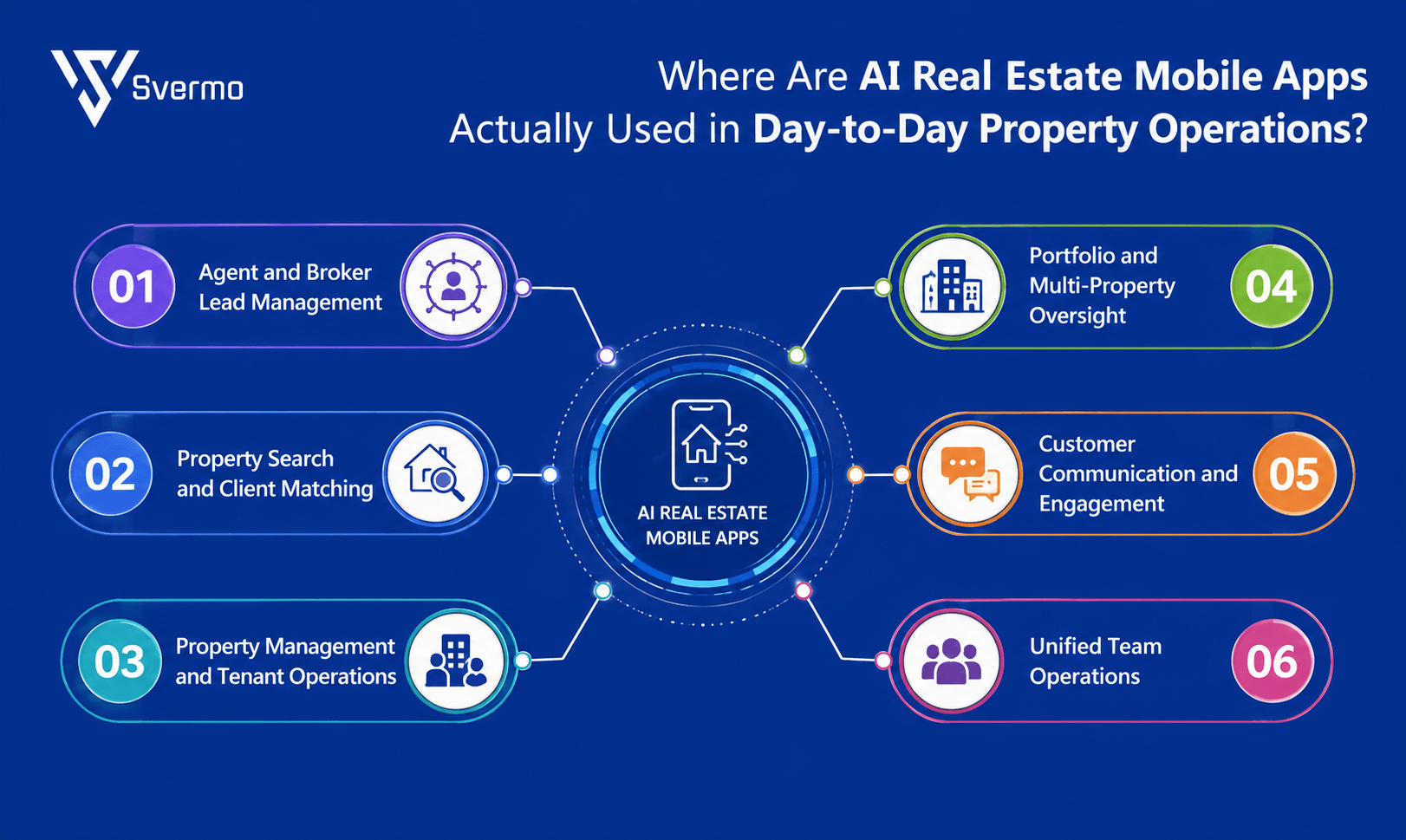
Once the operational model becomes clear, the practical question follows.
Where do best AI real estate mobile apps for property operations actually create measurable impact inside daily real estate workflows?
The answer spans every major function, from lead handling to property management and portfolio oversight. These are not theoretical concepts. They reflect how real estate teams actively use mobile-first platforms to manage operations in real time.
1. Agent and Broker Lead Management
AI real estate mobile apps help capture leads instantly, assess intent, and ensure the right agent is notified without manual effort. The entire process moves quickly so that prospects are not left waiting.
Example: In a typical scenario using an AI real estate mobile app, a buyer submits an inquiry on a listing late in the evening. The AI-powered real estate mobile platform immediately captures the lead, analyzes intent signals, and assigns it to the right agent. The agent receives a mobile notification with full context before the next working hour, allowing follow-up without delay.
This reflects how best AI mobile apps for real estate lead generation and follow-up automation support faster response cycles and improved conversion consistency.
2. Property Search and Client Matching
AI real estate mobile apps help agents deliver this experience by continuously matching listings with client behavior, budget, and location preferences. The process feels more like a guided journey than a manual search.
Example: An agent using an AI real estate mobile app in Miami can instantly share curated property options with a client based on budget, location, and behavior patterns. As the client interacts with listings inside the app, recommendations update automatically in real time.
This is powered by a smart property search and recommendation engine, which helps agents reduce manual search effort while improving match accuracy.
3. Property Management and Tenant Operations
AI-powered platforms help organize these requests, assign responsibility automatically, and keep all stakeholders updated in real time. This reduces manual coordination and improves operational clarity.
Example: Through an AI real estate mobile app, a tenant submits a maintenance request for a plumbing issue. The AI real estate mobile app categorizes the request, assigns it to an approved vendor, and updates both tenant and property manager inside the app at every stage of resolution.
This is where best AI-powered real estate apps for property managers help streamline operational coordination and reduce manual intervention.
4. Portfolio and Multi-Property Oversight
AI real estate mobile apps consolidate this information so decision-makers can see what is happening across all properties in one place. This helps identify issues early and supports faster strategic decisions.
Example: In a real estate mobile app dashboard, an asset manager overseeing a portfolio of residential buildings can instantly view occupancy rates, revenue trends, and maintenance activity. Instead of waiting for weekly reports, decisions are made using live operational data directly inside the app.
This capability is commonly found in leading AI real estate apps for property operations and portfolio management, especially for scaling real estate organizations.
5. Customer Communication and Engagement
Clients and tenants expect instant responses, especially when they are actively exploring properties or waiting on updates.
AI apps help maintain this responsiveness through automated engagement tools that can handle conversations, answer queries, and move interactions forward without delay.
Example: A prospective tenant messages a property listing at night through an AI real estate mobile app. The built-in assistant responds instantly, answers questions, qualifies interest, and schedules a viewing for the next available slot without human delay.
This reflects how AI-driven real estate customer engagement helps teams stay responsive while reducing manual communication load.
6. Unified Team Operations
Real estate operations often become inefficient not because of poor effort, but because teams are spread across different tools and systems. This creates gaps in communication and slows down coordination.
AI real estate mobile apps bring these workflows into a shared environment where teams can stay aligned in real time.
In a growing agency using an AI real estate mobile app, one team manages listings, another handles tenants, and another track leads. Instead of working in separate tools, all updates flow through a shared mobile platform where communication, tasks, and progress are synchronized.
This is a practical example of how leading AI real estate mobile apps for modern real estate operations and management reduce operational silos and improve coordination across teams.
With these real-world implementations in mind, the next focus shifts toward what actually separates an advanced AI-powered platform from basic real estate app.
What Could AI Automate for Your Business Next?
Let's explore where AI can create the biggest operational impact across your real estate workflows.
What Core Features Truly Powers the Best AI Real Estate Mobile Apps Behind the Scenes?
Every AI real estate mobile app promises to improve productivity, but not every platform delivers the capabilities that real estate businesses actually need.
If you're evaluating the best AI real estate mobile apps, look beyond AI buzzwords and focus on the core features that support day-to-day operations. Whether you're an agent, broker, property manager, or operations leader, these are the foundational capabilities every modern platform should offer.
| Core Feature | What It Means | Why It Matters |
|---|---|---|
Property Listings Management | Create, edit, publish, and update property listings from a single mobile interface while keeping listing information synchronized across channels. | Ensures your inventory stays accurate, reduces duplicate work, and helps agents respond to buyers faster. |
Property Search & Discovery | Help buyers and agents quickly find relevant properties using intelligent filters, maps, and recommendations. Many businesses now rely on a real estate AI property search engine to make property discovery faster and more relevant. | Delivers a better search experience while reducing the time spent manually matching properties with client requirements. |
Lead & Contact Management | Capture, organize, and track inquiries from websites, listing portals, campaigns, and referrals in one place. | A must-have capability in the best AI mobile apps for real estate lead generation and follow-up automation, helping teams respond faster and improve conversion rates. |
CRM & Customer Profiles | Maintain complete customer profiles, communication history, buying preferences, and transaction records throughout the relationship lifecycle. Modern real estate CRM software combines customer management with operational intelligence. | Gives agents and brokers complete customer visibility, enabling more personalized communication and stronger relationships. |
Property Management | Manage tenants, leases, maintenance requests, inspections, vendors, and property records from a single platform. | One of the most important capabilities in the best AI-powered real estate apps for property managers, helping reduce manual coordination and improve operational efficiency. |
Workflow & Task Management | Automate task assignments, approvals, reminders, inspections, and operational workflows across departments. | Keeps projects moving without constant manual follow-ups and supports intelligent real estate workflow automation across the business. |
Communication Center | Centralize calls, emails, messages, appointment scheduling, and customer conversations within the app. Platforms often integrate an AI chatbot & voice assistant to handle inquiries around the clock. | Improves response times, strengthens AI-driven real estate customer engagement, and ensures no customer inquiry goes unanswered. |
Document Management | Securely store contracts, lease agreements, inspection reports, disclosures, and other property documents in one place like an AI document management software to simplify document handling. | Eliminates paperwork, improves accessibility, and helps teams retrieve important documents from anywhere. |
Reporting & Analytics | Provide dashboards for occupancy, sales performance, pipeline health, maintenance activities, and operational KPIs. | Helps decision-makers identify trends quickly and improve business performance using real-time insights. |
These capabilities represent the operational foundation of trusted AI-powered mobile apps for real estate businesses and property managers. Once these essentials are in place, advanced AI capabilities become far more valuable because they build on a connected, well-structured platform rather than disconnected systems.
So, once the fundamentals are covered, which advanced AI features truly separate market-leading platforms from the rest?
Which Advanced AI Features Make the Best AI Real Estate Mobile Apps Future-Ready?
Core features help real estate teams manage their daily operations. Advanced AI features take those operations a step further by helping businesses predict outcomes, uncover opportunities, and automate complex decisions.
If you're comparing the best AI real estate mobile apps, these are the capabilities that separate innovative platforms from traditional mobile solutions.
| AI Feature | How It Works | Business Value |
|---|---|---|
Predictive Lead Scoring | AI evaluates customer behavior, inquiry history, engagement patterns, and buying signals to identify which prospects are most likely to convert. | Helps agents prioritize high-value opportunities, improving productivity and supporting best AI mobile apps for real estate lead generation and follow-up automation. |
Behavior-Based Property Recommendations | AI continuously refines property recommendations by learning from customer interactions, saved listings, search history, and changing preferences instead of relying only on search filters. | Creates a highly personalized buying experience and strengthens best AI real estate apps with intelligent property recommendations and automation. |
Generative Listing & Marketing Content | AI automatically creates property descriptions, listing summaries, social media captions, email campaigns, and promotional content directly within the app. | Reduces content creation time while helping agents market properties more consistently across channels. |
AI Property Valuation Intelligence | AI analyzes comparable sales, neighborhood trends, market demand, and historical pricing patterns to generate more accurate property value estimates. Many businesses leverage real estate property valuation intelligence to support pricing strategies. | Supports better investment decisions, pricing accuracy, and market competitiveness. |
Market Trend Intelligence | AI monitors market activity, inventory levels, buyer demand, pricing fluctuations, and local trends to identify emerging opportunities before they become obvious. | Helps brokers, agencies, and investors make proactive business decisions based on real-time market intelligence. |
Predictive Portfolio Intelligence | AI analyzes occupancy trends, rental performance, operational costs, and asset performance to forecast future risks and opportunities across property portfolios. | Supports organizations using leading AI real estate apps for property operations and portfolio management by enabling long-term portfolio optimization. |
AI Document Intelligence | Instead of simply storing documents, AI extracts important information, summarizes contracts, highlights missing clauses, and enables intelligent document search. Businesses often extend this capability with AI document management software for faster document processing. | Improves compliance, reduces manual document review, and accelerates operational workflows. |
Natural Language Business Insights | Users can ask questions such as "Which properties generated the most qualified leads this month?" and receive AI-generated insights without creating manual reports or dashboards. | Makes business intelligence more accessible for executives, brokers, and operations leaders while supporting faster decision-making. |
Predictive Maintenance Intelligence | AI identifies recurring maintenance patterns, equipment health trends, and potential service issues before they become costly repairs. | Helps property managers reduce maintenance costs, minimize downtime, and improve tenant satisfaction. |
AI Workflow Optimization | AI continuously monitors how teams complete operational processes and recommends smarter workflows, automation opportunities, and resource allocation based on usage patterns. | Enhances digital property management and automation by continuously improving operational efficiency as the business grows. |
These advanced capabilities are transforming trusted AI-powered mobile apps for real estate businesses and property managers into intelligent business platforms. Rather than simply helping teams complete tasks, they provide the insights and automation needed to make faster decisions, improve customer experiences, and scale operations more efficiently.
Now that we've figured out both the core and advanced features, which AI real estate mobile apps deliver the right combination of functionality, intelligence, and mobile experience for different real estate businesses?
Which are the Best AI Real Estate Mobile Apps for Modern Property Operations?
Choosing the best AI real estate mobile apps depends on how your business operates. Some platforms are designed to simplify property search and lead generation, while others focus on leasing, investment analysis, or day-to-day property operations.
If you're evaluating the best AI real estate mobile apps for property operations, consider how well each platform aligns with your business goals, whether that's managing listings, nurturing leads, improving customer engagement, or streamlining operational workflows. Here are the best ones we have selected for you:
1. Zillow
Zillow has evolved from a property search app into a comprehensive real estate platform that uses AI to deliver personalized property recommendations, improve search experiences, and connect buyers with agents more efficiently. It remains one of the top-rated AI real estate apps for property search and lead management in the U.S. market.
Core capabilities:
- Property recommendations based on user preferences
- Intelligent property search with advanced filters
- Zestimate home value estimates
- Buyer and seller lead generation
- Saved searches and instant property alerts
- Agent discovery and customer communication
Best suited for:
Homebuyers, real estate agents, and brokerages focused on residential property transactions.
2. Redfin
Redfin combines property search, brokerage services, and AI-driven recommendations within a mobile-first experience. The platform helps buyers make faster decisions while giving agents access to customer activity and market insights, making it one of the best AI real estate mobile apps for agents and brokers.
Core capabilities:
- Personalized property recommendations
- Interactive map-based property search
- Real-time listing updates
- Home value estimates
- Tour scheduling through the mobile app
- Customer collaboration and saved property tracking
Best suited for:
Residential agents, buyers, and brokerages managing client property searches.
3. Apartment List
Apartment List focuses on the rental market by matching renters with suitable apartments using AI-driven recommendation models. Instead of browsing thousands of listings, renters receive personalized suggestions based on their lifestyle and preferences.
Core capabilities:
- Intelligent apartment recommendations
- Personalized renter matching
- Budget and lifestyle-based filtering
- Rental availability updates
- Favorite property tracking
- Guided apartment discovery experience
Best suited for:
Property managers, leasing teams, and renters searching for residential apartments.
4. DealMachine
DealMachine is widely used by real estate investors looking to discover off-market opportunities directly from their mobile devices. Its AI capabilities help organize property data, prioritize opportunities, and improve lead management throughout the acquisition process.
Core capabilities:
- Off-market property identification
- Driving-for-dollars property tracking
- Lead organization
- Owner contact information lookup
- Property marketing campaigns
- Investment pipeline management
Best suited for:
Real estate investors, wholesalers, and investment agencies.
5. PropStream Mobile
PropStream Mobile gives investors and real estate professionals access to nationwide property intelligence while working in the field. It combines property research with AI-assisted analysis to support investment decisions, making it one of the leading AI mobile apps for real estate property operations focused on market research and acquisitions.
Core capabilities:
- Property and owner data search
- Investment opportunity analysis
- Comparable sales research
- Property history and ownership insights
- Lead management
- Mobile property prospecting
Best suited for:
Investors, brokers, and agencies focused on acquisitions and market research.
6. HomeAgent AI
HomeAgent AI serves as an intelligent mobile assistant for real estate professionals by helping automate customer interactions, organize information, and improve day-to-day productivity. It is particularly useful for agencies looking for recommended AI real estate apps for brokers and real estate agencies that simplify customer engagement.
Core capabilities:
- Automated customer conversations
- Property recommendation support
- Lead qualification
- Listing information retrieval
- Appointment scheduling
- Customer follow-up automation
Best suited for:
Individual agents, brokerages, and growing real estate teams.
7. ChatAPT
ChatAPT is designed specifically for multifamily property management and leasing operations. The platform automates renter communication while helping leasing teams respond faster to inquiries, making it a strong choice among best AI-powered real estate apps for property managers.
Core capabilities:
- Automated leasing conversations
- Prospect qualification
- Property question handling
- Tour scheduling
- Resident communication
- Lead nurturing throughout the leasing process
Best suited for:
Multifamily property managers, leasing teams, and apartment communities.
8. Bowerbird AI Real Estate Agent
Bowerbird AI Real Estate Agent acts as an intelligent assistant that helps agents manage client interactions, property information, and daily workflows from a single mobile experience. It supports agencies looking for trusted AI real estate mobile apps for managing listings and client interactions while improving productivity.
Core capabilities:
- Automated property recommendations
- Customer communication support
- Lead organization and follow-up
- Market information assistance
- Property information retrieval
- Daily productivity support for agents
Best suited for:
Independent agents, brokers, and agencies looking to improve customer engagement and operational efficiency.
Each of these platforms addresses different business needs. Some focus on property discovery, while others help streamline leasing, investment analysis, or customer engagement. The right choice depends on whether your priority is property search, portfolio growth, lead management, or building a mobile-first real estate operations platform that supports long-term business growth.
So, with several strong options available, how can you compare them side by side to identify the right AI real estate mobile app for your business?
How Do You Choose the Right AI Real Estate Mobile App Without Guesswork?
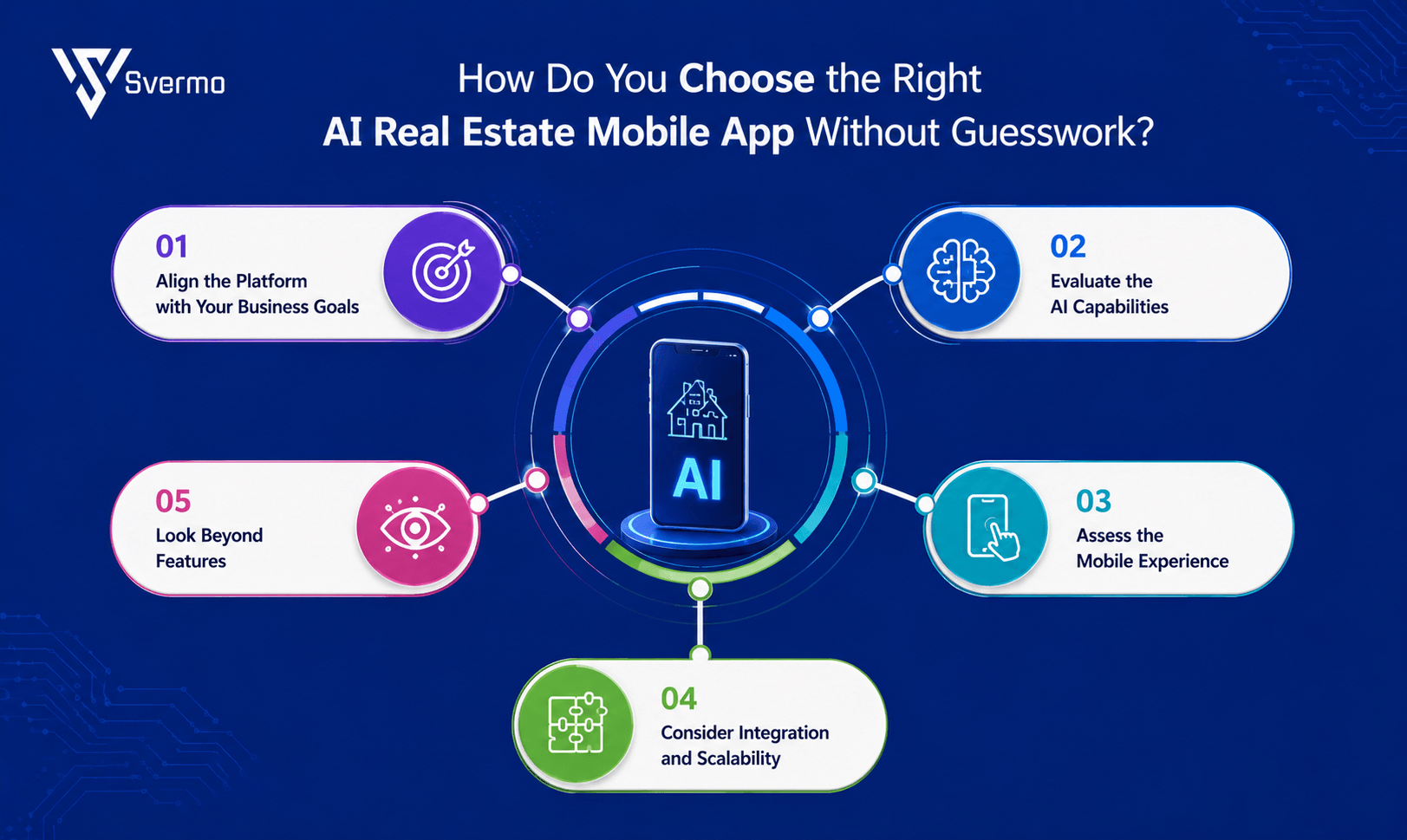
With so many AI real estate mobile apps available, comparing feature lists alone isn't enough. The right platform should solve today's operational challenges while supporting your business as it grows.
Whether you're evaluating solutions for an agency, brokerage, or property management company, consider the following factors before making a decision.
1. Align the Platform with Your Business Goals
Start by identifying the problems you want to solve. A platform that works well for an independent agent may not meet the needs of a growing property management company.
Before investing, ask whether the app can help you:
- Improve lead generation and follow-up
- Manage property listings more efficiently
- Strengthen customer communication
- Simplify property management operations
- Support long-term business growth
If your primary focus is improving agent productivity, then the best AI platforms for real estate agents can also help you understand how mobile apps fit into your broader technology stack.
2. Evaluate the AI Capabilities
Not every app that claims to use AI delivers meaningful business value. Look beyond marketing claims and understand how AI contributes to daily operations.
Check whether the platform can:
- Recommend relevant properties based on customer behavior
- Prioritize high-intent leads automatically
- Automate follow-ups and routine communication
- Generate operational insights from business data
- Improve decision-making with predictive analytics
These capabilities are often what separate trusted AI-powered mobile apps for real estate businesses and property managers from traditional software.
3. Assess the Mobile Experience
Since your teams spend much of their time away from the office, the mobile experience should support complete workflows rather than provide limited access.
Look for an app that allows users to:
- Manage listings and customer information
- Respond to inquiries from anywhere
- Track tasks and operational updates
- Access reports and business insights
- Collaborate with team members in real time
A true mobile-first real estate operations platform should allow work to continue seamlessly, regardless of location.
4. Consider Integration and Scalability
Your AI real estate mobile app should fit naturally into your existing technology ecosystem instead of creating another isolated system.
Before selecting a platform, confirm that it can:
- Integrate with your CRM and property management software
- Connect with marketing and communication tools
- Scale as your portfolio or team expands
- Support multiple users, offices, or business locations
- Adapt to future operational requirements
Choosing a scalable solution today helps avoid costly migrations later.
5. Look Beyond Features
A long feature list doesn’t always lead to better results. What matters is how effectively the app improves daily operations and decision-making.
Instead, evaluate whether the platform helps your business:
- Reduce manual work
- Improve response times
- Increase team productivity
- Deliver better customer experiences
- Make faster, data-informed decisions
The best AI real estate mobile apps for property operations should become part of your everyday workflow rather than another application your team has to manage.
Once you've identified the right platform, another question often comes up during the buying process.
What challenges do real estate businesses face when adopting AI mobile apps, and how can they overcome them successfully?
What Challenges Do Businesses Face When Adopting AI Real Estate Mobile Apps and How Can You Overcome Them?
Investing in one of the best AI real estate mobile apps is just the first step. The real impact depends on how well your team adopts and integrates the platform into daily operations. Without proper alignment between technology and workflows, even the most advanced tools can fail to deliver expected results.
Here are the most common challenges businesses face and how to address them effectively.
1. Managing Too Many Disconnected Systems
Many real estate businesses rely on separate tools for listings, CRM, communication, and operational tasks. This fragmentation often leads to duplicated work, inconsistent data, and reduced visibility across teams.
Solution:
Choose a unified platform that connects workflows and centralizes data in one place. This reduces manual effort, improves collaboration, and ensures that all team members have access to accurate, real-time information.
2. Responding Quickly to Every Customer Inquiry
Handling a high volume of inquiries from multiple channels can slow response times and result in missed opportunities. In a competitive market, delayed responses can directly impact conversions.
Solution:
Use an AI chatbot virtual assistant to automate responses, qualify leads, and engage customers 24/7. This ensures that every inquiry is acknowledged instantly, even outside business hours.
3. Keeping Leasing Operations Efficient
Leasing teams often spend a significant amount of time answering repetitive questions, scheduling tours, and managing follow-ups. These tasks can limit their ability to focus on closing deals and building relationships.
Solution:
An AI leasing assistant can automate routine interactions, handle scheduling, and guide prospects through the leasing process, allowing teams to focus on higher-value activities.
4. Handling Rent Collection at Scale
As property portfolios grow, managing rent payments manually becomes increasingly complex. Tracking payments, sending reminders, and handling delays can consume valuable time and resources.
Solution:
Adopt automated rent collection software to streamline payment processes, send automated reminders, and reduce administrative workload while improving consistency.
5. Driving Team Adoption
Even the most advanced tools can fail if teams continue relying on old processes. Resistance to change and lack of training are common barriers to successful adoption.
Solution:
Select user-friendly platforms, provide structured onboarding, and introduce automation gradually. Demonstrating clear benefits and offering ongoing support can help teams transition more smoothly.
Addressing these challenges helps maximize the value of AI adoption and ensures smoother implementation across your organization. But as technology continues to evolve, what trends will shape the future of AI real estate mobile apps?
What Future Innovations Could Transform the Best AI Real Estate Mobile Apps?
Today's best AI real estate mobile apps already simplify property search, customer engagement, and operational workflows. The next generation of AI will move beyond assisting users and begin making intelligent operational decisions with minimal human intervention.
While these capabilities are still emerging, they are not yet widely available in AI real estate mobile apps across the U.S. market.
1. Multi-Agent AI Collaboration
Most AI apps rely on a single assistant to perform individual tasks. Future platforms could deploy multiple AI agents that work together across different business functions.
For example, one agent could qualify leads, another prepare listing documents, while another coordinates property tours and updates customer records. Instead of managing every step manually, teams would supervise an AI-driven workflow.
2. Autonomous Deal Orchestration
Today's apps help organize transactions, but users still coordinate inspections, documents, approvals, and communication manually.
Future AI real estate mobile apps could manage the entire transaction lifecycle by scheduling inspections, requesting documents, updating stakeholders, and tracking milestones until closing with minimal user involvement.
3. Self-Optimizing Business Operations
Future AI won't just analyze business data. It will continuously improve how your organization operates.
By learning from historical performance, AI could automatically optimize lead distribution, follow-up timing, staffing decisions, and operational workflows. This would make leading mobile AI platforms for modern real estate operations and management even more valuable as businesses scale.
4. Ambient AI for Field Operations
Future mobile apps may understand what's happening around agents without requiring constant manual input.
As an agent arrives at a property, the app could automatically retrieve property history, display comparable listings, summarize previous interactions, capture client preferences during conversations, and prepare follow-up actions before the visit ends.
5. Continuous Regulatory Intelligence
Keeping up with changing regulations remains a manual process for most real estate businesses.
Future AI platforms could continuously monitor regulatory changes, identify affected transactions, recommend compliance actions, and update operational workflows automatically, helping reduce compliance risks.
6. Intelligent Property Memory
Property information is often scattered across contracts, inspection reports, maintenance records, and CRM systems.
Future AI could create a permanent knowledge layer for every property, allowing users to ask natural language questions and instantly retrieve complete historical context. As these capabilities evolve, technologies featured by AI avatar companies for real estate may also become intelligent digital representatives that interact with buyers, sellers, and tenants throughout the property journey.
These innovations may not be common today, but they represent the direction AI real estate technology is heading. Businesses that choose scalable, AI-ready platforms now will be better prepared to adopt these capabilities as they become commercially available.
With the future of AI real estate mobile apps in mind, why are more businesses looking for platforms that combine intelligent automation with end-to-end property operations?
Why Are More Real Estate Businesses Turning to Svermo for AI-Driven Property Operations?
As we've explored throughout this guide, the best AI real estate mobile apps solve specific operational challenges. However, growing real estate businesses often need more than a single app. They need AI solutions that work together across sales, leasing, property management, customer engagement, and business operations.
This is where Svermo takes a different approach.
Svermo is a U.S.-based AI product-led company delivering AI products for real estate agents, brokers, agencies, and property management companies.
Its product ecosystem supports a wide range of operational needs, including:
- AI chatbots and virtual assistants for customer engagement
- Intelligent property search and recommendations
- AI-driven CRM and lead management
- Property valuation intelligence
- Tenant screening and leasing automation
- Asset management and portfolio intelligence
- Document management and workflow automation
Rather than asking businesses to adopt everything at once, Svermo allows organizations to introduce AI where it creates the greatest operational impact and expand adoption over time as business needs evolve.
Svermo's AI products are designed to help real estate businesses achieve measurable operational improvements, including 40 to 60% fewer missed property inquiries, 2x faster response times, 2x faster deal cycles, 24/7 AI tenant and lead support, lower operational costs, and improved tenant experiences.
Whether you're evaluating the best AI real estate mobile apps for agents and brokers or planning a broader AI strategy for your organization, adopting connected AI products can help reduce operational complexity, improve customer experiences, and create a more scalable foundation for future growth.
Still Comparing AI Solutions?
Find the AI products that align with your business goals, not just your feature checklist.
Wrapping Up!
The best AI real estate mobile apps are helping agents, brokers, agencies, and property managers simplify operations, strengthen customer engagement, and make faster, data-driven decisions. As AI continues to evolve, businesses that invest in connected, scalable solutions will be better positioned to improve productivity and adapt to changing market demands.
At Svermo, we build purpose-driven AI products that help real estate businesses automate workflows, improve operational efficiency, and create better customer experiences. Our goal is to help organizations adopt AI where it delivers measurable business value without adding unnecessary complexity.
If you're planning your AI roadmap, exploring the use cases of conversational AI agents can help you stay ahead of what's next.
Ready to modernize your real estate operations. Let's build smarter, together.
 https://www.linkedin.com/in/saanvi-verma-38711a36a
FAQs
The best AI real estate mobile apps for agents and brokers combine listing management, lead tracking, customer communication, and AI automation in one mobile app. This helps agents reduce app switching and respond to clients faster.
The best AI-powered real estate apps for property managers simplify tenant communication, leasing, maintenance requests, inspections, and daily property operations. Many also use AI to automate repetitive tasks and improve operational efficiency.
Leading AI real estate apps for property operations and portfolio management automate follow-ups, customer communication, workflow management, and operational tasks. This reduces manual work, improves response times, and helps teams stay productive.
Yes. Most modern AI real estate mobile apps integrate with CRM systems, property management software, calendars, communication tools, and document management solutions, creating a more connected workflow.
Look for core features such as property listings, CRM, lead management, workflow automation, reporting, and mobile accessibility. AI capabilities like predictive lead scoring and intelligent property recommendations provide additional long-term value.
Yes. Many recommended AI real estate apps for brokers and real estate agencies are designed to scale with your business, making them suitable for independent agents, growing brokerages, and larger real estate firms.
Start by identifying your biggest operational challenges and compare the best AI real estate mobile apps for property operations based on AI capabilities, integrations, scalability, security, and ease of use rather than feature count alone.