
AI for Real Estate Investing: From Property Analysis to Smarter Investment Decisions


Get a summary of this article with your favorite AI





AI Summary
- •AI for real estate investing helps teams analyze property, financial, and market data faster and with greater consistency.
- •AI property investment analysis can support property screening, comparable analysis, valuation, and preliminary investment evaluation.
- •AI real estate investment analytics helps investors compare opportunities using returns, cash flow, market signals, and risk factors.
- •Better data and structured workflows can improve property deal evaluation while reducing repetitive manual research.
- •Human review remains essential for validating assumptions, conducting due diligence, and managing real estate investment risk assessment.
- •Svermo's investment AI, deal AI, and valuation AI help real estate professionals apply AI across key investment workflows.
What if investors could evaluate more properties, uncover risks earlier, and make investment decisions without spending hours working through fragmented data?
This is possible with AI for real estate investing. AI property investment analysis can bring together property data, comparable sales, rental potential, financial performance, market signals, and risk factors to support faster and more consistent investment decision making for US real estate.
The market is moving quickly. The global AI in real estate market is projected to reach $1.3 trillion by 2030, growing at a 33.9% CAGR from 2026 onward. And the potential business impact extends beyond adoption: organizations with fully integrated AI are nearly 4x more likely to report AI-enabled revenue growth than those still piloting AI.
But can AI actually help investors identify profitable properties?
How reliable are AI-generated return forecasts and risk assessments?
And what should companies look for when choosing AI tools for real estate investors?
For real estate investors, investment analysts, portfolio managers, and brokers the real question is no longer whether AI can analyze data. It is how that analysis can become part of a repeatable investment workflow.
Svermo's investment AI is designed around that practical need, helping real estate professionals evaluate property performance, investment potential, expected returns, market insights, and risks within an AI-powered investment workflow.
But do you know, what does AI actually look like when it enters the real estate investment process?
Turn Property Data Into Investment Intelligence
Make your next property analysis smarter with Svermo's investment AI.
What Is AI for Real Estate Investing and How Is It Changing Property Investment?
AI for real estate investing uses artificial intelligence to process property, financial, market, and transaction data to generate investment insights and support decisions across the property investment lifecycle.
For a real estate investor, the practical value becomes clearer when you look at what AI can actually change in the workflow:
- Process more investment data: AI can analyze large volumes of property, financial, rental, comparable, and market information without requiring analysts to review every input manually.
- Screen more opportunities: Investment teams can apply predefined criteria to a broader pool of properties before committing analyst time to detailed underwriting.
- Surface relevant investment signals: AI can identify patterns, relationships, anomalies, and information gaps that may deserve closer investigation.
- Support faster comparisons: Teams can evaluate properties and deals using consistent criteria instead of relying on disconnected spreadsheets and manually assembled research.
- Shift analyst time toward higher-value work: Analysts can spend more time validating assumptions, investigating exceptions, comparing scenarios, and applying investment judgment.
- Extend analysis across the investment lifecycle: Investors, developers, brokers, portfolio managers, and real estate technology teams can apply AI to different stages based on their investment strategy and operational requirements.
The biggest change is scale. An investment team that once had to narrow its opportunity set early can use AI to conduct an initial evaluation across a much larger pipeline. That does not make every AI-generated insight accurate. It makes the process of finding and organizing relevant information more efficient.
Once AI identifies an opportunity worth investigating, how does it assess the property closely enough to support the next investment decision?
How Does AI Analyze a Property Before an Investment Decision?

Once a property passes the initial opportunity screen, the analysis needs to become more specific. An AI-powered real estate investment platform can bring property records, comparable data, income information, operating figures, and other relevant inputs into a structured workflow.
The objective is to give an investor a clearer view of the property before committing significant time to full underwriting or due diligence. The process typically moves through the following stages.
1. Property Data Collection
The analysis starts with establishing a reliable property-level data set. An investment platform can bring together information from connected sources and documents, then organize it around the property being evaluated.
This creates a consistent starting point for AI property investment analysis and makes it easier to identify missing or inconsistent information before deeper analysis begins.
Relevant inputs can include:
- Property characteristics, location, size, and property type
- Asking price, transaction history, and available ownership information
- Rental, occupancy, and operating information where available
- Missing, inconsistent, or low-confidence data requiring validation
2. Comparable Property Analysis
Comparable properties provide important context for understanding how a property fits within its local market. Machine learning can help identify and organize potentially relevant comparables using attributes such as location, property type, size, and transaction characteristics.
The resulting set gives analysts a starting point for evaluating pricing and property performance against similar assets.
Useful comparison factors include:
- Recent comparable sales and transaction prices
- Property size, type, age, and physical characteristics
- Geographic proximity and relevant submarket factors
- Differences that could make a comparable less relevant
3. Property Valuation
Property valuation brings the property's characteristics and comparable evidence together to support an estimated value range. Svermo’s valuation AI can process large datasets and identify valuation patterns that may be difficult to evaluate manually at scale.
The estimate should serve as an analytical reference point that investors can investigate alongside market evidence and property-specific information.
Valuation analysis can incorporate:
- Estimated property value or valuation range
- Price per square foot or other relevant unit metrics
- Comparison between asking price and estimated value
- Factors contributing to significant valuation differences
4. Rental Income Estimation
For income-producing properties, potential rental income is a major input into the investment case. An investment analytics platform can analyze available rental information, comparable properties, occupancy data, and local market conditions to support an income estimate.
The quality of this estimate depends heavily on the relevance and freshness of the underlying rental data. Key inputs may include:
- Current and historical rental rates
- Comparable rents for similar properties
- Occupancy and vacancy assumptions
- Potential rental growth indicators
5. Operating Expense Analysis
Revenue alone does not show how a property may perform financially. Operating expenses affect net operating income and therefore influence the economics of an acquisition.
Automated analysis can organize expense categories, compare available operating figures, and highlight assumptions that deserve additional scrutiny before they enter the investment model.
Relevant expense categories can include:
- Property taxes and insurance expenses
- Maintenance, utilities, and property management costs
- Historical versus projected operating expenses
- Unusual or potentially incomplete expense assumptions
6. Investment Return Analysis
The property-level inputs can then feed into an AI real estate ROI analysis that estimates potential investment outcomes under defined assumptions. The system can help organize the financial inputs and calculate relevant return measures consistently across opportunities.
At this stage, the outputs are only as reliable as the assumptions behind them, so investors should be able to inspect the inputs supporting each result.
The analysis can bring together:
- Projected rental income and operating cash flow
- Acquisition costs and financing assumptions
- Key return measures such as cap rate and cash-on-cash return
- Projected returns under defined investment assumptions
7. Risk Signal Detection
Property analysis also needs to identify factors that could weaken the investment case. An AI property investment risk assessment can help surface relevant signals from the available property, financial, and market information.
These signals give analysts a focused list of issues to investigate rather than requiring them to discover every potential concern manually.
Potential signals include:
- Unusual pricing relative to relevant comparables
- Weak occupancy or rental-performance indicators
- Expense assumptions that materially affect projected performance
- Data gaps or assumptions that could increase decision uncertainty
8. Investment Opportunity Scoring
Once the core property analysis is complete, an investment platform can consolidate selected indicators into an opportunity score or ranking. The scoring model should reflect the investor's strategy and the factors that matter to the specific acquisition criteria.
A score works best as a prioritization tool that helps determine which properties warrant deeper underwriting and due diligence.
A property-level score can consider:
- Alignment with the investor's acquisition criteria
- Financial performance against target thresholds
- Property and market characteristics
- Strength and completeness of the supporting data
9. Human Review of AI Analysis
After AI real estate investment analytics, the final stage is review by the professional. Analysts can examine the underlying data, challenge assumptions, verify important property information, and determine whether the AI-generated analysis provides enough confidence to move the opportunity forward.
This review creates an important control between automated analysis and an actual capital allocation decision. The reviewer should confirm:
- Verify material property and financial information
- Investigate unusual results or conflicting data
- Validate assumptions that materially affect the analysis
- Decide whether the property advances to detailed underwriting or due diligence
The result is a more structured AI property evaluation process that helps investment teams move from raw property data to a validated view of value, returns, risks, and investment potential before committing to deeper underwriting.
Once the role of AI is clear, where can it make the biggest difference in the day-to-day investment workflow?
What Aspects of Real Estate Investing Can AI Automate or Improve?
Real estate investing involves a surprising amount of repetitive work before an investment committee ever discusses a deal. Teams may collect property details, review listings, pull comparable data, update spreadsheets, check market conditions, calculate preliminary returns, and prepare internal summaries.
When the portfolio or deal pipeline grows, the bottleneck becomes the time required to turn that information into something decision-ready.
A real estate investment tool using AI can improve these workflows by handling repeatable analysis and information-management tasks while leaving investment judgment with the people responsible for the capital. Here is where AI can make a practical difference:
1. Property Research and Data Collection
An investment analyst may need to extract information from listing documents, property records, spreadsheets, market reports, PDFs, and other sources before analysis can even begin. AI real estate investment analytics can extract relevant fields, organize unstructured information, summarize documents, and prepare data for downstream analysis.
This is particularly useful for teams dealing with large document volumes. For example, an investor reviewing acquisition materials could use an AI document management application to identify key property details, lease information, operating figures, and other relevant data points before deeper review.
Example: An acquisition analyst receives a 200-page property package containing rent rolls, operating statements, leases, and property details. AI can extract the key figures and organize them for the analyst's initial review.
2. Deal Sourcing and Opportunity Screening
Instead of treating every property equally, AI property deal analysis can apply predefined criteria such as property type, geography, price range, expected yield, rental characteristics, or other investment requirements. The output can be a prioritized set of opportunities for further analysis.
If an investment firm receives hundreds of potential deals, the value comes from quickly separating properties that meet the initial investment criteria from those that clearly do not. Analysts can then dedicate more time to opportunities that warrant detailed underwriting.
Example: A multifamily investor receives 300 potential listings across three markets. The team can use defined acquisition criteria to identify properties within its target price range, location, asset type, and return profile for closer evaluation.
3. Property and Comparable Analysis
AI can organize property characteristics and comparable information so investors can evaluate relevant similarities and differences more consistently. It can help identify potentially relevant comparables, extract important attributes, and present the information in a format that makes comparison easier.
Comparable selection still requires scrutiny. A property that looks similar based on basic attributes may differ materially in location, condition, tenant profile, renovation status, or other characteristics.
Example: An investor evaluating an office property can compare it with nearby transactions based on location, size, asset type, age, and transaction price. The analyst can then investigate why seemingly similar properties achieved different prices.
4. Underwriting and Financial Analysis
Investment teams often maintain complex spreadsheets for preliminary underwriting. Many calculations are repetitive, particularly when analysts evaluate multiple properties or run several scenarios.
AI can support this work by organizing financial inputs, applying defined formulas, identifying inconsistent assumptions, and generating alternative scenarios. This is particularly relevant to AI real estate investment analysis, where financial information needs to be considered alongside property and market data.
Example: An analyst is comparing two multifamily acquisitions with different purchase prices, rental assumptions, financing structures, and operating expenses. AI can organize the inputs and help model how those assumptions affect projected cash flow and returns.
5. Market Research and Investment Intelligence
Market research can quickly become an information-heavy task. An investor entering a new market may need to review rental trends, transaction activity, inventory, demographic indicators, economic conditions, and other market signals.
AI can help collect and synthesize information from multiple sources. This gives teams a more consistent way to compare markets and identify changes that warrant further investigation.
Example: A real estate investment company considering expansion into a new U.S. market can use AI to organize rental growth, supply, pricing, and other relevant market indicators before deciding which submarkets deserve deeper research.
For a broader view of how these capabilities fit into real estate operations, see Svermo's AI for real estate.
6. Investment Reporting and Decision Preparation
AI can also reduce the work required to turn analysis into information that investment committees and other stakeholders can review.
An investment team can use AI to summarize key findings, highlight changes from previous analysis, organize supporting data, and prepare a preliminary investment brief. This reduces formatting work and gives analysts more time to assess whether the conclusions are defensible.
Example: Before an investment committee meeting, an analyst can use AI to organize a property's key financial metrics, valuation findings, market signals, and open diligence items into a structured decision brief for internal review.
The important boundary remains clear: AI can prepare and accelerate the analysis, but investment professionals should validate the information and make the final decision.
Once these use cases are connected, AI can give investors a more structured view of an opportunity before they commit time to deeper analysis. But how reliable can that analysis be without the right property, financial, and market data behind it?
Ready to Screen More Deals?
Let AI handle the repetitive analysis while your team focuses on the deals worth pursuing.
Which Data Points Are Important When Using AI for Real Estate Investment Analysis?
AI can only produce useful real estate investment analysis when it has the right information to work with. For an investor, that means looking beyond basic property details and bringing together the data that influences acquisition price, income potential, operating performance, market conditions, and investment context.
The exact data mix depends on the property type and strategy, but a strong analysis usually combines several layers of information rather than relying on a single source. The following categories provide a practical foundation for AI property investment analysis:
| Data category | What it tells the AI | Key data points |
|---|---|---|
Property-Level Data | Establishes the asset's physical and geographic profile and gives AI the foundation for property investment analysis and property evaluation. | Property type and intended use; building size, unit count, and lot size; construction year and major improvements; address, submarket, and geographic location |
Transaction and Ownership Data | Provides historical pricing and ownership context that can strengthen AI real estate investment analytics and help identify relevant transaction patterns. | Previous sale prices and transaction dates; listing history and price changes; ownership and transaction records; time between previous transactions |
Financial and Operating Data | Gives AI the core financial inputs needed for property investment analysis, including revenue, operating performance, and recurring costs. | Rental revenue and other property income; operating expenses and recurring costs; property taxes and insurance; occupancy, vacancy, and operating history |
Rental and Occupancy Data | Helps establish the property's income position and supports AI property investment insights by comparing property-level rental performance with relevant market conditions. | Current rent by unit or property type; market asking and achieved rents; occupancy and vacancy rates; rental changes over relevant historical periods |
Comparable Property Data | Provides the reference points needed for AI property deal analysis, helping investors evaluate a property against similar assets while keeping comparable relevance under human review. | Recent transaction prices; property size and configuration; location and submarket; property condition and relevant characteristics |
Local Market Data | Adds geographic context to AI market analysis for real estate investors, helping teams understand supply, demand, transaction activity, and submarket conditions. | Property supply and inventory; rental demand and vacancy trends; local transaction activity; neighborhood and submarket trends |
Economic and Demographic Data | Adds broader economic context to AI real estate investment analysis, helping investors interpret factors that can influence demand, rents, financing conditions, and property values. | Population and household growth; employment and income trends; interest-rate conditions; local economic activity |
Alternative and Unstructured Data | Allows AI to extract information from documents and other sources that can contribute to real estate investment intelligence but are difficult to analyze manually at scale. | Offering memorandums and property reports; lease and tenant documents; inspection and assessment reports; market research and other investment documents |
Data Quality, Freshness, and Completeness | Determines the reliability of property investment insights and downstream AI real estate investment analytics. Incomplete, outdated, or poorly sourced data can materially affect the analysis. | Accuracy of information; data freshness; completeness of required fields; source and data provenance |
A reliable AI investment tool for real estate investors should make these data limitations visible rather than hiding them behind a single investment score. That gives analysts a clearer basis for deciding which findings can be used immediately and which require additional verification.
With the right data in place, another challenge emerges: how do investors compare several promising deals without relying on disconnected spreadsheets?
How Can AI Help Investors Evaluate and Compare Multiple Real Estate Deals?

What happens when five or ten properties meet your initial investment criteria at the same time?
The challenge then shifts from finding opportunities to deciding which deals deserve deeper underwriting, due diligence, and investment-team attention. Manually comparing every property across different spreadsheets can make that process slow and inconsistent.
AI can help investment teams apply the same evaluation framework across multiple opportunities. It can organize financial, property, market, and risk inputs into a comparable view, making the trade-offs between deals easier to identify. This is where AI property deal analysis and real estate investment analysis tools using AI can be particularly useful.
1. ROI and Return Profile
Projected return is usually one of the first metrics investors compare, but the headline percentage only tells part of the story. Two properties can show similar returns while relying on very different purchase prices, financing structures, holding periods, or exit assumptions.
AI can standardize the inputs used across deals so investors can examine return potential on a consistent basis.
A multi-deal comparison can include:
- Projected ROI and cash-on-cash return
- Cap rate and other relevant return measures
- Initial equity requirement
- Hold-period and exit assumptions
2. Cash-Flow Profile
A property's expected cash flow can tell a very different story from its projected total return. One deal may generate stronger current income, while another depends more heavily on future appreciation.
AI can place revenue, operating expenses, and financing assumptions into the same analytical framework, helping investors see how each opportunity is expected to perform during the investment period.
Useful comparison points include:
- Projected annual cash flow
- Revenue and expense assumptions
- Debt-service requirements
- Expected cash-flow stability
3. Market Potential
A property's projected performance is closely connected to the market in which it operates. Comparing opportunities across different submarkets therefore requires more than looking at property-level numbers.
AI can organize relevant market signals for each opportunity, allowing investors to compare properties without repeatedly switching between separate research sources.
The comparison can include:
- Rental growth and vacancy trends
- New supply and available inventory
- Employment and population indicators
- Recent transaction and pricing activity
4. Risk Profile
Two deals with similar projected returns can carry very different levels of uncertainty. One may depend on aggressive rent growth, while another may have more conservative assumptions but greater exposure to a specific market or property risk.
AI property investment risk assessment can help surface the factors that differentiate these risk profiles and direct analysts toward the assumptions that need closer examination.
Relevant comparison points include:
- Dependence on optimistic assumptions
- Property and market risk indicators
- Financing sensitivity
- Location or concentration exposure
5. Deal Quality and Strategy Fit
The property with the highest projected return is not necessarily the best investment for a particular organization. A value-add investor, income-focused owner, developer, and long-term portfolio manager can evaluate the same opportunity very differently.
AI can incorporate predefined investment criteria into the comparison, helping teams assess each deal against the strategy it is intended to serve.
The framework can account for:
- Property type and asset-class requirements
- Target markets and geographic constraints
- Return and cash-flow thresholds
- Hold-period and capital-allocation requirements
6. Data Confidence
A deal with attractive projections but incomplete supporting information deserves a different level of attention from one backed by current and consistent data.
Including data confidence in AI real estate investment analytics helps investors distinguish between an opportunity that looks attractive and one supported by sufficiently reliable information.
The comparison can examine:
- Completeness of property and financial data
- Recency of key information
- Consistency between different sources
- Material assumptions requiring validation
7. Deal Ranking and Prioritization
Once the relevant factors have been standardized, deal AI can help investment teams prioritize which opportunities should move to deeper analysis.
For example, an investment firm could assign different weights to return potential, cash flow, market potential, risk, and strategy fit. The resulting score can help analysts focus their time on the deals that best match the investment thesis.
A practical comparison framework could look like this:
| Evaluation factor | What AI compares | Why investors care |
|---|---|---|
Return profile | Projected returns under defined assumptions | Shows potential financial upside |
Cash-flow profile | Income, expenses, and debt service | Shows expected ongoing cash generation |
Market potential | Rental, supply, demand, and transaction signals | Provides market context |
Risk profile | Key assumptions and risk indicators | Highlights potential downside |
Strategy fit | Deal characteristics against investment criteria | Shows alignment with the investment thesis |
Data confidence | Completeness, freshness, and consistency | Indicates how much validation may be required |
The resulting ranking should give investors a structured starting point for discussion, not an automatic investment decision. A lower-ranked property may still warrant attention if it has a strategic advantage that the scoring framework does not fully capture.
That makes AI tools for analyzing real estate investments particularly useful when deal volume is high. Instead of asking analysts to manually compare every spreadsheet, the technology can create a consistent first-pass view and help the team decide where deeper underwriting effort is most justified.
Comparing opportunities at scale raises a practical question: which AI capabilities can support each part of that investment analysis?
What AI Tools Can Help Investors Evaluate Real Estate Deals and Expected Returns?
Once investors understand where AI fits into the investment process, the next question is more practical: which type of AI tool should an investment team actually use?
The answer depends on the decision the team needs to support. A property analyst screening opportunities has different requirements from an acquisition team evaluating a deal or a portfolio manager monitoring assets. The table below separates the major AI tools for real estate investors by their primary investment use, while also showing where Svermo's products fit into that landscape.
| AI tool | What investment needs it caters to | Who it is for |
|---|---|---|
Investment AI | Property investment analysis, investment opportunity identification, expected return analysis, market insights, investment forecasting, risk-related analysis, and portfolio-level investment insights | Real estate investors, investment firms, investment analysts, portfolio managers, developers, and investment decision-makers |
Deal AI | Deal screening, property deal analysis, financial and document analysis, deal comparison, investment criteria evaluation, and preliminary underwriting | Acquisition teams, real estate investors, investment analysts, developers, brokers, and deal teams |
Valuation AI | Property valuation, comparable property analysis, pricing validation, property value estimation, and valuation-related market analysis | Real estate investors, valuation teams, brokers, developers, acquisition teams, and property investment professionals |
Together, these tools allow real estate professionals to address different stages of the investment process through a connected AI approach, from evaluating a property's value and analyzing a deal to assessing investment potential, returns, risks, and portfolio opportunities.
AI can expand an investment team's analytical capacity, but where does it create genuine value, and where should investors remain cautious?
What Are the Benefits and Limitations of Using AI for Real Estate Investment Decisions?
AI can make real estate investment analysis faster and more consistent, but its value depends on how it is used within the investment process. The strongest use cases are usually the ones where teams handle large amounts of data, repeat the same analytical steps across many opportunities, or need to compare investments using consistent criteria.
For real estate investors, the benefits become more practical when AI is connected to existing investment workflows rather than used as a standalone source of recommendations.
Benefits
The biggest gains generally come from reducing the manual effort required to move from raw information to an investment-ready analysis. An acquisition team reviewing dozens of opportunities, for example, can benefit from AI screening and organizing information before analysts spend time on detailed underwriting.
Key benefits include:
- Faster analysis: AI can process property, financial, market, and document data more quickly than manual workflows.
- Consistent evaluation: The same investment criteria can be applied across multiple properties and deals.
- Greater analytical capacity: Teams can screen more opportunities without increasing manual research at the same rate.
- Better information visibility: AI can bring fragmented investment information into a structured view for analysts and decision-makers.
Limitations
AI real estate investment analytics still depends heavily on the quality and availability of its underlying data. An AI model cannot reliably compensate for an outdated rent roll, incomplete operating statement, incorrect property information, or poorly defined investment assumptions.
Investment professionals also need to account for information that may be difficult to quantify. A model may identify a property's financial characteristics, but local knowledge, physical inspection findings, negotiation dynamics, or a sponsor's track record can materially influence an investment decision.
Important limitations include:
- Data quality: Inaccurate or incomplete inputs can produce unreliable analysis.
- Model assumptions: Forecasts are only as credible as the assumptions used to generate them.
- Context gaps: AI may not capture every qualitative factor affecting a property or market.
- Validation requirements: Material findings still require review against reliable source information.
This approach allows AI tools for analyzing real estate investments to improve speed and analytical capacity without turning an investment decision into an automated black box.
For real estate investment organizations, that balance is ultimately more important than maximizing the number of tasks AI performs. Knowing what AI can do is one thing, but how can an investment firm introduce it without disrupting the workflow that already works?
How Should Real Estate Investment Firms Implement AI in Their Investment Workflow?
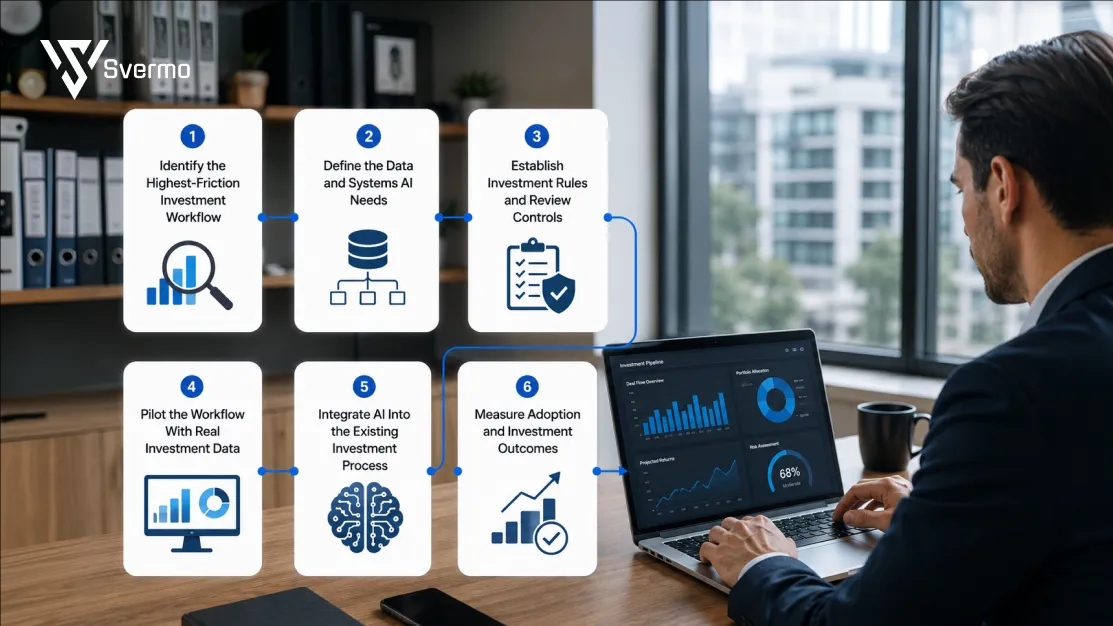
Implementing AI in real estate investing does not require an investment firm to automate its entire workflow at once. A better approach is to start with a specific bottleneck, connect AI to the data and systems already in use, and measure whether it improves the investment process.
For most firms, the goal should be repeatable AI-assisted workflows that analysts can trust and use consistently.
1. Identify the Highest-Friction Investment Workflow
Start with the task that consumes significant analyst time and follows a reasonably consistent process. Deal screening, document review, comparable research, and preliminary underwriting are often good candidates.
Define the current process before introducing AI so the team has a baseline for measuring improvement.
Focus on:
- Hours spent per property or deal
- Number of opportunities processed
- Manual steps and duplicate data entry
- Frequent delays or analytical bottlenecks
2. Define the Data and Systems AI Needs
An AI real estate investment tool is only useful when it can work with the information required for the investment decision. Map where property, financial, market, and transaction data currently reside and determine which sources the AI workflow should access.
This step also helps identify data-quality problems before they affect the analysis.
Establish:
- Required internal and external data sources
- Data ownership and access permissions
- Integration requirements with existing systems
- Rules for handling missing or conflicting information
3. Establish Investment Rules and Review Controls
AI should operate within clearly defined investment criteria rather than inventing its own definition of an attractive deal. Investment teams should specify the thresholds, assumptions, and conditions that guide screening and analysis.
Human review should remain mandatory for material decisions and exceptions.
Define:
- Investment criteria and screening rules
- Approval thresholds
- Required analyst review points
- Escalation rules for unusual findings
4. Pilot the Workflow With Real Investment Data
Run the AI workflow against a controlled set of actual properties or deals before expanding its use across the organization. Compare the AI-assisted process with the team's existing workflow to determine where it performs well and where additional validation is needed.
A useful pilot measures business outcomes, not simply whether the AI produces an output.
Track:
- Analysis time per opportunity
- Number of deals reviewed per analyst
- Data or assumption issues identified
- Analyst acceptance and correction rates
5. Integrate AI Into the Existing Investment Process
Once the workflow demonstrates value, integrate it into the systems and processes analysts already use. The objective is to reduce workflow friction rather than create another disconnected application that requires duplicate data entry.
For example, Svermo's AI platforms can address different parts of the investment workflow, allowing teams to apply AI to property evaluation, deal analysis, valuation, and broader investment analysis within a product-led approach.
At this stage, establish:
- Integration with existing investment systems
- User permissions and access controls
- Standard operating procedures
- Ownership for AI-generated analysis and exceptions
6. Measure Adoption and Investment Outcomes
AI implementation should continue to be evaluated after deployment. Faster analysis is useful, but investment firms should also determine whether the technology is increasing analytical capacity, improving consistency, or helping teams evaluate opportunities more effectively.
Useful metrics include:
- Time saved per investment analysis
- Opportunities screened per analyst
- Time from deal receipt to initial decision
- Percentage of AI outputs requiring material correction
A disciplined implementation approach turns AI for real estate investing from an experimental technology into a measurable part of the investment workflow, with clear responsibilities for the technology and the people using it.
After establishing an implementation approach, what should investors consider when selecting the right AI platform for their needs?
Build a Smarter Investment Workflow
Bring AI-powered analysis into your investment process with a product built for real estate teams.
What Should Investors Look for When Choosing an AI Real Estate Investment Tool?

Investors often ask “I'm evaluating AI tools, what should I check before choosing one?” The right AI real estate investment tool should fit the firm's investment workflow, work with the data it already relies on, provide useful analytical depth, and give professionals enough visibility to validate important outputs.
A practical evaluation should focus on the following criteria:
| Evaluation criterion | What to assess in the AI investment tool | Why it matters |
|---|---|---|
Use-case fit | Support for the investment workflows the team actually needs, such as deal analysis, valuation, forecasting, or portfolio analysis | Prevents investment teams from adopting capabilities they will rarely use |
Data connectivity | Ability to work with relevant property, financial, market, transaction, and document data | Determines how easily the platform fits into existing investment processes |
Analytical depth | Ability to perform meaningful property, financial, market, and investment analysis rather than simple summarization | Distinguishes investment-focused AI from general-purpose AI tools |
Configurability | Investment criteria, thresholds, scoring logic, and workflows that can reflect the firm's strategy | Makes AI-generated analysis relevant to the investment thesis |
Explainability | Visibility into the data, assumptions, calculations, and factors behind important outputs | Helps analysts validate AI-generated investment insights |
Scalability | Capacity to handle increasing deal volume, properties, users, and markets | Allows the platform to support growth without becoming a bottleneck |
Security and governance | Access controls, data protection, permissions, and administrative oversight | Protects sensitive property, financial, and investment information |
Integration | Compatibility with the systems and workflows already used by the investment organization | Reduces duplicate work and disconnected data |
Human oversight | Ability for analysts to review, challenge, modify, and approve AI-generated outputs | Keeps professional judgment involved in material investment decisions |
Measurable value | Ability to track changes in analysis time, deal throughput, adoption, and other relevant KPIs | Helps determine whether the AI investment is producing measurable business value |
Evaluating these factors upfront helps firms choose AI investment tools that can deliver practical value beyond a short-term AI experiment. Once the evaluation criteria are clear, which AI partner can bring these investment capabilities together for a real estate organization?
Why Choose Svermo's AI Tools for Real Estate Investing?
Real estate investment teams need more than a generic AI assistant. They need technology that can work with property data, deal information, valuation inputs, market signals, and investment criteria within the same decision-making environment.
Investors often asks, “I manage several real estate investments and need to make faster decisions about which properties are worth pursuing, but manual underwriting and market research take too much time, so can you suggest companies offering AI tools for property analysis and investment decision-making?”
Svermo addresses these needs through purpose-built products. The advantage is a product-led approach that can scale with the investment function. Analysts can use AI to accelerate research and AI property investment insights, acquisition teams can standardize preliminary analysis, and investment managers can use structured intelligence for AI real estate investment decision making while retaining professional oversight.
This makes the product ecosystem relevant across the investment function, from real estate investors and investment analysts screening opportunities to acquisition teams, developers, portfolio managers, and real estate investment companies evaluating deals and allocating capital. Each team can apply AI to the parts of the investment workflow where faster analysis and structured insights can create the most value.
Svermo also extends beyond investment workflows into broader real estate operations. Teams looking at AI-enabled customer and operational experiences can reference its use cases of conversational AI agents for real estate, while organizations evaluating AI-powered digital engagement can review its top 10 AI avatar companies for real estate.
For firms looking for AI investment tools for property investors, Svermo provides a connected product ecosystem that brings property evaluation, deal intelligence, valuation, investment analytics, and portfolio-level insights into a scalable AI workflow.
Wrapping Up!
AI is changing real estate investing. It is making property research, deal evaluation, valuation, market analysis, and portfolio intelligence more connected and scalable. The real opportunity is practical. AI can reduce repetitive analysis while giving investment professionals clearer information for decisions that still need human judgment.
For investors, acquisition teams, developers, analysts, and portfolio managers, the right AI real estate investment tools can turn fragmented property and financial data into structured investment intelligence.
Svermo supports this shift with purpose-built Investment AI, Deal AI, and Valuation AI. These products are designed around real estate workflows rather than generic business automation. Svermo's broader AI ecosystem also supports property operations and customer-facing workflows.
For teams evaluating AI across the wider real estate business, Svermo's resource on the best AI platforms for real estate agents and operations teams provides useful context on how different AI platforms address operational needs.
The strongest adoption strategy is practical. Start with a high-value investment workflow. Connect reliable data. Establish review controls. Measure outcomes. Then expand as the team gains confidence.
Ready to put investment AI to work? Talk to us and make your next deal a smarter workflow.
 https://www.linkedin.com/in/saanvi-verma-38711a36a
FAQs
AI investment tools for real estate investors can organize property and market information across different locations using consistent evaluation criteria. Investors can compare rental trends, supply, pricing activity, and local market conditions without manually consolidating the same information for every market.
AI property investment analysis can use purchase price, property characteristics, rental income, operating expenses, financing terms, comparable transactions, vacancy, market conditions, and historical performance. Data quality, completeness, and freshness directly affect the usefulness of the resulting analysis.
Teams can assign AI repetitive tasks such as data processing, screening, comparison, and insight generation. Analysts can then validate important findings, challenge assumptions, and conduct due diligence before an investment decision. This keeps AI real estate investment decision making within an accountable human-led process.
AI real estate investment tools for property investors can help portfolio managers monitor asset performance, portfolio exposure, operating trends, and changing market conditions after properties have been acquired. AI property portfolio analysis can highlight changes that deserve further investigation and help managers maintain visibility across multiple assets.
Yes. AI tools for property investment analysis can process larger volumes of property, financial, and market information without requiring every step to be completed manually. This can increase screening capacity and allow analysts to dedicate more time to detailed underwriting and investment decisions.
AI can analyze historical and current investment data alongside defined financial assumptions to support projections for income, property performance, and potential returns. AI real estate investment forecasting can also help teams examine how changes in key assumptions may affect projected outcomes.
Investors should verify the underlying property and financial data, review important assumptions, check relevant market information, and investigate material risk signals. AI-generated real estate investment intelligence should serve as an input to underwriting and due diligence, not as the sole basis for committing capital.